
钢铁行业供给侧改革

Search documents
双焦价格持续偏强,吨钢利润短期承压
Xinda Securities· 2025-10-18 13:28
Investment Rating - The investment rating for the steel industry is "Positive" [2] Core Viewpoints - The steel sector has faced a decline of 2.62% this week, underperforming the broader market, with specific segments like special steel down 4.47% and long products down 2.47% [10] - Despite current challenges, including supply-demand imbalances and declining profits, the implementation of "stability growth" policies is expected to support steel demand, particularly in real estate and infrastructure [3][10] - The report suggests that the steel industry is likely to maintain a stable supply-demand situation, with potential for value recovery in undervalued companies, especially those with high gross margins and strong cost control [3] Supply Situation - As of October 17, the capacity utilization rate for blast furnaces in sample steel companies is 90.3%, a decrease of 0.22 percentage points week-on-week [24] - The average daily pig iron output is 2.4095 million tons, down 0.59 tons week-on-week but up 78,700 tons year-on-year [24] - The total output of five major steel products is 7.489 million tons, a decrease of 45,200 tons week-on-week [24] Demand Situation - The consumption of five major steel products reached 8.754 million tons as of October 17, an increase of 123,980 tons week-on-week, representing a 16.50% rise [33] - The transaction volume of construction steel by mainstream traders is 97,000 tons, down 1.24 tons week-on-week [33] Inventory Situation - Social inventory of five major steel products is 11.258 million tons, a decrease of 23,200 tons week-on-week, but an increase of 28.51% year-on-year [41] - Factory inventory of five major steel products is 4.564 million tons, down 161,400 tons week-on-week [41] Steel Prices & Profits - The comprehensive index for ordinary steel is 3,415.7 yuan/ton, down 44.57 yuan/ton week-on-week, and down 11.93% year-on-year [47] - The profit for rebar produced in blast furnaces is -66 yuan/ton, a decrease of 44 yuan/ton week-on-week [55] - The profit for electric arc furnace construction steel is -146 yuan/ton, an increase of 6 yuan/ton week-on-week [55] Raw Material Situation - The spot price index for Australian iron ore (62% Fe) is 781 yuan/ton, down 12 yuan/ton week-on-week [69] - The price of coking coal at the port is 1,690 yuan/ton, up 30 yuan/ton week-on-week [69] - The average profit for independent coking enterprises is -13 yuan/ton, down 22% week-on-week [69] Investment Suggestions - The report recommends focusing on regional leading companies with advanced equipment and environmental standards, as well as those with strong growth potential and cost control capabilities [3]
钢铁行业三季度业绩前瞻,关注全市场唯一钢铁ETF(515210)
Mei Ri Jing Ji Xin Wen· 2025-10-16 14:38
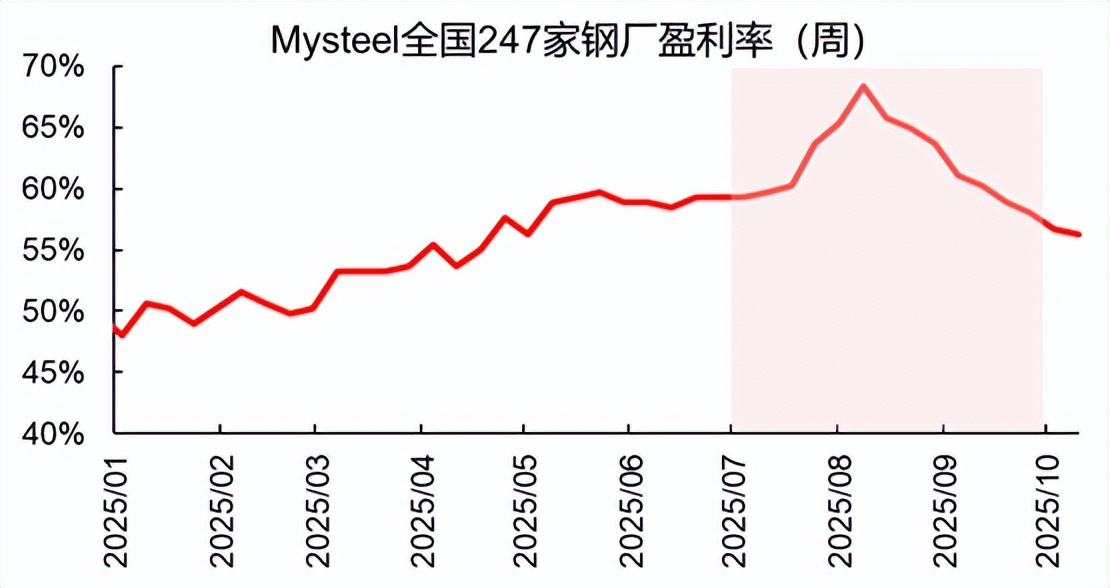
Core Viewpoint - The steel industry is experiencing improved profitability due to supply-side exit expectations and rising steel prices, with a notable increase in profit margins for steel mills in Q3 compared to Q2 [1]. Group 1: Profitability Analysis - Steel mill profitability increased from 59% in late June to 64% by the end of August, with an average profitability of 62% in Q3, up 4.5 percentage points from Q2 [1]. - The year-on-year profitability for Q3 is expected to show significant improvement due to a low base last year [1]. Group 2: Supply and Policy Outlook - Expectations for reduced steel production capacity are rising, with a focus on eliminating inefficient production [6]. - The "Steel Industry Stability and Growth Work Plan (2025-2026)" emphasizes production reduction policies to balance supply and demand, targeting the exit of outdated capacities [6]. Group 3: Cost Dynamics - The commencement of the West Simandou iron ore project is expected to ease iron ore supply, potentially benefiting the steel industry [7]. - Although steel prices may decrease with lower costs, improved supply-demand dynamics could allow profits to flow back to the steel sector and its downstream industries [7]. Group 4: Investment Opportunities - The steel sector is currently undervalued, with the CSI Steel Index price-to-book ratio at 1.11, within the 54.71% percentile over the past decade [8]. - The steel ETF (515210) has seen significant inflows, exceeding 10 billion since September, indicating strong investor interest in the sector [8].

钢铁行业反内卷“扶优劣汰”,头部钢企有望迎价值重估
Di Yi Cai Jing· 2025-09-22 10:53
Core Viewpoint - The steel industry is accelerating its "anti-involution" efforts, with a focus on capacity reduction and optimization, as outlined in the "Steel Industry Stabilization Growth Work Plan (2025-2026)" issued by multiple government departments [1][2] Group 1: Industry Goals and Measures - The main goal of the plan is to achieve an average annual growth of about 4% in the steel industry's added value from 2025 to 2026 while prohibiting new capacity and implementing production cuts [1][2] - The plan emphasizes enhancing supply-demand adaptability through five key measures: strengthening industry management, promoting technological innovation, expanding effective investment, increasing market demand, and deepening open cooperation [2][3] Group 2: Current Industry Challenges - The steel industry is facing significant downward pressure due to a prolonged demand decline influenced by the real estate and infrastructure sectors, leading to an oversupply of crude steel [2][4] - The net asset return rate for the ordinary steel sector was only 0.93% in the first half of 2025, marking a historical low since 2010 [2] Group 3: Financial Performance and Market Reaction - The steel sector's revenue decreased by approximately 10% year-on-year in the first half of the year, with many companies reporting losses [5] - The average price-to-book ratio (PB) for the ordinary steel sector is currently at 0.74, significantly lower than peaks in 2017 and 2021, indicating a historical low valuation [5][6] - Following the announcement of the new plan, there has been a notable increase in stock prices for several steel companies, with some experiencing gains of over 5% [1][6] Group 4: Future Outlook - Analysts suggest that the focus on capacity reduction and the shift towards high-value, low-carbon, and intelligent production methods may lead to a recovery in profitability and valuation for leading steel companies [3][4] - The market is expected to closely monitor the implementation of production cuts and the resulting effects on the industry [6]



特钢专家交流
2025-08-05 03:20
Summary of Key Points from the Conference Call Industry Overview - The conference call primarily discusses the **special steel industry** in relation to the **Yasha Hydropower Project** and its specific requirements for high-performance steel materials [2][4][5]. Core Insights and Arguments - **Demand for Special Steel**: The Yasha Hydropower Project has a significant demand for special steel materials, requiring structural support materials to meet grades of 420-450 and impact toughness greater than 50 Joules at -40 degrees Celsius. Pressure pipelines need tensile strength above 1,000 MPa, and non-oriented silicon steel for generators must meet grade 230 or higher with special coatings [2][4]. - **Production Capabilities**: Companies like **Baowu Steel**, **Wuyang Steel**, and **Taiyuan Iron and Steel (TISCO)** have production advantages in high-strength pressure pipelines and magnetic materials, having previously supplied to major projects like Baihetan [2][6][9]. - **Market Share**: Baowu Steel holds an 80% market share in the ultra-high voltage market for non-oriented silicon steel, indicating a strong competitive position [11]. - **Quality Assurance**: The Yasha project has stringent quality requirements, with a high cost of rework, necessitating 100% quality assurance from manufacturers. The profitability of special steel products is high but contingent on manufacturing capabilities [14]. Special Requirements for Steel Products - **Structural Support Steel**: Requires HRB400 or higher, with low-temperature impact toughness for use in tunnels and construction [4]. - **High-Strength Steel Plates**: For hydropower systems, typically WH80Q or higher, with tensile strength above 800 MPa and low sensitivity to welding cracks [5]. - **Generator Steel**: Requires magnetic steel to be 750-800 MPa and non-oriented silicon steel to be of the highest grade, with specific coatings [6]. Production and Supply Chain Dynamics - **Geographical Advantages**: Steel mills located near the western regions, such as Chongqing and Xinjiang, have logistical advantages due to lower transportation costs [7]. - **Profit Margins**: The market price for silicon steel can reach up to 13,000 yuan per ton in high-demand projects, with other special steels also showing high profit margins depending on manufacturing quality [14][15]. Regulatory and Environmental Considerations - **Reduction Targets**: The steel industry faces a 5% reduction target by the end of 2025, with stricter measures to follow in 2026, focusing on ultra-low emissions and carbon reduction [3][18]. - **Compliance Measures**: Companies must adapt to new regulations, with a shift from voluntary compliance to mandatory checks for those not meeting emission standards [19]. Future Outlook - **Electric Arc Furnace (EAF) Production**: The government encourages EAF production to align with carbon reduction goals, although current usage is low. Future policies may enhance the viability of EAFs as high furnace capacities are reduced [21]. Additional Important Points - **Market Dynamics**: The Yasha project is expected to consume approximately 3 million tons of special structural materials, indicating a substantial market opportunity for suppliers [5]. - **Material Specifications**: The project requires specific grades and performance characteristics that exceed those of conventional materials, highlighting the need for advanced manufacturing capabilities [4][12].

钢铁ETF(515210)上一交易日资金净流入超8000万元,行业政策与供需格局引关注
Mei Ri Jing Ji Xin Wen· 2025-08-05 02:28
Core Insights - The steel ETF (515210) saw a net inflow of over 80 million yuan in the last trading session, drawing attention to industry policies and supply-demand dynamics [1] Industry Analysis - The steel industry faces supply-side contradictions due to differences in environmental cost investments leading to unfair competition. The National Development and Reform Commission's "anti-involution" policy aims to rectify disorderly competition, and ultra-low emission modifications may reverse the "bad money driving out good" phenomenon, pushing the industry back to supply-demand balance [1] - On the cost side, the easing of iron ore prices and the commissioning of the West Mangdu project will enhance the certainty of cost reductions. On the demand side, growth potential in infrastructure and shipbuilding sectors supports a rise in both volume and price of steel, stabilizing profit margins for steel companies [1] - Current steel inventory is at historical lows, coupled with peak capital expenditures, indicating the industry may enter a high dividend era [1] ETF Overview - The steel ETF (515210) tracks the CSI Steel Index (930606), which selects listed companies involved in steel production, processing, and related businesses from the A-share market to reflect the overall performance of securities in the steel industry. The constituent stocks cover both upstream and downstream of the industry chain, exhibiting significant cyclical characteristics and industry concentration. This index serves as an important indicator of the market performance of China's steel industry [1]
减产预期继续演进,钢价有望整体偏强
Xinda Securities· 2025-08-03 09:10
Investment Rating - The investment rating for the steel industry is "Positive" [2] Core Viewpoints - The steel market is expected to remain strong overall due to ongoing production cuts and favorable demand conditions, despite recent price declines and inventory increases [3][4] - The report highlights that while the steel industry faces supply-demand imbalances, the implementation of "stability growth" policies is likely to support steel demand, particularly in real estate and infrastructure sectors [3][4] - The report suggests that the industry is moving towards a more concentrated supply structure, which may stabilize the overall supply-demand situation [3][4] Summary by Sections Market Performance - The steel sector declined by 2.26% this week, underperforming the broader market, with specific declines in various sub-sectors: special steel down 1.28%, long products down 4.00%, and flat products down 1.80% [10][12] - Iron ore and steel raw materials also saw declines, with iron ore down 5.96% and steel consumables down 3.74% [12] Supply Data - As of August 1, the average daily pig iron production was 2.4071 million tons, a week-on-week decrease of 1.52 tons, but a year-on-year increase of 1.10 tons [25] - The capacity utilization rate for blast furnaces was 90.2%, down 0.57 percentage points week-on-week, while electric furnace utilization increased by 1.56 percentage points to 57.1% [25] Demand Data - Total consumption of the five major steel products was 8.52 million tons, a week-on-week decrease of 161,000 tons, reflecting a 1.85% decline [35] - The transaction volume of construction steel by mainstream traders was 94,000 tons, down 2.07 tons week-on-week, marking an 18.00% decrease [35] Inventory Data - Social inventory of the five major steel products increased to 9.424 million tons, up 152,900 tons week-on-week, but down 25.37% year-on-year [43] - Factory inventory remained stable at 4.095 million tons, with a slight week-on-week increase of 1,000 tons [43] Price Trends - The comprehensive index for ordinary steel was 3,563.9 yuan/ton, down 42.25 yuan/ton week-on-week, while the special steel index increased slightly to 6,629.6 yuan/ton [49] - The profit for rebar production was 200 yuan/ton, a significant decrease of 82.0 yuan/ton week-on-week [57] Raw Material Prices - The spot price index for Australian iron ore (62% Fe) was 770 yuan/ton, down 13.0 yuan/ton week-on-week [70] - The price for first-grade metallurgical coke was 1,660 yuan/ton, up 55.0 yuan/ton week-on-week [70] Investment Recommendations - The report recommends focusing on regional leaders with advanced equipment and environmental standards, as well as companies benefiting from the new energy cycle and high-margin special steel producers [3][4]
钢铁行业周度更新报告:盈利率环比回升,持续看好板块布局机会-20250730
GUOTAI HAITONG SECURITIES· 2025-07-30 05:27
Investment Rating - The report maintains an "Overweight" rating for the steel industry [5]. Core Viewpoints - Demand is expected to gradually bottom out, while supply-side adjustments are beginning to show, indicating that the steel industry is slowly emerging from its low point [3]. - The report anticipates that if supply policies are implemented, the speed of supply contraction will accelerate, leading to a quicker recovery in the industry [3]. - The profitability of steel companies has improved, with the average gross profit per ton of rebar rising to 330.1 CNY/ton, an increase of 131.5 CNY/ton [36]. Summary by Sections Steel Market Overview - Last week, the apparent consumption of five major steel products was 8.6813 million tons, a decrease of 1.98 million tons week-on-week [24]. - The total inventory of steel was 13.365 million tons, down 1.16 million tons week-on-week, maintaining the lowest level for the same period in recent years [5]. - The operating rate of blast furnaces among 247 steel mills was 83.46%, unchanged from the previous week [32]. Raw Materials - The spot price of iron ore increased by 4 CNY/ton to 779 CNY/ton, a rise of 0.52% [48]. - The total inventory of iron ore at ports rose to 137.9038 million tons, a slight increase of 0.04% [49]. - The average available days of imported iron ore for 64 domestic steel companies increased to 21 days, up by 1 day from the previous week [49]. Profitability and Production - The average gross profit for hot-rolled coils rose to 244.1 CNY/ton, an increase of 113.5 CNY/ton [36]. - The profitability rate of 247 steel companies was 63.64%, up 3.47% from the previous week [32]. - The total steel production last week was 8.6697 million tons, a decrease of 1.22 million tons week-on-week [33]. Recommendations - The report recommends focusing on companies with leading technology and product structures, such as Baosteel and Hualing Steel, as well as low-cost firms like Fangda Special Steel and New Steel [5].




铁矿石行业研究报告
Hua Tai Qi Huo· 2025-07-28 10:26
Report Industry Investment Rating No relevant content provided. Core Viewpoints of the Report - The global iron ore supply is expected to expand with the upcoming production of Simandou Iron Ore in Africa, while emerging economies such as India will drive demand growth. The iron ore price is projected to fluctuate within a reasonable range of $80 - $100 per ton in the next 3 - 5 years under normal circumstances [66]. Summary by Related Catalogs I. Iron Ore Production 1.1 Global Iron Ore Production - Since 2000, global iron ore production increased significantly before 2014 and has remained stable at around 2 billion tons per year since 2015. In 2024, global iron ore production was 2.33 billion tons, a year - on - year increase of 1.9%. The compound annual growth rate from 2000 to 2024 was 3.6% [11]. 1.2 China's Iron Ore Production - From 2000 - 2013, China's iron ore production increased steadily due to the expansion of small and medium - sized mines. However, since 2014, production has declined due to environmental protection, safety inspections, and competition from imported ores. In 2024, China's iron ore concentrate production was 284 million tons, a year - on - year decrease of 1.5%. The compound annual growth rate from 2000 to 2024 was 3%. The main production areas are North, Northeast, East, and Southwest China, with North China being the largest, accounting for 34.1% [12][15]. II. Iron Ore Trade 2.1 Global Iron Ore Trade - Before 2015, global iron ore trade volume increased rapidly, and has since remained stable at a high level. In 2023, global iron ore exports reached 1.711 billion tons, a year - on - year increase of 7.8%. Australia and Brazil are the two major exporters, accounting for 76.3% of global exports. In the same year, global iron ore imports reached 1.638 billion tons, a year - on - year increase of 5%, with China being the largest importer, accounting for 72% [17][22]. 2.2 China's Iron Ore Trade - Since the 21st century, China has become the world's largest iron ore importer, mainly importing from Australia and Brazil. In 2024, China's iron ore imports reached 1.237 billion tons, a year - on - year increase of 4.9%. The compound annual growth rate from 2010 to 2024 was about 5% [26][27]. III. Iron Ore Consumption 3.1 Global Iron Ore Consumption - Global iron ore consumption has been growing steadily in the past 15 years. China, India, and Japan are the top three consumers, accounting for 58.9%, 10.3%, and 4.4% of global consumption in 2023 respectively. From 2010 to 2024, global iron ore apparent consumption increased from 1.958 billion tons to 2.437 billion tons, with a compound annual growth rate of 1.59% [31][33]. 3.2 China's Iron Ore Consumption - Affected by the domestic economic cycle, China's iron ore consumption increased before 2015 and has remained stable at a high level since then. In 2024, China's iron ore apparent consumption was 1.473 billion tons, a year - on - year increase of 7.6%. The compound annual growth rate from 2010 to 2024 was 3.15%. China's iron ore demand is highly dependent on imports, with an import - to - consumption ratio of 86% in 2023. The most demanded iron ore type is sinter ore, followed by pellet ore and lump ore [37][38][43]. IV. China's Iron Ore Industry Competition - From 2003 - 2017, small and medium - sized iron ore producers expanded rapidly. After 2017, due to mine consolidation, many small mines exited the market, and the market share of large key enterprises increased from 18% in 2010 to 39% in 2023 [47]. V. Global Iron Ore Production Cost - Global iron ore production costs vary significantly among different mines. The top four global iron ore producers (Vale, BHP, Rio Tinto, and FMG) have low production costs and high iron grades. China's iron ore generally has low iron content and variable production costs ranging from 300 - 900 yuan per ton. Iron ore price fluctuations can adjust global supply. When the price is between $80 - $100 per ton, the global shipping volume is about 137 million tons [50][51]. VI. Steel Industry Overview 6.1 Steel Production - Since the 21st century, global pig iron and crude steel production have grown rapidly, with the growth rate slowing down after 2015. In 2024, global pig iron and crude steel production were 1.421 billion tons and 1.934 billion tons respectively. China is the world's largest steel producer, with pig iron and crude steel production of 893 million tons and 1.099 billion tons respectively in 2024, accounting for 62.9% and 56.8% of the global total. The main production areas in China are Hebei, Jiangsu, and Shandong provinces [53]. 6.2 Steel Consumption - In 2024, global crude steel consumption was 1.938 billion tons, a year - on - year decrease of 0.1%. China's crude steel consumption was 989 million tons, a year - on - year decrease of 2.9%, accounting for 51.03% of the global total. Consumption outside China was 947 million tons, a year - on - year increase of 2.9%. Since the implementation of the "Three Red Lines" policy in the real estate sector in 2021, China's steel consumption structure has changed significantly, with a sharp decline in real - estate steel demand and an increase in export and manufacturing demand [61]. VII. Iron Ore Price Performance - Iron ore prices fluctuate with supply and demand. After the 2008 global financial crisis, prices rose rapidly due to strong demand from emerging economies and insufficient global supply. From 2011 - 2015, prices fell due to over - supply and weakening Chinese demand. After 2016, prices were volatile at a low level due to steel industry reforms. After the Vale dam collapse and post - COVID - 19 recovery, prices reached a record high. Since 2021, prices have been under pressure due to China's crude steel production cuts and real - estate policies. In 2025, the supply - demand situation is slightly loose, and the price is currently fluctuating around $100 per ton [65].
宏观题材提升市场情绪 短期螺纹盘面料震荡偏强运行
Xin Hua Cai Jing· 2025-07-24 06:18
Group 1 - Domestic steel prices have been rising continuously in recent trading days under the expectation of "anti-involution" [1] - As of July 24, the weekly rebar production increased by 29,000 tons to 2.1196 million tons, while year-on-year it decreased by 47,300 tons [1] - Steel inventory data shows a slight increase in social inventory by 28,100 tons to 3.7297 million tons, but a year-on-year decrease of 1.9362 million tons [1] Group 2 - The average daily transaction volume of construction materials nationwide from Monday to Wednesday was 114,900 tons, a week-on-week increase of 22.63% [2] - The Ministry of Industry and Information Technology is set to introduce a growth plan for key industries, including steel, to optimize supply and eliminate outdated production capacity [2] - The establishment of the Yarlung Tsangpo River downstream hydropower project by China Yajiang Group, with a total investment of 1.2 trillion yuan, is expected to enhance market sentiment [2]
策略对话金属:钢铁反内卷行情展望
2025-07-22 14:36
Summary of Steel Industry Conference Call Industry Overview - The steel industry is currently facing significant challenges due to a decline in the real estate sector, leading to a sharp drop in steel prices from 5,000-6,000 RMB to a low of 3,000 RMB [1][2] - Raw material costs (coking coal, coke, iron ore) account for over 70% of steel production costs, severely squeezing gross margins and pushing the industry towards cash flow losses, comparable to the situation in 2015 [1][2] - The unhealthy state of perfect competition in the steel industry has benefited upstream raw material suppliers, allowing major mining companies to control supply and maintain high profits [1][2] Key Points and Arguments - There are high expectations for supply-side reforms in the steel industry, with significant market attention and enthusiasm [1][4] - Recent government initiatives, including a "ten major growth stabilization plans," prioritize the steel sector, focusing on capacity structure adjustments, phasing out outdated equipment, and optimizing production capacity [1][4] - Historical data indicates that steel stocks exhibit a "short and quick" market behavior, with strong explosive potential during reform periods, as seen in 2017 [1][5] Historical Context - From 2016 to 2018, the steel industry implemented significant supply-side reforms, including the elimination of outdated capacity, resulting in the removal of approximately 145 million tons of outdated production capacity [6][7] - The crackdown on non-compliant rebar production led to a substantial reduction in effective supply, pushing steel prices higher [7] - In 2021, under the dual carbon policy, administrative reductions in crude steel production resulted in a price surge, but the market weakened in the fourth quarter due to supply stabilization policies [8] Future Outlook - The steel industry is expected to enter a transitional phase in 2025, with a full-scale supply-side reform 2.0 beginning in 2026, focusing on ultra-low emissions, energy efficiency improvements, and carbon reduction [9][11] - The new policy framework will support the transition of China's economic structure and manufacturing upgrades, favoring high-quality enterprises while phasing out underperforming ones [11] Investment Strategy - In 2025, the best stock selection strategy will focus on companies in the 1.5 to 2 line category, which can enhance profit elasticity with slight cost reductions and have potential for product structure upgrades [12] - Recommended companies include Hualing, Shougang, New Steel, Fangda Special Steel, Sansteel Minguang, and Liugang, which offer a good balance of cost-effectiveness and safety margins [12]