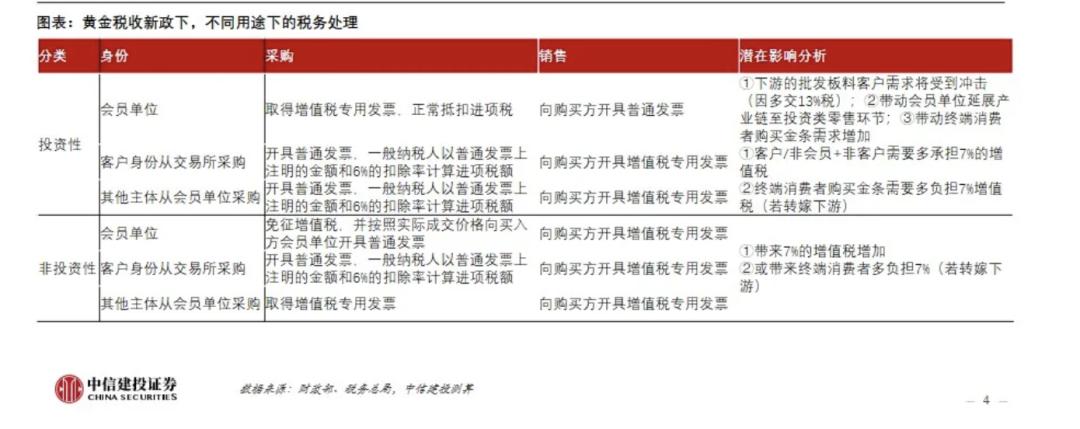
黄金税收新政

Search documents
清理“不动户”、推进标准化……银行贵金属业务迎变局
Guo Ji Jin Rong Bao· 2025-12-17 13:43
Core Viewpoint - Recent adjustments in the banking precious metals business indicate a shift towards enhanced risk control and cost management, with banks focusing on cleaning up inactive accounts and promoting standardized products [1][2][4]. Group 1: Adjustments in Banking Precious Metals Business - Several banks, including Industrial and Commercial Bank of China (ICBC) and China Construction Bank, have announced the cleaning of long-term inactive accounts in personal precious metals business at the Shanghai Gold Exchange [1][3]. - ICBC will transfer the balances of inactive margin accounts to settlement accounts and close related business functions starting December 19, 2025 [2]. - Other banks, such as China CITIC Bank and Industrial Bank, have also announced similar measures to clean up inactive accounts or halt their personal precious metals business [3]. Group 2: Risk Control and Cost Management - Banks are enhancing risk control and liquidity management by clearing high-risk, long-idle deferred delivery accounts and promoting low-risk standardized products like accumulated gold [4]. - Experts predict that more small and medium-sized banks will follow suit, gradually reducing their proprietary gold business and shifting towards agency sales and standardized products [4]. Group 3: Marketing of Standardized Products - As the 2026 Spring Festival approaches, banks are ramping up marketing efforts for gold products, offering promotional activities for physical gold and accumulated gold [5][6]. - ICBC has launched a promotional campaign reducing the handling fee for accumulated gold from 0.5% to 0.2% [5]. - Other banks, such as China Merchants Bank, are also promoting gold products with significant returns, while advising investors to be cautious of market volatility [6].


多家银行清理“休眠账户”
Sou Hu Cai Jing· 2025-12-17 10:12
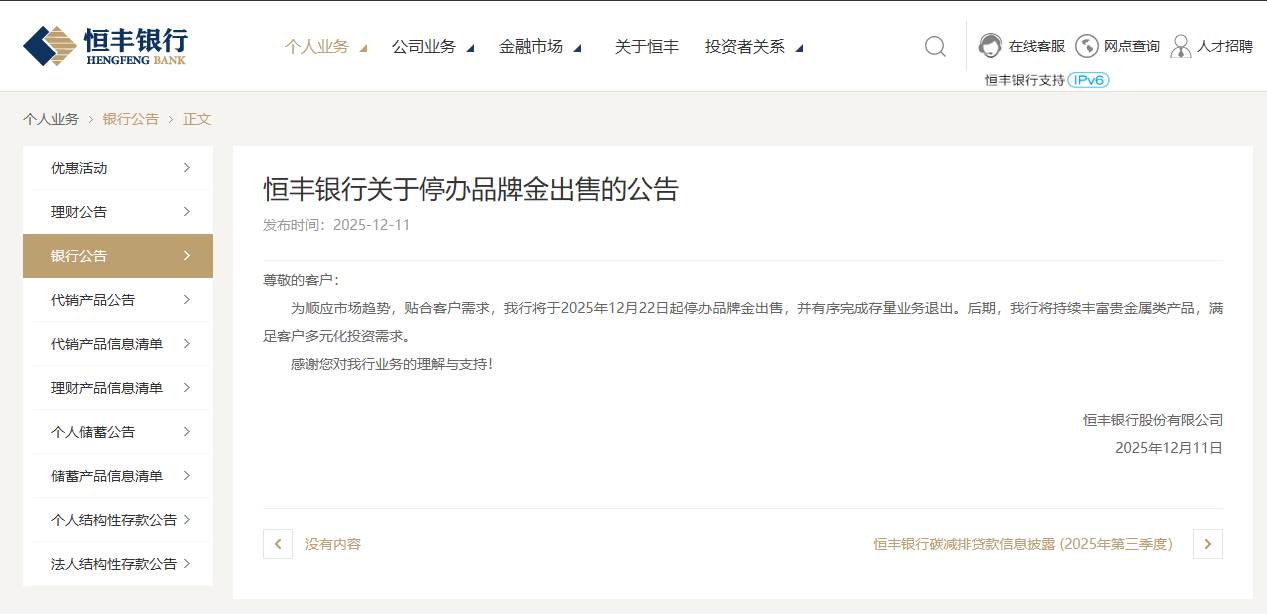
Core Viewpoint - The adjustment by Industrial and Commercial Bank of China (ICBC) to close "three-no" customer gold trading functions reflects a tightening trend in the gold trading business among major banks due to market risk volatility, tax compliance pressures, and changes in investor demand structure [1][2]. Group 1: ICBC's Adjustments - ICBC announced the closure of gold trading functions for customers with no positions, no inventory, and no debts but still holding funds in their accounts, effective December 19 [1]. - Customers are required to withdraw their funds, and the bank will terminate related business agreements, while existing positions will not be affected [1]. - This move aims to enhance account management efficiency and reduce the risk of idle customer funds, aligning with regulatory requirements for fund safety and transparency [2]. Group 2: Industry-Wide Trends - Other banks, including Everbright Bank, China Construction Bank, and Postal Savings Bank, have also taken similar actions to tighten personal gold trading services [2]. - Postal Savings Bank announced the cessation of related services, requiring customers to close positions by October 31, while Citic Bank and Ningbo Bank have also initiated account clean-ups for inactive customers [2]. - The tightening of these services is attributed to the high risk and volatility in the gold market, as well as the low entry barriers for leveraged products, making it difficult for banks to verify customer investment capabilities [2]. Group 3: Brand Gold Sales Exit - Following the implementation of new gold tax regulations, Hengfeng Bank announced it will cease brand gold sales starting December 22, marking the first bank to exit this business since the new policy [3]. - The new tax regulations have increased operational complexity and risk for banks, prompting some to withdraw from brand gold sales due to compliance pressures [3]. - Despite significant price increases in precious metals this year, the volatility has led to a decline in brand gold sales, with expectations that more banks may follow suit in exiting this market segment [3].
这类个人贵金属账户请注意!工商银行19日开始清理
Xin Lang Cai Jing· 2025-12-16 10:17
Core Viewpoint - The recent adjustments by major banks in China regarding personal precious metals trading reflect a cautious approach towards market risks, with several banks tightening their management of such businesses to protect investor interests [1][3][7]. Group 1: Bank Adjustments - On December 15, Industrial and Commercial Bank of China (ICBC) announced enhanced management for personal precious metals trading, urging clients with idle accounts to withdraw funds by December 19 [1][4]. - Other banks, including Agricultural Bank of China, China Construction Bank, and several regional banks, have also followed suit, indicating a broader trend of reducing personal precious metals business [1][6][7]. - The adjustments are part of a larger industry trend, with banks closing accounts that have had no trading activity for extended periods, reflecting a shift in risk management strategies [7][8]. Group 2: Market Context - The tightening of personal precious metals trading comes in the wake of a new tax policy implemented in October, which distinguishes between investment and non-investment gold, increasing compliance costs for banks [11][12]. - The new tax regulations require banks to track the use of physical gold more stringently, leading to operational challenges, particularly for smaller banks [11][12]. - The demand for gold has shifted towards more liquid financial products like ETFs, which offer lower costs and greater convenience compared to physical gold investments [12]. Group 3: Future Outlook - The global gold market has seen significant price increases, with a reported rise of over 60% in 2025, driven by economic expansion and geopolitical uncertainties [12]. - Looking ahead to 2026, the gold market is expected to experience a dynamic balance of various forces, with ongoing structural demand from investors and central banks potentially supporting prices, while economic recovery and interest rate changes may exert downward pressure [12].


黄金税收新政显效,恒丰银行首度退出自营品牌金销售
Huan Qiu Wang· 2025-12-15 09:15
Core Viewpoint - The new gold tax policy implemented at the end of October 2023 is significantly impacting the gold market, leading to strategic adjustments by banks in their gold sales operations [1][2] Group 1: Regulatory Changes - Hengfeng Bank announced it will cease its "Hengyu Gold" brand sales starting December 22, 2023, marking the first bank to exit self-branded gold sales under the new regulatory environment [1] - The Ministry of Finance and the State Taxation Administration issued a notice that strictly differentiates between investment and non-investment gold, imposing high compliance requirements on trading members [1] - The new policy increases the complexity and risk of internal accounting and usage declaration for banks, with severe penalties for non-compliance, including the suspension of tax benefits [1] Group 2: Market Dynamics - There is a structural change in market demand, with a shift towards more convenient and cost-effective gold investment products like gold ETFs and paper gold, despite rising gold prices [2] - The design costs, inventory requirements, and slow turnover of self-branded gold products pose significant risks, especially under high price volatility, leading to potential inventory devaluation [2] - The new tax policy favors non-physical gold products by exempting them from VAT for transactions without physical delivery, further diminishing the commercial viability of physical gold [2] Group 3: Strategic Adjustments - The exit of Hengfeng Bank may signal a broader trend among smaller banks facing operational pressures in self-branded gold sales, potentially leading to more exits in the future [2] - Banks are transitioning from self-selling physical gold to a "light asset" model, focusing on promoting standardized products like gold ETFs and accumulation gold, thus evolving from product sellers to asset allocation service providers [2]
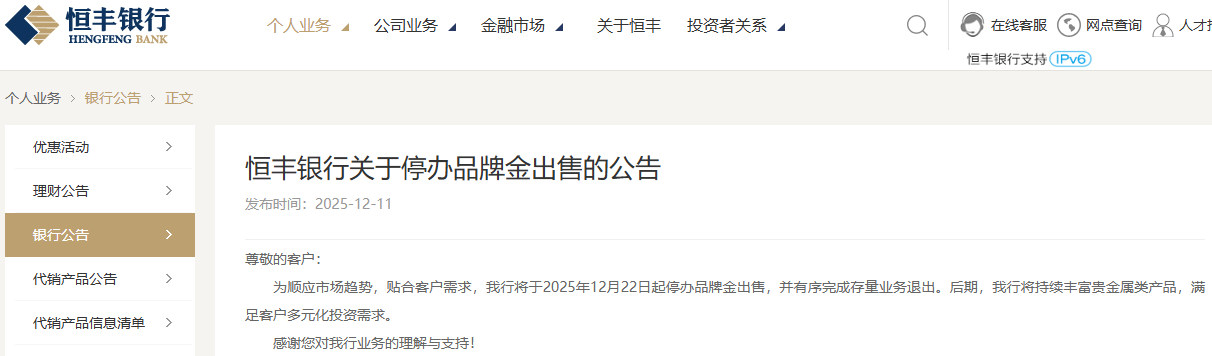
黄金税收新政落地,首度有银行退出自营品牌金销售,或基于合规压力
Feng Huang Wang· 2025-12-15 07:40
Core Viewpoint - The recent tax policy changes have led several banks, including Hengfeng Bank, to announce their exit from the brand gold sales business, citing compliance pressures and market trends as primary reasons [1][4]. Group 1: Bank Actions - Hengfeng Bank will cease brand gold sales by December 22, 2025, and will gradually exit existing business [1]. - It is the first commercial bank to announce such a decision since the implementation of the new tax policy [1]. Group 2: Compliance and Market Dynamics - The new tax policy has increased compliance requirements for banks, particularly regarding internal accounting and usage declarations, which has added operational complexity and risk [4]. - Industry insiders believe that compliance pressure is a direct trigger for banks to stop brand gold sales [4]. Group 3: Market Trends and Consumer Preferences - There is a structural shift in market demand towards financial products like gold ETFs, which are more convenient and cost-effective compared to physical gold [5]. - The new tax policy exempts transactions without physical delivery from VAT, making non-physical products like accumulative gold and paper gold more attractive for banks to promote [5]. Group 4: Future Directions for Banks - Banks are likely to transition from selling physical gold to promoting standardized products like gold ETFs and accumulative gold, moving towards a role as asset allocation service providers [5][6]. - The regulatory environment is increasingly favoring a shift towards standardized, transparent, and low-friction virtual gold markets, which may further diminish the commercial viability of physical gold sales for banks, especially smaller ones [6].
响应黄金税改,德诚珠宝集团主办2025黄金珠宝行业峰会,共谋发展新图景!
Sou Hu Cai Jing· 2025-12-08 09:21
Core Viewpoint - The conference hosted by Decheng Jewelry Group marks a pivotal moment for the Chinese gold and jewelry industry, addressing the future in light of new tax policies and industry transformation [1][3]. Group 1: Conference Overview - The "New Policy, New Opportunities, New Future" conference took place on December 6, 2025, in Fuzhou, gathering government officials, industry leaders, experts, and media to discuss the implications of the new gold tax policy [3][4]. - The event featured over a thousand partners and prominent figures, including government officials and industry association leaders, who engaged in discussions about industry changes and future opportunities following the implementation of the new tax policy [4][6]. Group 2: Industry Transformation - The new gold tax policy, effective November 1, 2025, signifies the end of a growth model reliant on resource advantages and flexible channels, pushing the industry towards a focus on quality development [6][10]. - The conference highlighted the need for the industry to shift from scale expansion to resource-intensive and quality-driven growth, emphasizing compliance and value creation as essential for future success [8][10]. Group 3: Strategic Insights - Decheng Jewelry Group has proactively prepared for the new tax policy by initiating the "Hui Shi Plan" five years ago, focusing on refined, data-driven, and intelligent transformation [13][25]. - The chairman of Decheng Jewelry Group stated that the era of growth based on resource advantages is over, and compliance is now fundamental for survival and development in the industry [13][25]. Group 4: Future Directions - The conference underscored the importance of compliance, innovation, and collaboration as the new foundation for the industry, with a focus on creating a transparent and fair competitive environment [8][28]. - Experts at the conference discussed the necessity for companies to adapt to consumer demands through cultural innovation and precise marketing, moving away from price competition to value-added services [18][21][23]. Group 5: New Brand Initiatives - Decheng Jewelry Group introduced the "Jin Zhun Tong" brand, focusing on gold recycling and bar sales, aiming to create a one-stop trading platform that emphasizes compliance and quality assurance [26][25]. - The launch of the "Jin Zhun Tong" brand and the comprehensive upgrade of the "Hou De Jin" brand were highlighted as significant steps towards establishing a new paradigm of professional collaboration and intelligent empowerment in the industry [25][26]. Group 6: Industry Outlook - The conference concluded with a strong belief that the Chinese gold and jewelry industry is entering a new phase characterized by compliance, innovation, and collaboration, with Decheng Jewelry Group positioning itself as a leader in this transformation [28][30].

黄金税改满月,记者走访深圳水贝!
Zheng Quan Shi Bao Wang· 2025-12-01 12:32
Core Viewpoint - The gold jewelry market in Shenzhen's Shui Bei is experiencing a transitional phase following the implementation of new tax policies, leading to changes in pricing and consumer behavior, while businesses are adapting to maintain competitiveness. Group 1: Market Changes - The gold jewelry business in Shui Bei has seen a slight decline in November compared to October, but it is not as "cold" as portrayed in online videos. Both merchants and consumers are gradually adapting to the new market changes [1] - The new tax policies have led to a rapid chain reaction in the gold market, with the largest gold distribution market in China, Shui Bei, undergoing significant changes [1] - The pricing mechanism in Shui Bei has stabilized, with gold jewelry prices reaching 1105 yuan per gram by November 30, which is approximately 150 yuan higher than the international gold price [2] Group 2: Pricing Dynamics - The initial confusion regarding tax calculations led to significant price fluctuations, with the price of gold jewelry experiencing daily variations close to 50 yuan [2] - The price gap between Shui Bei's gold jewelry and branded gold stores has narrowed, with branded stores like Chow Tai Fook pricing their gold jewelry around 1300 yuan per gram [2][3] Group 3: Business Adaptation - Many brand gold stores have seen an increase in tax costs, but their scale allows them to maintain lower prices compared to Shui Bei, potentially attracting more consumers to branded gold jewelry [3] - Some merchants in Shui Bei are exploring differentiation strategies, such as offering gold exchange services and focusing on high-end customization to attract consumers [3][4] - The market is shifting from a "price war" to a "value war," with the new tax policy clarifying the investment and consumption attributes of gold, pushing the industry towards higher value-added product innovation [4][5] Group 4: Future Outlook - The gold market is at a crossroads, with companies increasing their research and development investments to meet the evolving consumer preferences for craftsmanship and cultural significance [5] - As the market adapts to the new tax-inclusive pricing system, consumers are expected to enjoy a wider variety of high-quality gold jewelry options, contributing to a healthier and more sustainable industry development [5]
周大福(1929.HK):定价产品表现靓丽推动业绩稳健复苏
Ge Long Hui· 2025-11-28 04:14
Core Viewpoint - Chow Tai Fook's mid-term performance shows signs of recovery with improved sales and profitability metrics, indicating a positive outlook for the company's future growth [1][2][3] Financial Performance - For FY26H1, Chow Tai Fook reported revenue of HKD 38.99 billion, a year-on-year decline of 1.1%, but a significant improvement compared to previous periods [1] - Operating profit reached HKD 6.82 billion, up 0.7% year-on-year, with an operating profit margin of 17.5%, marking a 0.3 percentage point increase and a five-year high [1] - The group maintained a gross margin of 30.5%, supported by a higher proportion of high-margin priced jewelry and rising gold prices [1] - The company declared an interim dividend of HKD 0.22 per share, a 10% increase year-on-year, reflecting confidence in future growth [1] Sales Performance - Same-store sales growth (SSSG) for FY26H1 showed positive trends, with mainland China and Hong Kong/Macau recording SSSG of +2.6% and +4.4%, respectively, representing significant year-on-year improvements of 30.0 and 35.2 percentage points [1] - Retail sales of priced jewelry in mainland China increased by 16.1% year-on-year, while gold retail sales declined by 5.8% [2] - The company launched its first high-end jewelry line, "He Mei Dong Fang," enhancing brand positioning and influence [2] Store Network Optimization - Chow Tai Fook is optimizing its store network by closing underperforming stores and opening new concept stores, focusing on improving single-store efficiency and profitability [2] - In FY25H1, the company closed 609 stores, ending the period with 5,663 stores in mainland China and 151 in Hong Kong/Macau [2] - New concept stores achieved an average monthly sales of HKD 1.3 million, a 72% year-on-year increase, indicating improved productivity [2] Market Trends and Future Outlook - Retail growth has accelerated since October, with a 33.9% year-on-year increase in retail value from October 1 to November 18, reflecting a recovery in consumer demand [3] - The implementation of a new gold tax policy in early November may temporarily disrupt demand but is expected to raise industry compliance standards, benefiting leading brands like Chow Tai Fook [3] - Profit forecasts for FY26 to FY28 are set at HKD 81.2 billion, HKD 89.1 billion, and HKD 99.0 billion, representing year-on-year growth of 37.3%, 9.8%, and 11.0%, respectively [3] - The target price is set at HKD 19.4, corresponding to a 24 times PE ratio for FY26, maintaining a "buy" rating [3]

黄金税收新政 - 水贝一线调研直击
2025-11-24 01:46
Summary of the Conference Call on the Gold Jewelry Industry Industry Overview - The gold jewelry industry is currently facing challenges due to a new tax policy, which has led to increased costs for brands and changes in consumer behavior. [1][2] Key Points and Arguments 1. **Price Adjustments**: Brands are responding to the increased tax burden by raising prices by 60-80 yuan per gram, which translates to a price increase of approximately 5-7%. Despite the tax increase, consumer acceptance remains high due to stable gold prices. This is not expected to significantly impact the overall performance for 2025. [1][2] 2. **Impact on Water Bay Market**: The Water Bay market is experiencing severe impacts from the new policy, with merchants reluctant to issue invoices due to strict enforcement. This has led to a preference for a processing model where customers provide materials, and merchants only earn processing fees, resulting in price increases that exceed those of branded products. [1][2] 3. **Performance of Major Companies**: - **Changrongji**: Achieved over 50% same-store sales growth in November, marking a record high. The company opened 150 new stores this year and plans to accelerate to 200 stores in 2026. Same-store sales are expected to maintain a growth rate of around 20%. The proportion of high-weight products has increased, with a repurchase rate of 60% and an average transaction value rising to 6,000-8,000 yuan. [3][4] - **Zhou Li Fu**: Sales from November 1 to 18 remained stable with a slight decrease, but year-on-year growth was 4%. Franchise stores showed higher growth rates. The company remains confident in achieving its 2025 profit growth target of 5-15%, as price increases have not significantly affected end sales. [6] - **Zhou Da Sheng**: The company maintains its profit growth target of 5-15% for 2025. A new store in Xi'an generated over 3 million yuan in sales within a few days. The company is adjusting its franchise inventory structure and store locations to improve performance from a low base. [6] Important Considerations - **Future Sales Monitoring**: Although the new policy has not significantly impacted sales so far, it is crucial to monitor sales data closely over the next few months, particularly from November to December and January to February of 2026. The performance during the Spring Festival, which accounts for about 30% of annual sales, will be critical in determining the overall industry outlook and confidence in future performance. [5]
黄金税改两周,水贝低价神话终结?
3 6 Ke· 2025-11-18 10:41
Core Insights - The new tax policy on gold has significantly impacted the market dynamics, leading to increased prices and reduced sales activity among retailers in the Shenzhen Shui Bei market [2][3][9] Market Reaction - Following the announcement of the new tax policy, major brands like Chow Tai Fook raised prices for gold jewelry by over 60 yuan per gram, resulting in a noticeable decline in market activity [3][4] - Retailers in Shui Bei reported a drastic drop in sales, with some shops halting operations due to the inability to sustain business under the new pricing structure [4][6] Tax Policy Changes - The new tax policy differentiates between investment and non-investment gold, imposing different VAT rates, which has led to an increase in costs for non-investment gold sellers [9][10] - Previously, gold merchants could obtain a 13% VAT rebate, but under the new policy, they now face a 7% to 13% increase in tax costs, significantly affecting their profit margins [12][13] Price Disparity - The price of gold jewelry in Shui Bei has risen to around 1100 yuan per gram, which is approximately 150 yuan higher than the international gold price, diminishing the competitive pricing advantage that Shui Bei once held [4][5] - The price gap between retail and recovery prices has widened, leading to a situation where consumers face significant losses when selling back gold [13] Industry Transformation - The new tax regime is forcing the gold industry to shift from a price-driven model to a value-driven approach, prompting some retailers to explore alternative products like silver and alloy jewelry [8][14] - The market is witnessing a trend towards "curve purchasing," where consumers buy gold bars from banks at lower prices and then have them crafted into jewelry, reflecting a change in consumer behavior [17] Long-term Implications - The restructuring of the gold market may lead to a decline in speculative buying, as the new tax policy discourages short-term investments in physical gold [17][18] - The overall impact of the new tax policy is still unfolding, with many retailers in Shui Bei struggling to adapt to the new market conditions [18]