
AI产业周期

Search documents
港股异动 | 科网股集体上涨 恒科指数涨超2.5%创近四年新高 百度集团-SW(09888)领涨成份股
智通财经网· 2025-09-17 05:35
Core Viewpoint - The technology stocks collectively rose, leading to a more than 2.5% increase in the Hang Seng Tech Index, reaching a new high since November 2021 [1] Group 1: Stock Performance - Baidu Group-SW (09888) increased by 10.34%, reaching HKD 124.9 [1] - NIO-SW (09866) surged by 764%, reaching HKD 54.95 [1] - JD Group-SW (09618) rose by 4.77%, reaching HKD 136.2 [1] - Alibaba-W (09988) increased by 3.39%, reaching HKD 158.7 [1] Group 2: Industry Developments - The National Cybersecurity Entrepreneur Symposium was held, emphasizing the need for leading companies to take responsibility for "bottleneck" technology breakthroughs, particularly in key areas like chips [1] - The focus is on creating innovative partnerships with universities and research institutions to accelerate the development of self-controlled secure chips [1] Group 3: Strategic Partnerships - On September 15, China Merchants Group signed a strategic cooperation framework agreement with Baidu in Shenzhen [1] Group 4: Market Outlook - According to CCB International, technology stocks are expected to benefit from the current domestic substitution acceleration and the rapid development of the AI industry cycle [1] - Despite a macroeconomic "weak recovery" environment, large-cap technology companies still have room for growth, with clear absolute prosperity advantages [1] - The recent performance of Hong Kong tech stocks and the market sentiment may lead to a dual strengthening of market emotions and momentum [1]

港股开盘 | 恒生指数高开0.44% 科网股延续强势 阿里巴巴(09988)港股总市值重回3万亿港元
智通财经网· 2025-09-17 01:44
Group 1 - The Hang Seng Index opened up 0.44%, with the Hang Seng Tech Index rising by 0.91%, indicating strong performance in tech stocks, including NIO up over 7%, Baidu up over 6%, and JD Group up over 3% [1] - Alibaba opened up 2.74%, reaching a nearly four-year high, contributing to the total market capitalization of Hong Kong stocks returning to 30 trillion HKD, with a cumulative increase of over 96% this year [1] Group 2 - According to Zhongyin International, the acceleration of domestic substitution and the rapid development of the AI industry cycle are expected to benefit tech stocks, with large-cap tech companies having further upside potential [2] - The strategy team at China Merchants Securities (Hong Kong) believes that the improvement in supply-demand dynamics may lead to an economic turning point, with capital expenditure and R&D in the tech sector gradually translating into corporate profits [2] - Huatai Securities' chief macroeconomist noted that the liquidity environment for Hong Kong stocks remains ample, with expectations for fundamental recovery providing significant support [2] Group 3 - China Galaxy Securities' chief strategy analyst suggests focusing on three investment opportunities in Hong Kong stocks: high growth sectors with low to medium valuations, sectors benefiting from policy support such as the AI industry chain, and financial sectors offering stable returns amid uncertainties [3]

龙芯中科触及涨停,科创50高开高走
Mei Ri Jing Ji Xin Wen· 2025-09-16 01:55
Group 1 - The core viewpoint of the article highlights the positive impact of Nvidia's antitrust investigation on the A-share semiconductor sector, with significant gains in stocks like Loongson Technology and Haiguang Information [1] - The China Securities Bank expresses optimism towards technology stocks, anticipating a new round of interest rate cuts by the Federal Reserve starting in September [1] - Historical analysis indicates that during periods of simultaneous monetary easing in China and the U.S., the A-share market typically experiences valuation increases, particularly favoring small-cap and growth stocks over large-cap and value stocks [1] Group 2 - The ChiNext 50 ETF (588000) tracks the ChiNext 50 Index, which has a significant allocation in the electronics sector (68.77%) and the pharmaceutical and biological sector (9.85%), totaling 78.62% [2] - The index aligns well with the development of cutting-edge industries such as artificial intelligence and robotics, while also covering various sub-sectors like semiconductors, medical devices, software development, and photovoltaic equipment [1] - Given the historical performance of the ChiNext board, the future growth potential of the ChiNext 50 is considered promising, and investors are encouraged to keep an eye on the long-term development prospects of China's hard technology sector [1]

创业板指突破3100点 科技板块带动行情向好
Jin Rong Shi Bao· 2025-09-16 01:42
Market Overview - A-shares have shown a continuous upward trend, with the Shanghai Composite Index reaching a nearly ten-year high of 3892.74 points on September 12, and the ChiNext Index surpassing 3100 points for the first time in three and a half years, peaking at 3106.88 points on September 15 [1][2] - The market is experiencing a divergence in performance among major indices, with the Shanghai Composite Index closing at 3860.50 points, down 0.26%, while the Shenzhen Component Index and ChiNext Index rose by 0.63% and 1.51%, respectively [1] Sector Performance - Key sectors attracting institutional attention include Artificial Intelligence (AI), domestic computing power, chips, photovoltaic energy storage, and innovative pharmaceuticals [1][2] - The technology sector has significantly outperformed other indices, with the ChiNext Index rising by 50% over the past three months, driven by favorable policies and active capital flows [3] Investment Trends - Analysts suggest that sectors such as domestic computing power, innovative pharmaceuticals, robotics, chemicals, batteries, and leading consumer stocks are worth monitoring [2] - The current market favors growth stocks over value stocks, with a focus on sectors benefiting from domestic substitution and the rapid development of the AI industry [3] Battery and Energy Storage Sector - The battery and energy storage sectors have seen significant gains, with companies like Ningde Times experiencing a stock price increase of over 14%, reaching a new high since the end of 2021 [5] - The energy storage industry is in a phase of accelerated growth driven by policy support and increasing demand, with a target of 180 million kilowatts of new energy storage capacity by 2027 [6] Future Market Direction - Despite recent highs in A-share indices, there are concerns about declining trading volumes, with daily turnover dropping from 3.2 trillion to 2 trillion [7] - Recent trends indicate a strong inflow of financing into the A-share market, with over 500 billion yuan in net inflows over the past week, suggesting continued investor interest [7] - The AI sector is expected to be a key driver for future market performance, supported by the upward trend in the new productive forces and the importance of self-sufficiency [7]


科技股行情会否扩散?高成长高研发的优质中小盘科技股曝光
Sou Hu Cai Jing· 2025-09-10 11:24
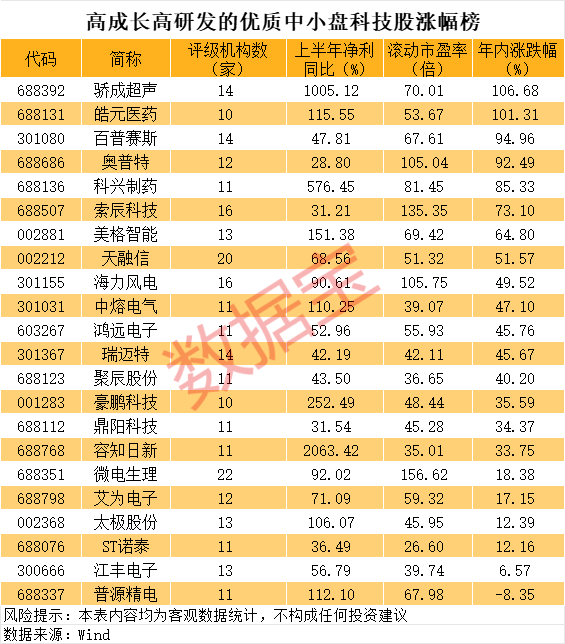
Group 1 - The technology sector has experienced a strong rally in 2023, with the communication index rising over 55%, leading the gains among major sectors [1] - Other sectors such as media, electronics, and computers have also seen significant increases, with gains exceeding 30% and 20% respectively [1] - The bullish sentiment in technology stocks is highlighted by the performance of leading companies, with some stocks like Weichuang New Materials increasing over 10 times in value this year [1] Group 2 - Tianfeng Securities predicts a new technology bull market starting on September 24, 2024, driven by policy and AI synergy, with potential for further gains in the market [2] - Historical data shows that the average peak gain for leading sectors during the last technology bull market (2013-2015) was 446%, while the current market may only reach about 110% [2] - A selection of 22 high-growth, high-R&D small and mid-cap technology stocks has been identified, all from the technology sector, with significant growth potential [2] Group 3 - Companies like Hongyuan Electronics and Meige Intelligent have been highlighted for their strong performance in the electronics and communication sectors, respectively [3] - The average gain for the selected 22 stocks has exceeded 48% this year, significantly outperforming the broader market [3] - Notable individual stock performances include Jiaocheng Ultrasound and Haoyuan Pharmaceutical, both of which have more than doubled in value [3] Group 4 - A detailed list of high-growth, high-R&D small and mid-cap technology stocks shows significant year-to-date performance, with some stocks like Jiaocheng Ultrasound and Haoyuan Pharmaceutical achieving gains of over 100% [4] - The list includes companies from various technology sub-sectors, indicating a broad-based recovery and growth potential within the industry [4] - The data highlights the importance of R&D investment, with many of the selected companies having substantial R&D expenditures relative to their revenue [4]

兼论下半年市场风格展望:对小盘风格的三个理解误区
Haitong Securities International· 2025-07-13 14:28
Group 1 - The report identifies three misconceptions regarding the dominance of small-cap stocks, emphasizing that macro liquidity and quantitative funds are not the primary reasons for small-cap outperformance [1][6][7] - The recent outperformance of small-cap stocks is attributed to a significant influx of retail investor capital, which contrasts with institutional investment trends [21][22][24] - Historical data suggests that the relative profitability trends of large and small-cap stocks serve as leading indicators for style shifts, indicating that a fundamental turnaround is necessary for large-cap dominance to return [24][27] Group 2 - The report highlights that the perception of macro liquidity being beneficial for small-cap stocks is misleading, as historical instances show both large and small-cap stocks can outperform under similar liquidity conditions [7][16][18] - It is noted that the scale of quantitative private equity funds entering the market has not been as significant as perceived, and their activity is more a response to existing market conditions rather than a driving force [16][21] - The report argues that trading intensity does not effectively predict small-cap stock performance, as historical data shows that high trading volumes can still coincide with continued small-cap strength [18][25] Group 3 - The report concludes that the future switch between large and small-cap styles will likely depend on the confirmation of an upward trend in industry cycles, particularly in the context of the AI sector [24][27][28] - It emphasizes that the current market environment, characterized by a recovery in risk appetite since September 2024, has not yet fully aligned with fundamental improvements, suggesting a cautious outlook for small-cap stocks [21][24] - The report anticipates that as the AI industry cycle gains momentum, it may lead to a resurgence of large-cap technology leaders in the market [27][28]
今年以来南向资金净流入港股超6600亿港元,N港股通恒生ETF(520940)上市首日成交额超1.3亿元
2 1 Shi Ji Jing Ji Bao Dao· 2025-06-09 06:13
Group 1 - The Hang Seng Index (HSI) Hong Kong Stock Connect Index showed active performance with a rise of 0.84% as of 1:39 PM [1] - The newly listed N Hong Kong Stock Connect Hang Seng ETF (520940) had a trading volume of 133 million yuan on its first day, with a turnover rate of 22.24% [1] - Major stocks in the ETF, such as Kuaishou-W, Meituan-W, WuXi Biologics, and ZTO Express-W, experienced significant gains, with Kuaishou-W rising over 5% [1] Group 2 - Southbound capital has been actively buying Hong Kong stocks, with net inflows exceeding 660 billion HKD as of June 6, significantly higher than the same period last year [1] - The annual Worldwide Developers Conference (WWDC) by Apple is scheduled from June 10 to 14, showcasing innovations across various operating systems [1] Group 3 - Cathay Securities reported that the AI industry cycle may lead the Hong Kong stock market upward amid the transition of old and new driving forces [2] - The influx of southbound capital is strengthening pricing power, indicating potential for further growth in the Hong Kong market [2] - The Hang Seng Index's price-to-earnings (PE) ratio has increased from approximately 7.5 times to 10.5 times, aligning with the ten-year average, suggesting room for further appreciation compared to previous highs [2]
港股开盘 | 恒生指数低开0.05%:携程集团(09961)跌2%
智通财经网· 2025-06-04 01:44
Core Viewpoint - The Hong Kong stock market is undergoing a transformation, with the AI industry cycle expected to lead the market upward, supported by strong capital inflows and a favorable policy environment [2][3]. Group 1: Market Trends - The Hang Seng Index opened down 0.05%, while the Hang Seng Tech Index fell by 0.34%, with Ctrip Group (09961) declining by 2% [1]. - Historical trends indicate that each market cycle has a leading industry, with the current AI industry cycle likely to drive the Hong Kong stock market upward [2]. Group 2: Capital Inflows and Valuation - Significant capital inflows from mainland China are enhancing the pricing power of Hong Kong stocks, with foreign capital gradually improving its allocation towards Chinese assets [2]. - The Hang Seng Index's price-to-earnings (PE) ratio has increased from approximately 7.5 times to 10.5 times, aligning with the ten-year average, indicating ongoing valuation recovery [3]. Group 3: IPO Market and Investment Opportunities - The year 2025 is anticipated to be a significant year for Hong Kong's IPO market, providing a crucial platform for domestic companies to raise foreign capital [3]. - The Hong Kong stock market is evolving into a global technology capital hub, attracting high-quality domestic tech companies and linking them with international capital [4]. Group 4: Policy Support and Market Structure - The Hong Kong government has implemented several policies to support the stock market, including lowering stamp duties and optimizing trading mechanisms to enhance liquidity and attractiveness [5]. - The influx of quality core assets into the Hong Kong market is expected to influence trading in the A-share market, potentially shifting pricing power southward [4].

港股开盘 | 恒生指数低开0.99% 石药集团(01093)高开超7%
智通财经网· 2025-05-30 01:37
Core Viewpoint - The Hong Kong stock market is undergoing significant changes, with a focus on the AI industry and the influx of quality companies, which is expected to drive future growth and investment opportunities [2][4]. Group 1: Market Performance - The Hang Seng Index opened down 0.99%, while the Hang Seng Tech Index fell by 1.26% [1]. - The influx of capital from mainland China is strengthening pricing power in the Hong Kong market, with expectations of continued inflows [2]. Group 2: Investment Opportunities - The AI industry is anticipated to lead the Hong Kong stock market upward, benefiting from high capital expenditure and the accumulation of scarce assets [2]. - Quality Chinese assets are seen as a fundamental basis for the sustainable growth of the Hong Kong stock market [3]. - The valuation of Hong Kong stocks is recovering, with the Hang Seng Index's PE ratio rising from approximately 7.5 times to 10.5 times, indicating room for further appreciation compared to historical highs [3]. Group 3: IPO Trends - The Hong Kong IPO market is expected to see a significant revival in 2025, providing a crucial window for domestic companies to raise foreign capital [3]. - The trend of A-share companies listing in Hong Kong is driven by strategic overseas expansion, regulatory advantages, and improved liquidity in the Hong Kong market [4]. Group 4: Government Policies - The Hong Kong government has implemented several supportive policies for the stock market, including lowering stamp duties and optimizing trading mechanisms to enhance market liquidity and attractiveness [5].