AI算力扩张

Search documents
中金:相关资源股行情并未结束 历经短期调整后中期有望重拾升势
Di Yi Cai Jing· 2026-02-09 00:43
Group 1 - The core viewpoint of the report is that commodities are benefiting from global capital diversification, with current valuations in energy and chemicals potentially at the lower end of the range, despite increased short-term volatility [1] - The demand driven by AI computational expansion and energy transition, along with structural supply-demand gaps for certain commodities, has not changed significantly, indicating that the structural market for commodities may not be over [1] - The strategy team at CICC believes that Kevin Warsh's decisions may face multiple constraints, making significant balance sheet reduction unlikely in the short term, and the Federal Reserve may not turn as hawkish as the market fears [1] Group 2 - As short-term sentiment releases and trading congestion decreases, the market for related resource stocks is not over, and after a short-term adjustment, there is potential for a mid-term rebound [1]
太空机房这件事,马斯克为什么认真了
3 6 Ke· 2026-02-06 00:42
Core Insights - The AI industry has experienced significant growth, but power supply remains a critical bottleneck for scaling operations [2][10] - Elon Musk predicts that within 36 months, deploying AI will be cheaper in space than on Earth due to various advantages [3][12] - The current challenges in the AI sector are not related to chip availability but rather to electricity supply and infrastructure [5][10] Group 1: Power Supply Challenges - The deployment of xAI's Colossus 2 cluster requires 1 gigawatt of power, which is a significant portion of the U.S. average electricity consumption [5][6] - The lengthy approval processes for power generation permits and equipment shortages hinder the timely scaling of AI operations [8][9] - Musk anticipates that by the end of the year, many AI chips will be stockpiled due to insufficient power supply [10] Group 2: Transition to Space - Musk argues that space offers a viable solution for AI deployment, as it eliminates ground-based obstacles such as permitting and equipment bottlenecks [12][13] - Solar power in space can be generated at a significantly lower cost compared to Earth, with estimates suggesting a tenfold reduction in electricity costs [13][14] - SpaceX and Tesla are already preparing for this transition by developing the necessary launch capabilities and solar technology [14][28] Group 3: Future Projections - Within five years, Musk predicts that AI computing power in space will exceed the cumulative total on Earth, marking a shift in the competitive landscape [16][17] - The projected annual increase in space-based AI capacity could reach hundreds of gigawatts, equivalent to adding a new U.S. power grid every two and a half years [17][18] - Musk envisions that the Moon could serve as a future launch point for even larger-scale AI operations, leveraging local resources for solar panel production [20][21] Group 4: Strategic Alignment of Companies - SpaceX, Tesla, and xAI are positioned to collaborate effectively, with SpaceX providing launch capacity, Tesla manufacturing solar panels, and xAI driving demand for AI capabilities [25][30] - This synergy allows for a streamlined approach to overcoming the limitations of terrestrial data centers, paving the way for scalable AI solutions in space [31]

AI硬件“强者恒强”逻辑延续,关注创业板ETF易方达(159915)等产品配置机会
Sou Hu Cai Jing· 2026-01-16 10:44
Group 1 - The core viewpoint of the article highlights the active performance of AI hardware sectors, such as storage chips and CPO, with significant increases in various indices, including a 2.6% rise in the ChiNext Mid-Cap 200 Index and a 1.7% increase in the ChiNext Growth Index [1] - The current market should focus on the dual growth of "technology + cycle," with AI hardware experiencing a surge similar to the previous peak during 5G base station construction, driven by rapid structural demand for AI computing power [1] - The sustained strength of AI hardware is attributed to the marginal changes in profit growth, which have not yet shown a significant turning point, suggesting a continuation of the valuation bull market [1] Group 2 - The ChiNext Index increased by 1.0%, while the ChiNext Mid-Cap 200 Index and ChiNext Growth Index saw increases of 2.6% and 1.7%, respectively, indicating a positive trend in the market [3] - The rolling price-to-earnings (P/E) ratios for the indices are 43.1 times for the ChiNext Index, 116.6 times for the ChiNext Mid-Cap 200 Index, and 41.8 times for the ChiNext Growth Index, reflecting varying levels of valuation across these indices [3] - The ChiNext Mid-Cap 200 Index consists of 200 stocks with medium market capitalization and good liquidity, with over 40% representation from the information technology sector [4]



中证A500ETF(159338)近20日资金净流入超112亿元,当前市场关注“科技+周期两翼齐飞”
Mei Ri Jing Ji Xin Wen· 2026-01-16 06:23
Group 1 - The core viewpoint of the article emphasizes the current market focus on the dual growth of "technology and cyclical sectors" [1] - The recent net inflow of over 11.2 billion yuan into the CSI A500 ETF (159338) over the past 20 days indicates strong investor interest [1] - In the technology sector, the rise of AI hardware, particularly in optical communication, is compared to the previous peak during the 5G base station construction, driven by rapid structural demand for AI computing power [1] Group 2 - The CSI A500 index highlights industry balance and leading companies in specific sectors, offering a more diversified and growth-oriented investment style compared to the CSI 300 [1] - Historical performance shows that the CSI A500 index has increased by 464.28% since its base date, outperforming the CSI 300 index, which has risen by 361.15%, resulting in an excess return of 103.13% [1] - The core factor for the sustained strength of AI hardware is the marginal change in profit growth (ΔG), which has not shown a significant turning point, suggesting a continuation of the bullish environment for valuations [1]
逆势不涨价 格力不从容
Xin Lang Cai Jing· 2026-01-07 16:09
Core Viewpoint - The air conditioning industry is shifting from growth expansion to optimizing existing stock, with rising copper prices and price wars pushing companies to make strategic choices [1] Group 1: Industry Trends - The air conditioning market is experiencing a transition where the demand for replacements is expected to exceed 60% in 2024, indicating a shift towards a stock replacement model [1] - The cost pressure from copper, which constitutes 15%-20% of air conditioning costs, is significant, with copper prices projected to exceed 90,000 yuan per ton by the end of 2025, reflecting a year-on-year increase of over 35% [1] - The copper-aluminum price ratio has reached 3.9:1, making the idea of substituting aluminum for copper appealing to many companies [1] Group 2: Cost Pressures - The long-term trend of rising copper prices is exacerbating cost pressures in the air conditioning industry, with a cumulative return of 92.13% in the copper index over the past year [4] - The global copper supply is expected to face zero or negative growth by 2026 due to constraints on supply, while demand is rising due to factors like AI expansion and increased investment in power grids, leading to a projected supply gap of approximately 830,000 tons [5] Group 3: Technological Developments - Companies like Midea, Haier, and TCL are exploring aluminum as a substitute for copper, but the technology is still in its early stages and not yet a mainstream solution [5][6] - The penetration rate of aluminum in air conditioning heat exchangers is currently limited, and the risks associated with aluminum, such as higher electrochemical corrosion, pose additional challenges [5] Group 4: Market Dynamics - The air conditioning market is showing signs of differentiation, with online sales increasing by 9.48% and 11.41% in volume, while offline sales are declining [7] - The average price of online air conditioners decreased by 1.73% to 2,688 yuan, and offline prices fell by 3.05% to 4,174 yuan, indicating a price competition driven by market share concerns [7] - Major brands are under pressure to maintain high profit margins while competing with lower-cost alternatives, leading to a decline in market share for top brands [10][11] Group 5: Company Performance - Gree Electric's revenue for the first three quarters of 2025 was 137.18 billion yuan, a year-on-year decline of 6.5%, with net profit down 2.3% [10] - The company is facing multiple pressures, including rising consumer demand for cost-effectiveness and competition from digital reforms by rivals [10] - The competitive landscape is shifting, with lower-tier brands gaining market share through aggressive pricing strategies, while top brands are losing ground [11]


有色ETF基金(159880)涨超1.7%,区域局势升温推升有色金属价格
Xin Lang Cai Jing· 2026-01-05 03:13
Group 1 - The core viewpoint is that the non-ferrous metals sector is experiencing a strong upward trend, driven by concerns over global supply chain disruptions and a recovering gold price above $4,400 [1] - The non-ferrous metals industry index (399395) has risen by 1.93%, with notable increases in stocks such as Xingye Silver Tin (000426) up 7.08% and China Aluminum (601600) up 6.22% [1] - The market is witnessing a structural shift in supply and demand dynamics, particularly in copper, where a potential supply gap of approximately 830,000 tons is expected by 2026, leading to a significant price increase [2] Group 2 - The top ten weighted stocks in the non-ferrous metals industry index account for 51.65% of the index, with major players including Zijin Mining (601899) and China Aluminum (601600) [3] - The non-ferrous ETF fund (159880) closely tracks the non-ferrous metals industry index, reflecting the overall performance of listed companies in this sector [2][4]
多因素助推铜价迭创历史新高 机构认为后市仍将进一步上行
Zhong Guo Zheng Quan Bao· 2025-12-30 21:14
Core Viewpoint - The recent surge in copper prices, following record highs in gold and silver, is seen as a remedy for investors who missed earlier opportunities. The London Metal Exchange (LME) three-month copper price has increased by over 40%, making it a standout in the 2025 commodity market [1][2]. Group 1: Copper Price Surge - Copper prices officially began to accelerate from late November 2025, reaching a historical high of $12,960 per ton on December 29. The Shanghai copper futures also surpassed 100,000 yuan per ton, peaking at 102,660 yuan [2]. - The performance in the futures market has positively impacted the stock market, with the non-ferrous metal sector becoming a popular investment area. The non-ferrous metal industry index rose over 92% in 2025, with leading stocks like Zijin Mining up over 125% and Jiangxi Copper up over 153% [2][3]. Group 2: Market Predictions and Influencing Factors - Analysts predict that copper prices will continue to rise in 2026, driven by macroeconomic conditions and supply-demand dynamics. The first half of 2025 was influenced by tariff expectations, while the second half shifted focus to supply risks [3][5]. - The tight supply of copper concentrate is identified as a core reason for the price increase, exacerbated by U.S. tariff policies that have led to significant price volatility [3][6]. Group 3: Demand and Supply Dynamics - The current "copper rush" is attributed to both the monetary attributes of commodities and fundamental supply-demand factors. The global macro environment remains uncertain, but trends such as de-globalization and monetary expansion are driving commodity prices higher [4][5]. - Supply-side constraints, including frequent production disruptions and accidents in copper mines, have led to a significant reduction in expected copper concentrate output. Meanwhile, demand from sectors like AI data centers and energy infrastructure is expected to offset declines in traditional sectors [4][5]. Group 4: Future Outlook - Institutions are optimistic about copper prices in 2026, anticipating that the Federal Reserve's interest rate cuts and ongoing de-dollarization will support prices. The long-term tight supply of copper concentrate, coupled with production disruptions and U.S. scrap copper export regulations, is expected to further constrain supply [5][6]. - The demand for copper is projected to grow significantly due to the energy transition and AI expansion, with expectations for a price range of 83,000 to 130,000 yuan per ton for Shanghai copper futures and $10,300 to $16,000 per ton for LME three-month copper [5][6].
矿端担忧情绪凸显供应脆弱性 锡价重心持续上移【文华观察】
Wen Hua Cai Jing· 2025-12-12 11:34
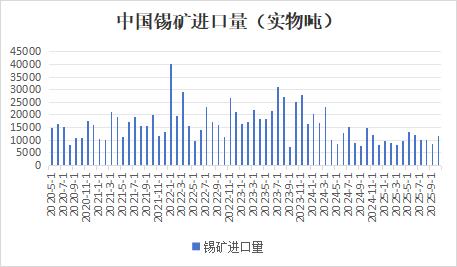
近期锡价开启连续上行模式,沪锡主力合约一举突破33万元关口,创2022年3月以来新高,市场看涨情 绪浓厚。这一轮上涨并非单一因素驱动,而是地缘冲突升级、矿端供应瓶颈难破、低库存支撑以及资金 情绪助推等多重力量交织的结果。 近期,刚果(金)东部的地缘局势急剧恶化,成为锡价飙升的重要推手。位于刚果(金)北基伍省的 Bisie矿是全球第三大锡矿(由Alphamin Resources运营),2024年产量达17300吨,占全球锡矿供应量的 约6%,占刚果(金)全国锡矿产量的超80%。Bisie锡矿的生产稳定性多次受到其国内武装叛乱组 织"M23"的影响,2025年3月,由于武装冲突逼近矿区,Bisie锡矿一度停产,后于4月中旬逐步恢复运 营。11月以来,刚果(金)东部安全形势再次恶化,战火逼近Bisie矿区范围,Alphamin面临二次停产 风险。中国驻刚果(金)使馆紧急提醒,要求中国公民和企业立即撤离东部高危省份。12月4日,尽管 刚果(金)总统齐塞克迪与卢旺达总统卡加梅已在华盛顿签署和平协议,但受武装团体未完成解除武 装、矿产资源利益分配争议等因素制约,协议实际约束力有限,且协议签署后,刚果(金)政府武装与 " ...
国泰海通|策略:利率决议将至,建议均衡配置——战术性资产配置周度点评(20251208)
国泰海通证券研究· 2025-12-09 15:25
报告导读: 我们维持此前的战术性大类资产配置观点。我们建议战术性超配 A/H 股与工 业金属,战术性标配国债,战术性低配美元。 报告来源 以上内容节选自国泰海通证券已发布的证券研究报告。 报告名称: 利率决议将至,建议均衡配置——战术性资产配置周度点评(20251208);报告日期: 2025.12.08 报告作者: 王子翌(分析师),登记编号:S0880523050004 方奕(分析师),登记编号:S0880520120005 多重因素支持中国权益表现,我们维持对 A/H 股的战术性超配观点。 经济工作会议临近, 2026 年是十五五开局之年,预计广义赤字有望进一步扩张,经济 政策有望更加积极。若美联储 12 月降息,当下人民币稳定升值也为 2026 年初中国宽松货币提供有利条件。改革提振中国市场风险偏好。中国权益相较于其 他主要大类资产的风险回报比较高。 融资需求与信贷供给仍不平衡,我们维持对国债的战术性标配观点。 在海外货币政策预期的趋松修正的背景下,我国央行货币政策或发力,以呵护银行间资 金流动性充裕稳定。此前债券市场调整较大,但融资需求与信贷供给不平衡仍是客观现实,流动性的边际改善或有利于稳定债市情 ...


马斯克最新宏大设想:每年发射百万吨级的卫星来扩张AI算力
Sou Hu Cai Jing· 2025-12-08 10:12
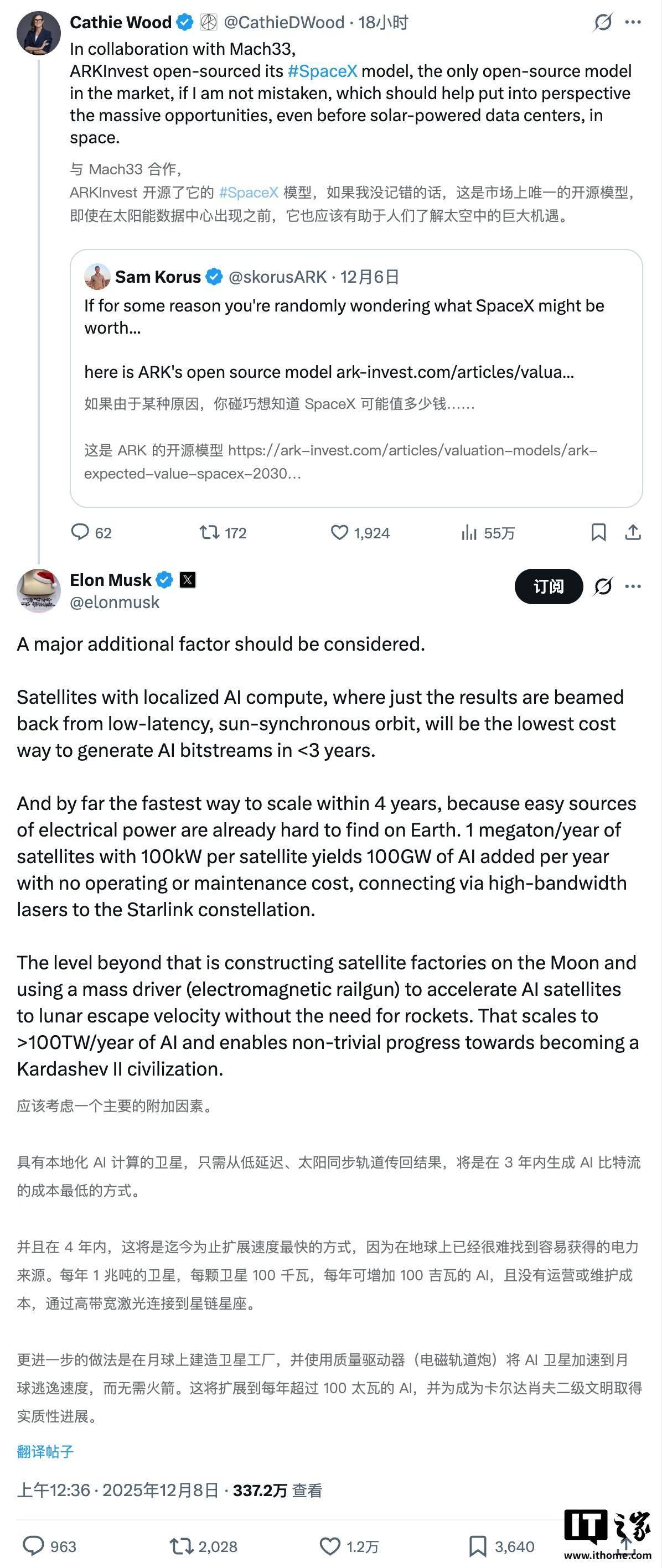
Core Insights - Musk claims that localized AI computing satellites will be the most cost-effective way to generate AI bitstreams within three years and the fastest way to scale within four years [1] - The proposed plan includes launching one million tons of satellites annually, each equipped with 100 kW of power, which could add 100 GW of AI computing power per year without operational or maintenance costs [1] - Musk envisions building satellite factories on the Moon, utilizing mass drivers to accelerate AI satellites to escape velocity without rockets, ultimately aiming for over 100 TW of AI computing power [1] Group 1 - Musk suggests that once factories, robots, and large-scale drivers are established on the Moon, the system could operate independently of traditional currency, using watts and tons as units [3] - The potential for cost-effective deployment and operation of large-scale AI systems in space is highlighted, with predictions that costs could be lower than on Earth within the next 4-5 years due to "free" solar energy and efficient radiation cooling [4] - Musk emphasizes the limitations of Earth, stating that the combined demand for power and cooling from expanding AI computing clusters will exceed the capacity of existing terrestrial infrastructure [4]