AI PC

Search documents
英特尔亮出AI PC王牌:酷睿Ultra
Tai Mei Ti A P P· 2026-01-15 07:08
Core Insights - Intel has launched the Core Ultra processors based on the new Panther Lake platform, marking a significant advancement in semiconductor manufacturing with the introduction of the Intel 18A process technology [2][3] - The company anticipates 2026 to be a pivotal year for the industry, with a surge in AI, computing, and process technology [2] - The Core Ultra processors demonstrate enhanced CPU performance, leading GPU integration, and improvements in energy efficiency, gaming performance, connectivity, and AI capabilities [2] Manufacturing Technology - The Core Ultra processors utilize Intel's 18A process technology, featuring backplane power delivery and a mixed architecture of performance cores, efficiency cores, and LPE efficiency cores [3] Performance Metrics - The Panther Lake platform supports up to 27 hours of battery life, with CPU performance improved by 60%, graphics performance by 77%, and overall AI performance doubled compared to the previous generation [4] - The new platform achieves a total computing power of 180 TOPS, capable of running large models with 700 billion parameters, and features a low-power NPU with 50 TOPS, enhancing inference performance by 2 times [4] AI Strategy and Market Position - Intel supports over 350 independent software developers and more than 900 AI models for local deployment, indicating rapid growth in the AI PC ecosystem [6] - The company plans to release the first Core Ultra-equipped PCs globally on January 27, with a total computing power equivalent to 40 data centers [6] - Intel's strategy includes the simultaneous launch of edge processors and corresponding PC versions, aiming to accelerate AI deployment in various sectors [6] Market Outlook - Following the restart of its wafer foundry business, Intel aims to validate its manufacturing technology through product performance and market success, which is crucial for future advancements [8] - The capital market outlook for Intel is optimistic, with a 32% increase in stock price year-to-date as of January 14, 2026, and a notable 10.6% rise over two days [8]



联想集团(00992):穿越周期波动
citic securities· 2026-01-15 07:06
Investment Rating - The report maintains a positive outlook on Lenovo Group, with expectations of net profit growth in the third quarter of fiscal year 2026, driven by robust PC shipments and stable profit margins [4]. Core Insights - Lenovo's PC business is expected to remain resilient, with a projected year-on-year revenue increase in the third quarter of fiscal year 2026, despite rising memory prices impacting profit margins [4][5]. - The Infrastructure Solutions Group (ISG) is anticipated to approach breakeven in operating profit margins, with profitability expected in the fourth quarter of fiscal year 2026 due to product mix optimization and sales team restructuring [4]. - Lenovo's strong bargaining power and large-scale procurement capabilities position it favorably against competitors, allowing it to better manage cost pressures and transition towards the high-end market [4]. Summary by Relevant Sections Company Overview - Lenovo is the largest PC brand globally, holding a 24% market share in sales. The company has expanded its global footprint through acquisitions and joint ventures in the PC, smartphone, enterprise server, and cloud service sectors [8]. - Approximately 80% of Lenovo's revenue comes from laptops and desktops, while 10% is derived from smartphones and another 10% from servers, services, and software [8]. Revenue Breakdown - The revenue distribution by product category is as follows: Intelligent Devices Group (73.1%), Infrastructure Solutions Group (14.6%), and Solutions and Services Group (12.3%) [9]. - The revenue distribution by region is: Asia (39.8%), Americas (34.5%), Europe (17.3%), and Middle East & Africa (8.5%) [9]. Catalysts - Key catalysts for Lenovo's growth include a rebound in global PC shipments, continuous market share expansion in the PC segment, AI PC launches boosting shipments and profit margins, and improved profitability prospects in the server business [6].

德明利跌2.91%,成交额25.37亿元,后市是否有机会?
Xin Lang Cai Jing· 2026-01-13 08:02
Core Viewpoint - The company, Demingli, is experiencing fluctuations in stock performance and is focusing on expanding its product offerings in the AI and storage sectors, while also benefiting from the depreciation of the RMB. Group 1: Company Overview - Demingli specializes in the design and development of flash memory controller chips and storage module products, primarily targeting the mobile storage market [2] - The company was established on November 20, 2008, and went public on July 1, 2022, with its main business revenue composition being 41.37% from embedded storage products, 37.34% from solid-state drives, 13.06% from mobile storage, and 8.22% from memory modules [7] - As of December 31, the number of shareholders decreased by 15.60% to 55,300, while the average circulating shares per person increased by 18.48% to 2,910 shares [8] Group 2: Financial Performance - For the period from January to September 2025, Demingli achieved a revenue of 6.659 billion yuan, representing a year-on-year growth of 85.13%, while the net profit attributable to the parent company was -27.0765 million yuan, a decrease of 106.42% year-on-year [8] - The company has distributed a total of 78.2496 million yuan in dividends since its A-share listing [9] Group 3: Market Position and Product Development - Demingli has launched a new series of DDR5 SO-DIMM and U-DIMM memory modules for AI PCs, with a single module capacity of up to 48GB and a theoretical bandwidth of 32GB/s, aimed at enhancing AI storage solutions [2] - The company has been recognized as a "specialized and innovative" small giant enterprise, indicating its strong market position and innovation capabilities [2] - As of the latest report, overseas revenue accounted for 69.74% of total revenue, benefiting from the depreciation of the RMB [3]
对话英特尔吉姆·约翰逊:AI PC将往何处走
3 6 Ke· 2026-01-13 03:59
Core Insights - The rise of AI PCs, capable of independently processing AI tasks, is becoming increasingly significant as the cost of computing power for large models continues to rise [2][3] - Intel's CEO, Pat Gelsinger, announced the launch of the third-generation Core Ultra processor using Intel 18A technology at CES 2026, which is expected to enhance performance and efficiency in AI PCs [2][4] - The integration of CPU, GPU, and NPU in Intel's AI PC processors allows for more local processing of AI tasks, attracting interest from consumers and cloud computing companies [3][4] Group 1: AI PC Development - As of January 2026, over 100 million AI PCs equipped with Intel processors have been shipped globally, with their combined computing power equivalent to that of 40 data centers [4] - Intel has partnered with over 200 independent software vendors (ISVs) to develop more than 500 AI applications based on AI PCs, indicating a growing ecosystem [4][10] - The AI PC is seen as a resource that is currently undervalued, with potential to alleviate financial pressures on software companies by allowing local processing of AI tasks [3][4] Group 2: Technological Advancements - The Intel 18A process technology improves energy efficiency by 15% and increases chip density by 30%, allowing for more features to be integrated into smaller chip areas [7][10] - The third-generation Core Ultra processor is designed to achieve 40% better performance at the same power consumption compared to previous generations [7] - AI PCs are expected to enhance user experiences in various applications, including gaming, by providing smoother performance through AI-generated frames [9][10] Group 3: Collaboration with Cloud Services - Intel is exploring the collaboration between AI PCs and cloud services, with the aim of providing users with greater control, lower costs, and improved privacy [20][21] - The current strategy involves a static allocation of tasks between local and cloud resources, with ongoing efforts to create a more dynamic system [18][20] - Applications that benefit from the collaboration include content creation tools, where local processing can enhance performance and reduce reliance on cloud resources [19][20] Group 4: Future Directions - The company aims to drive the large-scale deployment of AI PCs in 2026, focusing on optimizing applications to enhance user experience [9][20] - Intel is committed to supporting developers by providing tools and frameworks that facilitate the integration of AI capabilities into existing software [12][22] - The company recognizes the importance of local AI capabilities and is actively working to strengthen its partnerships with OEMs and ODMs, particularly in the Chinese market [23]

半导体行业月报:长鑫IPO获受理,关注国内存储器产业链-20260112
Zhongyuan Securities· 2026-01-12 08:28
Investment Rating - The report maintains an "Outperform" rating for the semiconductor industry, indicating a positive outlook compared to the broader market [1]. Core Insights - The semiconductor industry showed strong performance in December 2025, with a 5.11% increase, outperforming the 2.28% rise of the CSI 300 index. The overall industry saw a 45.07% increase throughout 2025 [6][12]. - Global semiconductor sales continued to grow, with a year-on-year increase of 29.8% in November 2025, marking 25 consecutive months of growth. The forecast for 2026 anticipates an 8.5% increase in global semiconductor sales [6]. - The demand for AI-related hardware infrastructure remains robust, with significant capital expenditure increases from major cloud service providers [6][8]. - The report highlights the ongoing price increases in DRAM and NAND Flash, with predictions of substantial contract price growth in early 2026 [6][8]. Summary by Sections 1. December 2025 Semiconductor Market Performance - The semiconductor sector outperformed the CSI 300 index, with notable increases in integrated circuits (4.32%) and semiconductor equipment (9.61%) [12]. - The Philadelphia Semiconductor Index rose by 0.83% in December 2025, with a total increase of 42.23% for the year [18]. 2. Global Semiconductor Sales Growth - Global semiconductor sales saw a 29.8% year-on-year increase in November 2025, with a month-on-month growth of 3.5% [6]. - The demand for AI hardware is driving significant capital expenditures from major companies, with North American cloud providers increasing spending by 67% year-on-year in Q3 2025 [6][8]. 3. Price Trends in Memory Products - DRAM and NAND Flash prices continued to rise, with DRAM spot prices increasing approximately 15% and NAND prices by about 16% in December 2025 [6]. - Predictions for Q1 2026 suggest a 55-60% increase in DRAM contract prices and a 33-38% increase in NAND Flash contract prices [6][8]. 4. Investment Opportunities - The report suggests focusing on investment opportunities within the domestic memory industry chain, particularly in storage modules and semiconductor equipment, as domestic manufacturers are expected to accelerate production [6][8].
2026不是PC最难的一年,巨头恒强,白牌退场
3 6 Ke· 2026-01-09 13:08
Core Insights - The AI boom is significantly impacting the global PC market, leading to a challenging year for the industry, with predictions of reduced shipments and increased prices [1][2][3] - The shift in demand from personal computers to AI data centers has permanently altered the resource allocation and growth drivers within the industry [2][3][4] Market Dynamics - High bandwidth memory (HBM) demand from data centers is causing a severe reduction in supply and price increases for consumer-grade DRAM and NAND, leading to overall cost hikes for core components like GPUs and CPUs [1][3][4] - IDC forecasts a 6% to 8% increase in average PC prices by 2026, with some systems seeing price hikes of 15% to 20%, while global PC shipments may decline by 5% under neutral conditions [1][3] Supply Chain Challenges - The transition of memory production towards higher-margin HBM has resulted in a deliberate shortage of standard memory for consumer PCs, pushing prices up and altering the cost structure of the entire industry [6][8] - The industry is experiencing a permanent increase in cost structures due to the high-end technologies developed for AI servers, which will affect the pricing of standard PC components [6][8] Strategic Responses - Semiconductor giants are cautiously adjusting their production capacities to meet AI demands but are hesitant to invest heavily in new factories due to concerns over a potential "AI bubble" [8][19] - The current supply chain crisis is expected to lead to a prolonged period of supply shortages for consumer electronics, as the demand for high-performance components outstrips supply [8][19] Regional Insights - The Chinese PC market exhibits unique resilience, driven by government policies and a strong demand for digital transformation, which may not align with global trends of reduced shipments and increased prices [12][13] - The demand structure in China is diverse, with a significant user base that is pragmatic about performance and price, allowing for adjustments in purchasing behavior based on market conditions [14][15] Future Outlook - The ongoing transition in the PC industry is seen as a necessary adjustment rather than a decline, with the potential for a new equilibrium as AI infrastructure stabilizes and new chip capacities come online [10][26][30] - The market is expected to experience a shift towards higher-value products and a focus on local intelligence capabilities, which will redefine the competitive landscape [30][32][34]



两条8.6代OLED产线今年将量产,高端笔记本将进入OLED时代
第一财经· 2026-01-09 12:08
Core Insights - The article discusses the expansion of flexible OLED panel applications, particularly in the IT and automotive sectors, driven by the upcoming mass production of 8.6-generation OLED panel lines by major manufacturers like BOE and Samsung in 2026 [3][4]. Group 1: OLED Panel Production and Market Penetration - In 2026, BOE and Samsung are expected to start mass production of their 8.6-generation OLED panel lines in Q2, which will accelerate the adoption of flexible and hybrid OLED panels in laptops [3]. - TCL Huaxing and Visionox are projected to begin mass production of their 8.6-generation OLED panel lines in Q3 and Q4 of 2027, respectively, further enhancing OLED panel usage in laptops [3]. - By 2030, the penetration rate of OLED panels in laptops is anticipated to reach approximately 19%, with OLED screens dominating the high-end laptop market [3]. Group 2: Advantages of OLED Panels - Compared to LCD screens, laptops equipped with OLED screens will offer superior performance in terms of lightweight design, portability, and image quality [4]. - The expected shipment volume of OLED laptop screens is projected to reach 45 million units by 2030, influenced by the differing production techniques of high-generation OLED panel lines [3][4]. Group 3: Cost and Technology Developments - TCL Huaxing's 8.6-generation OLED production line utilizes printing technology, which simplifies the manufacturing process and theoretically offers cost advantages, making OLED screens more accessible for mainstream laptops [4]. - The introduction of new generation chips by Intel and AMD, utilizing 2-3 nanometer processes, will enhance computing power, transitioning laptops from the 40 TOPS to the 50 TOPS era [4]. Group 4: Market Outlook - Despite rising memory costs, the global laptop market is expected to maintain stable shipment volumes in 2026, with growth anticipated in 2027 [5].




猛攻AI PC市场,第三代酷睿Ultra只用了「一半」实力
雷峰网· 2026-01-09 11:13
Core Viewpoint - The growth of AI PCs is expected, while edge computing inference is opening up a new market that is difficult to estimate [1] Group 1: Market Dynamics - The PC processor market has entered a competitive phase, reshaped by Apple's M-series processors and AMD's strengthened position, putting pressure on Intel [2] - Intel's third-generation Core Ultra processors (codenamed Panther Lake) are crucial for maintaining its leadership in the PC market, with mass production achieved ahead of expectations [4][6] - The third-generation Core Ultra platform targets both PC and industrial markets, reflecting Intel's strategy to capture the trillion-dollar AI inference market [4] Group 2: Technological Advancements - The Intel 18A process technology enables significant improvements in performance and energy efficiency, with a 60% performance increase and a 40% reduction in power consumption [6] - The third-generation Core Ultra processors can achieve battery life of up to 27 hours, thanks to low-power island design and AI technology optimizing power control [10][11] - The integrated Iris Xe GPU B390 offers a 77% performance increase over the previous generation and supports AI inference with 53% improvement [11][13] Group 3: Strategic Positioning - Intel's early investment in edge AI products is aimed at capturing the growing demand for privacy-sensitive applications and real-time response requirements [19][20] - The company has integrated its edge computing and PC business units to respond more effectively to market dynamics [23] - The third-generation Core Ultra is positioned to leverage AI capabilities across various applications, including gaming and industrial AI devices, with a broad product design range [19][21] Group 4: Future Outlook - 2026 is anticipated to be a pivotal year for both PC development and Intel, as the company aims to capitalize on its technological advancements and market positioning [29]

两条8.6代OLED产线今年将量产,高端笔记本将进入OLED时代
Di Yi Cai Jing· 2026-01-09 10:48
Core Insights - The year 2026 is projected to be pivotal for the promotion of affordable AI PCs, driven by the increased application of OLED screens and enhanced CPU capabilities [1][2] Group 1: OLED Panel Development - Two 8.6-generation OLED panel production lines are expected to commence mass production in 2026, accelerating the penetration of flexible and hybrid OLED panels in IT and automotive display sectors [1] - BOE and Samsung's 8.6-generation OLED panels are anticipated to be used in the next generation of Apple's MacBook Pro and will supply Taiwanese IT manufacturers, respectively [1] - TCL Huaxing and Visionox are expected to start mass production of their 8.6-generation OLED panels in Q3 and Q4 of 2027, further supporting the application of OLED panels in laptops [1] Group 2: Market Projections - The penetration rate of OLED panels in laptops is projected to reach nearly 20% by 2030, with OLED screens dominating the high-end laptop market [1] - The shipment volume of OLED laptop screens is expected to reach 45 million units by 2030 [1] Group 3: Technological Advancements - The adoption of OLED screens will enhance laptops' performance in terms of portability and display quality compared to LCD screens [1] - The introduction of new generation chips by Intel and AMD, utilizing 2-3 nanometer processes, is expected to elevate laptop computing power from 40 TOPS to 50 TOPS [2] - The new CPU architectures are anticipated to penetrate mainstream laptop product lines over the next three years, enabling more diverse task processing capabilities [2] Group 4: Market Outlook - Despite rising memory costs, the global laptop market is expected to maintain stable shipment volumes in 2026, with growth anticipated in 2027 [2]
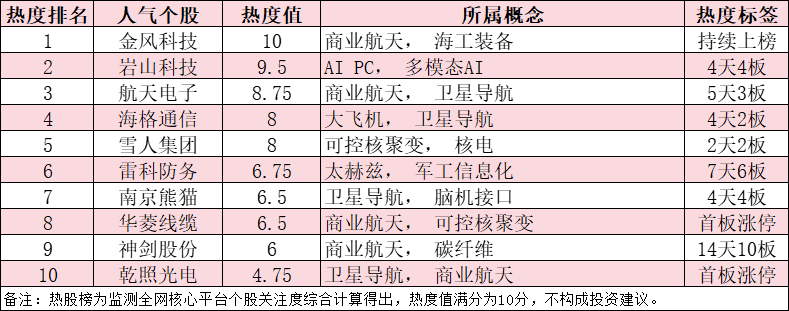
今日十大热股:金风科技、岩山科技领衔,雷科防务7天6板,神剑股份14天10板持续爆炒
Jin Rong Jie· 2026-01-09 01:28
Market Overview - On January 8, A-shares saw most major indices decline, with the Shanghai Composite Index down 0.07%, Shenzhen Component down 0.51%, and ChiNext down 0.82%, while the Sci-Tech 50 index rose 0.82% [1] - The total trading volume in the Shanghai and Shenzhen markets was 2.80 trillion yuan, a decrease of approximately 53.8 billion yuan from the previous day [1] - There were 3,533 stocks that rose and 1,514 stocks that fell [1] Sector Performance - The aerospace and shipbuilding sectors saw the highest net inflows of funds, while sectors such as silver, energy metals, and brokerage firms experienced the largest declines [1] Popular Stocks - The top ten popular stocks included Jin Feng Technology, Yan Mountain Technology, Aerospace Electronics, Hai Ge Communication, Xue Ren Group, Lei Ke Defense, Nanjing Panda, Hualing Cable, Shen Jian Co., and Qian Zhao Optoelectronics [1][2] Key Factors Influencing Stock Prices - Jin Feng Technology's popularity is attributed to its leading position in the wind power industry and strong fundamentals, with significant growth in the sales capacity of wind turbines and an increased proportion of large-capacity units [3] - Yan Mountain Technology's rise is linked to its alignment with multiple hot technology sectors, including AI PC and multi-modal AI, and partnerships with AMD to expand terminal applications [3] - Aerospace Electronics benefits from the overall heat in the commercial aerospace sector, with policy support for projects like Qian Fan Constellation and China Star Network [3] - Hai Ge Communication's popularity stems from its technical capabilities in satellite navigation and communication, with applications in various scenarios [3] - Xue Ren Group's stock price increase is driven by the rising interest in controllable nuclear fusion, supported by significant capital inflow [4] - Lei Ke Defense is gaining attention due to its involvement in commercial aerospace and military information technology [4] - Nanjing Panda's stock is influenced by speculation around brain-computer interface technology, although the company has indicated that its related technology is still in the R&D phase [4] - Hualing Cable's growth is linked to its special cable business, which has seen significant revenue increases in high-end equipment sectors [4] - Shen Jian Co. benefits from both commercial aerospace and carbon fiber concepts, with strong fundamentals supporting its stock performance [4]