卫星互联网

Search documents
银河电子跌2.21%,成交额8.52亿元,主力资金净流入2394.80万元
Xin Lang Cai Jing· 2026-01-26 02:23
Core Viewpoint - Galaxy Electronics has experienced significant stock price fluctuations and trading activity, with a notable increase in share price this year, despite a recent decline in revenue and profit margins [1][2]. Group 1: Stock Performance - As of January 26, Galaxy Electronics' stock price decreased by 2.21% to 8.86 CNY per share, with a trading volume of 8.52 billion CNY and a turnover rate of 8.44%, resulting in a total market capitalization of 99.80 billion CNY [1]. - Year-to-date, Galaxy Electronics' stock price has risen by 36.73%, with a 6.11% increase over the last five trading days, a 45.01% increase over the last 20 days, and a 93.03% increase over the last 60 days [1]. - The company has appeared on the trading leaderboard five times this year, with the most recent appearance on January 19, where it recorded a net buy of -136 million CNY [1]. Group 2: Company Overview - Galaxy Electronics, established on June 15, 2000, and listed on December 7, 2010, is based in Zhangjiagang, Jiangsu Province, and specializes in the research, manufacturing, and sales of smart digital TV multimedia terminals and precision electronic components [2]. - The company's main business revenue is composed of 45.43% from new energy products, 45.06% from smart electromechanical products, and 9.51% from other sources [2]. - Galaxy Electronics operates within the defense and military industry, specifically in ground equipment, and is associated with sectors such as broadcasting, leading stocks, military information technology, and satellite internet [2]. Group 3: Financial Performance - For the period from January to September 2025, Galaxy Electronics reported a revenue of 332 million CNY, reflecting a year-on-year decrease of 59.12%, and a net profit attributable to shareholders of -40.16 million CNY, a decline of 128.29% year-on-year [2]. - The company has distributed a total of 856 million CNY in dividends since its A-share listing, with 225 million CNY distributed over the past three years [3]. - As of September 30, 2025, the number of shareholders decreased by 8.62% to 87,300, while the average circulating shares per person increased by 9.43% to 12,815 shares [2].

3大火箭企业,同台披露最新时间表
Zhong Jin Zai Xian· 2026-01-26 01:08
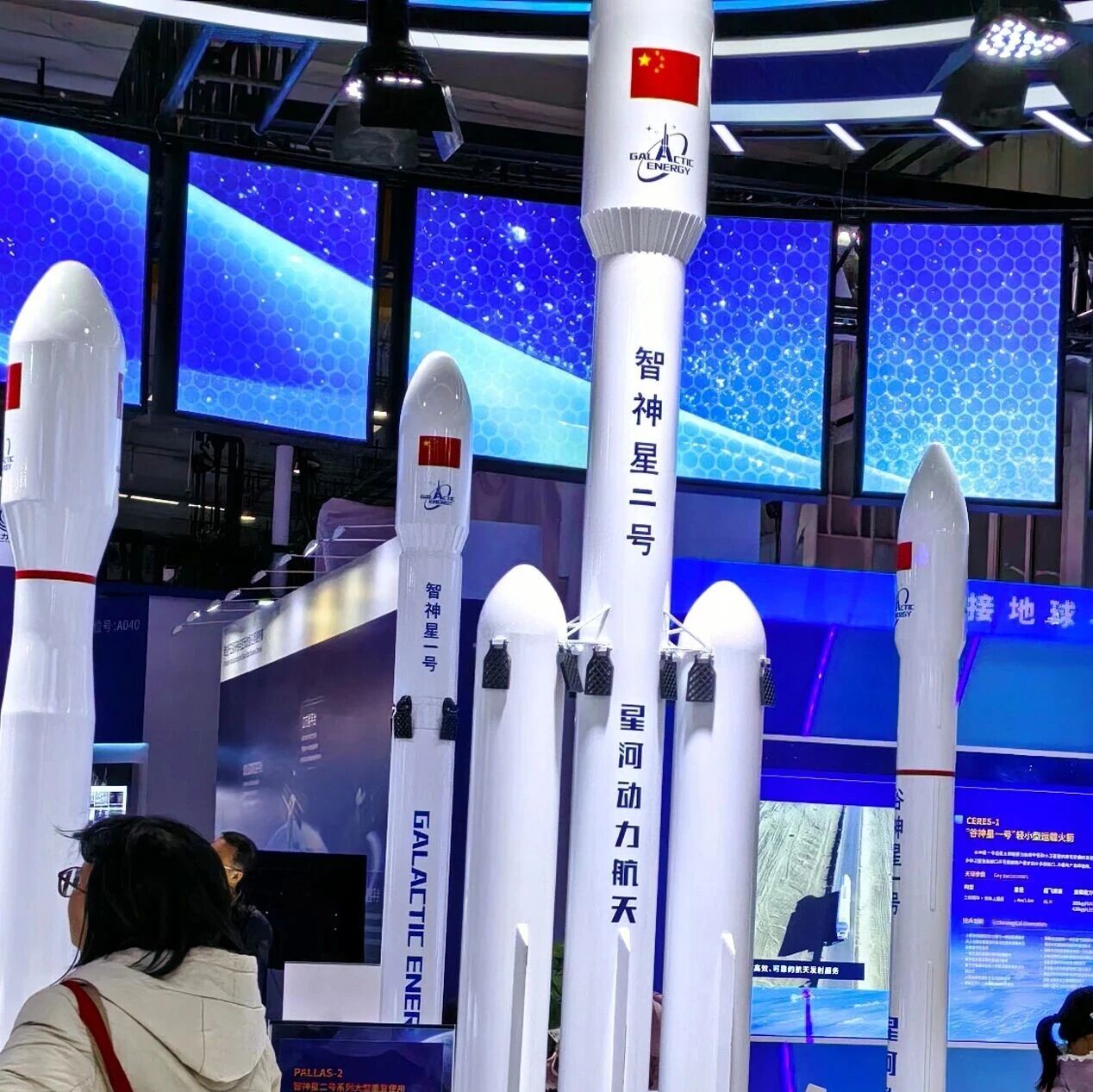
Core Viewpoint - The construction of satellite internet constellations faces significant capacity shortages and cost pressures, making reusable rockets a critical focus for domestic commercial aerospace companies. Group 1: Blue Arrow Aerospace - Blue Arrow Aerospace's Zhuque-3 rocket aims for high-frequency reuse, with a three-step development plan: solidifying recovery technology, transitioning to mass production, and developing the Zhuque-3A variant [2][3] - The first flight of Zhuque-3 on December 3, 2025, successfully verified many reusable rocket technologies, despite the failure of the first stage recovery [3][4] - The goal is to achieve a recovery capacity of 18 tons, providing flexible, low-cost, and rapid response launch options [2] Group 2: Star River Power - Star River Power's Zhishen-2 rocket is targeting its first flight by the end of 2026, utilizing a hundred-ton deep-thrust liquid oxygen-kerosene engine and 3D printing technology for lightweight innovation [5] - The Zhishen-2 rocket has a takeoff mass of approximately 757 tons and a launch capacity of 20 tons to LEO, with a cost of about 60,000 yuan per kilogram for satellite customers [5] Group 3: China Aerospace Science and Technology Corporation - China Aerospace is adopting a dual-track strategy to address the current capacity shortage in commercial aerospace, focusing on both small and large rockets [6][7] - The Lijian-1 rocket has completed 11 launches, placing over 80 satellites into orbit, while the Lihong series aims to validate recovery technologies for future applications [7][8] - The Lijian-2 rocket's launch cost has been reduced to 30,000 yuan per kilogram, comparable to SpaceX's Falcon 9, with further reductions expected through recovery [8]
久之洋:在半导体测量领域目前主要聚焦于光学零部件配套业务
Ge Long Hui· 2026-01-26 00:54
Group 1 - The company has made strategic investments in the commercial aerospace and satellite internet sectors [1] - The current focus is on the development and research of core components and devices for inter-satellite and ground-satellite communication payloads [1] - In the semiconductor measurement field, the company is primarily concentrating on the optical component supporting business, providing essential optical components for related equipment [1]

久之洋(300516.SZ):在半导体测量领域目前主要聚焦于光学零部件配套业务
Ge Long Hui· 2026-01-26 00:53
格隆汇1月26日丨久之洋(300516.SZ)在投资者互动平台表示,公司已在商业航天和卫星互联网领域进行 了布局,目前聚焦于星间、星地之间通信载荷的核心部件、组件的开发和研制。公司在半导体测量领域 目前主要聚焦于光学零部件配套业务,为相关设备提供核心光学组件支持。 ...
久之洋(300516.SZ):已在商业航天和卫星互联网领域进行了布局
Ge Long Hui· 2026-01-26 00:53
Core Viewpoint - The company, Jiu Zhi Yang (300516.SZ), is focusing on core businesses such as infrared thermal imaging, laser sensors, optical components, and star trackers, with applications in defense, industrial temperature measurement, power inspection, high-end equipment manufacturing, low-altitude economy, and satellite internet [1] Group 1 - The company is actively responding to the national strategy for becoming a space power and has made arrangements in commercial aerospace and satellite internet sectors [1] - The current focus is on the development and research of core components and modules for inter-satellite and ground-satellite communication payloads [1] - The company aims to continuously monitor market demand and industry trends while actively expanding cooperation opportunities [1] Group 2 - The company is committed to enhancing its product technological advantages and market competitiveness to drive business development and improve overall competitiveness [1]
我国首次实现火箭平台太空金属3D打印实验交付;银河航天徐鸣表示,太空新基建迎万亿市场,2035年全球太空经济将达1.8万亿美元——《投资早参》
Mei Ri Jing Ji Xin Wen· 2026-01-26 00:00
点评:复杂异形构件外形复杂、空腔分隔片薄、工艺刚性差,且对力学性能要求高,锻造技术成型难度 大,而 3D 打印不受零件外形轮廓复杂程度约束,制造的零件强度基本能满足航天领域关键零件的设计 要求。3D 打印在发动机、叶片、结构框架、机匣类等关键零件制造中优势明显:材料利用率从 30% 提 升至 95% 以上,废料率可降低到 5% 以下,零部件减重 30%-60%,交付周期缩短 50% 以上。在火箭 发动机领域,多重因素叠加可使综合生产制造成本降低 30%-60%。概念股包括银邦股份、德恩精工、 锐科激光等。 每经记者|杨建 每经编辑|彭水萍 (一)重要市场新闻 1月24日,据北京市经济和信息化局网站,《北京市关于促进商业卫星遥感数据资源开发利用的若干措 施(2026—2030年)》近日印发,其中提出,强化空间基础设施建设。支持企业规划建设具有差异化优 势、商业价值明确、应用前景清晰的商业卫星星座。完善空间基础设施资源,推动通导遥算能力融合, 满足多元化使用需求。加强太空云计算、人工智能、大数据等新一代信息技术在卫星星座中的应用。对 于符合要求的空间基础设施建设项目,支持申请国家、市级财政资金。 (二)行业掘金 ...
商业航天从“敢想”向“敢为”跨越
Zheng Quan Ri Bao Zhi Sheng· 2026-01-25 17:09
本报记者 郭冀川 1月23日至25日,2026北京国际商业航天展览会(以下简称"展览会")在北京亦庄北人亦创国际会展中 心举办。《证券日报》记者深入展馆探访,目之所及的每一件展品,都生动勾勒出商业航天产业蓬勃跃 动的发展脉络。 深空探测器的精密核心部件纹理清晰可见,可重复使用火箭发动机的工业质感扑面而来,低轨卫星星座 的实时数据图表在屏幕上动态流转,太空漫游的沉浸式模拟演示让人仿佛置身于浩瀚星际——展馆里的 每一件展品,皆是商业航天发展的鲜活见证,它们无声却有力地印证着:中国商业航天已跨越技术验证 的萌芽阶段,正以产业化发展的全新姿态,持续拓展人类探索太空的想象与实践边界。 国家航天局公布的数据显示,2025年,我国商业航天保持高速发展态势,全年完成发射50次,占我国全 年宇航发射总数的54%。去年11月份,国家航天局设立商业航天司,这标志着我国商业航天产业迎来了 专职监管部门,产业链有望全线受益。 政策的护航为商业航天产业的快速发展提供了坚实有力的支撑。据展览会组委会公布,本届展览会吸引 了来自海内外的300余家商业航天企业及产业链相关机构参展,展品覆盖运载火箭、卫星制造、航天应 用、航天服务与配套、航天投 ...
商业航天:可回收火箭技术进展及成本拆解(附产业链企业清单)
材料汇· 2026-01-25 15:49
Industry Overview - The commercial space industry is structured into three main segments: upstream (rocket and satellite manufacturing), midstream (satellite launch and operation), and downstream (application and service markets) [4][5] - The global space economy is projected to reach $415 billion (approximately 2.9 trillion RMB) in 2024, with a year-on-year growth of 4% [6][7] - The commercial satellite industry accounts for 71% of the total space economy, with significant contributions from satellite services and ground equipment [6] Launch and Operations - In 2024, global space launch activities are expected to continue growing, with a total of 263 launches, including 255 successful and 5 failures, surpassing the previous year's record [16] - The United States and China dominate global launches, accounting for 85.6% of total launches, with the U.S. completing 158 launches and China 68 launches in 2024 [16][11] Key Players - SpaceX, founded by Elon Musk, is a major player in the commercial space sector, focusing on launch services and its Starlink satellite internet project. It has a competitive edge due to reusable rocket technology, significantly reducing launch costs [18][19] - As of 2024, SpaceX's launch services are primarily for its own needs (47.8%), followed by commercial clients (27.8%) and government contracts (21.3%) [20][21] Satellite Deployment - By the end of 2025, SpaceX is expected to have launched over 10,000 Starlink satellites, with the Starlink service already covering 155 countries and regions, boasting over 9 million active users [40][41] - The Starlink project aims to provide high-speed internet globally, with significant improvements in bandwidth and service reliability [43][44] Competitive Landscape - Blue Origin, founded by Jeff Bezos, is another key player, developing the New Glenn heavy-lift rocket, which aims to compete with SpaceX's offerings [45][46] - The Chinese commercial space sector is also rapidly developing, with initiatives like the "GW constellation" and "Qianfan constellation" aiming to establish a significant presence in low Earth orbit communications [50][52] Future Outlook - The commercial space industry is expected to see continued growth, driven by advancements in satellite technology, increased launch frequency, and expanding applications in various sectors, including telecommunications and emergency services [58]

【公告全知道】商业航天+卫星互联网+国产芯片+光模块+第三代半导体!公司研发的光伏电池目前主要用于航天领域的空间电源
财联社· 2026-01-25 15:42
Group 1 - The article highlights significant announcements in the stock market, including "suspensions and resumption of trading, shareholding changes, investment wins, acquisitions, performance reports, unlocks, and high transfers" to help investors identify investment hotspots and mitigate risks [1] - A company involved in commercial aerospace, photovoltaic technology, satellite internet, domestic chips, optical modules, and third-generation semiconductors has successfully applied gallium arsenide solar cell products in domestic large-scale commercial aerospace satellite constellations [1] - Another company is deeply engaged in the "Spark One" project, with total orders related to magnets and other components amounting to approximately 5 billion yuan [1] - A company has achieved a comprehensive layout of semiconductor storage device testing equipment, focusing on robotics, storage chips, computing power, and semiconductor equipment [1]

人气爆表!现场直击!北京商业航天展来了
中国基金报· 2026-01-25 14:52
Core Viewpoint - The article highlights the significant advancements and developments in China's commercial space industry, particularly focusing on the participation of leading private companies at the Beijing International Commercial Space Exhibition, showcasing their innovative technologies and upcoming IPOs [2][13]. Group 1: Company Developments - Blue Arrow Aerospace showcased the world's first continuously successful liquid oxygen-methane rocket, the Zhuque-2, and the Zhuque-3 model, which has completed China's first reusable rocket orbital launch verification [4]. - Galaxy Aerospace presented its flexible solar wing technology and the Lingxi-03 satellite model, aiming to enhance mobile direct connection capabilities with low-orbit broadband satellites [6]. - Zhongke Aerospace displayed its reusable spacecraft, the Lihong-2, which is designed for space tourism, indicating advancements in safe travel between Earth and space [8]. - Star River Power exhibited its "Zhishenxing" series of medium-sized reusable liquid launch vehicles and "Gushenxing" series of small solid launch vehicle models [8]. Group 2: Market Trends and IPOs - The article notes that two U.S. commercial space companies are already listed, with Rocket Lab's market value at $47.4 billion (approximately 330 billion RMB) and SpaceX expected to go public in 2026 [2][12]. - In China, Blue Arrow Aerospace's IPO is in the "inquiry" stage, while Zhongke Aerospace has completed IPO counseling, and other companies like Tianbing Technology and Star River Power are also in the IPO counseling phase [13][15]. - The article emphasizes that the development of reusable technology and future market potential are critical factors influencing the growth of China's commercial space sector [15].