太空数据中心

Search documents
马斯克抛出“太空算力”,能成为引爆市场的资本故事吗?
3 6 Ke· 2025-12-16 00:19
Core Viewpoint - Tech giants are collectively focusing on building data centers in space, driven by the belief that Earth can no longer support the vast computational power and energy needs of AI development [1] Group 1: Key Developments - Elon Musk has sparked interest in space-based data centers, with support from Jeff Bezos, Eric Schmidt, and Jensen Huang [1] - Google plans to launch prototype satellites by 2027 to test the performance of its AI chips in space [1] - Starcloud claims to have trained the first space-based large language model on a satellite equipped with NVIDIA chips [1] Group 2: Economic Implications - The concept of space data centers serves as a capital narrative, potentially enhancing the valuation of companies like SpaceX ahead of its IPO [2] - The decreasing cost of launching materials into orbit, currently around $1,500 per kilogram with SpaceX's Falcon Heavy, is expected to drop to $100 per kilogram with the Starship rocket [6] Group 3: Challenges and Considerations - Critics highlight the technical feasibility issues, such as cosmic radiation damaging sensitive chips and the high costs of maintenance and updates for orbital equipment [3] - The increasing energy demands from AI growth in the U.S. are straining the electrical grid, leading to concerns about power shortages [7] - Community opposition to data centers due to environmental concerns has stalled several multi-billion dollar projects [10]

华尔街见闻早餐FM-Radio | 2025年12月16日
Hua Er Jie Jian Wen· 2025-12-15 23:24
Market Overview - The market sentiment is cautious ahead of the U.S. non-farm payroll report, with a continued sell-off in AI-related stocks, dragging down technology stocks and the overall U.S. stock market [2] - Tesla's stock rose over 3%, reaching a new high for the year, while Broadcom fell 5.7%, marking an 18% decline over three days, the worst performance since March 2020 [2] - Bitcoin dropped over 5%, falling below $86,000, while Ethereum failed to rebound, dropping nearly 9% to below $3,000 [3] - Gold prices surged before dropping over 1.5%, while silver outperformed gold, rising 3.7% to return to the $64 mark [4] - In Asia, AH shares experienced fluctuations, with the ChiNext index down 1.77% and significant gains in consumer sectors [5] Key News - An important article by President Xi Jinping in "Qiushi" magazine emphasized the strategic importance of expanding domestic demand, focusing on consumption and investment [6][17] - China's November economic data showed resilience in industrial production, but consumption fell to its lowest point of the year, with real estate and fixed investment under pressure [18] - The first batch of L3 autonomous driving vehicles received approval for commercial application in China, marking a significant step towards the commercialization of autonomous driving [19][35] - iRobot, the pioneer of robotic vacuum cleaners, announced bankruptcy, with its stock plummeting over 70% [11][23] Industry Insights - Morgan Stanley predicts a significant increase in global robot hardware sales, projecting a rise from approximately $100 billion in 2025 to $25 trillion by 2050, with China expected to hold a 26% share of global robot sales [25] - The service outsourcing industry is set for high-quality development, with a focus on digitalization and innovation, aiming to enhance employment and competitiveness [38] - The brain-computer interface industry in China is expected to see significant advancements, with core technology breakthroughs and multi-scenario applications paving the way for large-scale development [37] - The electric manganese market has seen substantial price increases due to supply constraints and strong demand, with prices rising significantly in recent weeks [36]

马斯克猛猛带货太空数据中心,“能耗比地球香太多”
3 6 Ke· 2025-12-15 10:50
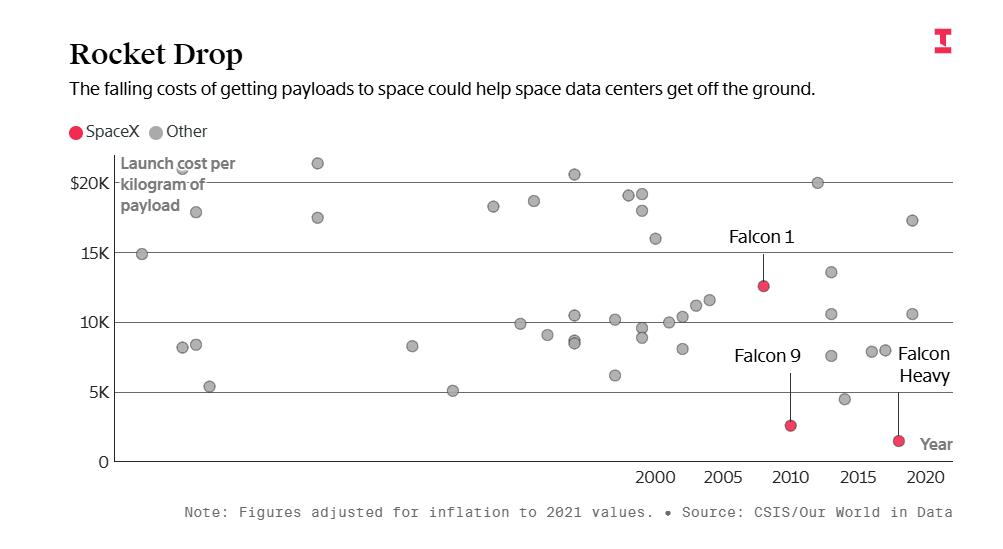
Core Viewpoint - The space has emerged as a new battleground for AI infrastructure, with significant interest from tech giants like Elon Musk, Jeff Bezos, and former Google CEO Eric Schmidt in establishing space data centers as a solution to energy and cooling challenges faced by terrestrial data centers [1][16]. Group 1: Space Data Centers - SpaceX plans to deploy data centers in space, with Musk emphasizing that the cost of operating large-scale AI systems in space may become more cost-effective than on Earth within the next 4 to 5 years [4][10]. - The concept of space data centers is gaining traction among Silicon Valley leaders, with Musk leading the charge and suggesting that the energy limitations on Earth necessitate a shift to space [5][6]. - The potential for abundant and stable energy in space, coupled with efficient cooling methods, positions space data centers as a viable alternative to traditional data centers [8][9]. Group 2: Energy and Cooling Advantages - In space, solar panels can provide continuous power due to the absence of weather and day-night cycles, making energy supply reliable [8]. - The cold environment of space allows for efficient heat dissipation through radiation, significantly reducing cooling costs compared to ground-based data centers [9]. - Estimates suggest that energy costs for space data centers could be as low as one-tenth of those for terrestrial solutions, enhancing their economic viability [9]. Group 3: Cost and Launch Economics - The cost of launching payloads into space is decreasing, with current estimates around $1,500 per kilogram using SpaceX's Falcon Heavy rocket, and projections suggest this could drop to $100 per kilogram with the Starship [11][12]. - This reduction in launch costs, combined with the advantages of space energy and cooling, creates a compelling business case for the establishment of space data centers [13]. Group 4: Industry Response and Developments - Companies like Starcloud have already begun testing space data center concepts, successfully launching a satellite equipped with NVIDIA H100 GPUs for training language models in space [16]. - Google is advancing its "Project Suncatcher," which aims to deploy a constellation of solar-powered satellites equipped with tensor processing units (TPUs) for in-orbit testing by 2027 [18]. - Bezos has indicated that moving data centers to orbit will become economically viable within 20 years, while Schmidt has invested in space technology companies, reflecting a consensus among tech leaders that the future of AI infrastructure lies in space [21]. Group 5: Domestic Developments - In China, initiatives are underway to establish space data centers, with plans to develop key technologies and construct a constellation of satellites for computational purposes by 2035 [23].
美股异动丨太空概念股Destiny Tech100盘前续涨5% 此前5连升,累计涨幅超44%
Ge Long Hui· 2025-12-15 09:27
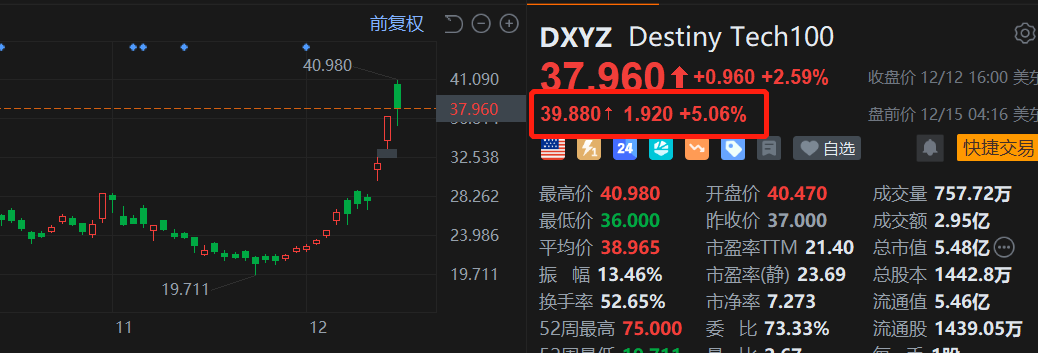
Core Insights - Destiny Tech100 continues to rise, up 5% in pre-market trading, marking a five-day consecutive increase with a cumulative gain of over 44% and reaching a new phase high [1] Industry Developments - In response to the surge in AI computing power demand and ground power constraints, major U.S. tech companies are collectively shifting towards the concept of "space data centers" [1] - Google plans to launch a prototype testing satellite by 2027, while companies like SpaceX and Blue Origin are accelerating their investments in this area [1] - The trend is being driven by decreasing launch costs and a reshaping of capital narratives, moving the sector from a technological vision to early validation stages [1] Company Specifics - SpaceX is planning to go public as early as mid-2026, aiming to raise over $30 billion with an estimated valuation of approximately $1.5 trillion [1] - The funds raised will be allocated towards space data centers and chip procurement [1] - SpaceX anticipates revenues of $15 billion in 2025, increasing to between $22 billion and $24 billion in 2026 [1]
马斯克疯狂带货太空数据中心:“能耗比地球香太多”
Sou Hu Cai Jing· 2025-12-15 07:14
Core Viewpoint - The space data center has emerged as a new battleground for AI infrastructure, with significant interest from tech giants like Elon Musk, Jeff Bezos, and former Google CEO Eric Schmidt, who are exploring the potential of deploying data centers in space to overcome energy and cooling limitations on Earth [1][4][9]. Group 1: Space Data Center Concept - SpaceX plans to deploy data centers in space, with Musk suggesting that the cost of operating large-scale AI systems in space could be more cost-effective than on Earth within the next 4 to 5 years [1][5]. - The concept of space data centers is gaining traction among Silicon Valley leaders, indicating a collective interest in this innovative approach to AI infrastructure [1][9]. - The idea is driven by the belief that energy limitations on Earth will hinder the growth of AI capabilities, making space a viable alternative for energy and cooling solutions [4][5]. Group 2: Advantages of Space Data Centers - Space offers abundant and stable energy from solar power, as solar panels in space can operate continuously without weather interruptions [5][6]. - Cooling in space is more efficient due to the extreme cold temperatures, allowing for effective heat dissipation from GPUs without the need for extensive cooling systems [5][7]. - The cost of launching payloads into space is decreasing, with estimates suggesting that costs could drop to $100 per kilogram in the near future, enhancing the feasibility of space data centers [6][7]. Group 3: Industry Developments - Starcloud, a private startup, successfully launched a satellite equipped with NVIDIA H100 GPU chips, marking a significant step in training large language models in space [9]. - Google is advancing its "Project Suncatcher," which aims to create a constellation of solar-powered satellites equipped with tensor processing units (TPUs) for in-orbit testing by 2027 [11]. - Bezos has expressed that relocating data centers to orbit is a rational move, predicting that costs will surpass terrestrial AI infrastructure within 20 years [14].
马斯克猛猛带货太空数据中心!“能耗比地球香太多”
量子位· 2025-12-15 05:57
Core Viewpoint - The article discusses the emerging trend of space data centers as a new frontier for AI infrastructure, driven by key figures like Elon Musk and supported by other tech giants such as Amazon and Google [1][12]. Group 1: Space Data Centers and AI Infrastructure - Space data centers are becoming a focal point in discussions within Silicon Valley and beyond, with significant interest from major tech leaders [2][12]. - Elon Musk has been a prominent advocate for space data centers, indicating that SpaceX plans to deploy data centers in space and expressing support for Google's similar initiatives [4][6]. - Musk argues that the energy potential in space is vastly greater than on Earth, suggesting that deploying AI systems in space could be more cost-effective within the next 4-5 years [8][27]. Group 2: Advantages of Space Data Centers - Space offers abundant and stable energy sources, as solar panels in space can provide continuous power without the interruptions caused by weather or day-night cycles [24]. - Cooling in space is more efficient due to the extreme cold temperatures, allowing for effective heat dissipation without the need for complex cooling systems [25]. - The cost of launching payloads into space is decreasing, with estimates suggesting it could drop to $100 per kilogram in the near future, enhancing the feasibility of space data centers [30]. Group 3: Industry Response and Developments - Major companies are actively pursuing space data center projects, with Starcloud successfully launching a satellite to train a language model in space [38]. - Google is working on "Project Suncatcher," which aims to create a constellation of solar-powered satellites equipped with their tensor processing units (TPUs) [41][42]. - Jeff Bezos has also indicated that moving data centers to orbit is a rational approach, predicting that costs will surpass terrestrial AI infrastructure within 20 years [46]. Group 4: Future Prospects and Challenges - The article highlights the potential for space data centers to alleviate the energy shortages projected for data centers on Earth, particularly in the U.S., where demand for electricity is expected to exceed supply due to AI growth [33][34]. - The construction of space data centers could provide a solution to the regulatory and environmental challenges faced by terrestrial data centers, offering a more agile and sustainable approach to meet increasing computational demands [36]. - The article concludes that both domestic and international players are recognizing the potential of space data centers, marking a significant shift in the landscape of AI infrastructure [50][55].

顺灏股份盘中再度涨停 公司提示风险
Zheng Quan Shi Bao Wang· 2025-12-15 03:09
Core Viewpoint - The stock of Shunhao Co., Ltd. (002565) has seen a significant increase, rising over 130% in the last 12 trading days, but the company has issued a risk warning regarding its business collaboration with Beijing Rail Transit Technology Co., Ltd. [1] Group 1: Stock Performance - Shunhao Co., Ltd. hit a new high with a limit-up increase of approximately 8% on the 15th, before the limit was lifted [1] - The stock has accumulated a rise of over 130% in the past 12 trading days [1] Group 2: Business Risks - The company stated that its existing business does not have synergistic effects with the business of Beijing Rail Transit Technology Co., Ltd. [1] - The business of Beijing Rail Transit is subject to macroeconomic factors, industry policies, and market environment changes, which may lead to risks in industrialization and commercialization [1] - The "Tianshu Tiansuan" business may only have clear commercial value in the next five years, while the "Dishu Tiansuan" business may take five to ten years to compete with ground data centers [1] - The space data center faces significant challenges such as strong radiation, difficult orbital maintenance, debris hazards, and regulatory issues related to data governance and space traffic [1] Group 3: Financial Performance - For the first three quarters of 2025, the net profit attributable to shareholders of the listed company was 67.319 million yuan, a year-on-year increase of 20.29% [2] - The net profit attributable to shareholders after deducting non-recurring gains and losses was 22.1344 million yuan, a year-on-year decrease of 61.12% [2]

马斯克带头,贝佐斯黄仁勋加入,美国科技圈突然“铺天盖地”讨论太空数据中心
Sou Hu Cai Jing· 2025-12-15 01:26
Core Viewpoint - The explosive growth in AI's demand for computing power is driving major US tech companies to explore the concept of "space data centers" as a solution to ground infrastructure bottlenecks [1][4]. Group 1: Industry Dynamics - Key figures like Elon Musk, Jeff Bezos, and Jensen Huang have publicly supported the idea of space data centers, shifting the narrative from theoretical to practical actions [1][4]. - Google plans to launch a prototype satellite by 2027 to test its AI chips in space, while startup Starcloud has successfully trained the first space large language model on a satellite equipped with NVIDIA GPUs [1] [4]. - The trend reflects a response to severe electricity shortages and regulatory hurdles faced by domestic data centers, with industry leaders advocating for the use of abundant solar energy and natural cooling in space [1][6]. Group 2: Economic Viability - The economic rationale for space data centers is strengthened by the availability of free, continuous solar energy and natural cooling, which could significantly reduce operational costs [6]. - The cost of launching payloads into orbit has decreased, with estimates suggesting that SpaceX's Falcon Heavy rocket currently costs about $1,500 per kilogram, potentially dropping to $100 per kilogram with the introduction of the Starship [6]. - Competition from Blue Origin and other rocket startups is further driving down launch prices, making the economic model for deploying GPUs and solar arrays in space more feasible [6]. Group 3: Ground Infrastructure Challenges - The surge in AI demand is expected to create a 20% electricity shortfall for US data centers in the coming years, according to a Morgan Stanley report [7]. - Community opposition, driven by the "NIMBY" (Not In My Backyard) effect, is increasingly hindering data center projects, with $64 billion worth of projects reportedly delayed or blocked [8]. - The time-consuming process of obtaining permits and ensuring power supply for ground data centers can take years, making space solutions an attractive alternative [8]. Group 4: Capital Narrative and Potential Risks - Despite the ambitious vision, concerns remain regarding space radiation damaging AI chips and the challenges of maintenance and hardware upgrades in space [11]. - The concept of space data centers is providing a compelling narrative for companies like SpaceX, which is considering an IPO in the next year, allowing it to tap into the current AI investment theme [11]. - By integrating the space data center concept, SpaceX aims to enhance its growth story, similar to how Tesla has emphasized its technological attributes through the Optimus robot [11].
今日晚间重要公告抢先看——11天7板顺灏股份现有业务未与轨道辰光的业务产生协同效应,古鳌科技实控人变更为徐迎辉,12月15日复牌
Jin Rong Jie· 2025-12-14 13:00
Major Announcements - Shunhao Co., Ltd. faces potential delays and lower-than-expected commercialization benefits for its space data center project due to strong radiation and other factors [1] - Pudong Jinqiao's chairman Wang Ying has left the company due to a job transfer [1] Investment Projects - Jiaze New Energy plans to invest approximately 3.557 billion yuan in a green hydrogen and aviation fuel chemical co-production project in Jixi City, Heilongjiang Province [2] - Zoli Pharmaceutical intends to acquire a multi-trace element injection asset group for a total price of 356 million yuan [2] Regulatory Approvals - Jiankang Medical's U.S. subsidiary received pre-market notifications from the FDA for its four-in-one and three-in-one testing kits for respiratory viruses [3] - Saiyi Information has been approved to lead a national major science and technology project focused on intelligent manufacturing systems and robotics [4] - Jinpan Technology has received approval from the China Securities Regulatory Commission for issuing convertible bonds to unspecified investors [2] Corporate Actions - Hason Co., Ltd. is adjusting its plan to acquire assets, now focusing solely on acquiring a 45% stake in Suzhou Langkes [5] - Yipin Hong's U.S. subsidiary Arthrosi Therapeutics is set to be acquired by Sobi USA for a total of up to 950 million USD [5] - Zhonghuan Environmental plans to raise no more than 300 million yuan through a private placement to supplement working capital and repay loans [6] Clinical Trials and Approvals - Junshi Biosciences has received FDA approval for clinical trials of its JS212 drug for treating advanced solid tumors [7]
史上最大IPO要来了!马斯克计划募资超300亿美元,瞄准2026年上市
Sou Hu Cai Jing· 2025-12-14 10:57
大家好,我是小圆!金融圈和科技圈最近可能都在热议一个词:史上最大。这个词不是形容手机屏幕, 也不是形容购物节折扣,而是指向一家你可能既熟悉又觉得有些遥远的公司——埃隆·马斯克旗下的太 空探索技术公司(SpaceX)。据多家外媒报道,这家以回收火箭和"星链"互联网闻名世界的公司,正在 紧锣密鼓地推进其首次公开募股(IPO)计划。 这次上市如果成真,其规模之巨,足以载入史册:目标估值据说高达约1.5万亿美元,计划融资超过300 亿美元。 第一个支柱,也是当下最核心的现金牛和增长极,是"星链"卫星互联网业务。简单说,就是通过发射成 千上万颗近地轨道卫星,组建一个覆盖全球的高速互联网星座。这项服务已经为数以百万计偏远地区、 海上、航空的用户提供了网络接入,收入增长迅猛。 但"星链"更大的想象空间在于其"直连手机"的蓝图。想象一下,未来普通的智能手机不需要改造,就能 直接通过卫星进行通信和上网,这将彻底打破地面基站的地理限制,其潜在市场空间被极大地拓宽了。 一场瞄准纪录的资本盛宴 让我们先来感受一下这组数字带来的直观冲击。1.5万亿美元的估值是什么概念?这大约相当于两个多 特斯拉目前的市值,与全球最赚钱的石油公司沙特阿 ...