市场波动

Search documents
波动指标专家:别被美股反弹“冲昏头” 速购标普500“下行保险”
智通财经网· 2025-04-29 11:20
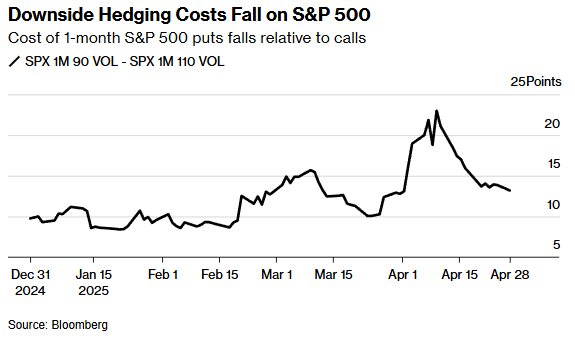
Core Viewpoint - The U.S. stock market has rebounded strongly from its lows, but market observers are cautioning investors not to celebrate too early, urging them to buy "insurance" in the options market to protect against potential declines [1][3]. Group 1: Market Performance and Options - The S&P 500 index has rebounded 10% from its April lows, leading to a decrease in the cost of hedging tools [1]. - The price of one-month put options, used to hedge against market declines, is currently at its lowest level since President Trump's large-scale tariff policy was introduced on April 2 [1]. - The Cboe Volatility Index, which measures market volatility, is currently at 25, down from approximately 60 on April 7, indicating reduced fear in the market [4]. Group 2: Economic Concerns and Trade Policies - Despite the market's positive response to signs of potential easing in Trump's trade policies, uncertainties remain regarding the resolution of tariff issues and their impact on the U.S. economy [1]. - The tariffs on China remain as high as 145%, with little hope for a short-term resolution, while a three-month suspension of tariffs on other countries is set to expire in July [1]. - Concerns about the economic outlook over the next 6 to 9 months persist, with analysts suggesting that the ultimate outcomes of tariffs, consumer spending, and corporate earnings remain uncertain [5]. Group 3: Investor Sentiment and Strategies - Some investors are confident that if the market declines again, the White House may further ease trade policies [3]. - There is a noted decrease in demand for "tail risk protection," indicating a level of confidence among investors regarding the current market conditions [4]. - Analysts suggest that the recent market gains may be largely due to low trading volumes, with some viewing the rebound as a short-covering rally [5].

巨汇Macro Global Markets:穿透波动,驾驭重构
Sou Hu Cai Jing· 2025-04-29 07:59
Core Insights - The article emphasizes the increasing complexity of investment decisions in the volatile financial markets of 2025, necessitating advanced analytical tools like Macro Global Markets for effective navigation through data [1] Market Trends and Analysis - The Macro Global Markets tool features a global policy simulator that captures the impact of central bank policy changes across 132 economies, breaking down the effects of a 50 basis point rate hike by the Federal Reserve into three phases: currency transmission (48 hours), bond market response (72 hours), and stock valuation restructuring (120 hours) [2] - The tool's "manufacturing GPS" capability utilizes 23 alternative data types, such as global port throughput and industrial electricity consumption, to predict manufacturing trends in emerging markets, with a lead time of 6-8 months [4] Strategic Insights - The "correlation matrix" function in the tool identifies hidden relationships in cross-market arbitrage, such as the correlation between the Brazilian real and the Norwegian krone rising from 0.32 to 0.81 when oil prices exceed $90 per barrel, aiding hedge funds in capturing arbitrage opportunities [5] - A unique three-layer defense mechanism in the "black swan warning system" scans media sentiment, analyzes shipping signal anomalies, and monitors dark web data to provide timely alternative route cost assessments when disruptions occur [5] User Guidance and Features - For new users, the "three-screen linked workstation" setup is recommended, which includes a U.S. Treasury yield curve, an industry rotation heatmap, and a commodity term structure monitor to stabilize market volatility [6] - Advanced users can activate the "Alpha Hunter" module, which integrates machine learning with fundamental analysis to generate decision trees based on specific investment themes, enhancing the precision of investment strategies [6] Practical Applications - The "data time machine" feature allows users to analyze historical events and their impacts, such as comparing the recent TSMC incident with past semiconductor disruptions to assess market implications [9] - The "volatility topography" function assists in risk management by simulating asset rebalancing paths under different interest rate scenarios, effectively controlling portfolio volatility during market fluctuations [9] - The Macro Global Markets tool is positioned as a comprehensive decision-making system that combines macro and micro perspectives, redefining market analysis in a new era of financial volatility [9]

美股巨震时对冲基金套现万亿,散户跑步进场
Wind万得· 2025-04-27 22:24
摩根大通的报告显示,今年迄今,对冲基金净套现1万亿美元,与此同时,散户每月净购买股票500亿美 元,而且"几乎没有中断"。这一动态颠覆了华尔街关于投资者在市场动荡期间的行为的传统观念。 华尔街长期以来一直称散户是"傻钱"(dumb money),因为散户倾向于根据恐惧和贪婪做出决定。相比 之下,对冲基金和机构投资者被称为"聪明钱"(smart money),因为他们历来能够依靠大量数据和分 析,忽视情绪驱动的波动。今年以来的数据显示,关于这些群体行为的流行观念越来越与现实脱节。 事实上,近年来大型基金在经济衰退时更有可能逃离市场,以避免潜在损失。散户也改变了他们的投资方 式。被动管理的指数基金以及401(k)计划多年来从每次下跌都能获得回报,这意味着,当市场变得疯狂 时,很多散户不再争相退出,而是持有或者继续加仓。 对冲基金长期资本(Long-Term capital)前合伙人Victor Haghani表示:"散户投资者充斥着这些庞大的资 本池,他们的行为非常明智"。Victor Haghani现在经营着管理Elm Market Navigator ETF的咨询公司Elm Wealth。 Wind 数据显示 ...


KKR Real Estate Finance Trust (KREF) - 2025 Q1 - Earnings Call Transcript
2025-04-24 14:00
Financial Data and Key Metrics Changes - For Q1 2025, the company reported a GAAP net loss of $10.6 million or $0.15 per share, with a book value of $14.44 per share, down approximately 2% from the prior quarter [4][13] - Distributable earnings for the quarter were $17 million or $0.25 per share, aligning with the dividend payout [5] Business Line Data and Key Metrics Changes - The company closed four loans totaling $376 million, primarily secured by Class A multifamily properties, with a weighted average loan-to-value (LTV) of 69% and a coupon of SOFR plus 277 basis points [11] - Repayments in the quarter amounted to $184 million, contributing to net fundings of $222 million [11] Market Data and Key Metrics Changes - The pipeline reached a record high of over $30 billion, indicating strong market demand despite increased spreads in various loan sectors [10] - Warehouse financing and senior loan spreads widened by approximately 10 to 15 basis points, while transitional loan sector spreads increased by 15 to 20 basis points [8] Company Strategy and Development Direction - The company is focused on maintaining a defensive posture while actively seeking new investment opportunities, particularly in the European lending market [7][11] - The strategy includes diversifying the portfolio and adding duration, with a strong emphasis on high-quality assets [11][12] Management's Comments on Operating Environment and Future Outlook - Management expressed concerns about market volatility and recession expectations but believes real estate is better positioned compared to past cycles [6] - The company anticipates that repayments will exceed $1 billion this year, tracking well above previous expectations [10] Other Important Information - The company has no corporate maturities until February 2030 and has ample liquidity of over $700 million [7][18] - The CECL reserve increased to $144 million due to two loan downgrades, but 90% of the loan portfolio remains risk-rated three or better [19] Q&A Session Summary Question: Concerns about macro issues and dividend policy - Management is monitoring both macroeconomic conditions and specific portfolio risks, noting that while there is heightened awareness, no specific asset is of particular concern [25][30] - Regarding the dividend policy, management feels comfortable with the current level and will evaluate it quarterly, considering the potential for future earnings growth from REO assets [32][33] Question: Originating in Europe and leveraging repayments - The company has been actively originating in Europe and expects to close deals soon, focusing on Western Europe and the UK [40] - Management indicated that while leverage is currently at 3.9 times, they are tracking repayments ahead of schedule and will focus on origination to maximize earnings [42][44] Question: Downgrade of Raleigh multifamily loan - The downgrade was due to the inability to drive rents in the submarket, with the property being on the watch list for some time [50][51] Question: Life Science sector outlook - Management believes that the life science sector has long-term positive fundamentals but faces cyclical headwinds, with expectations for a recovery depending on the economic environment [54][80] Question: New lending opportunities and market conditions - The current opportunity set allows for lending at lower valuations, with a shift towards more stabilized assets rather than transitional ones [60][62] - The company is seeing a significant amount of refinancing activity, with around 70% of the pipeline focused on refinancing rather than new acquisitions [67] Question: Portfolio growth expectations - Management anticipates some incremental growth in the portfolio but is approaching the upper limit of target leverage [76]

投资小知识:市场波动大,2个方法,帮你更好投资
银行螺丝钉· 2025-04-24 13:37
文 | 银行螺丝钉 (转载请注明出处) 有偏离自己制定的投资计划。 第二是我们在定投的时候,要综合考虑自 己的心理承受能力和投入的资金量。 定投开始时投入的钱不多,所以心理压 力会小一点。 IEA J V L J F J F J F J F J L L J ▼点击阅读原 文,免费学习大额家庭资产配置课程 而如果遇到下跌的时候感到恐慌,往往 说明这个时候你投的钱可能超出自己的 心理承受能力了。 投的钱越多,心理压力越大。这时候可 能就容易头脑一昏,做出错误的决策。 因此,最好用长期不用的闲钱投资,这笔 钱是遇到下跌你也不慌的金额。 说一个极端的例子,就是这笔钱哪怕打 水漂了,你也不会觉得心疼的那种。 这种程度的资金,做长期投资更容易坚 挂下求。 ...
特朗普暂缓“对等关税”90天,不确定性加剧市场波动!如何把握这段关键期的交易机会?邀你加入国信期货首席分析师顾冯达的圈子,直击关税风暴的危与机
news flash· 2025-04-24 09:04
进群直击关税热点 特朗普暂缓"对等关税"90天,不确定性加剧市场波动!如何把握这段关键期的交易机会?邀你加入国信 期货首席分析师顾冯达的圈子,直击关税风暴的危与机 相关链接 ...
挪威主权财富基金首席执行官:4月份市场波动剧烈,这是自疫情以来未曾出现过的高度波动期。
news flash· 2025-04-24 08:12
挪威主权财富基金首席执行官:4月份市场波动剧烈,这是自疫情以来未曾出现过的高度波动期。 ...
美股太疯狂,华尔街怯场了,散户却押上全部身家豪赌
Hua Er Jie Jian Wen· 2025-04-23 05:54
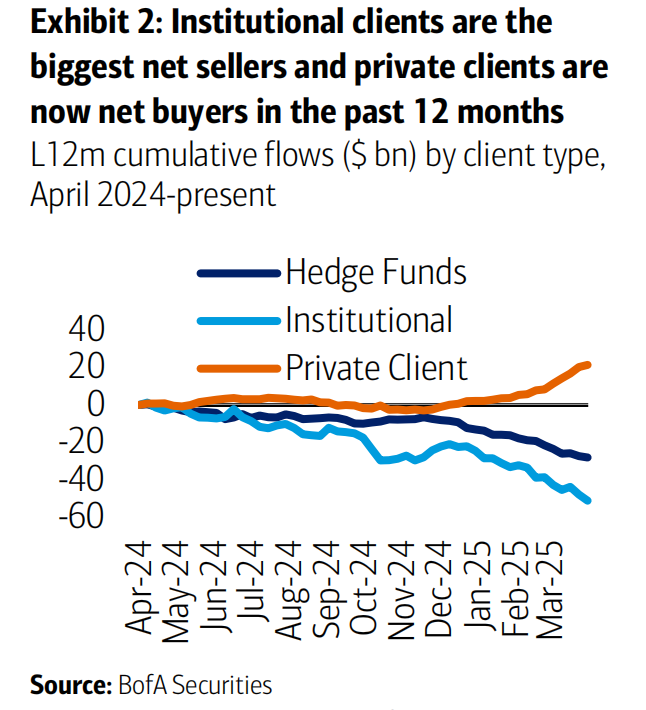
Group 1 - The core viewpoint of the articles highlights a divergence between retail investors and institutional investors in the U.S. stock market, with retail investors continuing to buy while institutions are selling off their holdings [1][6][10] - Retail investors have net bought stocks for 19 consecutive weeks, marking the longest buying streak since data collection began in 2008, despite a recent decline in the S&P 500 index [1][4] - Institutional investors have sold a total of $28.613 billion in stocks over the past 12 months, with a notable $3.263 billion sold in just one week, indicating a cautious outlook on the market [6][10] Group 2 - Specific sectors facing significant sell-offs by institutional investors include financials, technology, and industrials, with notable amounts sold in each sector during the week of April 14, 2025 [7][11] - The financial sector saw a net sell-off of $4.07 million, technology $0.59 million, and industrials $0.87 million, reflecting a broader trend of risk reduction among institutions [11][12] - Retail investors, particularly younger ones, are taking aggressive positions in high-risk assets, with some viewing the current market volatility as an opportunity for substantial returns [11][12][14]