
企业数字化转型

Search documents
什么是优秘数字人?它如何帮助企业解决实际问题?
Sou Hu Cai Jing· 2025-06-16 07:50
在数字化浪潮的推动下,一个全新的职场角色正在悄然崛起——数字人。它们不是科幻电影中的机器人,而是一群通过人工智能技术打造的"虚拟员工",能 够像真人一样工作、思考甚至与人互动。如果说过去的企业还在为效率和成本发愁,那么数字人的出现,则为企业打开了一扇通往高效未来的 doors。 但你见过不需要休息的客服吗?见过可以7×24小时工作的数据分析师吗?见过可以在几秒钟内处理数千条信息的"员工"吗?这些听起来像是天方夜谭的情 节,正在通过数字人成为现实。那么,什么是数字人?它们又如何帮助企业解决实际问题呢? 一、数字人的定义:不只是一个虚拟形象 很多人对数字人存在误解,认为它只是一个人形的虚拟角色,比如银行里的虚拟主播或电商平台上的智能客服。但事实上,数字人远不止于此。 在传统的企业中,客服岗位是一个典型的高压力、高强度工作。客户的问题五花八门,情绪也难以预测,而客服人员需要24小时待命,处理大量的重复性问 题。 数字人能够完美解决这些问题: 快速响应:数字人可以7×24小时在线,无需休息,随时为客户提供服务。 个性化解答:通过接入企业的知识库,数字人可以针对不同客户的问题提供个性化的解答。 数字人是一个基于人工智能 ...



枣庄工信“双线并行”精准诊断助转型
Qi Lu Wan Bao Wang· 2025-06-13 03:07
线下入企提供深度服务。以医药行业为试点,采取"现场查看+座谈研讨"的模式,深入4家重点企业生产 一线,聚焦信息化建设基础、核心痛点问题及转型需求开展深度诊断。由数字化服务商出具《企业数字 化转型诊断报告》,配套制定个性化解决方案,并建立"诊断-实施-跟踪"闭环服务机制,促成2家企业 与服务商初步达成合作意向。2025年计划分行业开展此类对接活动不少于5场。 建强队伍夯实技术支撑。整合省内外优质资源,组建"头部服务商+本地机构+金融单位"三位一体的数 字化转型专家团队。重点引入卡奥斯、浪潮、山东胜软等省内领军数字化服务商,联合市内骨干服务机 构及金融赋能平台,形成覆盖技术咨询、方案设计、实施落地的全链条服务体系,为企业提供专业化、 定制化的转型支撑。2025年新入库数字化服务商12家,全市数字化服务商队伍扩充至40家。 线上诊断实现广域覆盖。依托山东省工业和信息化厅"工业企业数字化转型评估诊断"系统开展线上诊断 评估,通过数字化水平测评、指标对标分析,帮助企业清晰认知自身在研发设计、生产制造、管理运营 等环节的数字化现状,为转型路径规划提供数据支撑。2024年,累计组织575家企业开展线上诊断评 估,2025年 ...
LABUBU爆红900%增长背后,中小企业能否复制这套“增长密码”?
Sou Hu Cai Jing· 2025-06-11 12:11
Core Insights - The LABUBU phenomenon showcases how a niche IP can achieve explosive growth through unique design, precise marketing strategies, and strong cultural relevance, leading to a 900% revenue increase in the Americas and 170% globally for Pop Mart [1][20] - The success of LABUBU raises questions about whether similar "acceleration secrets" exist for small and medium-sized enterprises (SMEs) seeking transformation and breakthrough in a competitive market [1][20] KPaaS Platform Overview - KPaaS is designed as a one-stop integrated expansion platform for SMEs, addressing issues like "information silos," "data inconsistency," and "fragmented processes" that hinder explosive growth [2][20] - The platform employs advanced microservices architecture and integrates various mature components to ensure performance and stability, ultimately translating technical details into tangible growth for enterprises [2][20] Data Management and Integration - KPaaS offers robust master data management capabilities, enabling unified management of data across different systems, which enhances decision-making with real-time, high-precision data [3][21] - The platform supports multi-source data integration, providing ETL functionalities that allow enterprises to analyze data and generate reports, transforming isolated data into valuable business insights [3][21] Efficiency and Innovation - KPaaS aims to reduce unnecessary losses and accelerate internal processes, facilitating seamless resource flow and continuous innovation in response to market changes [4][21] - The platform's low-code development capabilities empower non-technical personnel to quickly build lightweight systems, significantly shortening development cycles and reducing IT costs [8][21] Organizational Collaboration - KPaaS enhances collaboration efficiency by automating processes and breaking down friction points within workflows, allowing for automatic document flow and status synchronization across various business systems [15][16] - The platform's single sign-on feature simplifies user access to multiple systems, improving work efficiency and user experience [18][20] Strategic Value for SMEs - KPaaS serves as a strategic partner for SMEs in their digital transformation journey, enabling them to respond more agilely to market changes, utilize data effectively, and drive business innovation [20][21] - The platform encourages a culture of innovation by empowering all employees to participate in application development, thus accelerating the realization of business needs and fostering an internal innovation culture [21]
如何提升企业数字化转型能力?
Sou Hu Cai Jing· 2025-06-11 09:29
Core Insights - The establishment of a "Digital Committee" led by the CEO aims to integrate business, IT, and data departments to avoid isolated efforts from the technology department [1] Group 1: Digital Transformation Strategy - The transformation strategy focuses on turning data from an "asset" into "capital" and reshaping talent and cultural genes within the organization [2] - A top-level design for a "data-driven" transformation is emphasized, with a need for cross-departmental governance mechanisms [4] - The three pillars of transformation capabilities are identified as "technology + data + organization" [4] Group 2: Technical Infrastructure - Transitioning from "island systems" to a "middle platform" approach involves eliminating fragmented systems like traditional ERP and CRM, and building a "cloud-native + data middle platform" [4] - Implementing a Data Management Capability Maturity (DCMM) certification system is crucial for establishing data standards and application scenarios [4] Group 3: Skills and Cultural Transformation - Management training on "digital leadership" and employee courses on low-code tools and data analysis are essential for skill reshaping [4] - Cultural transformation encourages a "trial and error" approach, exemplified by a digital innovation fund allowing departments to allocate 5% of their budget for exploratory tech projects [4] Group 4: Industry-Specific Focus - Different industries are encouraged to focus on specific high-value business scenarios: manufacturing on "demand-driven" production, services on "user operations," and supply chains on "intelligent collaborative networks" [5] Group 5: Financial and Policy Support - Companies are advised to leverage policy benefits, diversify funding sources, and collaborate with ecosystem partners [6] - National and provincial digital project applications can provide significant subsidies, such as up to 5 million for smart manufacturing pilot demonstrations [7] Group 6: Evaluation and Optimization - Establishing a "feedback - optimization" loop is vital for quantifying transformation effectiveness through core indicators like production efficiency and IT operational cost reduction [8] - Continuous optimization should follow a PDCA cycle, with quarterly assessments of digital maturity and annual transformation planning iterations [8] Group 7: Common Pitfalls - Companies should avoid "technology following" trends, prioritize software and service investments, and prevent departmental silos that hinder effective data utilization [9] - Digital transformation is framed as a survival imperative, requiring a shift from "experience-driven" to "data-driven" business processes [9]

如何降低企业数字化探索期的试错成本
3 6 Ke· 2025-06-11 01:11
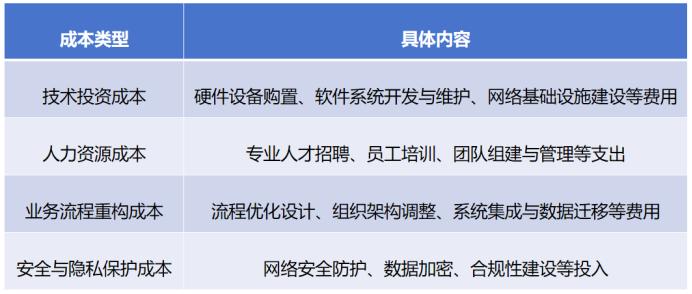
当前虽说数字化转型已经成为企业提升竞争力的关键路径,成为了企业发展的必答题,但仍有部分企业 不敢转,最主要的原因就是那看似高昂的建设成本、技术专业性以及不确定性,据麦肯锡研究,70%的 数字化项目未能达到预期目标,其中试错成本占比高达15%~25%,那么该如何系统性的降低试错成 本?首先我们来分析一下企业数字化转型建设的成本构成。 | 成本类型 | 具体内容 | | --- | --- | | 技术投资成本 | 硬件设备购置、软件系统开发与维护、网络基础设施建设等费用 | | 人力资源成本 | 专业人才招聘、员工培训、团队组建与管理等支出 | | 业务流程重构成本 | 流程优化设计、组织架构调整、系统集成与数据迁移等费用 | | 安全与隐私保护成本 | 网络安全防护、数据加密、合规性建设等投入 | 而隐性成本包括变革期间比如:企业文化重塑、员工观念转变等所产生的沟通协调等时间成本,这些是 最容易忽视的。 关于数字化成本的误区 对于部分传统企业而言一谈及数字化成本马上就会想到软件费用,于是为了降低成本就各种砍价、砍功 能、砍需求,总之越便宜越好,结果一不小心踩了软件公司的各种坑(此问题老杨已在上一篇文章中详 细 ...
中国澳门酒企Epsium纳斯达克敲钟,CEO称上市是新起点
2 1 Shi Ji Jing Ji Bao Dao· 2025-06-09 11:30
Core Viewpoint - Epsium Enterprise Limited's recent IPO on NASDAQ marks a significant milestone for the company, indicating a new phase in its development and a commitment to governance, brand building, and global communication [1][4] Group 1: Company Development and Strategy - The company views its IPO as a new starting point that will facilitate substantial progress in governance, brand building, and global communication [1] - Epsium Enterprise plans to optimize its product structure and collaborate with long-term oriented liquor brands and distributors to enhance market coverage [2] - The company is accelerating its digital transformation across various aspects, including supply chain management and data analysis, to improve management efficiency and market responsiveness [2] Group 2: Market Challenges and Opportunities - The liquor industry faces strict regulations, and international markets demand higher standards for product quality, compliance, and financial disclosure, posing challenges for small and medium-sized enterprises [1] - Epsium Enterprise recognizes the complexities of cultural differences, consumer habits, and regulatory systems in international markets, emphasizing the need for long-term investment in brand building [1] - The management is closely monitoring industry consolidation opportunities, with acquisitions being a key part of the mid-to-long-term strategy, focusing on projects that align with the company's core business [2] Group 3: Economic Environment and Risk Management - The management expresses a cautious stance regarding the current international economic landscape, particularly amid US-China trade tensions and policy uncertainties [3] - As an importer, the company is affected by international market fluctuations, including tariff adjustments and exchange rate changes, which can impact operational costs and market pricing [3] - Epsium Enterprise aims to mitigate upstream risks by securing key sources and optimizing inventory structures while strengthening long-term relationships with downstream customers [3] Group 4: Local Market Environment - The favorable policy environment in Macau is considered a key factor for Epsium Enterprise's steady growth, with the region's transparent business environment and legal system providing a conducive space for development [3] - The company plans to expand its overseas market presence while establishing a strong foundation in Macau, which serves as a bridge between mainland China and international markets [3]

经纬交织间,透视高德毛毯数字化转型“破茧”之路
Qi Lu Wan Bao Wang· 2025-06-06 10:36
Core Viewpoint - Gaode Carpet Company is a leading player in the domestic carpet industry, achieving significant production and sales milestones while facing challenges typical of traditional manufacturing, such as reliance on foreign trade and inventory pressure [1][3]. Group 1: Company Overview - Gaode Carpet Company operates with 8 flat screen printing lines and 2 round screen printing lines, producing over 20 million carpets annually [1]. - The company has a sales revenue exceeding 500 million yuan, with products exported to over 60 countries and regions worldwide [1]. Group 2: Challenges Faced - The company faces challenges including a single market structure due to over-reliance on foreign trade orders, long capital turnover cycles, and high inventory pressure [3]. - Increased volatility in international market demand has necessitated the exploration of new growth avenues for traditional manufacturing enterprises [3]. Group 3: Digital Transformation - A partnership with Shupai Group's Shupai Yigou has enabled Gaode Carpet to establish an online bridge to the domestic market, facilitating direct consumer access [3]. - The new digital model allows for immediate full payment upon contract signing, significantly improving cash flow and reducing inventory risks [3]. Group 4: Future Outlook - The company anticipates continued growth in domestic orders and improved operational efficiency through digital capabilities [3]. - Gaode Carpet aims to innovate product lines based on insights into domestic consumer demands for high-quality and personalized products, contributing to the digital transformation of the home textile industry [3].

远光软件(002063) - 002063远光软件投资者关系管理信息20250605
2025-06-05 09:18
Group 1: Core Product and Technology - The core product, YuanGuang DAP, is a next-generation "enterprise digital core system" that integrates digital management of core resources and business capabilities, surpassing traditional ERP systems [2][3]. - DAP is based on a cloud-native intelligent architecture, integrating management models, data services, and AI capabilities to support deep transformation from business informatization to management intelligence [3]. - DAP's product features are summarized as "three highs and three fulls": high adaptability to management changes, high support for group control, and high support for co-construction and sharing; fully autonomous and controllable, fully covering business, and fully leading in intelligence [3]. Group 2: Market Opportunities and Promotion Plans - In 2025, the emphasis on technology independence and digital upgrades presents historical opportunities for the comprehensive promotion of YuanGuang DAP, aiming to replace foreign counterparts [4]. - The company plans to optimize standard products and enhance solutions for various industries, including energy, construction, manufacturing, metallurgy, transportation, and healthcare [4][5]. - Targeting large enterprises, the company will provide specialized solutions to address their complex management needs, while also adapting standard products for medium-sized and local enterprises [5]. Group 3: Low-Carbon Business Strategy - The company aims to build a comprehensive carbon market service system, offering services such as carbon verification, carbon assets, carbon trading, and carbon footprint management [6]. - It will leverage its geographical advantages to support international green energy organizations and participate in standard formulation and certification services [6]. Group 4: Artificial Intelligence Development - Since 2015, the company has been researching AI technologies, developing over a thousand RPA robots and various intelligent devices, forming a 3+N business model for AI development [7]. - Future AI plans include enhancing the AI middle platform, scaling intelligent applications of DAP products, and expanding AI applications in the power grid sector [9]. - The company aims to strengthen its AI ecosystem through collaborations with leading industry firms and academic institutions [9]. Group 5: Impact of Marketization in Power Trading - The deepening of the electricity market presents challenges for market participants, requiring enhanced digital and informational support [10]. - Companies need to improve power prediction accuracy and multi-source collaborative optimization capabilities, creating significant opportunities for the company's information technology in power trading [10].

飞创港股IPO:供应链依赖与国际贸易摩擦风险显著
Jin Rong Jie· 2025-06-03 09:49
Core Viewpoint - Shenzhen Feichuang Innovation Technology Co., Ltd. (Feichuang) has submitted its listing application to the Hong Kong Stock Exchange, aiming to leverage its position as a leading global provider of enterprise-level network solutions to support digital transformation for businesses worldwide [1][2]. Company Overview - Feichuang is recognized as the second-largest online DTC network solutions provider globally, based on projected revenue for 2024 [1]. - The company offers a comprehensive range of products and services, including high-performance network devices, scalable operating systems, and cloud network management platforms [1]. - Feichuang has established a highly integrated DTC model that efficiently delivers contextual solutions globally, combining network architecture design, multi-vendor procurement, and after-sales support into a unified platform [1]. Financial Performance - For the year 2024, Feichuang reported revenues of RMB 2.612 billion, reflecting an 18.0% year-on-year growth [2]. - The net profit for the same period was RMB 397 million, with a gross margin of 50.0% [2]. - The compound annual growth rate (CAGR) of the company's revenue from 2022 to 2024 is 14.6%, indicating strong growth momentum [2]. - The net revenue retention rate improved from 94.4% in 2023 to 102.1% in 2024, showcasing strong customer loyalty [2]. Market Presence - Feichuang has served over 450,000 customers across more than 200 countries and regions, including approximately 60% of the Fortune 500 companies [1].
当前企业数字化转型似乎进入了一个死循环
3 6 Ke· 2025-06-03 07:34
近日与某微信好友聊天,他感叹这么多年数字化建设不易的同时说道:老杨,你有没有觉得当前在降本 增效的模式下企业、信息部门、软件公司三者之间似乎进入了一个死循环,企业在不断的压缩预算,信 息部门在疲于应付需求,而软件公司则在低价竞争中难以提供高质量服务。这种恶性循环不仅使企业无 法真正实现所谓的"降本增效"目标,反而可能导致技术债务越积越多,工作效率下降。 信息信息部门:夹缝中求生存处境艰难 大部分传统企业的信息部门一直以来都是尴尬的存在,虽然信息部门肩负企业数字化建设的重任,但由 于价值体现难,管理层认为其投入产出不成正比;众所周知,业务部门对于数字化的需求是多样化的, 引进一套系统不会解决所有的问题,于是信息部门需要不断引入新的技术与系统,随着工作量的不断增 加还需要不断的扩大团队,这就导致信息部门的可见成本不断攀升,进一步降低其价值。但随着企业降 本增效模式的推进,信息部门不仅要应对预算削减带来的资源紧张问题,还要努力维持现有系统的稳定 运行,并满足业务部门不断变化的需求。在资源有限的情况下,信息部门往往顾此失彼,比如在团队规 模缩减的情况下,信息部门只能疲于应付日常运维,对于业务部门的新需求难以招架,更加 ...