
新型工业化

Search documents
推动重点领域智能化升级
Qi Huo Ri Bao Wang· 2026-01-08 02:24
Core Viewpoint - The "Artificial Intelligence + Manufacturing" implementation opinion aims to accelerate the integration of AI technology in the manufacturing sector, enhancing productivity and supporting new industrialization by 2027 [1][2]. Group 1: AI Integration in Manufacturing - By 2027, China aims to achieve secure and reliable supply of key AI technologies, maintaining a leading position in industry scale and empowerment levels [1]. - The initiative plans to promote the deep application of 3 to 5 general large models in manufacturing, creating specialized industry models and high-quality datasets [1]. - The goal includes the establishment of 100 high-quality industrial datasets and the promotion of 500 typical application scenarios [1]. Group 2: Data Management and Governance - The opinion emphasizes the "Model-Data Resonance" action, advocating for the establishment of Chief Data Officer roles in enterprises and the implementation of national standards for data management maturity [1][2]. - It aims to create a resource list of data that meets industry model needs and to publish guidelines for constructing high-quality datasets in manufacturing [1]. - The focus is on transforming basic data into high-quality industry datasets and integrating data development with model construction [1]. Group 3: Intelligent Upgrades and Applications - The opinion calls for the promotion of intelligent upgrades in key areas, enhancing the synergy between AI and information communication networks [2]. - It encourages the development of intelligent solutions for green manufacturing, addressing energy management and resource recycling [2]. - The initiative supports the acceleration of intelligent terminal upgrades, including breakthroughs in edge models and applications for devices like smartphones and smart homes [2]. Group 4: Safety and Collaboration Measures - The opinion proposes the establishment of a collaborative mechanism involving departments, central and local governments, and industry to promote the initiative [3]. - It encourages local governments to develop tailored policies to guide enterprises in differentiated development and prevent "involution" in the industry [3]. - The plan includes coordinating existing funding channels to support the research and application of AI technologies in manufacturing [3].
天奇股份涨3.68%,成交额4.23亿元,主力资金净流出152.58万元
Xin Lang Cai Jing· 2026-01-08 02:03
Core Viewpoint - Tianqi Co., Ltd. has shown fluctuations in stock performance, with a recent increase in share price despite a year-to-date decline, indicating potential volatility and investor interest in the company [1]. Group 1: Stock Performance - On January 8, Tianqi's stock rose by 3.68%, reaching 22.53 CNY per share, with a trading volume of 4.23 billion CNY and a turnover rate of 5.31%, resulting in a total market capitalization of 90.62 billion CNY [1]. - Year-to-date, Tianqi's stock price has decreased by 0.40%, with a 3.84% drop over the last five trading days, but has increased by 37.80% over the last 20 days and 40.90% over the last 60 days [1]. - The company has appeared on the "Dragon and Tiger List" once this year, with the most recent appearance on January 6, where it recorded a net buy of -39.48 million CNY, with total buy transactions of 194 million CNY, accounting for 8.63% of total trading volume [1]. Group 2: Company Overview - Tianqi Automation Engineering Co., Ltd. is located in Wuxi, Jiangsu Province, established on November 18, 1997, and listed on June 29, 2004. The company specializes in automated conveyor systems, automated storage systems, and related software, as well as wind turbine development and recycling of scrapped vehicles [2]. - The company's revenue composition includes 62.73% from automotive intelligent equipment, 14.54% from heavy machinery, 11.02% from lithium battery recycling, 4.87% from recycling equipment, 4.83% from bulk material conveying equipment, and 2.02% from other sources [2]. - As of September 30, the number of shareholders in Tianqi was 56,300, a decrease of 7.72% from the previous period, with an average of 6,294 circulating shares per person, an increase of 8.36% [2]. Group 3: Financial Performance - For the period from January to September 2025, Tianqi reported a revenue of 1.964 billion CNY, a year-on-year decrease of 5.86%, while the net profit attributable to shareholders was 67.20 million CNY, reflecting a significant year-on-year increase of 215.81% [2]. - Since its A-share listing, Tianqi has distributed a total of 182 million CNY in dividends, with 11.85 million CNY distributed over the past three years [3]. - As of September 30, 2025, Hong Kong Central Clearing Limited was the third-largest circulating shareholder, holding 4.7125 million shares, an increase of 1.8935 million shares from the previous period [3].

港股开盘:恒指跌0.59%、科指跌0.44%,科网股多数走低,创新药及锂电池概念股活跃
Jin Rong Jie· 2026-01-08 01:31
Market Overview - The Hong Kong stock market opened lower on January 8, with the Hang Seng Index down 0.59% at 26,302.78 points, the Hang Seng Tech Index down 0.44% at 5,713.53 points, the National Enterprises Index down 0.43% at 9,099.63 points, and the Red Chip Index down 0.14% at 4,109.34 points [1] - Major tech stocks mostly declined, with Alibaba down 1.58%, Tencent down 0.96%, JD.com down 0.79%, Xiaomi down 0.42%, Meituan down 0.77%, and Bilibili down 0.47% [1] - New stocks listed today included Zhihui, which rose over 3%, Tianshu Zhixin, which surged over 31%, and Jingfeng Medical-B, which increased over 36% [1] Company News - Xinyi International (00732.HK) reported a cumulative net operating revenue of approximately HKD 16.534 billion for 2025, a year-on-year decrease of about 7.3% [2] - China Overseas Development (00688.HK) announced a cumulative contract property sales amount of approximately RMB 251.231 billion for 2025, down 19.1% year-on-year [2] - Greentown China (03900.HK) reported a total contract sales amount of approximately RMB 251.9 billion for 2025, a decrease of 9% year-on-year [2] - China Overseas Hongyang Group (00081.HK) achieved a contract sales amount of RMB 2.57 billion for December 2025, down 43.9% year-on-year [3] - Qinhuangdao Port Co., Ltd. (03369.HK) reported a total throughput of 433 million tons for the year ending December 31, 2025, an increase of 4.48% year-on-year [4] - Lijun Pharmaceutical (01513.HK) announced that the injection of Laconchita monoclonal antibody has been included in the priority review and approval process [5] - Kinko Service (09666.HK) received acceptance from independent shareholders for 218.6 million shares without interests [6] - CICC (03908.HK) plans to issue no more than HKD 3 billion in perpetual subordinated bonds [7] - Agricultural Bank of China (01288.HK) saw Ping An Life increase its stake in its H-shares [8] - Aoyou Group (03383.HK) reported a total pre-sale amount of approximately RMB 8.57 billion as of December 31, 2025 [9] - CIMC Group (02039.HK) stated that the sale of property projects will reduce the group's net profit attributable to shareholders by approximately RMB 1.08 billion for 2025 [10] Stock Buybacks - Xiaomi Group-W (01810.HK) repurchased 3.9 million shares for HKD 149 million at prices between HKD 38.12 and HKD 38.2 [11] - Tencent Holdings (00700.HK) repurchased 1.023 million shares for HKD 636 million at prices between HKD 615.5 and HKD 628 [11] - Geely Automobile (00175.HK) repurchased 3.388 million shares for HKD 59.156 million at prices between HKD 17.38 and HKD 17.65 [12] Institutional Insights - Zheshang International noted that the fundamentals of the Hong Kong stock market remain weak, with a decline in the funding environment, while policy focus is on new productivity and expanding domestic demand [14] - Goldman Sachs maintains an "overweight" rating on Chinese A-shares and H-shares, citing attractive risk-reward ratios amid low profit growth and valuation levels [14] - FSMOne indicated that the valuation recovery of the Hang Seng Index has largely been achieved, with future performance dependent on corporate profit recovery [15] - Huatai Securities highlighted three investment opportunities under new industrialization: high-end manufacturing going global, strengthening domestic supply chains, and forward-looking investments in emerging industries [15]
经济日报:新型工业化持续走深走实
Jing Ji Ri Bao· 2026-01-08 01:04
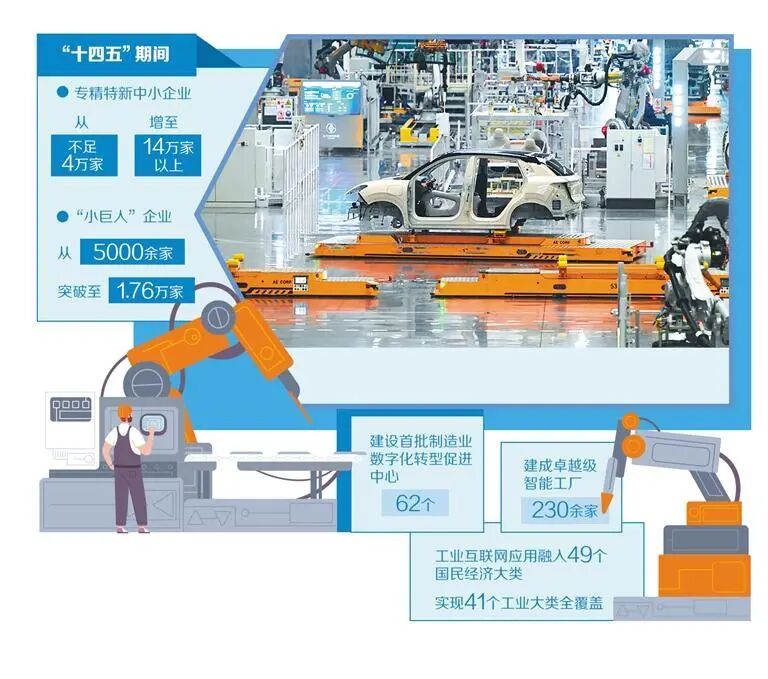
Core Insights - The modernization of industry is identified as the most crucial foundation and core of a modern industrial system, with a focus on strengthening the real economy and promoting technological innovation and digital transformation across various regions [1] Group 1: Industrial Development and Innovation - The Ministry of Industry and Information Technology (MIIT) has been advancing new industrialization since the 14th Five-Year Plan, enhancing the overall strength, quality, efficiency, innovation, competitiveness, and risk resistance of the industry [1] - Significant achievements have been made in various sectors, including integrated circuits, biomedicine, and AI-driven manufacturing, with a focus on creating a modern industrial system centered around advanced manufacturing [2] - The number of specialized and innovative small and medium-sized enterprises has increased from less than 40,000 to over 140,000 during the 14th Five-Year Plan, while "little giant" enterprises have grown from over 5,000 to 17,600 [3] Group 2: Industrial Clusters and Ecosystems - Industrial clusters are essential for high-quality development and transformation of manufacturing enterprises, with efforts to create specialized parks and ecosystems to enhance resource allocation and innovation collaboration [4] - The Hunan Medical Device Industrial Park serves as a successful example of rapid growth in the medical device sector, achieving explosive growth in just four years by attracting various upstream and downstream enterprises [4] Group 3: Digital Transformation - Traditional industries such as steel and machinery are accelerating their digital transformation, with companies like Shandong Haihua Group leveraging AI to enhance operational efficiency and safety [7] - The MIIT is implementing a digital transformation action plan for the manufacturing sector, establishing 62 digital transformation promotion centers and over 230 exemplary smart factories [9] - The next steps include further advancing the construction of a modern industrial system centered on advanced manufacturing and promoting industrial upgrades [9]

港股概念追踪 | 工信部发声!新型工业化迎利好 关注三类投资机会(附概念股)
智通财经网· 2026-01-07 23:29
Group 1 - The Ministry of Industry and Information Technology has issued an action plan to enhance the integration of industrial internet and artificial intelligence, aiming for significant improvements by 2028, with at least 50,000 enterprises undergoing new industrial network upgrades [1] - The new industrialization emphasizes a development model that promotes high technological content, good economic benefits, low resource consumption, and minimal environmental pollution, with key industries like drones, ships, and automobiles being crucial engines for this transformation [1] - Various cities, including Suzhou and Wuxi, are actively deploying new initiatives around new industrialization, focusing on advantageous industries, artificial intelligence, and scenario construction [1] Group 2 - Suzhou held a meeting to promote new industrialization and "AI + manufacturing," emphasizing the integration of technological and industrial innovation, and the development of a modern industrial system centered on advanced manufacturing [2] - The government of Shangqiu has released an action plan to accelerate AI-enabled new industrialization, targeting the creation of over 20 provincial-level digital transformation "lighthouse" enterprises and 100 intelligent workshops by 2027 [2] - Experts indicate that 2026 will be a critical year for advancing new industrialization, with more local policies expected to be introduced [2] Group 3 - The integration of industrial internet with AI technologies like large models and intelligent agents is expected to accelerate changes in industrial models and organizational structures, leading to new products and services [3] - Huatai Securities identifies three investment opportunities under new industrialization: high-end manufacturing going global, strengthening domestic supply chains, and forward-looking investments in emerging industries that meet digital and intelligent requirements [3] - Suggested sectors for tactical investment opportunities include electronics, machinery, software, automotive, servers, medical devices, chemicals, and rare earths [3] Group 4 - ZTE Corporation leverages 5G-A, AI, and industrial internet to provide comprehensive capabilities from infrastructure to application scenarios, supporting the development of industrial internet through technological innovation [4] - Innovation Works' "Qizhi Kongming AInnoGC" industrial model features over 15 billion parameters and aims to assist enterprises in developing customized large models and accelerating the deployment of generative AI applications [4] - Tencent has launched the WeMake industrial internet platform to facilitate the digital transformation of the manufacturing industry by leveraging its digital technology capabilities and ecosystem resources [4]
工信部发声!新型工业化迎利好 关注三类投资机会(附概念股)
Zhi Tong Cai Jing· 2026-01-07 23:26
Group 1 - The Ministry of Industry and Information Technology has issued an action plan to enhance the integration of industrial internet and artificial intelligence, aiming to support new industrialization by significantly improving the integration level by 2028 and facilitating the upgrade of no less than 50,000 enterprises [1] - New industrialization emphasizes a development model that promotes high technological content, good economic benefits, low resource consumption, and minimal environmental pollution, with key industries such as drones, ships, and automobiles being crucial engines for this transformation [1] - Various cities, including Suzhou, Wuxi, Zhangzhou, and Shangqiu, are actively deploying new initiatives around new industrialization, focusing on advantageous industries, artificial intelligence, and scenario construction [1] Group 2 - Suzhou held a meeting to promote new industrialization and emphasized the need for deep integration of technological and industrial innovation, aiming to build a modern industrial system centered on advanced manufacturing [2] - Shangqiu's action plan aims to create over 20 provincial-level digital transformation "lighthouse" enterprises and more than 100 intelligent workshops and factories by 2027, highlighting the role of artificial intelligence in driving new industrialization [2] - Experts suggest that 2026 will be a critical year for advancing new industrialization, with more local policies expected to be released [2] Group 3 - The integration of industrial internet with AI technologies like large models and intelligent agents is expected to accelerate changes in industrial models and organizational forms, leading to new products, services, and applications [3] - Huatai Securities identifies three investment opportunities under new industrialization: high-end manufacturing going global, strengthening domestic supply chains, and forward-looking investments in emerging industries that meet digital and intelligent requirements [3] - Suggested sectors for tactical opportunities include electronics, machinery, software, automotive, servers, medical devices, chemicals, and rare earths [3] Group 4 - ZTE Corporation leverages 5G-A, AI, and industrial internet to provide comprehensive capabilities from infrastructure to application scenarios, supporting the development of industrial internet through technological innovation [4] - Innovation Works' "Qizhi Kongming AInnoGC" industrial model features over 15 billion parameters and aims to assist enterprises in developing customized large models and accelerating the deployment of generative AI applications [4] - Tencent has launched the WeMake industrial internet platform to facilitate the digital transformation of the manufacturing industry by leveraging its digital technology capabilities and ecosystem resources [4]
我国提出到2028年推动不少于 5万家企业实施新型工业网络改造升级
Xin Lang Cai Jing· 2026-01-07 18:14
Core Insights - The Ministry of Industry and Information Technology has issued an action plan aimed at significantly enhancing the integration of industrial internet and artificial intelligence by 2028, targeting the transformation of at least 50,000 enterprises and the creation of high-quality data sets in 20 key industries [1][2] Group 1: Action Plan Objectives - The action plan focuses on deepening the application of artificial intelligence and industrial internet, promoting new industrialization, and supporting the construction of a manufacturing powerhouse and a network power [1] - Key initiatives include upgrading foundational infrastructure, ensuring data model interoperability, renewing application models, and fostering an integrated industrial ecosystem [1] Group 2: Specific Measures - The plan outlines measures such as accelerating the development of products like 5G programmable logic controllers, AI routers, and industrial computing network switches [1] - It emphasizes strengthening the supply of industrial intelligent computing power and promoting the integration of industrial internet with computing centers [1] - The plan also supports the transition of industrial internet solution providers to intelligent solution providers [1] Group 3: Supportive Policies - The action plan encourages local governments to enhance policy guidance and develop supporting measures tailored to local conditions [2] - It advocates for the establishment of special funds and the exploration of diversified funding mechanisms for key technology product development [2] - The plan includes optimizing academic and professional training for new roles such as industrial internet engineers and artificial intelligence trainers [2]
八部门聚力推出“人工智能+制造”专项行动
Xin Lang Cai Jing· 2026-01-07 18:14
Core Viewpoint - The integration of artificial intelligence (AI) with the real economy is set to profoundly change the production models and economic forms in the manufacturing industry, as outlined in the "AI + Manufacturing" action plan issued by multiple government departments [1]. Group 1: Goals and Objectives - By 2027, China aims to achieve secure and reliable supply of key AI technologies, maintaining a leading position in industry scale and empowerment levels globally [1]. - The plan includes the deep application of 3 to 5 general large models in manufacturing, the creation of 100 high-quality industrial data sets, and the promotion of 500 typical application scenarios [1]. - The initiative seeks to cultivate 2 to 3 globally influential ecosystem-leading enterprises and a number of specialized small and medium-sized enterprises, while establishing 1,000 benchmark enterprises [1]. Group 2: Key Industries and Applications - Key industries targeted for AI empowerment in new industrialization include raw materials, equipment manufacturing, consumer goods, electronic information, software, and information technology services [2]. - The plan encourages leading enterprises and state-owned enterprises to explore new models and applications of AI in manufacturing, alongside implementing digital empowerment initiatives for small and medium-sized enterprises [2]. Group 3: Implementation Strategies - The action plan emphasizes strengthening AI computing power supply, promoting the development of intelligent chips, and supporting breakthroughs in key technologies such as high-end training chips and AI servers [2]. - It outlines the need for an integrated mechanism for data collaboration, model training, application development, and security assurance through the "model-number resonance" initiative [2]. - The plan also focuses on upgrading intelligent equipment and terminals, fostering new business forms like humanoid robots, and enhancing the integration of AI with industrial software [2]. Group 4: International Cooperation and Funding - The initiative promotes high-level international cooperation, encouraging the export of advantageous industries and participation in AI discussions within multilateral cooperation frameworks [3]. - It proposes the establishment of a collaborative work mechanism involving departments, central and local governments, and industry to guide enterprises in differentiated development and prevent internal competition [3]. - The plan aims to leverage existing funding channels to support AI-related technology research and application tasks, utilizing the national AI industry investment fund to attract more social capital [3].

八部门聚力推出“人工智能+制造”专项行动 到2027年,我国人工智能关键核心技术实现安全可靠供给
Zheng Quan Shi Bao· 2026-01-07 18:01
Core Insights - The integration of artificial intelligence (AI) with the real economy is set to profoundly change the production modes and economic forms in the manufacturing sector [1] - The "AI + Manufacturing" initiative aims to accelerate the application of AI technologies in manufacturing, enhancing new industrialization with a focus on creating new productive forces [1] Group 1: Goals and Objectives - By 2027, China aims to achieve secure and reliable supply of key AI technologies, maintaining a leading position in industry scale and empowerment levels globally [1] - The initiative plans to promote the deep application of 3 to 5 general large models in manufacturing, develop 100 high-quality industrial data sets, and implement 500 typical application scenarios [1] - The goal includes nurturing 2 to 3 globally influential ecosystem-leading enterprises and a number of specialized small and medium-sized enterprises [1] Group 2: Key Industries and Applications - Key industries targeted for AI empowerment in new industrialization include raw materials, equipment manufacturing, consumer goods, electronic information, and software and information technology services [1][2] - The initiative encourages leading enterprises and state-owned enterprises to explore new models and applications of AI in manufacturing [2] Group 3: Implementation Strategies - The initiative emphasizes strengthening AI computing power supply, supporting the development of intelligent chips, and fostering collaboration between hardware and software [2] - It aims to promote the iteration of intelligent equipment and the upgrading of intelligent terminals, integrating AI with industrial machinery, robots, and smart connected vehicles [2] - A mechanism for "data collaboration, model training, application development, and security assurance" will be explored to enhance the AI application process [2] Group 4: Collaboration and Funding - A cooperative mechanism involving departments, central and local governments, and industry collaboration will be established to promote the initiative [3] - The initiative encourages local governments to develop tailored policies and measures to guide enterprises in differentiated development [3] - It aims to leverage existing funding channels to support AI-related technology research and application tasks, utilizing the national AI industry investment fund to attract more social capital [3]
A股晚间热点 | 八部门联合发文!事关“人工智能+制造”
智通财经网· 2026-01-07 15:21
Group 1: Artificial Intelligence and Manufacturing - The Ministry of Industry and Information Technology and seven other departments issued the "Implementation Opinions on the Special Action of 'Artificial Intelligence + Manufacturing'" aiming for key AI technologies to achieve reliable supply by 2027, with the industry scale and empowerment level remaining at the forefront globally [1] - The plan includes promoting the development of intelligent chips, supporting breakthroughs in high-end training chips, edge inference chips, AI servers, high-speed interconnects, and intelligent cloud operating systems [1] - It emphasizes the innovation of model training and inference methods, developing high-performance algorithm models suitable for the real-time, reliability, and safety characteristics of the manufacturing industry [1] Group 2: Central Bank and Gold Reserves - The People's Bank of China has increased its gold reserves for the 14th consecutive month, holding 74.15 million ounces as of December 2025, an increase of 30,000 ounces from the previous month [3] - Analysts suggest that the continuous increase in gold reserves is driven by changes in the global political and economic landscape, indicating a rising necessity to optimize international reserve structures [3] Group 3: Monetary Policy - The People's Bank of China announced a buyout reverse repurchase operation of 1.1 trillion yuan, set to take place on January 8, 2026, with a term of three months [4] - Experts predict that the central bank may conduct another six-month buyout reverse repurchase operation this month, indicating a potential continuous injection of medium-term liquidity into the market for the eighth consecutive month [4] Group 4: Investment in Agricultural Bank - Ping An Life announced an increase in its stake in Agricultural Bank of China H-shares to 20% as of December 30, 2025, triggering disclosure requirements under Hong Kong market rules [5] Group 5: Automotive Industry - Xiaomi plans to launch four new car models next year, including two range-extended SUVs, with the first models expected to be released in the first half of the year [7] Group 6: Trade Investigations - The Ministry of Commerce has initiated an anti-dumping investigation into imported dichlorodihydrosilane from Japan, responding to domestic industry applications [8] Group 7: Battery Industry Regulation - A meeting was held by multiple departments to discuss the regulation of the power and energy storage battery industry, focusing on controlling production capacity, managing price wars, and protecting patents [9] Group 8: Market Opportunities - The Ministry of Industry and Information Technology has issued an action plan to enhance the integration of industrial internet and artificial intelligence, aiming to support the upgrade of at least 50,000 enterprises by 2028 [11] - The market is currently focused on AI hardware sectors such as optical modules and PCBs, with a recommendation for investments in AI application companies showing marginal improvements in their third-quarter performance [11]
