红利策略

Search documents
港股开盘 | 恒指低开0.25% 恒生科技指数跌0.68%
智通财经网· 2025-10-23 01:50
Group 1 - The Hang Seng Index opened down 0.25%, while the Hang Seng Tech Index fell by 0.68%. Li Ning and WH Group saw gains of over 1% [1] Group 2 - Galaxy Securities indicates that uncertainties in US-China trade negotiations may keep market risk appetite low in the short term. The overall valuation of Hong Kong stocks is at a historically high level, suggesting potential wide fluctuations in the market [2] - In terms of sector allocation, it is recommended to focus on safe-haven assets like precious metals due to rising market risk aversion, as well as dividend assets that have seen lower gains recently. Attention is also drawn to sectors highlighted in the upcoming 20th Central Committee meeting and the "14th Five-Year Plan" [2] - China’s economy is expected to reach a turning point, with technology investments translating into profit growth. The anticipated easing of monetary policy in the US may enhance foreign capital inflows, supporting a slow bull market for Hong Kong stocks [2] Group 3 - Cathay Securities believes that short-term volatility will not alter the bullish outlook for Hong Kong stocks in Q4, particularly for the Hang Seng Tech Index. The narrative around AI is expected to benefit internet giants in Hong Kong, highlighting the structural advantages of Hong Kong assets [3] - The return of foreign capital is likely to exceed expectations due to the Federal Reserve's potential interest rate cuts, with southbound capital inflows expected to continue supporting the upward trend of Hong Kong stocks [3] - Insurance funds are anticipated to become significant incremental capital in the stock market, with a focus on dividend stocks due to their low volatility and high dividend characteristics, especially in the current low long-term interest rate environment [3]
广发证券原副总李谦加盟平安证券,拟任总经理职务;公募基金年内分红总额已超1881亿元 | 券商基金早参
Mei Ri Jing Ji Xin Wen· 2025-10-23 01:17
Group 1 - Former Vice President of GF Securities, Li Qian, has joined Ping An Securities as the proposed General Manager, marking a significant personnel change that enhances Ping An's executive team and reflects its talent strategy [1][2] - Li Qian holds a PhD in Economics from Renmin University of China and has extensive experience across banking and securities, having held key positions in both sectors [1][2] - This move is indicative of the increasing competition for talent within the financial industry, potentially leading to an evolution in the competitive landscape among leading brokerage firms [2] Group 2 - Public funds have shown increased enthusiasm for participating in private placements, particularly in technology leaders like Cambrian and Shenghong Technology, indicating a strategic shift towards technology investments [3][4] - Cambrian's recent private placement raised approximately 3.985 billion yuan, with participation from 13 institutions, while Shenghong Technology raised about 1.9 billion yuan with 10 institutions involved [4][5] - The surge in private placements reflects institutional recognition of the long-term value in technology sectors, potentially boosting market interest and capital inflow into these areas [3][4] Group 3 - Public funds have distributed over 188.1 billion yuan in dividends this year, with a notable increase in both the number of distributions and total amount compared to the previous year [4][5] - The increase in dividends is seen as a strategy by fund managers to reward investors, which may enhance market confidence, particularly for dividend-focused and bond funds [4][5] - This trend of increased dividends could provide liquidity to the market while also impacting fund net values and long-term investment strategies [4][5] Group 4 - CICC has established a new industrial investment fund in Suzhou with a capital contribution of 1 billion yuan, focusing on equity investments in unlisted companies [6][7] - This initiative highlights the deepening collaboration between leading brokerages and industrial capital, aiming to enhance investment influence in advanced manufacturing sectors [6][7] - The fund's establishment is expected to drive capital attention towards local high-end equipment industries, fostering structural vitality in the market [6][7]




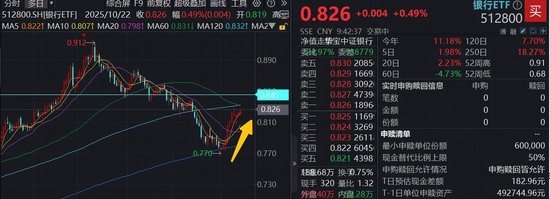
逆市冲击十连阳!双百亿银行ETF(512800)突围式上涨,10天吸金近60亿元
Mei Ri Jing Ji Xin Wen· 2025-10-22 02:35
Core Viewpoint - The banking sector, particularly state-owned banks, is becoming a preferred investment choice due to low valuations, high dividend yields, and stable operations amidst market volatility, with expectations for significant performance in the fourth quarter [1] Group 1: Market Performance - On October 22, A-shares opened lower but the banking sector showed strength, with the bank ETF (512800) rising by 0.49%, aiming for a ten-day consecutive increase [1] - Recent investor risk appetite has declined, making banks an important choice for capital allocation due to their relative and absolute returns [1] Group 2: Policy Impact - Medium to long-term, expansionary policies aimed at stabilizing real estate, promoting consumption, and enhancing social welfare are expected to accelerate, supporting economic growth [1] - The banking sector is anticipated to benefit from policy catalysts, with a cyclical advantage expected to yield alpha returns [1] Group 3: ETF Performance - The bank ETF (512800) and its linked fund (240019) passively track the CSI Bank Index, encompassing 42 listed banks in A-shares, serving as an efficient investment tool for the banking sector [2] - The bank ETF has seen significant inflows, with 9 out of the last 10 days recording capital increases totaling 5.987 billion yuan, and its latest scale exceeding 20.7 billion yuan [2]
稳!双百亿银行ETF(512800)走出10连阳,农业银行叒新高!
Xin Lang Ji Jin· 2025-10-22 02:03
Core Viewpoint - The banking sector in A-shares is showing resilience and strength, with significant inflows into bank ETFs, indicating a preference for stable investments amid market volatility [2][4]. Group 1: Market Performance - On October 22, A-shares opened lower but the banking sector performed strongly, with the bank ETF (512800) rising by 0.49%, marking a 10-day consecutive increase [1]. - All 42 bank stocks saw gains, with notable increases from Jiangyin Bank, Wuxi Bank, Xi'an Bank, and CITIC Bank, each rising over 1% [1]. - Agricultural Bank of China has achieved a 14-day consecutive rise, reaching a market capitalization of 2.76 trillion yuan, making it the largest bank in A-shares [1]. Group 2: Investment Trends - Investors are seeking "safe havens" in the banking sector, particularly in state-owned banks, due to their low valuations, high dividend yields, and stable operations [2]. - The banking ETF (512800) tracks the CSI Bank Index, which has a price-to-book ratio (PB) of only 0.71, indicating a high value relative to historical performance [2]. - Recent data shows that the banking ETF has attracted significant capital inflows, with 59.87 billion yuan added over the past 10 days, making it the largest and most liquid bank ETF in A-shares [2]. Group 3: Future Outlook - Analysts expect that the banking sector will benefit from upcoming expansionary policies aimed at stabilizing the economy, which may enhance the sector's performance [2]. - The anticipated economic recovery and potential for interest rate cuts suggest that the banking sector could continue to provide attractive returns [2].


[10月21日]指数估值数据(螺丝钉定投实盘第386期发车;养老指数估值表更新)
银行螺丝钉· 2025-10-21 14:00
Core Viewpoint - The overall market has shown an upward trend, with significant gains in both the A-share and Hong Kong markets, indicating a positive sentiment towards technology and value stocks [1][12][7]. Group 1: Market Performance - The overall market index has risen to 4.2 stars, reflecting a positive market sentiment [1]. - Both large, mid, and small-cap stocks have experienced similar upward movements [2]. - The ChiNext index has also seen a substantial increase, currently at a normal to slightly high valuation level [4]. - The technology sector has been a primary driver of profit growth in both A-shares and Hong Kong stocks this year [7]. Group 2: Earnings and Valuation - Leading companies in the ChiNext have reported good earnings growth, which is essential for the long-term rise of the index [3][5]. - Different sectors are recovering at varying paces, with value stocks showing less volatility compared to growth stocks [6][9]. - Recently, previously undervalued dividend stocks are approaching their normal valuation levels [10]. - The estimated valuation metrics suggest that as the market approaches around 3 stars, the green rate in the valuation table will be low [11]. Group 3: Investment Strategies - The investment strategy includes pausing regular investments in the index-enhanced portfolio as it returns to normal valuation, while continuing to hold existing positions [14]. - The active selection portfolio is also close to normal valuation, indicating a cautious approach to new investments [14]. - The "monthly salary treasure" investment strategy, which consists of 40% stocks and 60% bonds, is recommended for stable market participation [14]. - The introduction of an "automatic stop-loss" feature for investment portfolios aims to enhance risk management by automatically executing profit-taking strategies when market conditions are favorable [43].

注意!领涨主线开始切换了
Sou Hu Cai Jing· 2025-10-20 02:39
10月以来,以中美贸易摩擦升级(美方拟加征关税)为契机,市场迎来新一轮风格切换行情——科技成 长大幅回调,红利风格明显跑赢。 月初至17日,红利指数、中特估指数分别上涨4.81%和1.89%,在主要宽基指数中涨幅靠前;创业板、 科创100则分别下跌9.35%和10.13%。 结合黄金价格大涨与股市成交量萎缩等表现来看,本轮资本市场风格切换,在很大程度上可归因于避险 情绪的显著升温。以黄金为例,自10月以来其累计涨幅已超过12%,月内相继突破3900美元-4300美元 等多个整数关口,表现极为强势;与此同时,A股市场日均成交额降至2.37万亿元,较9月日均水平萎缩 488亿元,反映出市场交投活跃度的回落。 避险情绪升温的背后,既有外部环境变化的影响,也有内部基本面因素的推动。从外部来看,贸易摩擦 升级等不确定性严重打击市场风险偏好,VIX恐慌指数月内大幅上涨超过55%,预示着全球资金避险需 求急剧上升。从国内来看,7至9月制造业PMI持续位于50%的荣枯线以下,PPI与CPI同比仍处于负值区 间,社会消费品零售总额与规模以上工业企业增加值增速亦呈现放缓趋势。这些数据均指向企业盈利端 面临压力,市场对即将披露的三 ...
“避风港”行情来袭!公募人士:港股或更有分红优势
证券时报· 2025-10-19 10:32
Core Viewpoint - The article discusses a shift in market focus towards dividend stocks as a defensive strategy, particularly in the context of recent market volatility and the performance of various sectors [1][3]. Group 1: Market Trends - The technology sector and solid-state battery stocks have cooled off, while dividend-paying stocks are stabilizing, supported by banks and insurance companies [1]. - As of October 17, the Shanghai and Shenzhen indices have seen declines of over 1% and 6% respectively, while the CSI Dividend Index has increased by approximately 2.48% [3]. - The Hang Seng China Central State-Owned Enterprises Dividend Index has also been rising, reaching historical highs [3]. Group 2: Investment Strategies - Current market conditions have led to a renewed interest in dividend assets, with funds seeking "safe havens" [3]. - Dividend stocks are showing attractive yields, with mainstream dividend stocks returning to over 4% [3]. - The banking sector has experienced a significant correction, with a maximum drawdown of about 15%, and is now seen as having a high safety margin in terms of valuation [4]. Group 3: Comparative Analysis - The Hang Seng China Central State-Owned Enterprises Dividend Index boasts a dividend yield of 6.02%, significantly higher than the CSI Dividend Index [7]. - The banking sector in A-shares has a dividend yield of around 5%, while the Hong Kong market approaches 6%, indicating a relative attractiveness [7]. - Insurance funds are expected to become a significant source of capital in the stock market, with a focus on dividend stocks due to their low volatility and high yield characteristics [7]. Group 4: Sector Performance - The banking sector is highlighted as a key performer within the dividend space, with expectations for fundamental improvements supported by regulatory policies [9]. - The combination of supportive monetary policy and measures to stabilize interest margins is anticipated to enhance net interest income growth for banks [9].

博时基金市场异动陪伴10月17日:沪指跌1.95%,深证成指、创业板指跌超3%
Xin Lang Ji Jin· 2025-10-17 07:42
Market Performance - On October 17, the Shanghai Composite Index fell by 1.95%, while the Shenzhen Component Index and the ChiNext Index both dropped over 3% [1] Analysis of Market Conditions - The decline in the three major indices is attributed to the ongoing risks associated with U.S. regional banks, which have revealed potential losses due to loan issues, raising global concerns about the stability of the financial system. This, combined with uncertainties from U.S.-China trade tensions, has led to a significant tightening of market risk appetite [2] - The rapid increase in gold prices reflects market vigilance towards a potential credit crisis, further suppressing equity asset performance. Additionally, some previously popular sectors in the A-share market have seen substantial gains, prompting profit-taking amid a lack of clear market direction, particularly affecting growth sectors like electric equipment and electronics [2] Domestic Financial Environment - September financial data presents a mixed signal of overall positivity and structural concerns. The M1 growth rate rebounded significantly to 7.2%, indicating enhanced corporate liquidity and improved economic vitality. However, the year-on-year growth of new social financing and credit remains weak, with household loans still lagging and corporate medium to long-term demand needing improvement, suggesting that the recovery of the real economy is not yet solid [2] - A significant decrease in non-bank deposit increments may indicate a slowdown in the willingness of new funds to enter the market, although this could also be related to high year-on-year comparisons and seasonal financial adjustments [2] Market Outlook - In the context of external risks and internal structural transitions, the A-share market may continue to experience a volatile pattern in the short term, with accelerated sector rotation. However, in the medium to long term, the stabilization of the economic fundamentals and deepening capital market reforms are expected to support the recovery of A-share valuations [3] - Defensive sectors such as dividend strategies and essential consumption, which have previously underperformed, may present valuation advantages. Additionally, technology growth sectors like new energy and semiconductors may gradually reveal medium to long-term investment value following recent adjustments. Investors are advised to consider a "core + satellite" strategy, focusing on low-valuation dividend sectors with strong cash flow for core holdings, while opportunistically investing in policy-supported technology leaders for satellite positions [3]

三方因素催化,煤炭板块持续上涨,投资机会几何?
Zhong Guo Zheng Quan Bao· 2025-10-17 05:55
Group 1 - The coal sector has been experiencing a continuous rise, with companies like Antai Group and Dayou Energy hitting the daily limit up [1] - Analysts attribute the strength in the coal sector to three main factors: high dividend characteristics attracting market attention, expectations of recovery in Q3 earnings, and seasonal demand increases due to the upcoming heating season [2] - The expected profit for the coal industry in the first half of 2025 is projected to be 149.2 billion, a year-on-year decline of 52.9%, with Q1 and Q2 profits at 80.4 billion and 68.8 billion respectively, reflecting declines of 47.4% and 58.1% [2] Group 2 - With the arrival of the strongest cold air mass this year, temperatures are expected to drop significantly across various regions in China, which may further stimulate coal demand for heating [3] - The coal supply-demand balance is expected to remain tight over the next 3-5 years, with high barriers to entry for quality coal companies, leading to strong cash flow and dividend characteristics [3] - The coal price is anticipated to stabilize, which could lead to a revaluation of the sector, making it an attractive investment opportunity with a good risk-reward profile [3]


逆势大涨,2万亿巨头创历史新高!
天天基金网· 2025-10-17 05:19
Core Viewpoint - The article discusses the recent performance of various sectors in the stock market, highlighting the strength of high-dividend assets, particularly in the coal and real estate sectors, while noting the decline in technology and new energy stocks [3][5][9][14]. Coal Sector - The coal sector has shown continuous strength, with significant increases in stock prices for companies like Antai Group and Dayou Energy, both reaching their daily limit up [6][8]. - Analysts attribute the coal sector's performance to three main factors: renewed market interest in high-dividend strategies, expectations of improved quarterly earnings, and seasonal demand increases as winter approaches [8][9]. - According to Citic Securities, the coal market has rebounded since July, leading to a noticeable increase in prices, with a projected 18% quarter-on-quarter increase in net profits for major coal companies in Q3 [9]. Real Estate Sector - The real estate sector experienced a surge, with stocks like Shen Zhen Yi A and Shang Shi Fa Zhan hitting their daily limit up [11][12]. - Recent policy changes in cities like Chengdu and Nanjing aim to enhance housing loan accessibility, which is expected to stimulate the real estate market [13]. - Guojin Securities recommends investing in real estate stocks due to their low valuations and potential benefits from favorable policies, particularly focusing on developers with strong positions in core first- and second-tier cities [14].