绿色化

Search documents
2025年中国半导体设备零部件行业发展历程、市场政策、产业链图谱、市场规模、竞争格局及发展趋势分析:市场格局较为分散[图]
Chan Ye Xin Xi Wang· 2026-01-03 02:50
Core Viewpoint - The semiconductor equipment components industry is crucial for the development of the semiconductor sector, with significant growth driven by domestic policies and market demand, leading to a projected market size of 188.79 billion yuan in 2024, representing a year-on-year growth of 34.9% [1][8]. Industry Overview - Semiconductor equipment components are essential building blocks for semiconductor manufacturing equipment, directly impacting precision, stability, and lifespan [2]. - The industry has evolved from complete reliance on imports to local enterprises gradually breaking through, focusing on high-quality and systematic breakthroughs [3]. Market Size and Composition - The market size for semiconductor equipment components in China is expected to reach 188.79 billion yuan in 2024, with the supporting market (including imported equipment) accounting for 92.5% and the maintenance market for 7.5% [1][8]. - Within the supporting market, mechanical components hold the largest share at 36.5%, followed by system transport systems at 16.1% and electrical components at 14.3% [8]. Policy Support - The Chinese government has implemented numerous policies to support the development of the semiconductor industry, including tax reductions and action plans aimed at promoting high-quality growth [4]. Industry Chain - The upstream of the semiconductor equipment components industry includes suppliers of various metals and non-metals, while the midstream involves R&D, design, and production of components, and the downstream includes applications in wafer fabrication and chip packaging [4][5]. Competitive Landscape - Despite a large market, domestic manufacturers have historically captured a small share, with many relying on imported components. However, local firms are increasingly entering the supply chain, focusing on proprietary technology and modular solutions [6][9]. - Major domestic players include companies like 富创精密 (Fuchuang Precision) and 江丰电子 (Jiangfeng Electronics), which have established competitive positions in their respective niches [10][12]. Development Trends - The industry is moving towards systematic penetration of domestic alternatives across all categories, with a focus on high-end components previously reliant on imports [13]. - Future R&D will emphasize high precision and new materials to meet the evolving demands of semiconductor manufacturing [13]. - Collaboration across the supply chain will strengthen, with industry clusters enhancing resource integration and reducing costs [14]. - The integration of AI and a focus on green manufacturing practices are becoming key development directions, aiming to improve efficiency and reduce environmental impact [15][16].



趋势研判!2025年中国通信电缆行业政策、产业链、市场规模、重点企业及发展趋势分析:作为现代通信系统核心基础设施,通信电缆规模稳步增长[图]
Chan Ye Xin Xi Wang· 2026-01-02 06:19
Core Insights - The communication cable industry in China is experiencing steady growth driven by the increasing demand for 5G networks, gigabit optical networks, and the development of the "dual-gigabit" network [1][12] - The market size of China's communication cable industry is projected to grow from 794.8 billion yuan in 2018 to 1200 billion yuan by 2025, with a compound annual growth rate (CAGR) of 5% [1][13] Industry Overview - Communication cables are essential for transmitting telecommunication signals and are categorized into various types based on their structure and application [4] - The industry is supported by government policies aimed at promoting the development of communication cables, including initiatives for advanced technology applications [4][5] Market Demand - As of October 2025, the total number of fixed internet broadband users in China is expected to reach 697 million, with a net increase of 27.01 million users from 2024 [1] - The number of mobile IoT terminal users is projected to reach 2.89 billion, reflecting a net increase of 23.4 million users from 2024 [1] Industry Growth Factors - The exponential growth in data traffic due to the increasing number of internet users and the proliferation of mobile internet is driving the demand for communication infrastructure and cables [1] - The large-scale commercialization of 5G technology requires a vast amount of communication cables to support dense base station construction and extensive network deployment [1] Application Areas - The traditional communication sector remains dominant, accounting for 58.5% of total revenue, while high-speed communication devices are expected to capture 14.8% of the market by 2024 [10] - Emerging applications in smart manufacturing, smart cities, and the Internet of Things (IoT) are expanding the use of communication cables in diverse scenarios [1][10] Industry Structure - The communication cable industry features a competitive landscape with a mix of leading national enterprises and numerous small to medium-sized companies focusing on niche markets [13] - Key players in the industry include companies like Walden Materials, Wanma Co., Hengtong Optic-electric, and Tongding Interconnection Information [2][13] Future Trends - The industry is expected to evolve towards higher speeds, integration of functionalities, and sustainability, with a focus on developing multi-functional cables that can handle data transmission, power supply, and sensing [15][16][18] - The shift towards green practices will involve the use of eco-friendly materials and the establishment of efficient recycling systems throughout the cable lifecycle [18]





港股概念追踪|2026年家电以旧换新政策出台 家电消费景气有望提振(附概念股)
智通财经网· 2026-01-02 00:43
Group 1 - The Chinese government has announced a new policy for 2026 to support the replacement of old appliances and consumer goods, providing a subsidy of 15% of the product price for eligible energy-efficient appliances, with a maximum subsidy of 1,500 yuan per item [1][2] - The first batch of funding for this policy amounts to 62.5 billion yuan, aimed at stimulating consumer sentiment despite a smaller subsidy scale compared to 2025 [1][2] - The policy is expected to benefit e-commerce platforms, although the overall impact may be limited due to high baseline effects and reduced subsidy amounts [1][2] Group 2 - The 2026 policy focuses on high-efficiency products, with a narrower scope and lower subsidy rates compared to 2025, which aligns with market expectations and is anticipated to improve domestic appliance sales [2] - Companies with advantages in research, distribution, and branding in the white and black goods sectors are expected to benefit more from the new policy [2] - The policy is likely to drive the home appliance industry towards higher-end, smart, and green upgrades, optimizing product structures [2] Group 3 - Relevant Hong Kong-listed companies in the home appliance supply chain include Midea Group, Haier Smart Home, Hisense Home Appliances, TCL Electronics, Skyworth Group, and Xiaomi Group [3]

巩固提升海洋装备制造业优势
Jing Ji Ri Bao· 2026-01-01 22:13
Core Viewpoint - The development of China's marine equipment manufacturing industry is crucial for enhancing the country's maritime capabilities, with a focus on upgrading towards green and low-carbon technologies [1][2]. Group 1: Industry Development - The marine equipment manufacturing industry is a significant part of China's marine economy and a key growth point for foreign trade, with shipbuilding completion and order volumes increasing by 6.7% and 25.7% year-on-year, respectively, in the first three quarters of 2025 [1]. - China's global market shares for new orders, shipbuilding completions, and hand-held orders are 63.5%, 47.3%, and 58.6%, respectively, maintaining a leading position worldwide [1]. Group 2: International Context - The 21st century is recognized as the century of the ocean, with marine equipment being a focal point for national strategic development among marine nations [2]. - Countries like South Korea and France are advancing their marine equipment sectors, focusing on nuclear-powered ships and seawater desalination, respectively [2]. Group 3: Strategic Advantages - China possesses unique advantages for developing its marine equipment manufacturing industry, including a complete industrial system and vast maritime territory, which provides a stable market demand [2]. - The new type of national system allows for resource integration and concentrated efforts in tackling key core technologies, supporting the industry's upgrade [2]. Group 4: Future Directions - To enhance the marine equipment manufacturing industry's advantages, there is a need for systematic and forward-looking development, focusing on innovation and collaboration between academia and industry [3]. - Emphasis should be placed on addressing areas with significant gaps compared to global standards and high import dependency, particularly in chips, industrial software, and advanced materials [3]. Group 5: Integration and Globalization - Promoting land-sea integration and connecting marine equipment manufacturing with other manufacturing sectors is essential for industry upgrade [4]. - Utilizing artificial intelligence to improve collaboration efficiency across the supply chain and enabling real-time data sharing among upstream and downstream enterprises will enhance industry resilience [4]. - Encouraging advanced manufacturing enterprises to engage in global layouts and integrate into the global division of labor will create greater growth opportunities for the marine equipment manufacturing industry [4].
茅台集团:新征程上,坚定市场化、拥抱年轻化、走向国际化
Zheng Quan Shi Bao Wang· 2026-01-01 07:13
Core Viewpoint - Moutai Group emphasizes commitment to practical work, innovation, and cultural heritage in its New Year message for 2026, aiming to build a sustainable future and enhance brand responsibility [1] Group 1: Commitment to Quality and Innovation - The company will focus on craftsmanship to ensure quality as a foundational element [1] - Innovation will be a key strategy for future growth and development [1] Group 2: Cultural and Ecological Responsibility - Moutai Group aims to preserve its cultural heritage as a core aspect of its identity [1] - The company is committed to ecological sustainability as a basis for its development [1] Group 3: Market Strategy and Digital Transformation - The company plans to adopt a market-oriented approach while embracing youth culture [1] - Moutai Group is set to pursue internationalization and deepen its digital transformation efforts [1] Group 4: Green Development - The company is dedicated to green practices as part of its overall strategy [1] - Moutai Group seeks to create new advantages that align with contemporary trends [1]

华菱钢铁:预计2025年净利26亿元-30亿元 同比增长27.97%-47.66%
Zhong Guo Zheng Quan Bao· 2025-12-31 17:05
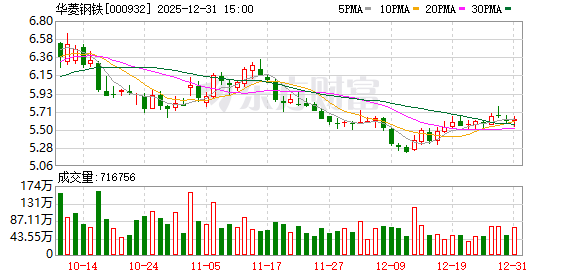
Group 1 - The company Huazhong Steel (000932) expects a net profit attributable to shareholders of 2.6 billion to 3 billion yuan for 2025, representing a year-on-year growth of 27.97% to 47.66% [4] - The expected net profit excluding non-recurring items is projected to be between 2.3 billion and 2.7 billion yuan, indicating a significant year-on-year increase of 76.14% to 106.78% [4] - The basic earnings per share are estimated to be between 0.3775 yuan and 0.4356 yuan [4] Group 2 - The steel industry is undergoing deep adjustments in 2025, remaining in a phase of "reduction in quantity and optimization of stock," with persistent supply-demand contradictions and significant operational pressures for enterprises [8] - The company is maintaining strategic determination and actively responding to market demands while promoting cost reduction and efficiency improvement initiatives [8] - Despite facing approximately 657 million yuan in environmental protection tax and late fees, the company anticipates achieving a total profit of 4.7 billion to 5.3 billion yuan for 2025 [8]

华菱钢铁:预计2025年度净利润为26亿元~30亿元,同比增长27.97%~47.66%
Mei Ri Jing Ji Xin Wen· 2025-12-31 14:39
Group 1 - The company, Hualing Steel, forecasts a net profit attributable to shareholders of 2.6 billion to 3 billion yuan for 2025, representing a year-on-year growth of 27.97% to 47.66% [1] - The basic earnings per share are expected to be between 0.3775 yuan and 0.4356 yuan [1] - The performance change is primarily due to the ongoing deep adjustment in the steel industry, which remains in a phase of "reduction development and stock optimization," with prominent supply-demand contradictions and significant operational pressures [1] Group 2 - The company is maintaining strategic determination in the face of a complex market environment, actively aligning with market demands, and promoting cost reduction and efficiency enhancement initiatives [1] - The company is accelerating its transformation towards "high-end, green, intelligent, and lean" development, with stable and improving production and operational conditions [1] - Despite incurring approximately 657 million yuan in environmental protection tax and late fees, the company expects to achieve a total profit of 4.7 billion to 5.3 billion yuan for 2025 [1]
华菱钢铁:2025年净利同比预增27.97%~47.66%
Mei Ri Jing Ji Xin Wen· 2025-12-31 14:28
Core Viewpoint - Hualing Steel (000932) forecasts a net profit of 2.6 billion to 3 billion yuan for the year 2025, representing a year-on-year growth of 27.97% to 47.66% [1] Group 1: Financial Performance - The company expects a total profit of 4.7 billion to 5.3 billion yuan for 2025 [1] - The anticipated profit growth occurs despite the company facing approximately 657 million yuan in environmental protection tax and late fees [1] Group 2: Industry Context - The steel industry is currently in a phase of "reduction development and stock optimization" [1] - The company is actively pursuing transformation strategies focused on "high-end, green, intelligent, and lean" development [1] Group 3: Operational Strategy - Hualing Steel is aligning its operations with market demand and is committed to cost reduction and efficiency improvement [1] - The company's production and operations are reported to be stable and improving [1]
华菱钢铁:预计2025年净利润同比增长27.97%~47.66%
Guo Ji Jin Rong Bao· 2025-12-31 14:25
Core Viewpoint - The company expects a net profit of 2.6 billion to 3 billion yuan for the year 2025, representing a year-on-year growth of 27.97% to 47.66% [1] Group 1: Company Performance - In 2025, the steel industry is undergoing deep adjustments and remains in a phase of "reduction in quantity and optimization of stock," with prominent supply-demand contradictions [1] - Despite facing significant operational pressures, the company maintains strategic determination and actively aligns with market demands [1] - The company is pushing forward with cost reduction and efficiency enhancement initiatives, accelerating the transformation towards "high-end, green, intelligent, and lean" development [1] Group 2: Financial Projections - The company anticipates a total profit of 4.7 billion to 5.3 billion yuan for 2025, with a net profit attributable to shareholders of 2.6 billion to 3 billion yuan [1] - The expected net profit growth of 27.97% to 47.66% is notable, especially considering the company will absorb approximately 657 million yuan in environmental protection taxes and late fees [1]
2026年换新指南:补贴加码,这些实惠与你有关
Sou Hu Cai Jing· 2025-12-31 11:03
新年伊始,一项关乎你我钱包和消费升级的重磅政策正式落地。近日,国家多部门密集发布2026年"大规模设备更新和消费品以旧换新"(简 称"两新")政策的实施细则。与往年相比,新一轮政策不仅资金加码、范围拓宽,更在补贴方式上做出了多项精准优化,力求让政策红利更直 接、更公平地惠及广大消费者和企业。无论是打算置换爱车、升级家电,还是关注智能生活,这份"换新指南"都值得你仔细了解。 首先,支持范围优化,新增领域直击民生痛点。除延续对汽车、家电等传统大宗消费的支持外,政策首次将智能手表、智能眼镜、智能家居 (含适老化产品) 纳入"数码和智能产品"补贴范畴,顺应了消费升级趋势。同时,在设备更新端,老旧小区加装电梯、养老机构设备、商业 综合体改造等也被纳入,体现了政策对民生改善与实体商业的扶持。 核心亮点:更精准的补贴,更广泛的受益 2026年"两新"政策的核心变化可概括为"两优化一扩大"。 这些真金白银的补贴,无疑将显著降低消费者的升级成本,加速老旧耐用消费品出清。 深远意义:促消费、稳增长与产业升级的"多赢"之举 此番"两新"政策的加码升级,其意义远不止于短期刺激消费。从宏观层面看,它通过中央财政(超长期特别国债)与地方 ...