
中国经济

Search documents
(经济观察)三季度中国经济有三个“不变”
Zhong Guo Xin Wen Wang· 2025-10-20 12:33
中新社北京10月20日电 (记者 王恩博)中国国家统计局最新公布的前三季度国内生产总值(GDP)等核心数 据平稳运行,反映出中国经济在复杂环境下有三个"不变"。 其一,"稳"的格局不变。这从经济增长、价格等观察经济运行的关键指标中可见一斑。 从经济增长看,前三季度中国GDP同比增长5.2%,比上年全年和上年同期分别加快0.2、0.4个百分点; 经济增量达到39679亿元(人民币,下同),同比多增1368亿元。放眼全球,5.2%的经济增长水平在主要 经济体中亦名列前茅。 即便只看三季度当季,中国4.8%的经济增速水平仍明显高于多数主要经济体。据测算,三季度中国经 济总量达35.5万亿元,超过了全球第三大经济体2024年全年经济总量。 从物价这个经济冷热的"体温计"看,前三季度,中国居民消费价格指数(CPI)同比略降0.1%,但扣除食 品和能源的核心CPI上涨0.6%,其中9月份上涨1.0%,涨幅连续5个月扩大。中国民生银行首席经济学家 温彬称,物价延续修复态势,得益于消费潜力释放、产业结构升级和市场竞争秩序持续优化。 其二,"进"的态势不变。不断调优的经济结构、有序转换的新旧动能,凸显这一特点。 从人工智能大模 ...
新华视点丨透视中国经济“三季报”释放的重要信号
Xin Hua Wang· 2025-10-20 12:19
Core Viewpoint - China's economy shows a steady growth trend with a GDP of 10,150.36 billion yuan, reflecting a year-on-year increase of 5.2% in the first three quarters, and a growth of 4.8% in the third quarter [1][3]. Group 1: Economic Performance - The GDP growth of 5.2% in the first three quarters is an acceleration of 0.2 and 0.4 percentage points compared to the previous year and the same period last year, respectively [3]. - The economic increment reached 3,967.9 billion yuan, which is an increase of 136.8 billion yuan year-on-year [3]. - The average urban unemployment rate stood at 5.2%, unchanged from the first half of the year, while the Consumer Price Index (CPI) slightly decreased by 0.1% year-on-year [4]. Group 2: International Trade and Currency - The scale of goods import and export reached a historical high for the same period, with a gradual increase in growth rate [5]. - As of the end of September, foreign exchange reserves remained above 3.3 trillion USD, and the RMB exchange rate showed a stable upward trend [5]. Group 3: Policy and Development - A series of macro policies have been implemented to stimulate high-quality development and expand domestic demand [7]. - The contribution rate of final consumption expenditure to economic growth reached 53.5%, an increase of 9.0 percentage points compared to the previous year [8]. - Investment in equipment and tools increased by 14.0% year-on-year, contributing to a 2.0 percentage point increase in overall investment growth [8]. Group 4: Innovation and Technology - High-tech manufacturing value added increased by 9.6% year-on-year, with significant growth in industrial robots and 3D printing equipment [9]. - The digital product manufacturing sector also saw a year-on-year increase of 9.7% [9]. Group 5: Future Outlook - The economic growth target of around 5% for the year remains achievable, supported by a solid foundation from the first three quarters [11]. - Recent macroeconomic adjustments and policies are expected to further stabilize economic performance [12].
中国经济数据观丨一组数据见证中国经济韧性活力
Xin Hua Wang· 2025-10-20 07:31
中国经济 数据观 组数据见证 中国经济韧性活力 初步核算,2025年前三季度 国内生产总值 1015036亿元 按不变价格计算,同比增长 5.2%0 分季度看 5 4% 54% 53% 5.2% 4.8% 4.7% 4.6% 二季度 三季度 四季度 二季度 三季度 2024年一季度 2025年一季度 分产业看 第一产业增加值58061亿元,同比增长 3.8%o 第二产业增加值364020亿元,增长4.9%o 第三产业增加值592955亿元,增长 5.4%o 2025年前三季度 我国货物贸易进出口 33.61万亿元 同比增长 4% 9 2025年前三季度 全国固定资产投资 (不含农户) 371535亿元 同比下降0.5% 高技术产业中,信息服务业,航空、航天器及 设备制造业,计算机及办公设备制造业投资 同比分别增长33.1%、20.6%、 7 10/2 O ルー、二季度分别增长 1.3%、 4.5% 到三季度增长 6% 我国进出口已连续 8个季度 实现同比增长 三个季度进出口规模均在 10万亿元以上,保持了历史较高水平 0 I 65 740 2025年前三季度 社会消费品零售总额 365877亿元 同比增长4. ...


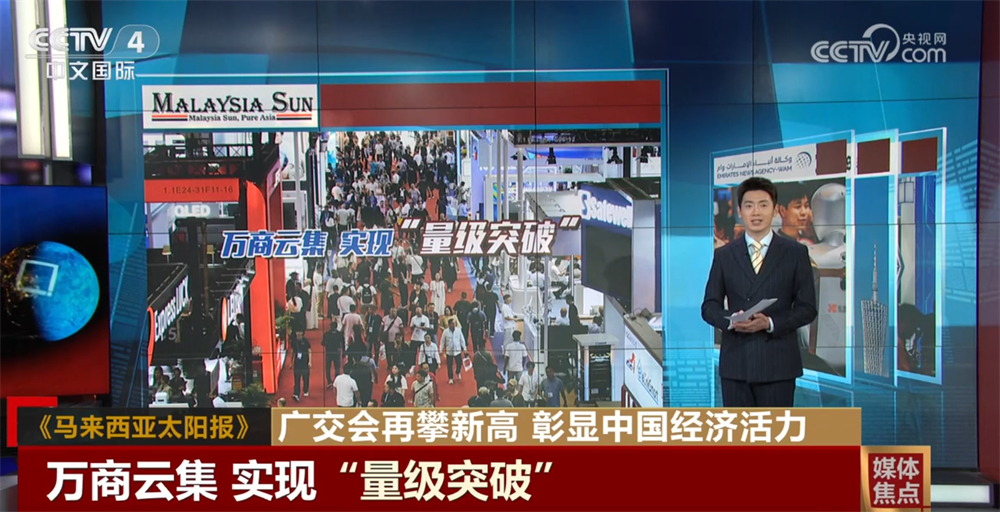
广交会“量级突破”印证中国经济底盘稳固 凸显外贸发展质效不断提升
Yang Shi Wang· 2025-10-20 06:14
Core Insights - The 138th China Import and Export Fair (Canton Fair) is being held from October 15 to November 4, with a record total of 74,600 exhibition booths and over 32,000 participating companies, marking a historical high and attracting significant international attention [1][3]. Group 1: Participation and Economic Indicators - This year's fair has surpassed 32,000 participating companies, with over 10,000 high-tech and specialized enterprises, showcasing the resilience and vitality of China's foreign trade [3]. - China's foreign trade report for the first three quarters indicates an export growth rate exceeding 7%, maintaining growth for eight consecutive quarters, reflecting a solid economic foundation [3]. Group 2: Innovation and Product Development - The fair features over 1 million new products developed in the past year, nearly 1.1 million products with independent intellectual property rights, and around 800,000 products making their debut, highlighting the ongoing R&D strength of Chinese enterprises [5]. - The event serves as a crucial window for understanding the dynamics of China's manufacturing development, showcasing a complete industrial chain and robust innovation capabilities [5]. Group 3: Global Trade and Market Integration - The Canton Fair exemplifies China's comprehensive industrial chain and mature industrial support capabilities, acting as a one-stop trade platform for global buyers [7]. - The fair facilitates efficient connections between emerging and traditional market demands, injecting more certainty into global trade [7]. Group 4: Future Directions and Trade Ecosystem - The fair focuses on "new," "intelligent," and "green" development directions, aligning with the ongoing R&D and upgrade efforts of Chinese foreign trade enterprises [9]. - The integration of online and offline models at the fair breaks spatial and temporal limitations, creating a perpetual trade ecosystem that enhances the quality and efficiency of China's foreign trade [9].
公布啦!我国前三季度经济增长5.2%,GDP为141682亿美元,全球第2
Sou Hu Cai Jing· 2025-10-20 04:13
Economic Growth - China's economy achieved a substantial growth of 5.2% in the first three quarters of 2025, with nominal GDP reaching 10,150.36 billion RMB (approximately 1,416.82 billion USD), maintaining its position as the second-largest economy globally after the United States [1][3] - The net increase in GDP for the first three quarters amounted to 396.79 billion RMB, highlighting the significant absolute growth for an economy of this scale [3] Employment and Inflation - The average urban unemployment rate remained stable at 5.2%, indicating a generally steady employment situation [3] - The Consumer Price Index (CPI) saw a slight year-on-year decrease of 0.1% due to fluctuations in food and energy prices, while the core CPI, excluding these factors, rose by 0.6%, reflecting the effectiveness of policies aimed at boosting domestic demand and consumption [3] Foreign Trade and Currency Stability - China's foreign trade demonstrated strong adaptability, with import and export volumes reaching historical highs and showing a quarterly increase, underscoring the irreplaceable position of "Made in China" in global supply chains [4] - Foreign exchange reserves remained stable at over 3.3 trillion USD, with the RMB exchange rate maintaining a reasonable and balanced level, providing ample space for domestic macroeconomic policy implementation [4] High-Quality Development - The focus on high-quality development is evident, with significant advancements in innovation and technology, as China transitions from being the "world's factory" to a "global innovation hub" [6] - The proportion of value added from equipment manufacturing and high-tech manufacturing reached 35.9% and 16.7%, respectively, indicating a structural upgrade in the economy [6] Domestic Consumption - Final consumption expenditure contributed 53.5% to economic growth, becoming the main engine of growth, supported by targeted macroeconomic policies [9] - Policies such as the consumption upgrade program have stimulated demand for major consumer goods, including home appliances and automobiles [9] Future Outlook - The foundation for achieving the annual growth target remains solid, with the 5.2% growth in the first three quarters providing a strong basis [10] - Emerging industries such as artificial intelligence, green energy, and biomanufacturing are expected to create new growth points for the economy [10] - Despite challenges from external environments and internal structural issues, the long-term positive trend of the Chinese economy is expected to continue, contributing stability and positive energy to global economic growth [12]
专家说|前三季度中国经济回升向好态势持续巩固 积极因素不断累积
Yang Shi Wang· 2025-10-20 02:31
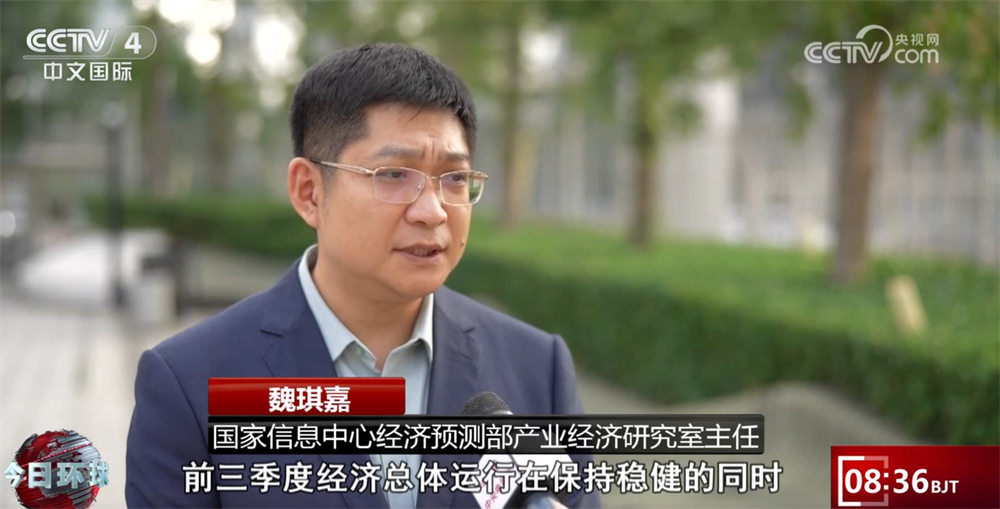
Core Viewpoint - China's economy is expected to maintain a growth rate of over 5% in the first three quarters of the year, with a focus on steady growth and structural adjustments [1][3]. Economic Performance - The overall economic performance in the first three quarters is characterized by stable growth, supported by policies aimed at expanding domestic demand and promoting consumption [5]. - The consumption market has shown steady growth, with new consumption drivers continuing to strengthen [5]. Consumption and Market Dynamics - The implementation of a 300 billion yuan subsidy for trade-ins has had a significant impact, estimated to generate a 1:10 effect on consumption [5]. - There has been a rapid growth in service consumption, particularly in cultural tourism and performances [5]. Industrial Upgrading - Significant achievements in industrial upgrading are highlighted, with rapid growth in high-tech manufacturing sectors such as new energy vehicles, integrated circuits, artificial intelligence, and high-end equipment manufacturing [7]. - The support for innovation and bold attempts by businesses in their respective fields have contributed to enhancing overall productivity [9]. Export and Market Diversification - Despite a challenging external environment, foreign trade has performed well, showcasing the resilience and upgrading benefits of Chinese industries [11]. - There is a trend towards diversifying export markets, particularly optimizing export structures [11].
前三季度GDP公布!|宏观经济
清华金融评论· 2025-10-20 02:30
Core Viewpoint - The article emphasizes that despite facing complex external and internal challenges, China's economy has shown resilience and achieved a GDP growth of 5.2% in the first three quarters of 2025, indicating a stable and progressive economic performance [4][6][8]. Economic Performance - China's GDP for the first three quarters of 2025 reached 10,150.36 billion yuan, with a year-on-year growth of 5.2%, which is an acceleration of 0.2 and 0.4 percentage points compared to the previous year and the same period last year, respectively [5]. - The average urban unemployment rate remained stable at 5.2%, while the Consumer Price Index (CPI) slightly decreased by 0.1%, with the core CPI (excluding food and energy) rising by 0.6% [5][10]. - The total import and export volume reached a historical high, with a year-on-year growth of 6.0% in the third quarter, and foreign exchange reserves remained above 3.3 trillion USD [5][10]. High-Quality Development - The article highlights the ongoing efforts towards high-quality development, with significant advancements in new production capacities and economic structure optimization [6][18]. - The proportion of added value from equipment manufacturing and high-tech manufacturing reached 35.9% and 16.7%, respectively, indicating a shift towards more advanced industries [6]. - The share of non-fossil energy consumption in total energy consumption increased by approximately 1.7 percentage points year-on-year, reflecting progress in green and low-carbon transformation [6][18]. Economic Resilience - China's economy demonstrated strong resilience, achieving a 5.2% growth rate despite global economic uncertainties and trade protectionism [7][10]. - The article notes that this growth rate is among the highest compared to other major economies, showcasing China's role as a stable and reliable driver of global economic growth [7][10]. Policy Implementation - The implementation of proactive macroeconomic policies has played a crucial role in stabilizing the economy, with measures aimed at expanding domestic demand and enhancing market vitality [13][14]. - The contribution of final consumption expenditure to economic growth reached 53.5%, an increase of 9.0 percentage points compared to the previous year, highlighting the effectiveness of consumption-boosting policies [13][14]. New Quality Productivity - The development of new quality productivity has been emphasized as a key driver for high-quality growth, with significant investments in R&D and innovation leading to advancements in various sectors [16][17]. - The added value of high-tech manufacturing increased by 9.6%, with notable growth in industries such as integrated circuits and industrial robots [16][17]. Green Transformation - The article discusses the steady progress in green transformation, with significant increases in renewable energy production and the adoption of green technologies [18][23]. - The production of new energy products, such as electric vehicles and solar batteries, has seen substantial growth, contributing to a more sustainable economic model [18][23].

国家统计局:我国经济“稳”的格局、“进”的势头、“韧”的特性没有改变 保持稳中有进发展态势具有坚实支撑
Zheng Quan Shi Bao Wang· 2025-10-20 02:21
Core Insights - The core viewpoint emphasizes that despite external challenges, China's economy has demonstrated resilience and achieved a 5.2% growth rate, positioning it as a stable and reliable source of global economic growth [1][2] Economic Performance - China's economy has shown strong resilience and potential, achieving a 5.2% growth rate this year, which ranks among the top in major economies [1] - The growth reflects China's ability to adapt and respond to instability and uncertainty in the global environment [1] External Environment - The global economic landscape is characterized by insufficient growth momentum, rising protectionism, geopolitical conflicts, and international trade frictions, which have intensified adverse impacts on the economy [1][2] - Despite these challenges, China's economic structure remains robust, with a focus on stabilizing and advancing growth [2] Domestic Challenges - There are ongoing structural contradictions in certain domestic sectors, and many enterprises are facing operational difficulties [2] - The government aims to implement counter-cyclical adjustments and enhance domestic demand to stimulate market vitality and development expectations [2]
一习话·非凡“十四五”|“推动经济实现质的有效提升和量的合理增长”
Yang Guang Wang· 2025-10-19 04:21
Core Viewpoint - The Chinese economy has made significant progress and transformative changes during the "14th Five-Year Plan" period, despite facing complex external challenges and domestic reform tasks [2][3]. Group 1 - The leadership of the Communist Party of China, centered around Xi Jinping, has played a crucial role in guiding the nation through difficulties and achieving historical accomplishments in economic and social development [2]. - The "15th Five-Year Plan" period is identified as a critical time for solidifying the foundation for socialist modernization and enhancing overall efforts [2]. - There is a strong emphasis on maintaining confidence and pursuing high-quality development to ensure effective qualitative improvements and reasonable quantitative growth in the economy [3].
中国经济圆桌会丨“十四五”前四年经济发展平均增速达到5.5%
Xin Hua Wang· 2025-10-17 12:10
Core Insights - The average economic growth rate during the first four years of the "14th Five-Year Plan" reached 5.5% [1] - The economy has successfully surpassed significant milestones of 110 trillion, 120 trillion, and 130 trillion yuan [1] - The advantages of a complete industrial system have become more prominent, with noticeable improvements in the quality and efficiency of development [1]