
产业升级

Search documents
新一轮以旧换新政策落地 消费活力显著提升
Zheng Quan Ri Bao· 2026-02-08 17:14
Core Viewpoint - The implementation of the old-for-new consumption policy is showing strong effects in boosting consumption and expanding domestic demand, with significant participation and sales figures reported in January 2023 [1][3]. Group 1: Policy Implementation and Changes - The latest data from the Ministry of Commerce indicates that in January, the old-for-new policy benefited 16.13 million people, resulting in sales of 92.56 billion yuan in automobiles, home appliances, digital, and smart products [1]. - The new policy allows local governments more autonomy in determining subsidy categories, standards, and implementation methods, encouraging support for high-efficiency, water-efficient, and environmentally friendly products [1]. - Local governments are actively exploring subsidy categories, with Jiangsu province including smart home products like robotic vacuums and smart toilets in its subsidy list while maintaining traditional categories like home appliances and automobiles [1]. Group 2: Market and Industry Implications - The expansion of the old-for-new policy to include categories like smart glasses and drones signals a shift towards "tech consumption" and "quality living," facilitating the upgrade of industries and consumer demand [2]. - Fiscal subsidies are expected to lower the entry barriers for high-quality new products, accelerating market cultivation and providing early market validation for strategic emerging industries [2]. - Local differentiated subsidies are becoming a crucial support for the ongoing effectiveness of the old-for-new policy, promoting local advantageous industries and enhancing regional competitiveness [2].
2026年乳制品行业迎投资机会:产业升级有望提振原奶需求,奶价拐点向上或助力头部乳企修复市场份额
Hua Yuan Zheng Quan· 2026-02-08 14:54
Investment Rating - The industry investment rating is "Positive" (maintained) [4] Core Viewpoints - The dairy industry is expected to see investment opportunities in 2026, driven by industrial upgrades that may boost raw milk demand and a potential upward turning point in milk prices, which could help leading dairy companies recover market share [4][8] - Supply-side dynamics indicate that raw milk prices are likely to rise, benefiting upstream farming companies. The price of fresh milk has declined for over four years, reaching 3.04 RMB/kg, a 30.6% drop from the 2021 peak of 4.38 RMB/kg. It is anticipated that the price stabilization will occur in the second half of 2025, with a turning point expected in 2026, significantly improving the performance of upstream farming companies [5] - On the demand side, there are structural opportunities in dairy product consumption, with potential for deep processing and domestic substitution to create new growth curves for dairy companies. The per capita consumption of dairy products in China is projected to be 40.6 kg in 2024, still below the 47 kg target set for 2030. The consumption structure is primarily focused on liquid milk, with low proportions of dairy solids [6] Summary by Sections - **Supply-Side Analysis**: The prolonged downturn in milk prices has been influenced by macroeconomic disturbances and the expansion led by large-scale enterprises during the previous price upturn. The ongoing losses in upstream farming companies are expected to lead to a supply-side contraction, with a price turning point anticipated in 2026 [5] - **Demand-Side Analysis**: The increasing health awareness among consumers is expected to drive the growth of low-temperature milk and cheese products, which will enhance raw milk demand. Regulatory changes are also expected to support the upgrade of the dairy industry by clarifying standards for deep-processed products and improving market access [6] - **Investment Recommendations**: Based on the positive outlook for the raw milk cycle and domestic substitution of deep-processed products, leading dairy companies are expected to benefit from the recovery of market share during the price upturn. Recommended companies include Yili Group and China Shengmu, with a focus on modern farming practices [8]



新五丰降本增效产业升级 迈向高质量发展新篇章
Zheng Quan Ri Bao Zhi Sheng· 2026-02-08 12:06
Core Viewpoint - Hunan Xinwufeng Co., Ltd. is implementing a comprehensive strategy focused on enhancing economic efficiency, optimizing production capacity, and promoting technological innovation to strengthen its core competitiveness in the pig farming industry [1][2][3] Group 1: Strategic Initiatives - The company is advancing its "Three-Year Action Plan for Cost Reduction and Efficiency Improvement," emphasizing cost control throughout the production chain [1][2] - Xinwufeng is actively optimizing production capacity by phasing out inefficient old capacities and concentrating resources on releasing high-quality production [1][3] - The company aims to enhance overall asset quality and operational efficiency to ensure stable supply in the pork market, contributing to national food security [1] Group 2: Financial Position - As of June 2025, the company has secured a bank credit limit of 6.5 billion yuan, ensuring strong financial support [2] - The comprehensive interest rate on existing loans has been reduced to 1.86% by the end of 2025, effectively lowering financial costs and enhancing profitability [2] Group 3: Technological Innovation - Xinwufeng is committed to technological innovation as a core driver of development, focusing on breeding technology and digital transformation across the entire production chain [2][3] - The company is collaborating with leading pig farming enterprises and academic institutions to achieve breakthroughs in core breeding technologies [2] Group 4: Organizational Development - The company is accelerating regional reforms in the breeding sector and enhancing talent selection and incentive mechanisms to stimulate internal motivation [3] - Xinwufeng is strengthening its biosecurity systems and improving health management to ensure stable survival rates in pig farming [3] Group 5: Future Outlook - The company is focused on driving industrial upgrades, reducing costs, enhancing profitability, and fostering research and development to achieve self-reliance [3] - Xinwufeng's leadership emphasizes a dual approach of "technological innovation" and "mechanism activation" to achieve high-quality development [3]

英国专家:当欧美都在靠印钱续命时,只有中国在死磕实体经济
Sou Hu Cai Jing· 2026-02-08 10:31
Group 1 - The article challenges the traditional notion that developed countries focus on finance while developing countries concentrate on manufacturing, highlighting China's commitment to the real economy amidst Western financial practices [1][5][14] - It emphasizes that Western economies, particularly the US and UK, have become overly reliant on financialization and capital monopolization, leading to a decline in genuine value creation [3][9] - The article points out that while Western nations experience apparent GDP growth, it is largely driven by virtual economic expansion rather than real industrial investment [5][9] Group 2 - It discusses the decline of manufacturing jobs and industrial investment in Western economies, contrasting this with China's efforts to stabilize and upgrade its manufacturing and supply chains [5][9][13] - The article notes that China's advancements in high-tech sectors such as smart manufacturing and renewable energy are the result of long-term, dedicated efforts rather than short-term financial gains [7][11] - It highlights that the current global economic competition will favor countries that can create irreplaceable value through real economic activities, with China positioning itself as a long-term player in this arena [9][11][13] Group 3 - The article critiques the Western model of wealth creation, which has led to increased inequality and a struggling middle class, while asserting that China's focus on industrial upgrades and education can provide a more sustainable social safety net [13][14] - It concludes that China's slower, more challenging path in industrial development is a strategic choice aimed at achieving future autonomy and global industrial leadership [14]


月入几万,春节都不能实现“炒货自由”?
凤凰网财经· 2026-02-08 10:20
Core Viewpoint - The article discusses the rising prices of snack foods, particularly nuts and dried fruits, during the Chinese New Year, highlighting how these items have become increasingly expensive and are perceived as luxury goods by consumers [6][30]. Price Trends - Snack prices have been climbing steadily over the past two to three years, with some items now priced at three-digit figures [6][12]. - For example, prices at popular stores like Xueji have reached exorbitant levels, such as 50 RMB per pound for mango slices and 218 RMB per pound for hand-shelled pine nuts [13][18]. Consumer Behavior - Consumers are increasingly willing to spend on these snacks during the festive season, viewing them as essential for family gatherings and social interactions [49][55]. - The act of purchasing these snacks is not just about food but also about facilitating social interactions and managing familial expectations during reunions [52][56]. Market Dynamics - The high prices are influenced by several factors, including reliance on imported nuts, which are affected by international supply chains and geopolitical issues [32][34]. - The snack industry is undergoing an "industrial upgrade," with stores moving from traditional markets to upscale locations, leading to increased operational costs that are passed on to consumers [37][41]. Industry Growth - The market for nuts and snacks is projected to exceed 300 billion RMB by 2024, indicating a significant growth trajectory for the industry [46]. - The rise of brands like Xueji has created a large consumer market, with their innovative product offerings driving demand and allowing for premium pricing [45][46].

一年四季随时体验冰雪之乐 看科技如何复刻“北国风光”
Yang Shi Wang· 2026-02-08 09:11
Group 1: Ice and Snow Economy Development - The rise of ice and snow sports has led southern cities like Xiamen to explore the potential of the ice and snow economy, creating an indoor "ice and snow world" to overcome seasonal and climatic limitations [1] - Xiamen's indoor ski resort, the largest in Fujian Province, spans approximately 15,000 square meters and features various attractions, including a 130-meter ski slope, to provide a realistic ice and snow experience [1] - The indoor temperature is maintained at -6°C while the outdoor temperature is 15°C, utilizing advanced technology such as snow-making machines and a robust insulation system to preserve the cold environment year-round [1] Group 2: Outdoor Ice and Snow Theme Park - An outdoor ice and snow theme park has recently opened in Xiamen, transforming a previously idle water park into a winter attraction through artificial snow technology [3] - The outdoor park covers about 20,000 square meters and includes various features like snow eaves, mini snow houses, and a snow slide, enhancing the winter experience for visitors [4] - The park's first-day ticket sales reached 300,000 yuan, with over 50,000 visitors in the first week, and it is expected to attract 400,000 to 500,000 visitors during the snow season [4] Group 3: Ice and Snow Equipment Export Growth - Xiamen is emerging as a production base for ice and snow sports equipment, with strong export figures, including hockey gear and ski poles used by Olympic athletes [5] - A local sports equipment company has seen significant demand from North American hockey clubs, with exports to this market accounting for half of its total revenue [6] - The overall export value of skiing equipment from Fujian Province is projected to reach 220 million yuan in 2025, marking a 51.6% year-on-year increase, with private enterprises contributing significantly to this growth [6][7]
瞄准下一个千亿级集群“加速跑” 企业“另类”突围让铁疙瘩焕新“生金”
Yang Shi Wang· 2026-02-08 03:05
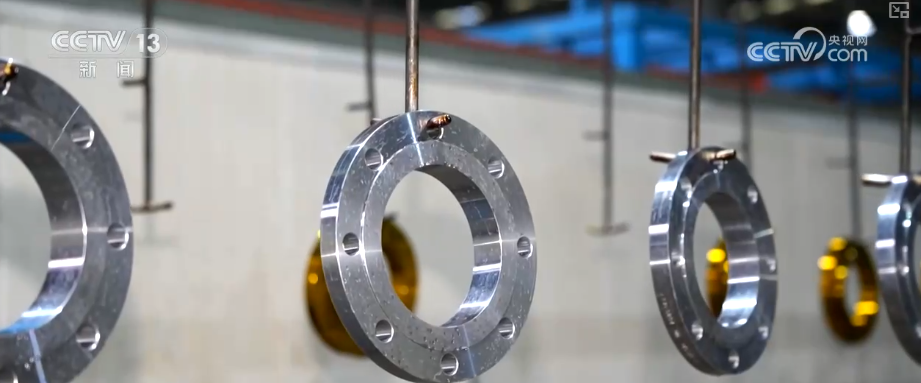
Core Viewpoint - The article highlights the transformation of the flange manufacturing industry in Dingxiang County, Shanxi, showcasing the shift from traditional low-end production to high-end, innovative manufacturing of "super" flanges made from advanced materials like super austenitic stainless steel [1][3][9]. Group 1: Industry Transformation - Dingxiang County produces nearly half of the flanges in China, with local companies adapting to market demands by upgrading their production capabilities and focusing on high-end products [1][3]. - The introduction of super austenitic stainless steel, which is two to three times harder than regular stainless steel, posed significant challenges in manufacturing, leading to a year-long trial and error process before successful production [5][7][9]. - Companies are investing approximately 3% of their total revenue, around 30 million yuan, annually into new product research and development to enhance their offerings and maintain competitiveness [9]. Group 2: Technological Advancements - The production lines in Dingxiang have evolved to include automated systems, allowing for the assembly of components into complete systems rather than just individual flanges, thus increasing product value [11][13]. - The shift from producing small flanges for pressure vessels to large flanges for wind power has positioned local companies among the top producers in the national market, with Dingxiang accounting for 60% of the country's wind power flange production [15]. Group 3: Collaborative Efforts and Support - A centralized raw material procurement platform has been established to help local flange manufacturers reduce costs and streamline supply chains, allowing for bulk purchasing from major steel mills [19][21]. - The local government has invested 690 million yuan in a forging industry service base, providing various support services, including a public quality inspection platform and a one-stop service for regulatory approvals [23]. - The county aims to achieve a forging industry output value of over 20 billion yuan by 2025, representing a 33% increase from 2021, with a long-term goal of reaching 40 billion yuan by the end of the 14th Five-Year Plan [25].
市领导与代表委员共同审议讨论各项报告
Zheng Zhou Ri Bao· 2026-02-08 02:49
Group 1 - The government work report presented by Mayor Zhuang Jianqiu is recognized as a practical and motivating document that emphasizes the importance of action and responsibility [1] - The "14th Five-Year" planning outline draft is clear in its path and solid in its measures, reflecting the requirements for high-quality development and the expectations of the people [1] - The high-tech zone is encouraged to align with the municipal party committee's "1+7+7+7" work deployment, leveraging its resource endowments and comparative advantages to excel in technological innovation, industrial upgrading, reform and opening up, efficient governance, and green transformation [1] Group 2 - Emphasis is placed on the political attributes of the CPPCC organization, the political identity of its members, and the political responsibilities of consultation [2] - Members are urged to actively promote development through in-depth research, policy suggestions, and democratic supervision, becoming participants, practitioners, and promoters of reform and development [2] - There is a call for strengthening unity and communication with non-party members and various sectors to encourage societal support for Zhengzhou's reform and development stability [2]
【大宗周刊】代表委员热议大宗商品市场发展新动向
Qi Huo Ri Bao· 2026-02-08 00:10
Group 1 - The core viewpoint of the articles revolves around the development of the commodity market in China, emphasizing high-quality economic growth and the optimization of resource allocation in the context of a new development pattern [1][3][4] - Various regions, including Shanghai's Putuo District, are focusing on creating trillion-level commodity trading platforms to enhance regional economic growth and competitiveness [2][3] - The integration of digital technology and financial services is highlighted as essential for industry upgrades, with proposals for building smart platforms that connect various industry stakeholders [9][10] Group 2 - Guangdong's approach to enhancing international competitiveness involves transitioning from policy-based to capability-based and systematic openness, aiming to support medium-sized enterprises in their internationalization efforts [5][7] - The construction of the "Golden Passage" in Yunnan is aimed at addressing logistics bottlenecks and enhancing trade, with significant growth in trade volumes reported [14][15] - The establishment of a comprehensive knowledge framework for the commodity industry is proposed to address systemic challenges and improve operational efficiency, focusing on the integration of digital transformation and financial services [16][18][19]
破解困局 建湖县近湖街道研讨会为传统产业注入“智慧芯”
Xin Lang Cai Jing· 2026-02-07 20:47
Core Insights - The seminar titled "Smart Farming and Future Cultivation" focused on the development of agricultural machinery and engineering machinery industries, gathering 16 growing enterprises from the local area along with experts and representatives to discuss industry upgrades and future development plans [1] Group 1: Industry Overview - Agricultural machinery and engineering machinery have been traditional industries in the region since the 1980s, with agricultural machinery covering the entire production chain from parts to complete machines [1] - The engineering machinery parts industry primarily supports major domestic companies like XCMG, Zoomlion, and SANY, but faces challenges such as low product added value and a lack of influential leading enterprises [1] Group 2: Future Development Strategies - Companies are focusing on technological advancements in areas like automation and new energy sources to meet market demands, with plans for cross-border e-commerce to expand international market access [2] - Experts emphasized the need for local agricultural machinery to leverage traditional and cluster advantages to capture new market opportunities, advocating for the development of key technologies such as clean energy power and remote control systems [2] Group 3: Innovation and Collaboration - The local government aims to enhance the innovation capabilities of enterprises and promote the transformation of innovative results, creating an industrial ecosystem characterized by leading enterprises, supporting clusters, and collaborative efforts [2] - A dedicated platform for cross-border e-commerce is being established to facilitate resource integration among local companies, encouraging collective efforts to enhance competitiveness in the global market [2]