
投资于人

Search documents
多方合力,让“投资于人”落到实处
Di Yi Cai Jing Zi Xun· 2025-12-17 23:56
Core Viewpoint - The article emphasizes the importance of combining investments in physical assets and human capital to promote overall investment and economic growth [2][4]. Group 1: Investment in Physical and Human Capital - Investment in physical assets includes infrastructure, housing, and machinery, which provide a solid material and technical foundation for economic development [2][4]. - Investment in human capital focuses on enhancing the capabilities and potential of individuals throughout their life cycle, including areas such as childcare, elderly care, health, education, and skills training [2][4][5]. - Current trends indicate that investment growth in physical assets is slowing, suggesting that the human capital investment sector presents significant opportunities for expansion [2][6]. Group 2: Direction of Investment - The "15th Five-Year Plan" suggests strengthening human resource development and increasing investment in social welfare sectors like elderly care, childcare, and healthcare to build a people-centered social security system [4][6]. - A combination of "hard investment" (infrastructure) and "soft construction" (knowledge and skills enhancement) is necessary to create a sustainable human capital dividend [5][6]. Group 3: Sources of Investment - Fiscal investment is a crucial source of funding, with the government allocating significant resources to healthcare, including 416.6 billion yuan for various medical insurance and support funds for 2026 [7]. - There is a need to encourage social capital investment in human capital, supported by favorable policies and a conducive environment for private sector involvement [7][8]. Group 4: Policy Implementation and Assurance - Effective implementation of human capital investment policies requires robust assessment mechanisms, including integrating human investment into statistical accounting [8]. - Local governments must adopt a long-term perspective on performance evaluation, moving away from the traditional focus on immediate returns from physical investments [8].


多方合力,让“投资于人”落到实处
第一财经· 2025-12-17 23:49
Core Viewpoint - The article emphasizes the importance of integrating investments in physical assets and human capital to promote overall investment and economic growth [3]. Group 1: Investment in Physical and Human Capital - Investment in physical assets includes infrastructure, housing, and machinery, which provide a solid foundation for economic development [3]. - Investment in human capital focuses on enhancing the capabilities and potential of individuals through education, healthcare, and skills training, representing a significant opportunity for growth [3]. - The current slowdown in investment growth indicates that traditional sectors like infrastructure are nearing saturation, while human capital investment remains a vast untapped market [3]. Group 2: Direction of Investment - The "14th Five-Year Plan" suggests strengthening human resource development and increasing investment in social welfare sectors such as elderly care, childcare, and healthcare [5]. - A combination of "hard investment" (infrastructure) and "soft construction" (knowledge and skills enhancement) is essential for maximizing the benefits of human capital [5][6]. - The focus on human capital investment aims to convert the existing population advantage into a talent resource advantage necessary for high-quality development [5]. Group 3: Sources of Investment - Fiscal investment is a crucial source of funding, with the government allocating significant resources to healthcare, including a projected 4,166 billion yuan for various medical insurance and support funds by 2026 [7]. - The article highlights the need for social capital to complement government funding, encouraging private investment in social welfare sectors [7]. - Policies are being implemented to reduce barriers for social capital investment, including legal frameworks that support private sector involvement in human capital development [7]. Group 4: Ensuring Policy Implementation - Effective implementation of human capital investment policies requires robust assessment mechanisms for local governments [8]. - Establishing comprehensive statistical systems to include human investment in national accounts is essential for tracking progress [8]. - A shift in performance evaluation away from traditional physical investment metrics towards long-term social benefits is necessary for fostering a balanced investment approach [8].

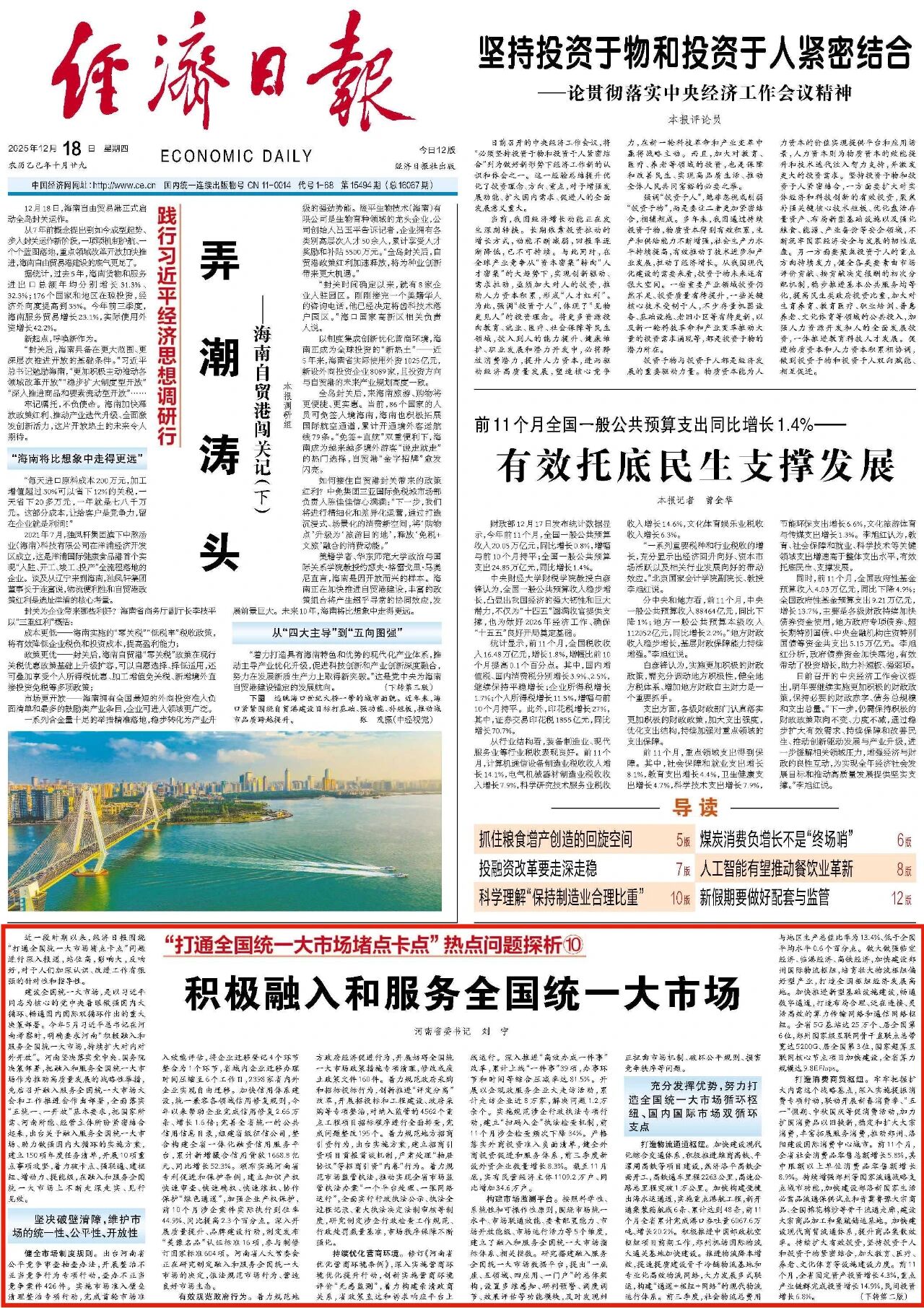
《经济日报》刊发刘宁署名文章:积极融入和服务全国统一大市场
Jing Ji Ri Bao· 2025-12-17 23:35
Core Viewpoint - The article emphasizes the importance of integrating and serving the national unified market as a strategic measure for promoting high-quality development in Henan Province, aligning with the central government's directives to strengthen domestic circulation and facilitate international exchanges [2][20]. Group 1: Implementation of National Unified Market - Henan has established a comprehensive implementation plan with 150 annual tasks and 10 key initiatives to enhance connectivity and remove barriers in the national unified market [2][20]. - The province has held conferences to promote the integration and service of the national unified market, focusing on the "Five Unifications and One Opening" principle [2][20]. Group 2: Market Regulation and Fair Competition - The province has introduced measures to ensure market unity, fairness, and openness, including the establishment of a fair competition review system and the resolution of 426 cases of unfair competition [3][4]. - A special action to clear market access barriers has streamlined the process for business relocations, reducing the time for enterprise migration to six working days [3][4]. Group 3: Optimizing Business Environment - Henan has revised its business environment regulations and implemented actions to enhance the efficiency of administrative processes, achieving an 81.5% reduction in processing time for various business-related tasks [5][21]. - The province has conducted extensive outreach to businesses, visiting nearly 80,000 companies and resolving over 12,000 issues [5][21]. Group 4: Infrastructure and Logistics Development - The province is advancing the construction of a modern transportation system, with high-speed rail and highway projects contributing to a total of 2,263 kilometers of high-speed rail and over 10,000 kilometers of highways [6][22]. - Henan has also focused on enhancing its logistics capabilities, achieving a 20.2% increase in port throughput, totaling 60.68 million tons in the first eleven months [6][22]. Group 5: Economic Growth and Investment - The province has seen a 4.3% increase in fixed asset investment, with key industrial sectors experiencing a 14.9% growth in investment [7][21]. - The number of newly established foreign-funded enterprises increased by 8.3% in the first three quarters, reflecting a positive trend in foreign investment [5][21]. Group 6: International Trade and Connectivity - Henan has expanded its international logistics capabilities, with 68 international freight routes established, connecting to 32 countries, and a 24.6% increase in cargo throughput at Zhengzhou Airport [9][22]. - The province's total import and export value reached 840.24 billion yuan, growing by 13.5% year-on-year, ranking it 10th in the country [9][22].
一财社论:多方合力,让“投资于人”落到实处
Di Yi Cai Jing· 2025-12-17 13:05
Group 1 - The core viewpoint emphasizes the need to strengthen policy support for investment, focusing on where to invest, who will invest, and how to ensure these investments are effective [1][8] - Investment in physical assets and human capital are two complementary aspects that promote overall investment, as highlighted in the "14th Five-Year Plan" and reiterated in the recent Central Economic Work Conference [2][4] - Current investment growth in China is slowing, indicating that infrastructure investment is nearing saturation, while investment in human capital presents a significant opportunity [2][5] Group 2 - The "14th Five-Year Plan" suggests enhancing human resource development and increasing investment in social welfare sectors such as elderly care, childcare, and healthcare to build a people-centered social security system [4][6] - Fiscal investment is a crucial source of funding, with the government allocating 416.6 billion yuan for medical insurance and related services, indicating a shift in fiscal spending towards education, healthcare, and social welfare [6][7] - Encouraging social capital to invest in human capital is essential, requiring policy adjustments and a conducive environment to attract private investment [6][7] Group 3 - Ensuring the implementation of policies related to human capital investment is vital, necessitating enhanced assessment mechanisms for local governments and the establishment of relevant statistical systems [8] - The integration of investment in physical and human capital will lead to adjustments in various relationships, directing investments towards more effective and sustainable long-term development [8]
从“供需失衡”到“投资于人”,2026经济政策逻辑要换赛道?
Sou Hu Cai Jing· 2025-12-16 13:02
Group 1 - The core viewpoint of the meeting is to set the economic policy direction for 2026, which will influence the economic landscape for the next five years, especially in the context of complex global changes [2][3] - The meeting labeled the economic work for 2025 as "extraordinary," acknowledging the challenges posed by external factors such as trade wars and geopolitical conflicts, while also highlighting the successful completion of major economic goals for the "14th Five-Year Plan" [3] - A notable shift in focus is the emphasis on the "strong supply and weak demand" contradiction, indicating a more balanced approach to addressing both supply and demand issues in the economy [3][4] Group 2 - The meeting prioritized "domestic demand-led growth and building a strong domestic market" as the first of eight key tasks for 2026, followed by fostering new growth drivers and reforming competitive practices [4] - The macroeconomic policy direction for 2026 is defined as "seeking progress while maintaining stability," with a new emphasis on improving quality and efficiency rather than solely pursuing GDP growth [6] - The meeting highlighted the importance of "investing in people," indicating a shift towards recognizing human capital as a critical factor in economic development, which aims to enhance domestic market strength and innovation [9][10]
投资于物和投资于人紧密结合,潜力巨大
2 1 Shi Ji Jing Ji Bao Dao· 2025-12-16 12:03
Group 1 - The central economic work conference emphasizes the need to stabilize investment and expand domestic demand as a priority for the upcoming year, with a focus on combining "investment in people" and "investment in things" to unlock significant potential [1][6] - The government plans to increase the scale of central budget investments and optimize the management of local government special bonds to stimulate private investment [1][6] - The upcoming year marks the beginning of the "15th Five-Year Plan," which will accelerate the launch of various strategic emerging industries and future industry projects, supported by ample financial tools and special bond reserves [1][6] Group 2 - In November, the social financing scale increased by 24,885 billion yuan, exceeding market expectations, with a notable contribution from non-standard financing and corporate bond financing rather than traditional credit demand [2][3] - The contribution of credit to social financing decreased in November, with new RMB loans amounting to 4,053 billion yuan, reflecting insufficient effective demand in the macroeconomic environment [2][3] - Corporate loans in November totaled 6,100 billion yuan, primarily driven by an increase in bill financing, indicating a shift in financing sources as companies focus on settling accounts near year-end [3] Group 3 - Non-standard financing saw a year-on-year increase of 1,328 billion yuan in November, while corporate bond financing rose by 1,788 billion yuan, highlighting the importance of off-balance-sheet financing in the current economic context [3][4] - The M1 growth rate declined due to a high base effect, while M2 growth also decreased, influenced by the reduction in credit and its impact on derived deposits [4] - The central economic work conference has shifted its focus from social financing and M2 to economic growth and price recovery, indicating a change in policy priorities [4] Group 4 - In November, the industrial added value for large-scale enterprises grew by 4.8% year-on-year, with a cumulative growth of 6.0% from January to November, reflecting a strong performance in the supply side of the economy [5][6] - Fixed asset investment from January to November showed a year-on-year decline of 2.6%, with significant growth in equipment purchases indicating a trend towards modernization and digitalization in industrial production [5][6] - The government is expected to implement policies supporting large-scale equipment updates in 2024, with additional funding of approximately 150 billion yuan allocated for this purpose [6] Group 5 - In November, the total retail sales of consumer goods reached 43,898 billion yuan, growing by 1.3% year-on-year, although this represented a decline compared to October [7] - The central economic work conference has proposed actions to boost consumption, including plans to increase urban and rural residents' income and optimize the supply of quality goods and services [7] - The resilience of foreign trade has contributed to stable economic growth, but challenges remain for the upcoming year, necessitating measures to maintain exchange rate stability and support exports [7]
投资于人,投给谁、怎么投?
Jing Ji Wang· 2025-12-16 06:23
Core Viewpoint - The "15th Five-Year Plan" emphasizes the integration of investments in both material and human resources, highlighting the importance of investing in people for high-quality development [1][2]. Group 1: Investment in People - Investment in people is essential for high-quality development, reflecting the unity of development goals and methods [2]. - The plan aims to transform the demographic advantage into a talent resource advantage necessary for high-quality development [2][4]. - The focus of investment is on meeting the people's aspirations for a better life, addressing various dimensions of social needs [4]. Group 2: Implementation Framework - The "15th Five-Year Plan" outlines a multi-dimensional and full-cycle implementation framework for investing in people [5]. - Investments must target the enhancement of human capital quality to adapt to profound industrial changes, emphasizing the need for high-quality talent and innovative workers [6]. - The plan stresses the cultivation of various types of talent, including strategic scientists and skilled workers, aligning individual growth with national strategic needs [6][7]. Group 3: Lifelong Investment - Investment in people should span the entire life cycle, focusing on equitable and inclusive principles [8]. - The plan aims to reduce the costs of childbirth, upbringing, and education, alleviating family pressures and ensuring fair opportunities for all [8]. - It also addresses urban-rural disparities in public services and development opportunities, promoting a friendly society for the elderly [8]. Group 4: Cultural and Spiritual Investment - Investment in people includes nurturing the spiritual dimension, aiming for a balance between material wealth and spiritual richness [9]. - The plan seeks to enrich public cultural services and promote core socialist values, fostering a positive and harmonious social atmosphere [9]. - This investment is seen as crucial for the comprehensive development of individuals and society, contributing to national rejuvenation [9].
国务院发展研究中心原党组书记马建堂:“投资于人”要更着力于低收入群体、困难群体
Ge Long Hui· 2025-12-16 04:37
Core Viewpoint - The emphasis on a "people-centered" approach in the 20th Central Committee's Fourth Plenary Session recommendations highlights the need to integrate investments in both material and human resources more closely [1] Group 1: Economic Development - The recommendations outline various tasks related to achieving common prosperity for the people, focusing on narrowing income distribution gaps [1] - It is essential to remember that high-quality development must solidly promote common prosperity [1] Group 2: Efficiency and Fairness - The relationship between production and distribution must be correctly managed, prioritizing efficiency while also paying more attention to fairness [1] - The recommendations stress the importance of balancing the "raising" and "lowering" aspects of economic policies, particularly focusing on low-income and disadvantaged groups in social welfare investments [1]
投资于物和投资于人紧密结合 明年财政政策“工具箱”有望进一步扩容
Zhong Guo Zheng Quan Bao· 2025-12-15 21:39
Group 1 - The core viewpoint of the articles emphasizes the effectiveness of proactive fiscal policies in supporting major national strategies, expanding domestic demand, stabilizing growth, and improving people's livelihoods in 2025 and the continuation of these policies into 2026 [1][2][3]. Group 2 - In 2025, significant fiscal measures included the allocation of 800 billion yuan in special bonds to support major projects, which involved 1,459 projects in key areas such as ecological restoration and transportation infrastructure [2]. - The consumer goods replacement policy led to a 26.5% increase in sales revenue for home appliances and a 20.3% increase for communication retail in the first eleven months of 2025 [2]. - The fiscal spending since the 14th Five-Year Plan has directed over 70% towards improving people's livelihoods, indicating a strong focus on social welfare [2]. Group 3 - The fiscal policy has played a crucial role in boosting consumption and expanding investment, contributing to the achievement of economic and social development goals [3]. - Investment in human capital through subsidies for childcare and education is seen as essential for high-quality development and improving residents' living standards [3]. Group 4 - The government plans to optimize expenditure structures and enhance financial support for major national strategies, focusing on investments in human capital and expanding domestic demand [4]. - The Ministry of Finance has outlined strategies to promote income growth and optimize income distribution to stimulate consumption [4]. Group 5 - Experts suggest that policies aimed at expanding domestic demand, such as the consumer goods replacement policy, may need optimization to avoid diminishing returns [5]. - There is potential for expanding the subsidy range to include new consumption-related products, such as AI products and electric vehicle charging stations [6]. Group 6 - The government aims to leverage various types of government bond funds to support major projects and enhance the effectiveness of fiscal policies [7]. - Optimizing project reserves and expanding the fiscal "toolbox" are seen as ways to improve the effectiveness of investment policies [8].
明年财政政策“工具箱”有望进一步扩容
Zhong Guo Zheng Quan Bao· 2025-12-15 20:19
Core Viewpoint - The article emphasizes the effectiveness of proactive fiscal policies in 2025, which have supported major national strategies, expanded domestic demand, stabilized growth, and improved people's livelihoods. It anticipates continued expansionary fiscal policies in 2026, focusing on both material and human investments [1][2]. Group 1: Fiscal Policy Effectiveness - In 2025, proactive fiscal policies significantly supported major national strategies, with 800 billion yuan allocated for "two重" construction and 1,880 billion yuan for equipment upgrades, leading to a 10.7% year-on-year increase in machinery and equipment purchases from January to November [1]. - Increased spending in the livelihood sector was noted, with sales in supported retail sectors growing by 26.5% and 20.3% year-on-year, respectively, from January to November [1]. - Over 70% of national fiscal spending since the start of the "14th Five-Year Plan" has been directed towards improving people's livelihoods, according to the Minister of Finance [1]. Group 2: Investment in People and Material - Fiscal policies in 2025 met expectations in material investments, while policies aimed at human investments, such as childcare subsidies and free preschool education, contributed to high-quality population development [2]. - The combination of material and human investments is seen as essential for high-quality development and improving residents' living standards, creating a virtuous cycle of new demand and supply [2]. Group 3: Future Policy Directions - The Ministry of Finance plans to optimize spending structures and enhance financial support for major national strategies, focusing on increasing funding for human investments and expanding domestic demand [3][4]. - Policies supporting "two重" and "two新" will continue, with an emphasis on utilizing government bond funds and increasing central budget investments to stabilize and boost investment [5]. - Experts suggest that optimizing project reserves and expanding the fiscal "toolbox" will enhance the effectiveness of material investment policies [5][6].