
产业集群

Search documents
走进科创园区|长三角绿洲智谷加“数”蝶变
Xin Hua Cai Jing· 2025-08-27 15:18
Core Insights - The article highlights the rapid development of the Changjiang Delta Oasis Zhigu Park in Qingpu District, which is becoming a hub for digital economy and innovation, integrating ecological and technological advancements [1][2][8] Group 1: Industry Development - The park is positioned within the Yangtze River Delta Integration Demonstration Zone and is closely aligned with Shanghai's new industrial system, focusing on digital economy and digital energy [2][3] - Over 300 companies have been attracted to the park, with more than 70 physical enterprises, and over half of them related to the digital economy [2][6] - Key players such as Huawei Digital Energy and Bull Group have established their headquarters in the park, contributing to significant industrial clustering and radiation effects [2][3] Group 2: Innovation and Collaboration - The park emphasizes collaboration between enterprises and research institutions, fostering innovation in synthetic biology and other fields through partnerships with local universities and research centers [3][5] - The establishment of the Changjiang Delta Innovation Center, covering over 9,000 square meters, provides a comprehensive service system for startups, including incubation and acceleration services [5][6] - The "Xiangxin Loan" financial product aims to support local enterprises with personalized financial solutions, with an expected total credit limit exceeding 1.8 billion [6] Group 3: Digital Transformation - The park utilizes digital tools to enhance operational efficiency in key areas such as environmental monitoring and public services, exemplified by the "i Zhigu" service platform launched in 2022 [4][6] - The integration of digital technologies is driving both enterprise growth and the park's own digital upgrade [4][6] Group 4: Talent Attraction and Community Development - The park has developed over 1,500 talent apartments, achieving over 70% occupancy, to attract and retain talent from leading companies [8][9] - A variety of community facilities, including recreational and service centers, have been established to enhance the living experience for residents [9] - The park is recognized for its commitment to ecological development, with multiple projects receiving prestigious environmental certifications [8][9]
市值“一哥”十年变迁,成都向新
Mei Ri Jing Ji Xin Wen· 2025-08-27 15:00
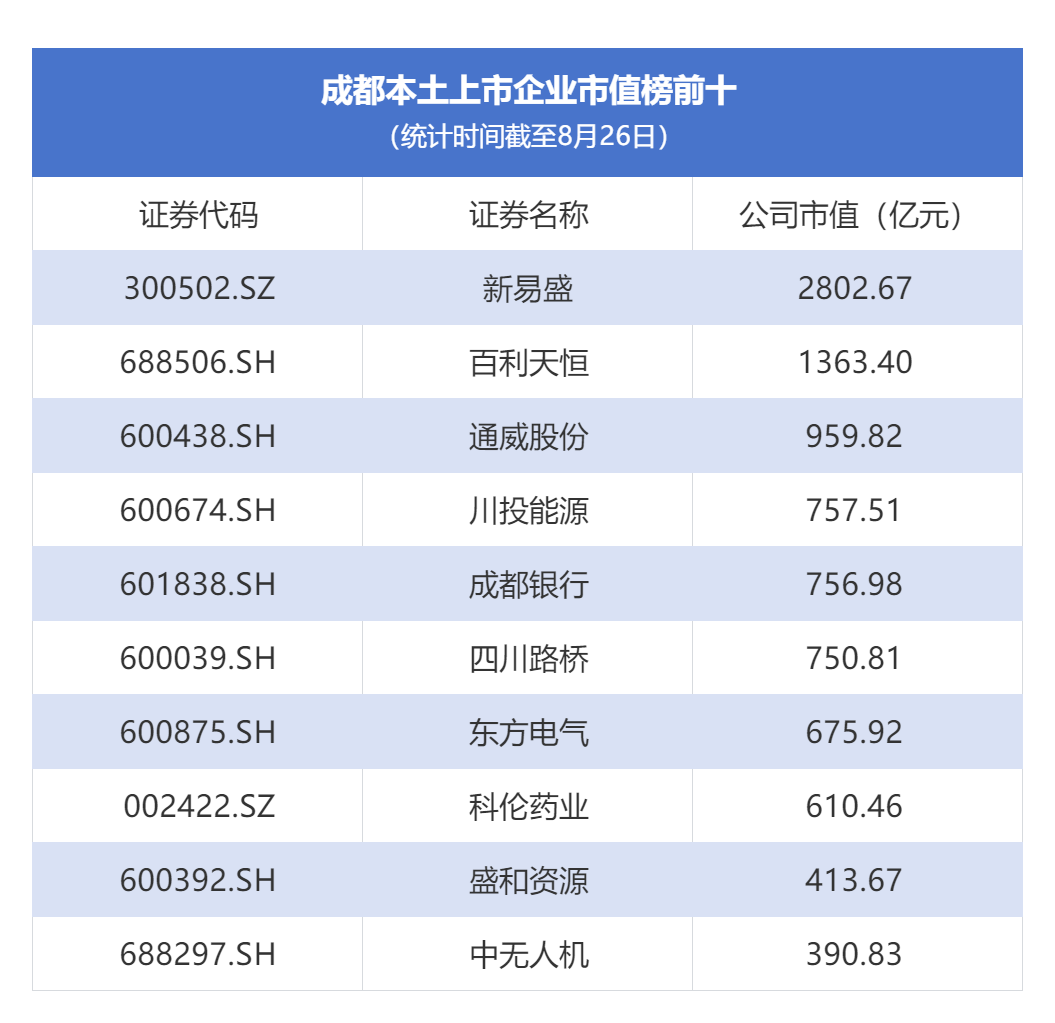
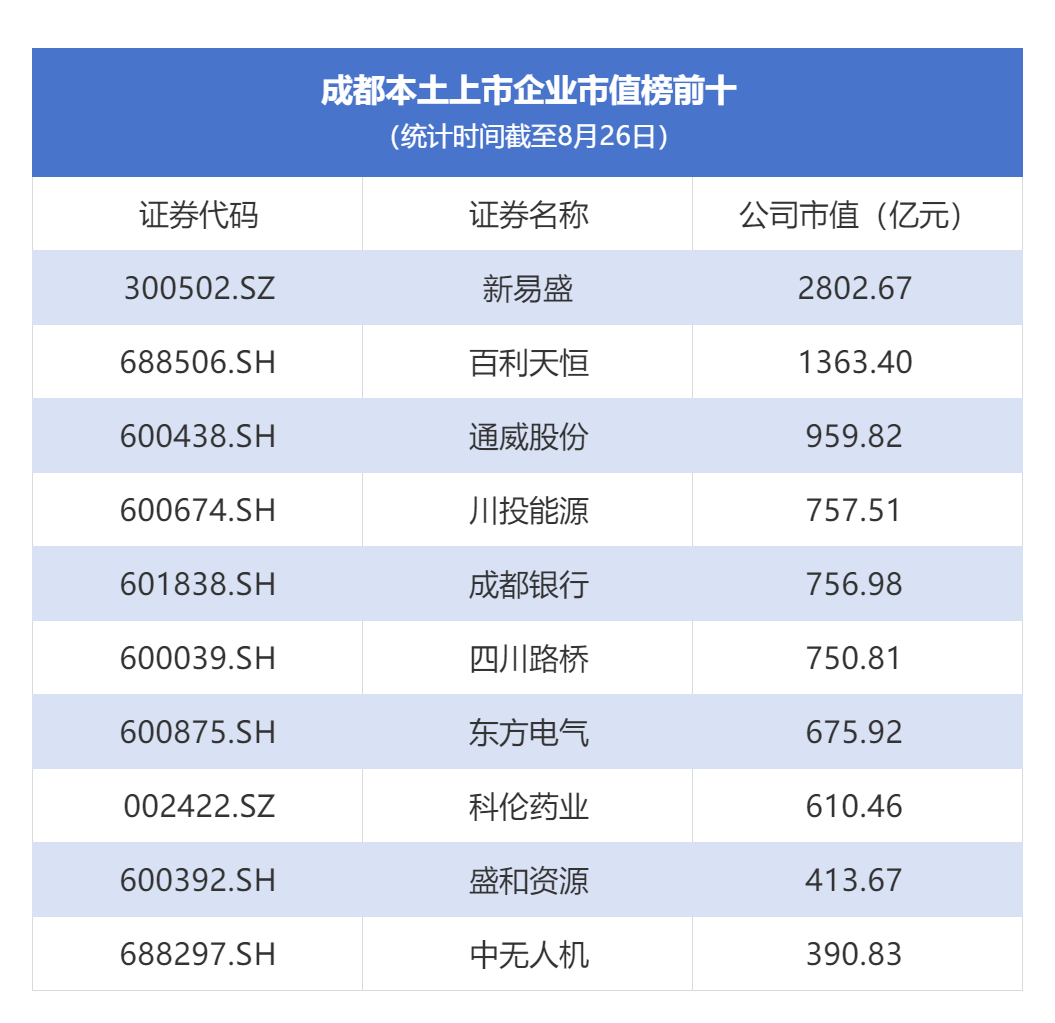
Core Insights - Chengdu's local listed companies have achieved a historic milestone with two companies, Xinyi and Baili Tianheng, surpassing a market capitalization of 100 billion yuan, marking the first time the city has had "double billion" companies [1][6] - The market capitalization is a crucial indicator of a company's overall strength, and the presence of billion-yuan companies remains rare among over 5,000 listed companies in A-shares [1][6] - The ranking of Chengdu's listed companies has undergone significant changes, influenced by factors beyond just market valuation, including industry dynamics and company performance [1][6] Market Capitalization Rankings - As of August 26, the top ten Chengdu listed companies by market capitalization are: 1. Xinyi: 2802.67 billion yuan 2. Baili Tianheng: 1363.40 billion yuan 3. Tongwei: 959.82 billion yuan 4. ChuanTuo Energy: 757.51 billion yuan 5. Chengdu Bank: 756.98 billion yuan 6. Sichuan Road and Bridge: 750.81 billion yuan 7. Dongfang Electric: 675.92 billion yuan 8. Kelun Pharmaceutical: 610.46 billion yuan 9. Shenghe Resources: 413.67 billion yuan 10. Zhongwu Drone: 390.83 billion yuan [1][7] Historical Context - Chengdu first saw a billion-yuan company in 2015, but the milestone was short-lived, with the market capitalization of Guojin Securities dropping below 500 billion yuan within six months [2][3] - From 2015 to 2019, the market capitalization rankings were dominated by Guojin Securities, ChuanTuo Energy, Kanghong Pharmaceutical, and Tongwei, with the top company fluctuating around 500 billion yuan [3][5] - The resurgence of billion-yuan companies began in 2020 with Tongwei surpassing 1 billion yuan, followed by a significant increase in market capitalization for other companies [5][6] Emerging Companies and Industries - New entrants to the billion-yuan market include Xinyi and Baili Tianheng, which represent new industries such as AI, photovoltaic energy, and innovative pharmaceuticals [8][9] - Xinyi specializes in optical modules, facilitating high-speed data transmission, while Baili Tianheng focuses on innovative ADC drug development for cancer treatment [9][10] - Chengdu's industrial landscape is evolving, with the city launching a future industry fund aimed at sectors like humanoid robots and gene therapy, indicating a strategic push towards innovation [10][13] Industry Development - Chengdu has established itself as a hub for electronic information and innovative pharmaceuticals, with significant investments and a growing number of listed companies in these sectors [12][13] - The city has developed two trillion-yuan industrial clusters and several other significant industry clusters, showcasing its capacity for economic growth and innovation [13][14] - The presence of long-established companies in these sectors, such as Tongwei and Baili Tianheng, highlights the importance of sustained investment and development in achieving high market valuations [12][14]



市值“一哥”十年变迁 成都向新
Mei Ri Jing Ji Xin Wen· 2025-08-27 14:59
Core Insights - Chengdu's local listed companies achieved a historic milestone in August with the emergence of two companies, Xinyi Technology and Baili Tianheng, surpassing a market capitalization of 100 billion yuan, marking the first time the city has seen "double billion" companies [1][5] - The market capitalization is a crucial indicator of a listed company's overall strength, and billion-yuan companies remain rare among over 5,000 listed companies in A-shares [1][5] - The ranking of Chengdu's listed companies has undergone significant changes, influenced by factors beyond just market valuation [1][5] Market Capitalization Rankings - As of August 26, the top ten Chengdu listed companies by market capitalization are: 1. Xinyi Technology: 2802.67 billion yuan 2. Baili Tianheng: 1363.40 billion yuan 3. Tongwei Co., Ltd.: 959.82 billion yuan 4. Chuan Investment Energy: 757.51 billion yuan 5. Chengdu Bank: 756.98 billion yuan 6. Sichuan Road and Bridge: 750.81 billion yuan 7. Dongfang Electric: 675.92 billion yuan 8. Kelun Pharmaceutical: 610.46 billion yuan 9. Shenghe Resources: 413.67 billion yuan 10. Zhong Wuyun Drone: 390.83 billion yuan [1][7] Historical Context - The first billion-yuan company in Chengdu was Guojin Securities, which reached a market cap of 1027.68 billion yuan in June 2015 but did not maintain this status for long [3][4] - From 2015 to 2019, the market capitalization rankings were dominated by four companies: Guojin Securities, Chuan Investment Energy, Kanghong Pharmaceutical, and Tongwei Co., Ltd., with market caps around 500 billion yuan [3][4] - In 2020, Tongwei Co., Ltd. broke the billion-yuan mark again, reaching 1730.4 billion yuan by year-end, leading to a new competitive landscape [4][5] New Entrants and Industries - The recent rankings feature new entrants such as Baili Tianheng, Xinyi Technology, and Jiachitech, with many companies representing emerging industries like AI, photovoltaic new energy, and innovative pharmaceuticals [8][9] - Xinyi Technology specializes in optical modules, facilitating data transmission in the digital world, while Baili Tianheng focuses on innovative ADC drug development for cancer treatment [9][10] Industrial Development - Chengdu has launched a future industry fund with an initial scale of 112 billion yuan, targeting sectors like humanoid robots, next-generation mobile communications, and gene therapy [10][15] - The city has developed two trillion-yuan industrial clusters in electronic information and equipment manufacturing, along with several other significant industry clusters [14][15]
中国外卖袋占领非洲
投资界· 2025-08-26 07:30
Core Viewpoint - The article highlights the unexpected popularity of Chinese takeaway bags in Africa, driven by local demand and the impact of plastic bans in various African countries [4][12][15]. Group 1: Market Overview - The global packaging bag market is projected to grow from $185 billion in 2023 to $240 billion by 2028, with food and retail sectors being the primary demand drivers [7]. - Chinese takeaway bags are priced between 0.1 to 0.3 RMB, with significant profit margins for international transport to Africa [7][9]. Group 2: Cultural and Economic Impact - African consumers have adopted Chinese takeaway bags as fashionable items, with certain designs fetching higher prices due to their perceived quality and aesthetic appeal [5][10]. - The introduction of strict plastic bans in countries like Kenya has created a market gap that Chinese takeaway bags have filled, as local alternatives are often more expensive and less accessible [12][15]. Group 3: Industry Dynamics - The Chinese non-woven fabric industry has rapidly evolved, with production reaching approximately 856,100 tons in 2022, showcasing a compound annual growth rate of 7% since 2014 [21]. - The industry benefits from a complete supply chain and cluster effects, particularly in regions like Hubei and coastal provinces, enhancing responsiveness and innovation [22][23]. Group 4: Environmental Considerations - The article discusses the environmental challenges posed by plastic waste in Africa, leading to stringent regulations that have inadvertently boosted the demand for alternative packaging solutions like Chinese takeaway bags [16][17]. - The effectiveness of these bans is debated, as they can lead to increased costs for consumers and impact local manufacturing jobs [17].

聚焦高质量发展|安徽灵璧:小轴承“转”出“智造”新天地
Xin Hua Wang· 2025-08-25 09:23
Core Viewpoint - The bearing industry in Lingbi County, Anhui Province, has developed a complete industrial chain from bearing steel pipe manufacturing to assembly, research, and testing, aiming to create a "100 billion cluster" and promote intelligent manufacturing in the sector [1][12]. Group 1: Industry Development - The bearing industry is crucial for equipment manufacturing, serving various applications from watches to airplanes [1]. - Lingbi County has established a bearing industry park that has grown from 4,000 square meters to 12,000 square meters, with over 300 product categories developed in five years [2]. - The county has attracted numerous bearing and supporting enterprises, leading to a significant increase in production capacity and value, with the industry park expected to exceed 4 billion yuan in output by 2024 [15]. Group 2: Innovation and Technology - Companies in Lingbi are focusing on continuous innovation, utilizing new technologies, materials, and processes to develop high-precision and high-performance mechanical products [4]. - The county has nurtured 13 high-tech enterprises and 5 strategic emerging industry companies, with a technology contract transaction volume of 3 billion yuan [6]. - The implementation of an innovation-driven development strategy has strengthened the role of enterprises in technological advancements [4][6]. Group 3: Government Support and Talent Development - The local government provides comprehensive support to enterprises, including fixed asset investment, factory leasing, financing guarantees, and tax incentives [9]. - A collaborative mechanism integrating production, education, research, and inspection has been established, resulting in the training of 760 skilled talents in the bearing industry [11]. - The establishment of a technician college in partnership with Hefei University of Technology aims to enhance the skill set of the workforce in the bearing sector [11]. Group 4: Future Prospects - The Lingbi bearing industry is transitioning towards high-end, intelligent, and green manufacturing, with plans to become a leading hub for high-quality bearing production [15]. - The industry is expected to continue attracting investment and talent, contributing to the overall economic development of the region [12].
盛泽纺企组团参加2025intertextile秋冬家纺展
Su Zhou Ri Bao· 2025-08-25 09:06
Group 1 - The 2025 China International Home Textile and Accessories (Autumn and Winter) Expo is being held at the National Exhibition and Convention Center (Shanghai) [1] - The Shengze exhibition group showcases high-quality home textile fabric products, highlighting the influence and charm of "Shengze Weaving" as the largest textile industry cluster in the country [1] - Over 30 Shengze home textile enterprises, including Zhongguan Textile, Qianhang Industrial, and Zhongtao Textile, are participating in the expo to display their flagship products [1] Group 2 - The Wujiang District Home Textile Association makes its debut with an independent booth, prominently located on the main aisle of the exhibition area, promoting collaborative development among member enterprises [1] - In recent years, Shengze has focused on a "1+3+N" industrial structure, centering on high-end textiles and targeting three key areas: new materials (new energy), intelligent equipment, and modern services [1] - The industry is aiming to enhance competitiveness through optimizing industrial structure, strengthening technological innovation, and promoting organic renewal [1]
甘坐冷板凳 啃下硬骨头
Liao Ning Ri Bao· 2025-08-25 01:27
Core Viewpoint - The development of large industrial projects in Huludao is crucial for the city's economic growth, demonstrating the importance of long-term investment and commitment to high-quality development [2][3][9]. Group 1: Industrial Development - The construction of four nuclear power units by China Nuclear Power Liaoning Co., Ltd. in Huludao is expected to generate an annual output value increase of over 3 billion yuan, with the first unit set to be operational in the second half of next year [1]. - The fixed asset investment in Huludao has doubled over the past four years, while the revenue of large-scale industrial enterprises has remained relatively stable, indicating the long-term nature of industrial projects [1][2]. - The city has implemented 670 key projects with a total investment of 271 billion yuan, of which 252 are industrial projects [6][10]. Group 2: Economic Strategy - Huludao's government has recognized that industrial development is essential for economic stability and growth, likening it to the skeletal structure of a body [2][3]. - The city has chosen to focus on long-term, impactful projects rather than short-term gains, demonstrating a commitment to enduring economic development [2][3]. Group 3: Investment Environment - The local government has improved the business environment, significantly reducing the time required for project approvals, as seen in the China Sinochem Yangnong project, which completed various approvals in record time [5][6]. - The city has adopted a proactive approach to project management, with dedicated teams ensuring timely execution and resolution of issues [5][6]. Group 4: Emerging Industries - Huludao has developed eight industrial clusters, enhancing its competitive edge in the economy, with significant contributions from large projects attracting smaller enterprises [9][10]. - The city is diversifying its industrial base, moving away from coal dependency towards renewable energy projects, with over 1.6 billion yuan invested in new energy initiatives [10][11]. Group 5: Future Outlook - The local government anticipates that the economic foundation laid during the 14th Five-Year Plan will lead to significant advancements in the 15th Five-Year Plan, aiming for continuous revitalization of the economy [11].
新一线城市:重庆第3,郑州险胜天津,济南、无锡皆无缘
Sou Hu Cai Jing· 2025-08-22 21:07
Group 1 - Chengdu and Hangzhou continue to lead the new first-tier cities, while Chongqing has risen to third place, showcasing the potential for western cities to break through [2] - Chongqing's digital economy core industry value has exceeded 500 billion, contributing significantly to its development [2] - The city is actively constructing international consumption centers, with major projects like the Cuntan International New City nearing completion, indicating substantial consumer potential [2] Group 2 - Zhengzhou and Tianjin are in a close competition for the tenth position, with Zhengzhou benefiting from national policy advantages and achieving notable success in technological innovation [3] - Zhengzhou's population has surpassed 13.5 million, and it has introduced a new talent policy to attract more residents [3] - Tianjin, despite ranking eleventh, has made significant strides in artificial intelligence, with its innovation index ranking among the top three nationally for seven consecutive years [3] Group 3 - The competition among Chinese cities is intensifying, as evidenced by the "2025 New First-tier City Charm Ranking," which reflects the current standings and development trends [4] - Cities like Wuxi and Jinan failed to make the top fifteen, despite their strong industrial outputs, indicating a need for improvement in talent attraction and hub capabilities [6] - Emerging cities like Hefei and Dongguan are rising in rankings due to their focus on future industries and advanced manufacturing, highlighting the increasing importance of technological strength in urban charm assessments [8]
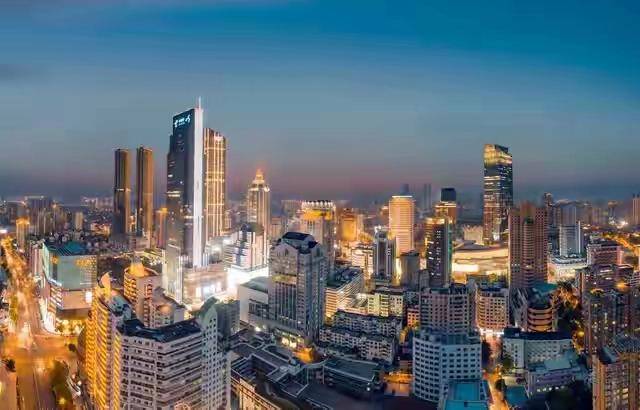
像搭积木般建产业链 安徽马鞍山拼出发展新高度
Zhong Guo Xin Wen Wang· 2025-08-21 07:32
Core Viewpoint - The article highlights the development of Ma'anshan Economic Development Zone in Anhui Province, focusing on industrial clustering, innovation-driven growth, and an improved business environment to achieve high-quality economic development [1][5]. Group 1: Industrial Development - Ma'anshan Economic Development Zone is concentrating on new energy vehicles and components, with a focus on "three smart" and "three electric" emerging industries, strengthening its main industries of equipment manufacturing, green food, and energy electronics [2]. - Hanma Technology, a leading company in the new energy commercial vehicle sector, reported a year-on-year increase in production and sales of new energy vehicles by 126.83% and 130.46%, respectively, with a significant export growth of 149% [2]. - The zone has attracted 222 industrial enterprises, including 4 listed companies, and signed 35 projects worth over 100 million yuan in the first seven months of the year [2]. Group 2: Innovation and Technology - Five companies from the Ma'anshan Economic Development Zone won awards in the 2023 Anhui Province Science and Technology Progress Awards, showcasing the integration of technological and industrial innovation [3]. - The zone has established 13 national-level innovation platforms and 83 provincial-level platforms, nurturing 182 high-tech enterprises [3]. - The development of digital and intelligent manufacturing is supported by the establishment of a national-level 5G factory and multiple provincial-level digital workshops and smart factories [3]. Group 3: Business Environment - The Ma'anshan Economic Development Zone has improved its business environment, attracting investments from companies like Xinyi Glass, which has launched two projects in the area [4]. - The "Jingxinban" service brand provides comprehensive support in finance, technology, and talent, addressing financing challenges for small and medium-sized enterprises [4]. - The zone has resolved over 400 enterprise-related issues this year through various initiatives, including meetings with foreign trade and private enterprise representatives [4].

如何在新一轮城市竞争中胜出
Zhong Guo Fa Zhan Wang· 2025-08-21 07:25
Group 1 - The competition among the top 30 cities in terms of economic total is ongoing, with cities needing to consolidate advantages and avoid complacency, while those lagging must accelerate transformation efforts [1] - Cities like Guangzhou, Foshan, and Dongguan are encouraged to develop clear industrial upgrade plans, including a negative list of industries to guide resource allocation towards high-tech and high-value-added sectors [1][2] - The importance of talent upgrade is emphasized, with local governments needing to attract high-end talent and optimize educational programs to meet industry demands [2] Group 2 - Foshan's economic foundation lies in traditional manufacturing, and its upgrade is crucial for stability, with potential for AI applications in manufacturing processes [3] - The cultivation of emerging industries is vital for Foshan to secure future competitive advantages, focusing on specific sectors like semiconductors and renewable energy [3] - Cities with slower growth should leverage cross-border e-commerce to enhance their industrial strengths and build independent brands, while local governments should facilitate resource integration and global innovation networks [4]