
农业新质生产力

Search documents
搭起京皋合作桥 长寿美味香飘京华 ——如皋特色农产品推介活动在北京成功举办
Yang Zi Wan Bao Wang· 2025-12-16 02:02
岁末京华逢盛会,长寿味道绽芳华。12月11日至14日,如皋市组织三家特色农产品企业亮相京津冀火锅食材选品会,并成功举办"如皋味道,香飘京华 ——共品家乡菜,共话桑梓情"推介活动,成功搭建起如皋与北京市场的产销合作桥梁,让长寿之乡的生态美味在京华大地飘香万里。 展区内,如皋的黑塌菜系列产品、"梓韵"富硒大米、蟹黄鱼圆火锅丸子等特色产品集中亮相,这些承载着如皋的生态禀赋与匠心工艺的农产品,以鲜明的 地域特色和上乘的品质,吸引了众多参会客商驻足咨询、品鉴洽谈,充分展现了如皋特色农业的发展活力。 推介环节气氛热烈,各界嘉宾齐聚一堂,共话合作商机。《振兴的脚步》《如皋黑塌菜》两部专题片,全方位呈现了长寿之乡的生态优势、产业基础与发 展潜力。如皋市农业农村局党组成员陈慎从产业布局、品质保障、品牌建设等维度,系统推介如皋特色农产品,详解优质稻米、优质畜禽等五大主导产业 的发展概况与核心优势。三家参展企业分别聚焦如皋黑塌菜、"梓韵"富硒大米、白蒲蟹黄鱼圆等核心产品,详细介绍产品特色与产业优势。互动交流环 节,与会嘉宾围绕如皋农产品进京的市场定位、渠道拓展与品牌推广建言献策,对如皋农产品的生态底色、优良品质与文化优势给予高度认 ...


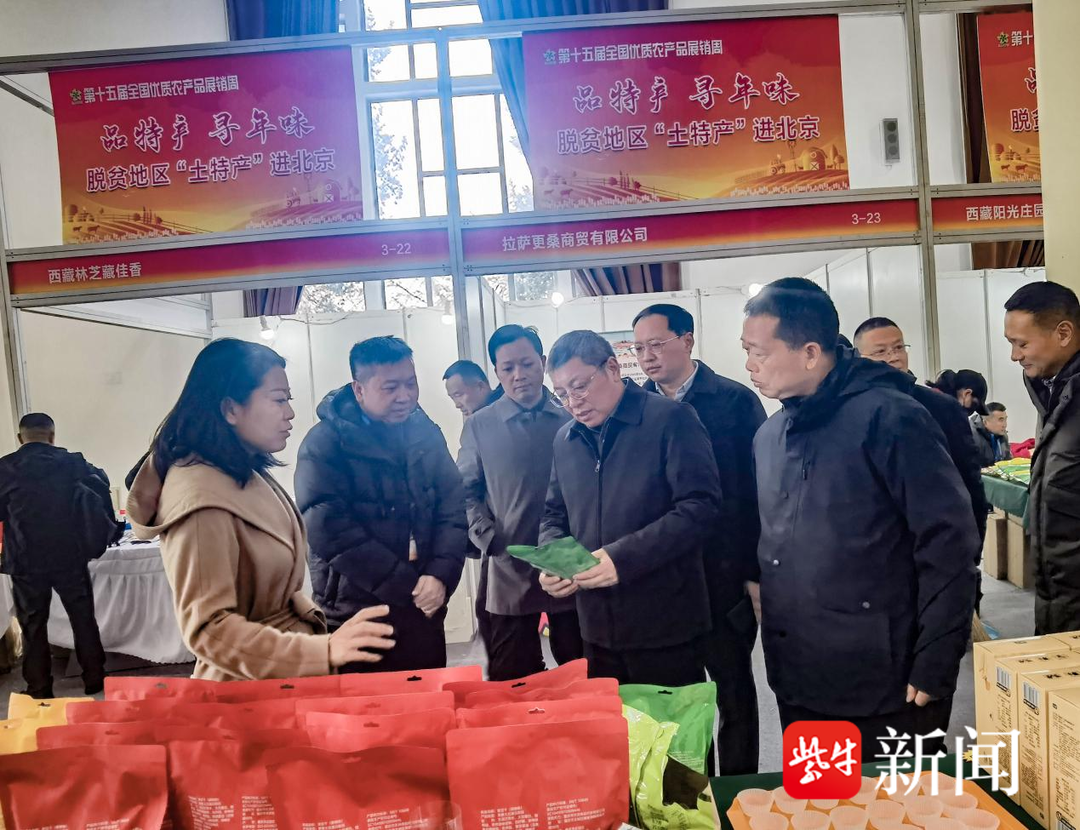
程国强:扛稳保障国家粮食安全重任
Jing Ji Ri Bao· 2025-12-16 00:05
Core Viewpoint - Food security is a critical strategic issue related to economic development and social stability, emphasized by the Chinese leadership as a top priority for governance [1][2]. Importance of Food Security - Food security is the cornerstone of national security and is essential for economic development and social stability, especially for a country with over 1.4 billion people [2][3]. - China's grain production has remained stable above 650 million tons for ten consecutive years, with projections to exceed 700 million tons in 2024, ensuring basic self-sufficiency in grains [2]. Enhancing Agricultural Production Capacity - The country is focused on improving agricultural land quality and efficiency, with significant investments in high-standard farmland construction and water management [5]. - By 2024, the effective utilization coefficient of irrigation water has increased from 0.523 in 2013 to 0.58, with annual water savings reaching 2.4 billion cubic meters [5]. Food Reserve and Regulation System - A comprehensive food reserve system is being established, combining central and local reserves, as well as government and enterprise reserves [6][7]. - By 2024, nearly 7,000 emergency processing enterprises will be operational, with daily processing capacity exceeding 1.7 million tons, sufficient to meet the food needs of residents for over two days [7]. Responsibility Mechanism for Food Security - The implementation of a dual responsibility system for food security has been emphasized, with clear accountability for local governments to ensure grain production and quality [8][13]. - Policies are being developed to stabilize farmers' incomes and encourage grain production through subsidies and insurance [14]. Addressing Risks and Challenges - Despite improvements, challenges remain, including land degradation and the need for technological advancements in agricultural practices [9][10]. - The mismatch between food supply and consumption demands highlights the need for better alignment in agricultural production, particularly in protein feed sources [11]. Technological Innovation and Support - There is a need for a more robust agricultural technology system to enhance productivity, with a focus on commercial breeding and mechanization [12][16]. - The integration of technology in agriculture is crucial for improving efficiency and ensuring sustainable food production [16].
全年粮食生产再次实现高位增产
Ren Min Ri Bao· 2025-12-12 22:00
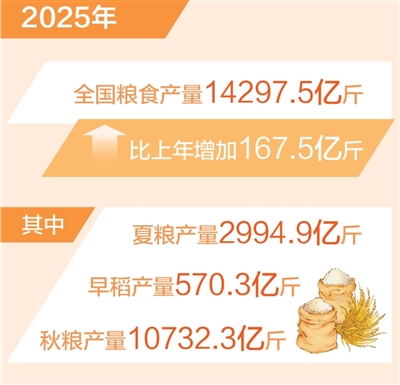
Core Viewpoint - China's grain production is projected to reach 14,297.5 billion jin by 2025, marking a 1.2% increase from the previous year, demonstrating stable high-level growth in agricultural output [2] Group 1: Grain Production and Achievements - The grain production target for 2025 is set at approximately 14 trillion jin, with a significant increase from 2021's 13,657 billion jin [2] - The per capita grain availability has risen from 483 kg in 2021 to 500 kg, indicating improved food security [2] - In 2025, summer grain production reached 2,994.9 billion jin, the second-highest on record, while early rice production increased by 1.2% to 570.3 billion jin [3] - Autumn grain production saw an increase of 1.5%, totaling 10,732.3 billion jin, driven by stable production conditions and adjustments in planting structure [3] Group 2: Resilience and Response to Adverse Conditions - In 2025, grain production faced challenges from extreme weather, including droughts and heavy rains, highlighting the importance of maintaining food security [4] - Local governments implemented emergency measures and provided financial support to ensure timely harvesting and drying of crops [4][5] Group 3: Technological Advancements and Agricultural Practices - The introduction of new agricultural machinery has improved efficiency and reduced grain loss during harvesting, contributing to higher yields [6] - The average grain yield reached 399.1 kg per mu, an increase of 4.4 kg from the previous year, showcasing the impact of technological advancements [6] Group 4: Policy and Institutional Framework - The "14th Five-Year Plan" emphasizes the importance of food security, integrating grain production capacity into safety assurance indicators [7] - Various supportive policies, including subsidies and insurance, have been implemented to stabilize farmers' income and encourage grain production [8] Group 5: Agricultural Technology Promotion - A robust agricultural technology promotion system has been established, with over 400,000 grassroots agricultural technicians actively supporting farmers [10] - New training programs and technology dissemination efforts are crucial for enhancing agricultural productivity and resilience [10] Group 6: Future Outlook and Strategic Goals - The "15th Five-Year Plan" aims to elevate grain production capabilities, focusing on quality and ecological sustainability [11][12] - Emphasis will be placed on enhancing disaster prevention and mitigation capabilities in agriculture to address potential risks [13] - The transition to environmentally friendly agricultural practices is essential for ensuring both quantity and quality in grain production [14]
科技赋能兴农路,实干担当谱新篇!广东农技推广工作会议成功举行
Nan Fang Nong Cun Bao· 2025-12-12 16:01
Core Viewpoint - The Guangdong Province's agricultural technology promotion system has made significant progress in enhancing agricultural productivity and ensuring food security, with a focus on integrating technology into rural development and planning for future advancements in the sector [7][12][40]. Group 1: Achievements and Progress - Over the past five years, Guangdong's total grain production has consistently exceeded 13 million tons, with a yield of 391.5 kg per mu [19]. - The coverage rate of high-quality seeds for major crops remains above 98%, with rice mechanization rates reaching 99.43% for tilling and 97.46% for harvesting [20]. - The province has successfully organized over 2,000 crop variety trials and approved 370 new varieties of rice and corn, ensuring a robust genetic resource base [25][26]. Group 2: Future Plans and Strategies - The agricultural technology promotion system aims to address existing gaps and enhance service mechanisms, focusing on food security, crop revitalization, and agricultural machinery [40][51]. - Plans include the establishment of a high-quality agricultural technology promotion plan for the 14th Five-Year Plan, emphasizing rapid response and long-term management mechanisms [55]. - The integration of digital transformation is a priority, with initiatives to upgrade smart agricultural service platforms and expand AI technology applications [59][60]. Group 3: Community Engagement and Innovation - The event highlighted successful case studies from various regions, showcasing innovative practices in agricultural technology that can be replicated [74]. - Local experts shared impactful stories of how practical technologies have improved livelihoods, emphasizing the role of grassroots talent in agricultural promotion [73]. - Interactive sessions and product showcases facilitated the exchange of quality agricultural products and technologies, enhancing collaboration between producers and consumers [78][80].

从新会出发,贯通全国!中国陈皮贸易中心运营启动
Nan Fang Nong Cun Bao· 2025-12-12 16:01
Core Viewpoint - The launch of the China Chenpi Trade Center and the China Supply and Marketing (Jiangmen) Xinhui Chenpi Industrial Park marks a significant milestone in the development of the Chenpi industry, transitioning from a regional specialty to a national commodity system, and aims to support rural revitalization and agricultural modernization [3][9][10]. Group 1: Overview of the Trade Center - The China Chenpi Trade Center aims to create a comprehensive service platform covering the entire industrial chain, including information, standards, and branding, focusing on the trading of Chenpi as a bulk commodity [7][8]. - The operation of the trade center is supported by various national-level associations, state-owned enterprises, and industry leaders, emphasizing collaboration to address key issues in standardization, branding, and marketization within the Chenpi industry [23][25][26]. Group 2: Recognition and Certification - The Xinhui Chenpi industry is recognized through eight national-level certifications, establishing its authority and foundational status in the market, including titles such as "Hometown of Chinese Chenpi" and "Demonstration Base of Chinese Medicine Culture" [11][12][18]. - These recognitions span multiple fields, providing comprehensive support for the development of the Chenpi industry and enhancing the credibility of the China Chenpi Trade Center [16][18]. Group 3: Collaborative Development - The trade center is designed to link national Chenpi production areas and build a collaborative development ecosystem, integrating resources from various regions to promote standardization and brand building [40][43][46]. - Initial partnerships include enterprises from Guangdong, Guangxi, Chongqing, Zhejiang, and Hunan, covering areas such as Chenpi cultivation, processing, and related products [42][43]. Group 4: Technological Integration - The China Chenpi Trade Center will utilize modern digital trading systems in collaboration with the Guangzhou Commodity Exchange, enhancing transaction efficiency and transparency in the industry [32][50][54]. - The center aims to create a closed-loop industrial chain supported by digital platforms, facilitating effective supply-demand matching and resource allocation [51][52]. Group 5: Strategic Importance - The launch of the trade center is seen as a benchmark project for high-quality development in rural areas and a practical exploration of new agricultural productivity [55][56]. - It signifies Xinhui's leadership in the Chenpi industry and aligns with national strategies to build a unified national market, contributing to the revitalization of rural economies [57][59].
80%蔬菜品种实现国产化,山东农业科技创新能力处在全国第一梯队
Qi Lu Wan Bao· 2025-12-12 08:27
Core Insights - Shandong Province is accelerating agricultural modernization during the "14th Five-Year Plan" period, leveraging technological innovation to enhance agricultural productivity and support the construction of a strong agricultural province [1][2]. Group 1: Agricultural Innovation and Achievements - Shandong has 32 agricultural research institutions and 9 academicians, leading to significant advancements in agricultural technology [1]. - The province's seed industry is nationally leading, with several crop varieties ranking in the top ten for national planting area, including 3 wheat, 1 corn, 1 soybean, and 3 peanut varieties [1]. - The mechanization rate for crop farming is 91%, which is 16 percentage points higher than the national average, and the contribution rate of agricultural technology progress is 67.4%, exceeding the national average by 4 percentage points [1]. Group 2: Key Initiatives and Strategies - Shandong is focusing on key technology research and has achieved breakthroughs, such as 80% of vegetable varieties being domestically produced and advancements in dairy and aquaculture technologies [2]. - The province supports the promotion of high-quality crop varieties, with over 98% coverage of improved seeds for major crops, and emphasizes the development of high-performance agricultural machinery [2]. - A talent matrix is being constructed, with 14 top talents recruited and 26 individuals selected for the national "Shennong Talent" program [2]. Group 3: Policy and Mechanism Support - A coordination mechanism for agricultural technology research has been established to integrate innovation resources, with a focus on cultivating 100 agricultural technology enterprises [3]. - Projects like the Rural Revitalization Technology Innovation Initiative are being implemented to promote agricultural technology innovation and application [3]. - Future plans include deepening the integration of technological and industrial innovation to enhance the overall effectiveness of agricultural technology innovation systems [3].
高帆:推进乡村全面振兴的理论和实践价值
Jing Ji Ri Bao· 2025-12-12 00:17
Core Viewpoint - The modernization of agriculture and rural areas is crucial for China's overall modernization, with rural revitalization being a key strategy emphasized by the leadership [1][2]. Group 1: Historical and Contemporary Significance - Understanding the role of rural areas is essential, as they have historically contributed significantly to China's modernization efforts [2]. - The current push for rural revitalization transcends mere economic growth, serving as a strategic move for balanced development and security [2][3]. Group 2: National Security and Economic Circulation - Rural revitalization is linked to multiple aspects of national security, including food security, ecological safety, and social stability, especially in a complex international environment [3]. - Enhancing rural industries can facilitate smoother urban-rural economic circulation, unlocking substantial consumer and investment demand [3]. Group 3: Improving Livelihoods - Rural revitalization is vital for improving the living standards of the rural population, which remains significant in a country with over 1.4 billion people [4]. - The Engel coefficients for urban and rural residents are projected to decrease, indicating a shift in consumption patterns towards higher-quality goods [4]. Group 4: Addressing Social Contradictions - The primary social contradiction has shifted to the imbalance between the growing needs for a better life and uneven development, particularly between urban and rural areas [5]. - Rural revitalization encompasses various dimensions, including economic, political, cultural, and ecological aspects, requiring coordinated planning and execution [5][6]. Group 5: Unique Characteristics of China's Approach - China's rural revitalization strategy is distinct, focusing on its unique national conditions rather than replicating models from developed countries [7]. - The collective ownership of rural land plays a crucial role in enhancing productivity and protecting farmers' rights, contributing to rural revitalization [7]. Group 6: Promoting Common Prosperity - A key goal of rural revitalization is to promote common prosperity by addressing income disparities across urban-rural and regional lines [8]. Group 7: Urban-Rural Integration - Urban and rural areas are interdependent, and promoting urban-rural integration is essential for achieving comprehensive rural revitalization [9]. - Efforts should focus on equalizing basic rights and services between urban and rural residents, fostering a balanced development environment [9][10]. Group 8: Industrial Transformation - Industrial revitalization is a critical component of rural revitalization, necessitating the integration of rural industries into the broader urban-industrial framework [11][12]. - Emphasizing green and low-carbon practices in agricultural production is essential for enhancing the resilience of the agricultural supply chain [12].
“一县一业联一所”模式赋能河南农业强省战略——国家级“农科天团”扎根安阳为哪般?
He Nan Ri Bao· 2025-12-11 01:29
Core Viewpoint - The establishment of the Anyang Comprehensive Innovation Base by the Chinese Academy of Agricultural Sciences (CAAS) in collaboration with Anyang Municipal Government marks a significant step towards high-quality agricultural development in Henan Province, promoting a model of "one county, one industry, one institute" to address industry bottlenecks and enhance agricultural innovation [4][5][6]. Group 1: Project Overview - The Anyang Comprehensive Innovation Base will host 46 research teams and 498 researchers from nine institutes of CAAS, focusing on practical technology application and industry upgrades [5]. - The base is strategically located just 2.5 kilometers from Anyang East Station, facilitating integration into a national agricultural innovation network [5]. - Anyang is recognized as a major grain production area, with stable grain planting areas exceeding 8.4 million acres and an annual grain output of over 3.8 million tons [5]. Group 2: Strategic Importance - The collaboration is rooted in a 60-year history of cooperation between CAAS and Anyang, aiming to implement national agricultural strategies and enhance local agricultural productivity [6][7]. - The base is expected to serve as a new engine for high-quality development in Anyang, with an injection of 30 million yuan in special funding to support research and development [6]. - The "one county, one industry, one institute" model is designed to align with local agricultural needs, facilitating integration into the Beijing-Tianjin-Hebei region and strengthening the local industrial foundation [6][7]. Group 3: Future Prospects - The base aims to become a showcase for agricultural innovation and a model for national agricultural technology collaboration, focusing on seed industry innovation and smart agriculture [7][8]. - As the "technology innovation community" develops, the base will enhance agricultural productivity and contribute to national food security [7][8]. - The establishment of the base is seen as a critical step in transforming Henan from a "Central Plains Granary" to an "Agricultural Power Province" [7][8].
“十五五”农业怎么干?增强粮食供给保障,强化科技装备支撑
2 1 Shi Ji Jing Ji Bao Dao· 2025-12-10 13:04
Core Viewpoint - The article emphasizes the importance of enhancing agricultural comprehensive production capacity and quality efficiency as a major task in building an agricultural power, highlighting five key tasks to achieve this goal [2][4]. Group 1: Key Tasks for Enhancing Agricultural Production Capacity - The five key tasks include: strengthening the supply guarantee capacity of important agricultural products, constructing a diversified food supply system, reinforcing farmland protection and quality improvement, enhancing technological support, and improving agricultural development quality and efficiency [2][4]. - The first task focuses on ensuring food security, with a projected national grain output exceeding 1.4 trillion jin in 2024, achieving a per capita grain availability of 500 kg [3][4]. Group 2: Measures for Grain Production and Supply - The article outlines measures to stabilize grain planting areas and enhance single crop yields, including optimizing the production layout and reinforcing production capacity by crop type and region [4]. - It also emphasizes improving grain storage, circulation, and processing capabilities, alongside developing infrastructure for grain logistics and initial processing [4]. Group 3: Agricultural Disaster Prevention and Technological Innovation - The article discusses the need to strengthen agricultural disaster prevention and mitigation capabilities, including enhancing monitoring and forecasting of meteorological disasters and improving irrigation infrastructure [5]. - It highlights the importance of agricultural technology innovation, advocating for a robust agricultural technology innovation system that integrates various research and educational institutions [7][8]. Group 4: Focus on Seed Industry and Agricultural Machinery - The article stresses the need for revitalizing the seed industry by promoting self-reliance in seed technology and protecting genetic resources [8]. - It also points out the necessity of addressing shortcomings in agricultural machinery, promoting high-quality development of agricultural equipment, and integrating machinery with agricultural practices [9].
提升农业综合生产能力和质量效益(学习贯彻党的二十届四中全会精神)
Ren Min Ri Bao· 2025-12-09 22:32
Core Viewpoint - The construction of a strong agricultural nation is a strategic deployment by the central government, focusing on enhancing agricultural production capacity and quality efficiency as a long-term historical task [1] Group 1: Achievements and Current Status - During the 14th Five-Year Plan period, significant achievements in agricultural modernization were made, with grain production capacity reaching 1.4 trillion jin in 2024 and per capita grain availability at 500 kg [2] - The quality of agricultural development has improved, with over 1 billion mu of high-standard farmland built and a crop variety coverage rate exceeding 96% [2] - Farmers' income has grown faster than GDP and urban residents' income, with the urban-rural income ratio narrowing to 2.34:1 [2] Group 2: Challenges and Needs - Despite progress, challenges remain due to limited per capita resources, historical debts, and low production efficiency, necessitating efforts to strengthen weak areas and accelerate high-quality agricultural development [2][3] - The need to ensure food security is critical, especially as demand for food and important agricultural products continues to grow [3] Group 3: Key Measures for Improvement - The 15th Five-Year Plan emphasizes enhancing agricultural production capacity and quality efficiency, focusing on a comprehensive approach that includes production, ecology, and income growth [4] - Key tasks include ensuring food supply security, optimizing the structure of important agricultural products, and enhancing agricultural disaster prevention and mitigation capabilities [5][6] Group 4: Diversified Food Supply System - A multi-faceted food supply system is to be developed, integrating agriculture, forestry, animal husbandry, and fishery to meet diverse consumer needs [7] - Modern facility agriculture will be promoted, including the use of greenhouses and vertical farming [7] Group 5: Land Protection and Quality Enhancement - Strict land protection measures will be implemented to ensure the quantity, quality, and ecological health of farmland [8] - High-standard farmland construction will be prioritized, with a focus on improving soil quality and productivity [8] Group 6: Technological Support - Advancements in agricultural technology are essential for improving production capacity and quality efficiency, with a focus on innovation and collaboration among various research entities [9] - The development of smart agriculture and the integration of technology in farming practices will be emphasized [9] Group 7: Quality and Efficiency in Agricultural Development - The establishment of a modern agricultural industry system will be pursued, focusing on quality improvement, green development, and brand building [10] - Efforts will be made to enhance the value of agricultural ecological products and promote the integration of agriculture with other industries [11] Group 8: Support and Policy Framework - A comprehensive policy framework will be established to ensure food security and agricultural development, including financial support and rural reform [12][13] - The focus will be on stabilizing land contracts and promoting efficient agricultural operations while supporting small farmers [13]