适度宽松的货币政策

Search documents
央行出台八项政策 降准降息仍有空间
Sou Hu Cai Jing· 2026-01-15 21:02
Group 1 - The People's Bank of China (PBOC) has lowered the interest rates of various structural monetary policy tools by 0.25 percentage points and increased the quota for technological innovation and technological transformation re-loans from 800 billion to 1.2 trillion yuan [1] - The PBOC aims to enhance the effectiveness of credit support in key areas by adjusting structural monetary policy tools and increasing support for economic structural transformation [1] - The PBOC plans to implement a series of measures, including increasing the quota for agricultural and small enterprise re-loans, expanding carbon reduction support tools, and enhancing support for service consumption and elderly care [1] Group 2 - The PBOC has indicated that there is still room for further reductions in the reserve requirement ratio (RRR) and interest rates, with the current average RRR at 6.3% [2] - The PBOC has established a 500 billion yuan re-loan for service consumption and elderly care, aiming to meet diverse financing needs in the consumption sector [2] - As of the end of November 2025, the balance of consumer loans, excluding personal housing loans, reached 21.2 trillion yuan, indicating a significant increase in consumer financing [2] Group 3 - The PBOC will continue to guide financial institutions to innovate products and services that align with consumption scenarios, focusing on industries closely related to people's livelihoods, such as accommodation, catering, tourism, and childcare [3] - The PBOC aims to create a suitable monetary environment to promote reasonable price recovery, with the Consumer Price Index (CPI) showing a year-on-year increase of 0.8% as of December last year [3][4] - The PBOC will consider stabilizing economic growth and promoting reasonable price recovery as key aspects of its monetary policy, continuing to implement a moderately loose monetary policy [4]


2025年货币金融政策支持实体经济效果显著
Zheng Quan Ri Bao· 2026-01-15 16:48
中国人民银行数据显示,2025年12月末,M2余额340.29万亿元,同比增长8.5%。狭义货币(M1)余额 115.51万亿元,同比增长3.8%。流通中货币(M0)余额14.13万亿元,同比增长10.2%。全年净投放现 金1.31万亿元。 闫先东表示,M2增速加快,将持续为经济回升向好创造适宜的货币金融环境。 金融结构不断优化 1月15日,2025年全年金融数据出炉。中国人民银行公布的统计报告显示,截至2025年末,社会融资规 模存量为442.12万亿元,同比增长8.3%;人民币贷款余额271.91万亿元,同比增长6.4%;广义货币 (M2)余额340.29万亿元,同比增长8.5%。 中国人民银行副行长邹澜1月15日在国新办举行的新闻发布会上表示,2025年,中国人民银行实施适度 宽松的货币政策,在货币金融环境已经较为宽松的状态下,在存量政策接续发挥作用的基础上,5月份 又宣布实施了一揽子金融支持举措,巩固经济回升向好势头。从全年金融数据看,货币金融政策支持实 体经济的效果是明显的。 社会融资规模保持合理增长 2025年,社会融资规模保持合理增长,较好地满足了实体经济的资金需求。中国人民银行数据显示,初 步 ...
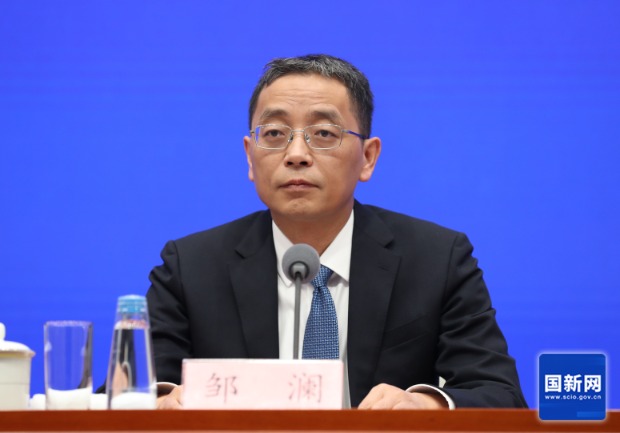
中国人民银行副行长邹澜:2026年降准降息还有一定空间
Xin Hua Cai Jing· 2026-01-15 14:48
Core Viewpoint - The People's Bank of China (PBOC) indicates that there is still room for further reductions in reserve requirements and interest rates to support high-quality economic development in 2026 [1][3]. Group 1: Monetary Policy Insights - The average statutory deposit reserve ratio for financial institutions is currently 6.3%, suggesting potential for a reduction in reserve requirements [3]. - The PBOC has noted that external constraints are relatively stable, with the RMB exchange rate being stable and the USD in a rate-cutting cycle, which does not impose strong constraints on monetary policy [3]. - Internally, the net interest margin for banks has stabilized at 1.42% over the past two quarters, indicating a favorable environment for potential interest rate cuts [3]. Group 2: Financing Cost Management - The PBOC plans to continue comprehensive measures to maintain low overall financing costs in society, including promoting transparency in loan costs through "loan clarity papers" for enterprises [3]. - Efforts will be made to reduce assessment, guarantee, and other intermediary financing costs to alleviate the financial burden on businesses and optimize the financing environment [3]. - The PBOC emphasizes the importance of effective execution and supervision of interest rate policies to ensure smooth transmission of these policies [3]. Group 3: Future Monetary Policy Direction - Looking ahead to 2026, the PBOC will implement moderately accommodative monetary policies in line with the central economic work conference's decisions, focusing on both stock and incremental policy effects [3]. - There will be an increased emphasis on counter-cyclical and cross-cyclical adjustments to create a conducive monetary and financial environment for stable economic growth and high-quality development [3].
创造适宜货币金融环境 增强高质量发展活力——两部门有关负责人详解货币金融政策
Xin Hua Wang· 2026-01-15 14:39
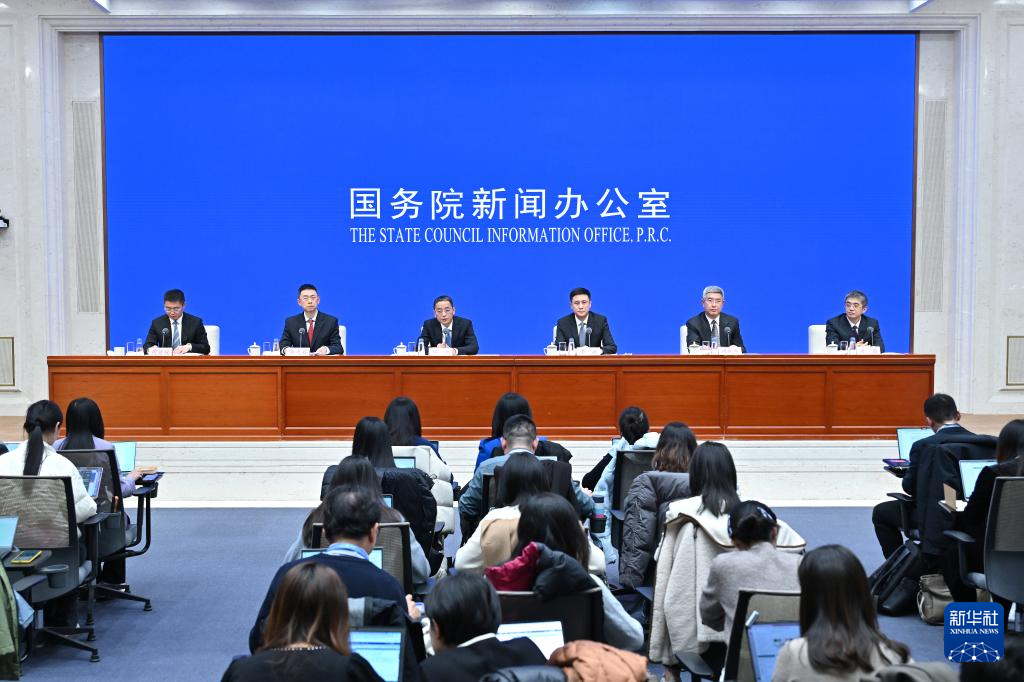
Core Viewpoint - The Chinese government is committed to creating a conducive monetary and financial environment to enhance the vitality of high-quality economic development, with a focus on supporting the real economy through effective monetary policies in 2025 and beyond [3][4]. Group 1: Monetary Policy and Economic Support - In 2025, the total social financing stock increased by 8.3% year-on-year, with broad money (M2) growing by 8.5% and RMB loans increasing by 6.4% [4]. - The average interest rate for newly issued corporate loans and personal housing loans was around 3.1%, marking a decline of 2.5 and 2.6 percentage points respectively since the second half of 2018 [4]. - Key sectors such as technology, green finance, inclusive finance, elderly care, and digital economy saw loan growth rates in double digits, significantly outpacing the overall loan growth rate [4]. Group 2: Future Financial Measures - In 2026, the People's Bank of China plans to continue implementing a moderately loose monetary policy, increasing counter-cyclical and cross-cyclical adjustments to support the "14th Five-Year Plan" [6]. - Structural monetary policy tools will see a rate cut of 0.25 percentage points, with an increase in re-lending quotas for agriculture and small enterprises by 500 billion yuan, and for technology innovation and transformation by 1.2 trillion yuan [6]. Group 3: Consumer and Private Sector Support - By the end of 2025, the People's Bank of China had issued 118.4 billion yuan in re-lending for service consumption and elderly care, with plans to include the health industry in this support area [7]. - A total of 1 trillion yuan in re-lending will be allocated to support private small and medium enterprises, enhancing financial support for this sector [8]. Group 4: Foreign Exchange and Market Stability - The Chinese government emphasizes the market's role in determining the exchange rate, aiming to maintain the RMB's stability at a reasonable level without resorting to devaluation for trade advantages [9]. - In 2026, the focus will be on deepening foreign exchange reforms, expanding openness in the foreign exchange sector, and enhancing the efficiency of foreign exchange business for various entities [9][10].
央行将推出八项政策措施
Qi Huo Ri Bao Wang· 2026-01-15 14:31
Core Viewpoint - The People's Bank of China (PBOC) is set to implement a moderately accommodative monetary policy to support high-quality economic development, with specific measures aimed at enhancing credit flow to key sectors and facilitating economic structural transformation [1][2][3] Group 1: Monetary Policy Measures - The PBOC will lower the interest rates of various structural monetary policy tools by 0.25 percentage points, reducing the one-year re-lending rate from 1.5% to 1.25% [1] - The PBOC will merge the agricultural and small enterprise re-lending with re-discounting, increasing the re-lending quota for agricultural and small enterprises by 500 billion yuan, with a separate quota of 1 trillion yuan designated for private enterprises [1][2] - The quota for re-lending aimed at technological innovation and technological transformation will be increased from 800 billion yuan to 1.2 trillion yuan, expanding support to high R&D investment private small and medium-sized enterprises [2] Group 2: Support Tools and Initiatives - The PBOC will merge the existing private enterprise bond financing support tool and the technological innovation bond risk-sharing tool, providing a total re-lending quota of 200 billion yuan [2] - The carbon reduction support tool will be expanded to include more projects with carbon reduction effects, such as energy-efficient renovations and green upgrades [2] - The minimum down payment ratio for commercial property loans will be lowered to 30% to support the destocking of the commercial real estate market [2] Group 3: Coordination and Implementation - The related policy documents will be released soon, and the implementation will be coordinated with fiscal policies such as interest subsidies and risk cost sharing to enhance policy effectiveness [3] - The PBOC will continue to increase liquidity and maintain ample liquidity levels, guiding overnight interest rates to operate near policy rate levels [3]
央行:2026年1月19日起,下调再贷款、再贴现利率0.25个百分点
Sou Hu Cai Jing· 2026-01-15 13:46
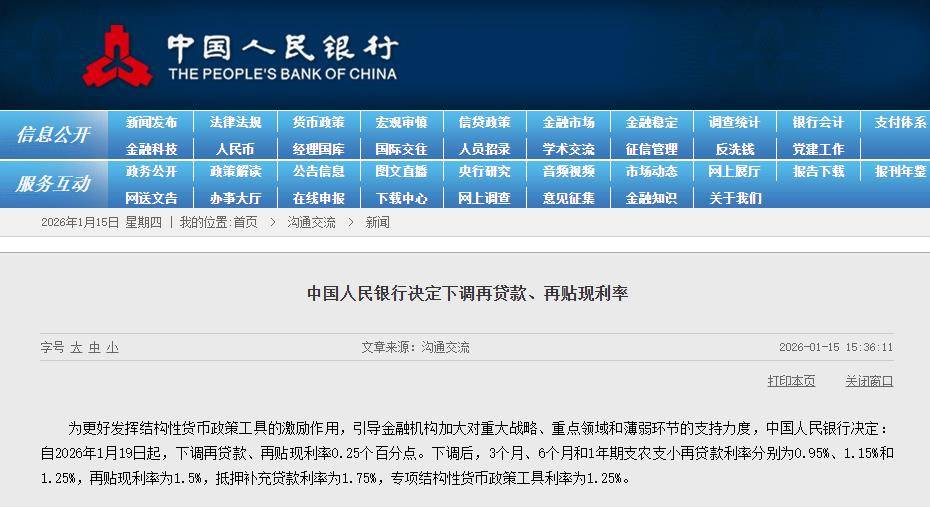
为更好发挥结构性货币政策工具的激励作用,引导金融机构加大对重大战略、重点领域和薄弱环节的支持力度,中国人民银行决 定:自2026年1月19日起,下调再贷款、再贴现利率0.25个百分点。下调后,3个月、6个月和1年期支农支小再贷款利率分别为 0.95%、1.15%和1.25%,再贴现利率为1.5%,抵押补充贷款利率为1.75%,专项结构性货币政策工具利率为1.25%。 | | | | 中国人民银行 THE PEOPLE'S BANK OF CHINA | | | | | | | | | --- | --- | --- | --- | --- | --- | --- | --- | --- | --- | --- | | 信息公开 | 新闻发布 | 法律法规 | 货币政策 | 宏观审慎 | 信贷政策 | 金融市场 | 金融稳定 | 调查统计 | 银行会计 | 支付体系 | | | 金融科技 | 人民币 | 经理国库 | 国际交往 | 人员招录 | 学术交流 | 征信管理 | 反洗钱 | 党建工作 | | | 服务互动 | 政务公开 | 政策解读 | 公告信息 | 图文直播 | 央行研究 | 音频视频 | 市场动态 ...
央行一揽子政策支持“十五五”开好局、起好步
Sou Hu Cai Jing· 2026-01-15 13:46
Core Viewpoint - The People's Bank of China (PBOC) is implementing a series of monetary policy measures to support high-quality economic development, including interest rate cuts and increased loan quotas for technology innovation and real estate [1][2]. Group 1: Monetary Policy Adjustments - The PBOC has lowered various structural monetary policy tool rates by 0.25 percentage points [1]. - The quota for re-loans for technological innovation and transformation has been increased from 800 billion yuan to 1.2 trillion yuan [1]. - The minimum down payment ratio for commercial property loans has been reduced to 30% to support the commercial real estate market [1]. Group 2: Economic Support Measures - The PBOC plans to enhance support for key sectors by adjusting structural tools and increasing funding for agriculture and small enterprises [2]. - Specific measures include integrating agricultural and small enterprise re-loans, expanding carbon reduction support, and enhancing service consumption and elderly care loan support [2]. - The PBOC aims to coordinate these monetary policies with fiscal measures to amplify their effectiveness in boosting effective domestic demand [2]. Group 3: Consumer and Employment Support - The PBOC has established a 500 billion yuan re-loan for service consumption and elderly care, aiming to meet diverse financing needs in the consumption sector [3]. - As of the end of November 2025, the balance of consumer loans (excluding personal housing loans) reached 21.2 trillion yuan [3]. - The PBOC will continue to support industries closely related to people's livelihoods, such as hospitality, tourism, and childcare services [3]. Group 4: Price Stability and Economic Growth - The CPI has shown positive changes, with a year-on-year increase of 0.8% in December 2025, the highest level since March 2023 [4]. - The PBOC is closely monitoring price trends and will implement policies to promote stable economic growth and reasonable price recovery [4]. - The central bank emphasizes the importance of maintaining a suitable monetary environment to support price recovery and economic stability [4].
降准降息还有一定空间!央行这场发布会释放了哪些信号?
Jin Rong Shi Bao· 2026-01-15 13:31
Core Viewpoint - The People's Bank of China (PBOC) has implemented a moderately accommodative monetary policy in 2025, resulting in significant support for the real economy and a notable increase in social financing and loan balances [1][2]. Group 1: Financial Growth and Policy Coordination - By the end of 2025, the total social financing stock reached 442.12 trillion yuan, growing by 8.3% year-on-year, while the balance of RMB loans to the real economy was 268.4 trillion yuan, up 6.3% [1][2]. - The PBOC utilized various monetary policy tools to maintain ample liquidity, effectively meeting the financing needs of the real economy [2]. - The issuance of government bonds accelerated, contributing significantly to the social financing scale, with a total issuance of 16 trillion yuan in 2025 [3]. Group 2: Financing Structure and Support - The structure of financing has diversified, with local governments issuing 4 trillion yuan in special refinancing bonds, primarily to repay bank loans, impacting loan growth by over 1 percentage point [4]. - In 2025, the net financing from government bonds was 13.84 trillion yuan, and direct financing accounted for 46.9% of the total social financing increment [4]. - Loans to enterprises increased by 15.47 trillion yuan, with significant growth in medium- and long-term loans, indicating strong financial support for the real economy [5]. Group 3: Financial "Five Articles" and Cost Reduction - The balance of loans in the financial "Five Articles" reached 107.7 trillion yuan by the end of November 2025, growing by 12.8% [6]. - The financing costs in the financial "Five Articles" have decreased, with new loan rates for technology and digital economy sectors lower than the previous year [7]. - The PBOC plans to continue promoting low financing costs and optimize the financing environment by enhancing transparency in loan costs [10]. Group 4: Future Monetary Policy Directions - The PBOC aims to maintain a moderately accommodative monetary policy in 2026, focusing on the integrated effects of existing and new policies to support economic stability and high-quality development [8][9]. - There is still room for further reductions in reserve requirements and interest rates, with the current average reserve requirement ratio at 6.3% [9]. - The emphasis will be on improving the efficiency of existing policies rather than simply increasing them, with a focus on directing financial resources towards technology innovation and green development [10].
新华鲜报|新增贷款超16万亿元!金融“活水”激发经济活力
Sou Hu Cai Jing· 2026-01-15 13:30
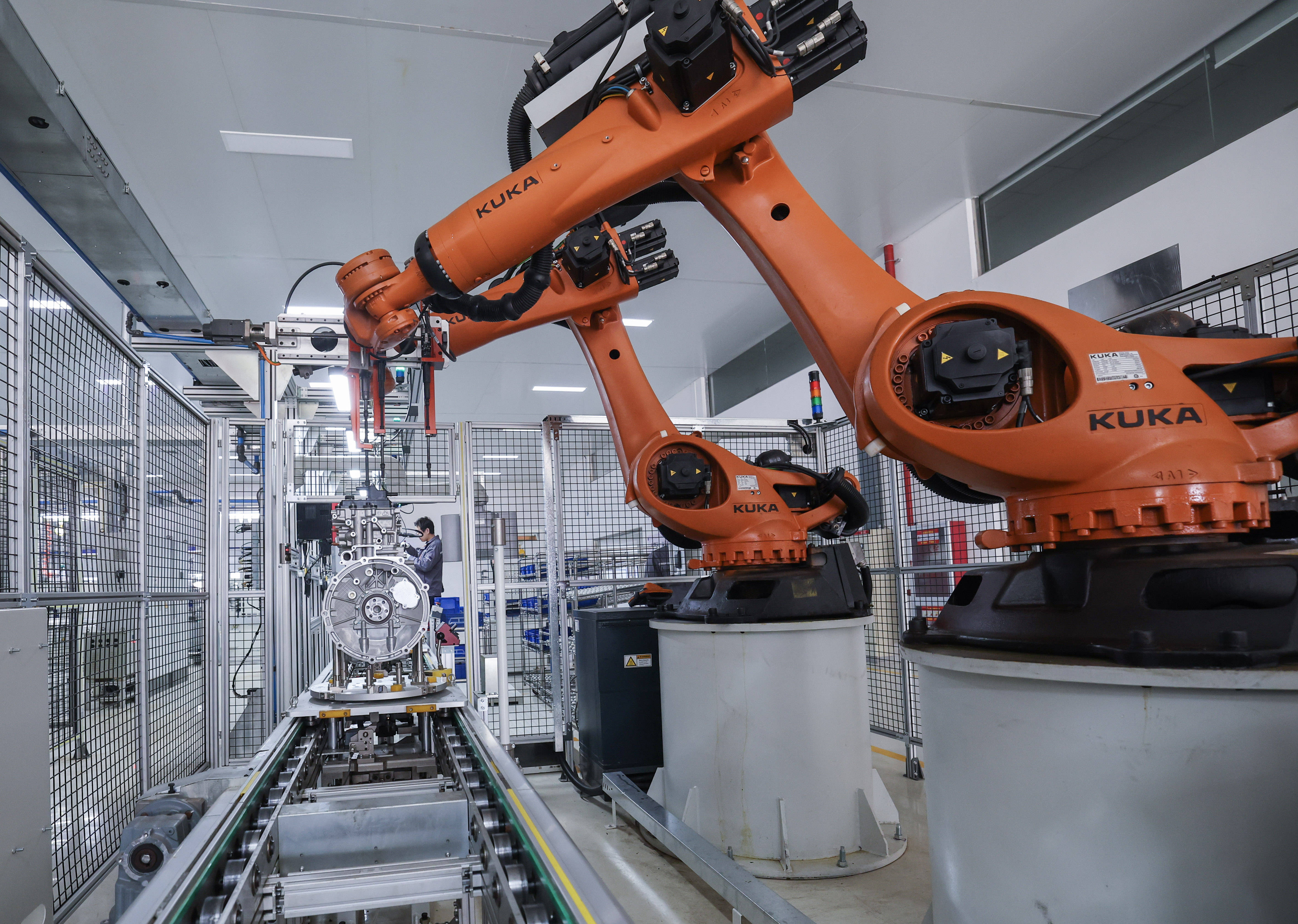
金融是国民经济的血脉。1月15日中国人民银行发布的数据显示,2025年全年新增贷款16.27万亿元。这背后是适度宽松的货币政策发力显效,企业和居民有 效信贷需求持续释放,为中国经济注入强劲活力。 2025年的金融成绩单亮点突出:全年社会融资规模增量累计为35.6万亿元,广义货币(M2)余额超340万亿元,人民币贷款余额超过270万亿元……一个个 总量数据展现出金融体系的坚实支撑,为提振内需、稳定经济蓄势赋能。 过去一年,货币政策精准发力:降低存款准备金率0.5个百分点,下调政策利率0.1个百分点,全面下调结构性货币政策工具利率0.25个百分点……一系列政 策措施落地见效,不仅促进社会融资规模和货币信贷合理增长,更带动贷款利率持续保持低位水平。 2025年12月,新发放企业贷款加权平均利率在3.1%左右,自2018年下半年下降了2.5个百分点。融资成本稳步走低,让更多企业"轻装上阵",投身生产经 营、技术创新的底气更足。 这些亮眼数据的背后,是结构性货币政策工具不断优化完善。 增加科技创新和技术改造再贷款、支农支小再贷款额度;推出债券市场"科技板",设立科技创新债券风险分担工具、服务消费与养老再贷款……2025 ...
新华鲜报丨新增贷款超16万亿元!金融“活水”激发经济活力
Xin Hua Wang· 2026-01-15 13:29
Core Insights - The financial sector is crucial for the national economy, with the People's Bank of China reporting a total of 16.27 trillion yuan in new loans for 2025, reflecting the effectiveness of moderately loose monetary policies and sustained credit demand from businesses and households [1] - The total social financing increment for 2025 reached 35.6 trillion yuan, with broad money (M2) exceeding 340 trillion yuan and the RMB loan balance surpassing 270 trillion yuan, indicating a robust financial system supporting economic stability and internal demand [1] - Monetary policy measures included a 0.5 percentage point reduction in the reserve requirement ratio and a 0.1 percentage point cut in policy interest rates, contributing to a sustained low loan interest rate environment [1] Financial Performance - New corporate loans amounted to 15.47 trillion yuan in 2025, with over 90% of new loans directly addressing corporate needs, and more than half of these loans being medium to long-term, indicating a stable outlook for corporate financing [2] - Key sectors attracting significant credit include technology (11.5% growth), green initiatives (23%), inclusive finance (10.3%), elderly care (60.2%), and digital fields (14.6%), all surpassing the overall loan growth rate [2] Policy and Structural Changes - The optimization of structural monetary policy tools has led to increased support for technological innovation, agricultural financing, and small enterprises, alongside the introduction of a "technology board" in the bond market [4] - Continuous policy initiatives since 2025 have focused on enhancing financial services for high-quality economic development, with emerging industries like humanoid robotics and biomedicine gaining momentum [4] Economic Outlook - The People's Bank of China plans to maintain a moderately loose monetary policy in 2026, emphasizing counter-cyclical adjustments to stimulate domestic demand and optimize supply, thereby fostering stable economic growth and a favorable financial environment [4] - The ongoing improvement in financial support quality is expected to align financial supply with the high-quality development of the real economy, reinforcing the positive economic momentum [5]