社会融资规模

Search documents
10月贷款规模合理增长,金融总量更看社融增速
Sou Hu Cai Jing· 2025-11-13 13:47
Core Insights - The People's Bank of China reported that the total social financing scale increased by 30.9 trillion yuan in the first ten months of 2025, which is 3.83 trillion yuan more than the same period last year [1] - The growth rate of social financing stock was 8.5% year-on-year as of the end of October, while the broad money supply (M2) growth rate was 8.2%, both showing a slight decrease compared to the previous month [1][8] - The overall financial volume remains at a reasonable growth level, reflecting a shift towards high-quality economic development rather than high-speed growth [1][10] Financing and Loan Data - As of the end of October, the balance of RMB loans was 270.61 trillion yuan, with a year-on-year growth of 6.5% [5] - In the first ten months, RMB loans increased by 14.97 trillion yuan, with a monthly increase of 220 billion yuan in October, which is a seasonal decrease [5][6] - The structure of loans shows that household loans increased by 739.6 billion yuan, while corporate loans increased by 13.79 trillion yuan, indicating a shift in demand and consumption patterns [5][7] Government Bonds and Financing Structure - The net financing scale of government bonds accounted for 21.3% of the total social financing scale in the first ten months, which is an increase of 2 percentage points year-on-year [6] - The issuance of government bonds and corporate bonds has significantly supported the growth of social financing, with government bond issuance reaching approximately 22 trillion yuan in the first ten months, an increase of nearly 4 trillion yuan compared to last year [8][10] - The financing structure is evolving, with direct financing (including government and corporate bonds) accounting for 44.4% of the total social financing scale, indicating a diversification of financing channels [10] Monetary Policy and Economic Outlook - The current monetary policy stance is supportive, with low financing costs for both enterprises and households, as evidenced by the average interest rates for new loans remaining low [7][11] - The report emphasizes the need for a balanced approach to monetary policy, focusing on both short-term growth and long-term structural adjustments [12][13] - Future monetary policy may see further easing, but the timing could be adjusted based on economic conditions, with a focus on enhancing macroeconomic governance and supporting sustainable growth [13]

央行,发布重要数据
21世纪经济报道· 2025-11-13 13:30
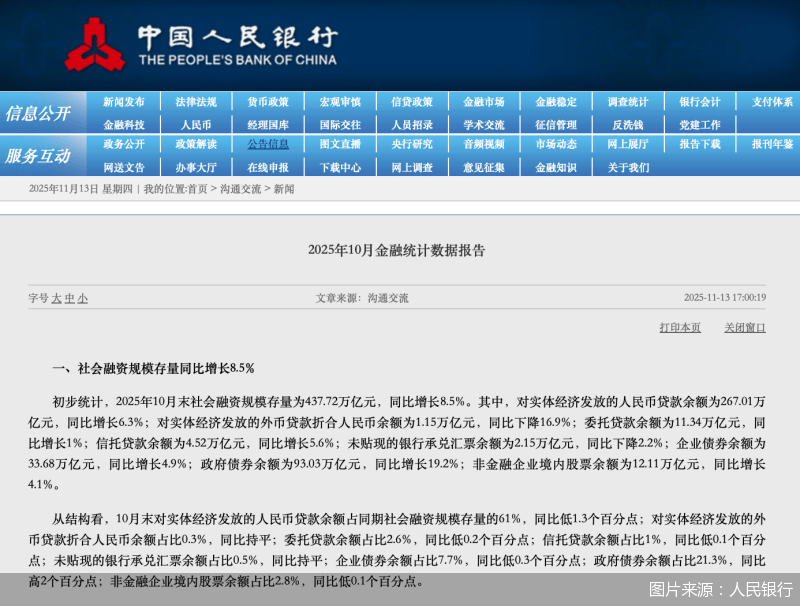
Core Viewpoint - The article highlights the ongoing shift in China's financing structure, with an increasing reliance on government bonds and a decrease in traditional bank loans, indicating a strategic move to support economic growth and stabilize financial conditions [2][3][4]. Financing Structure - As of October 2025, the total social financing stock reached 437.72 trillion yuan, growing by 8.5% year-on-year. The balance of RMB loans to the real economy was 267.01 trillion yuan, up 6.3%, while government bonds increased by 19.2% to 93.03 trillion yuan [2]. - The proportion of RMB loans to the real economy in the total social financing stock decreased by 1.3 percentage points year-on-year to 61%, while government bonds' share rose by 2 percentage points to 21.3% [2]. Economic Indicators - Broad money (M2) stood at 335.13 trillion yuan, with a year-on-year growth of 8.2%. Narrow money (M1) reached 112 trillion yuan, up 6.2%, showing a significant recovery from previous lows [6]. - The October PMI output index was at 50.0%, indicating stable economic activity, with the non-manufacturing business activity index at 50.1%, reflecting expansion [6][7]. Policy Support - The government is increasing the issuance of bonds to support major projects and stabilize the economy, with a focus on reducing corporate debt and easing financial pressures on businesses [3][8]. - The Ministry of Finance has pre-allocated 500 billion yuan for new local special bonds for 2026, which is expected to bolster investment significantly [8]. Inflation and Monetary Policy - The Consumer Price Index (CPI) rose to 0.2% year-on-year in October, while the core CPI increased by 1.2%, indicating signs of stabilization in price levels [9]. - The central bank's supportive monetary policy is expected to continue influencing price recovery, with a focus on maintaining a balance between economic support and avoiding excessive monetary easing [11][12]. Long-term Economic Outlook - Analysts suggest that the shift towards a consumption-driven economy is essential, with a need for structural reforms in fiscal spending to enhance consumer capacity and willingness [13]. - The government's long-term inflation target of around 2% is viewed as a reasonable goal, with expectations that macroeconomic policies will gradually yield positive results [10][12].
信贷、债券融资齐上阵 前十月社融增量同比多增3.83万亿元
Bei Ke Cai Jing· 2025-11-13 13:05
Core Insights - The report indicates that as of the end of October 2025, the total social financing scale reached 437.72 trillion yuan, reflecting a year-on-year growth of 8.5% [1][2] - The increase in social financing is supported by a rapid issuance of government bonds and a diversified financing approach by enterprises, moving away from reliance solely on bank loans [2][3] - The structure of social financing has evolved, with non-loan financing methods now accounting for over half of the total financing increment, indicating a shift towards market-based financing solutions [3][5] Financing Trends - Government bonds issuance has accelerated, with a cumulative issuance of approximately 22 trillion yuan from January to October, which is nearly 4 trillion yuan more than the previous year [2] - The issuance of ultra-long-term special government bonds has increased from 1 trillion yuan last year to 1.3 trillion yuan this year, reflecting fiscal support for economic growth [2] - The average interest rate for newly issued corporate loans was 3.1% in October, down about 40 basis points from the previous year, indicating a decline in financing costs for enterprises [6] Economic Outlook - The overall economic performance has shown steady improvement, with the composite PMI output index at 50.0% in October, indicating a stable economic environment [7][8] - Experts suggest that the macroeconomic policies implemented will continue to support economic recovery, with a solid foundation for achieving the annual GDP growth target of around 5% [8][9] - The current low inflation is attributed to a combination of supply and demand factors, and there are signs of price stabilization as macroeconomic policies take effect [10][11]
10月居民存款减少万亿!高息存款集中到期,居民财富再迁徙
Nan Fang Du Shi Bao· 2025-11-13 12:29
Group 1 - The core viewpoint of the article highlights that as of the end of October 2025, the total social financing scale reached 437.72 trillion yuan, with a year-on-year growth of 8.5%, indicating a continuous decline in growth rate for three consecutive months [2][4]. - The balance of RMB loans to the real economy was 267.01 trillion yuan, growing by 6.3% year-on-year, but the growth rate has also decreased by 0.1 percentage points compared to the previous month [4][5]. - In October, new RMB loans amounted to 220 billion yuan, which is a decrease of 280 billion yuan year-on-year, marking the fourth consecutive month of decline [5]. Group 2 - The report indicates that the structure of social financing has changed significantly, with direct financing channels, including government bonds and corporate bonds, accounting for 44.4% of the total financing in the first three quarters of 2025, an increase from previous years [5][6]. - The People's Bank of China (PBOC) plans to continue optimizing monetary policy and gradually shift focus away from quantity targets, aiming for a moderately loose monetary policy to maintain ample liquidity [6][7]. - There is a notable trend of residents' deposits decreasing by 1.34 trillion yuan in October, while deposits in non-bank financial institutions increased by 1.85 trillion yuan, indicating a shift in deposit behavior due to high trading activity in the stock market [8].

8.5%!央行最新披露
新华网财经· 2025-11-13 12:23
Core Viewpoint - The latest financial statistics from the central bank indicate a reasonable growth in key financial data such as M2 and social financing scale, creating a favorable monetary environment for economic recovery [2][4]. Social Financing Scale - As of the end of October, the social financing scale stood at 437.72 trillion yuan, reflecting a year-on-year growth of 8.5%. The cumulative increase in the first ten months was 30.9 trillion yuan, which is 3.83 trillion yuan more than the same period last year [4]. - The growth in social financing is significantly supported by the rapid issuance of government bonds and high corporate bond issuance. In the first ten months, net financing from corporate bonds reached 1.82 trillion yuan, and government bonds net financing was 11.95 trillion yuan, both showing year-on-year increases [5]. Loan Structure and Trends - The balance of RMB loans was 270.61 trillion yuan at the end of October, with a year-on-year growth of 6.5%. The increase in loans for the first ten months was 14.97 trillion yuan [7]. - The loan structure is evolving, with a notable increase in inclusive small and micro loans, which reached 35.77 trillion yuan, growing by 11.6% year-on-year. This reflects a shift in credit allocation towards new economic drivers such as technology innovation and green development [8][9]. Monetary Policy and Economic Outlook - The current monetary policy remains moderately loose, contributing to a favorable economic environment. The weighted average interest rate for newly issued corporate loans was 3.1%, which is approximately 40 basis points lower than the same period last year [6][8]. - International economic organizations have raised their growth forecasts for China's economy, indicating a positive outlook for economic recovery and growth, with expectations of achieving around 5% growth for the year [11].
10月M1-M2剪刀差为-2%,如何看待信贷小月数据表现?
第一财经· 2025-11-13 12:09
Core Viewpoint - The article discusses the performance of credit and financing in October, highlighting the growth in broad money supply (M2) and social financing scale, as well as the impact of government bond issuance on these metrics [2][4]. Group 1: Monetary and Financing Data - As of the end of October, the broad money (M2) balance reached 335.13 trillion yuan, with a year-on-year growth of 8.2%, which is 0.8 percentage points higher than the same period last year [2]. - The social financing scale stood at 437.72 trillion yuan, growing by 8.5% year-on-year, also 0.7 percentage points higher than the previous year [2]. - From January to October, the incremental social financing was 30.9 trillion yuan, which is 3.83 trillion yuan more than the same period last year [2]. Group 2: Government Bond Issuance - The issuance of government bonds, including treasury bonds and special refinancing bonds, has accelerated, significantly supporting the growth of social financing [3][4]. - In the first ten months of the year, the cumulative issuance of government bonds was approximately 22 trillion yuan, nearly 4 trillion yuan more than the same period last year [4]. - The issuance of ultra-long-term special treasury bonds is expected to increase from 1 trillion yuan last year to 1.3 trillion yuan this year, indicating fiscal support for economic growth [4]. Group 3: Changes in Financing Structure - The structure of social financing is gradually changing, with non-loan financing methods accounting for over half of the incremental social financing this year [6]. - In the first ten months, the increase in RMB loans was 14.52 trillion yuan, which is 1.16 trillion yuan less than the previous year, while net financing from corporate bonds was 1.82 trillion yuan, up by 1.36 billion yuan [6]. - The balance of RMB loans reached 270.61 trillion yuan by the end of October, with a year-on-year growth of 6.5%, and inclusive small and micro loans grew by 11.6% [8]. Group 4: Credit Structure Optimization - The increase in government bonds is seen as a short-term substitute for loans, aimed at supporting major projects and national strategies to boost demand and stabilize the economy [8]. - The leverage ratio of the government sector increased by 8.8 percentage points to 67.5% year-on-year, while the leverage ratios of non-financial enterprises and households saw slight changes [8]. - The ongoing changes in credit structure reflect the transformation and upgrading of the real economy, with a focus on supporting high-quality economic development [9]. Group 5: Monetary Policy and Economic Environment - M2 and social financing growth rates remain above 8%, providing a favorable monetary environment for economic recovery [10]. - The narrow money (M1) balance was 112 trillion yuan, with a year-on-year growth of 6.2%, indicating improved business activity and consumer demand [10]. - While there is still room for monetary policy adjustments, the marginal efficiency has declined, necessitating a balanced approach to maintain strong support for the real economy [10].
货币市场日报:11月13日
Xin Hua Cai Jing· 2025-11-13 12:03
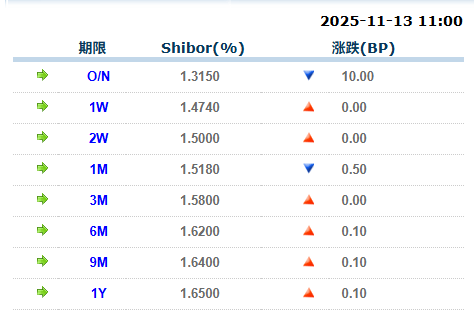
Monetary Policy and Market Operations - The People's Bank of China conducted a 190 billion yuan 7-day reverse repurchase operation at an interest rate of 1.40%, maintaining the previous rate; with 92.8 billion yuan of 7-day reverse repos maturing, the net injection into the open market was 97.2 billion yuan [1] - The overnight Shanghai Interbank Offered Rate (Shibor) fell by 10 basis points to 1.3150%, while the 7-day and 14-day Shibor rates remained unchanged at 1.4740% and 1.5000%, respectively [1][2] Interbank Market Rates - In the interbank pledged repo market, overnight funding rates continued to decline, with DR001 and R001 weighted average rates falling by 9.9 basis points and 7.7 basis points to 1.3199% and 1.3887%, respectively; transaction volumes increased by 68.5 billion yuan and 370.7 billion yuan [5] - The weighted average rates for DR007 and R007 decreased by 1.2 basis points and 0.4 basis points to 1.4782% and 1.5005%, with transaction volumes rising by 2.7 billion yuan and 89.4 billion yuan [5] Financial Instruments and Issuance - On November 13, 72 interbank certificates of deposit were issued, with a total issuance amount of 114.48 billion yuan; demand for 9-month and 1-year AAA-rated rural commercial bank products was strong, while other maturities showed average sentiment [10] - The secondary market for certificates of deposit was active, with yields for various maturities showing slight fluctuations; the 1-month national bank large enterprise ended at approximately 1.49%, up about 1 basis point from the previous day [10] Monetary Supply and Financing - As of the end of October, the broad money supply (M2) stood at 335.13 trillion yuan, growing by 8.2% year-on-year; the narrow money supply (M1) was 112 trillion yuan, up by 6.2% [12] - The total social financing scale for the first ten months of 2025 reached 30.9 trillion yuan, an increase of 3.83 trillion yuan compared to the same period last year, with a year-on-year growth of 8.5% [12]
央行发布最新金融数据!社融增量30.9万亿
Sou Hu Cai Jing· 2025-11-13 11:48
Core Insights - The People's Bank of China reported that the total social financing (TSF) increased by 30.9 trillion yuan in the first ten months of 2025, which is 3.83 trillion yuan more than the same period last year [1] - The structure of TSF is changing, with non-loan financing methods now accounting for over half of the total financing increment [2][3] - Government bond net financing reached 11.95 trillion yuan, making up nearly 40% of the TSF increment, indicating a significant role of fiscal policy in driving economic growth [2] Group 1: Monetary Policy and Financing - The year-to-date growth rate of broad money (M2) is 8.2%, while the year-on-year growth rate of narrow money (M1) is 6.2%, reflecting a slight decline in both metrics [1] - The current monetary policy stance is supportive, aimed at promoting reasonable price recovery, with a focus on maintaining strong support for the real economy [5][6] - The weighted average interest rate for new corporate loans is 3.1%, which is approximately 40 basis points lower than the same period last year [4] Group 2: Loan Structure and Economic Support - In the first ten months, RMB loans increased by 14.97 trillion yuan, with a growth rate of 6.5% as of the end of October [4] - Loans related to new economic drivers, such as technology and green financing, have maintained a rapid growth rate, indicating a shift towards high-quality economic development [4] - The leverage ratio of government departments increased by 2.2 percentage points in Q3 2025, highlighting the ongoing fiscal support for major projects and national strategies [2]
10月份金融统计数据出炉!
Zheng Quan Ri Bao Wang· 2025-11-13 11:46
Group 1 - The total social financing scale at the end of October 2025 was 437.72 trillion yuan, an increase of 8.5% year-on-year [1] - The balance of RMB loans to the real economy was 267.01 trillion yuan, growing by 6.3% year-on-year [1] - The balance of foreign currency loans to the real economy, converted to RMB, was 1.15 trillion yuan, showing a decline of 16.9% year-on-year [1] Group 2 - The cumulative increase in social financing for the first ten months of 2025 was 30.9 trillion yuan, which is 3.83 trillion yuan more than the same period last year [2] - The balance of broad money (M2) at the end of October was 335.13 trillion yuan, with a year-on-year growth of 8.2% [2] - The balance of narrow money (M1) was 112 trillion yuan, reflecting a year-on-year increase of 6.2% [2] Group 3 - The increase in RMB deposits for the first ten months was 23.32 trillion yuan, with household deposits rising by 11.39 trillion yuan [3] - The balance of RMB loans at the end of October was 270.61 trillion yuan, marking a year-on-year growth of 6.5% [3] - Corporate loans increased by 13.79 trillion yuan, with short-term loans rising by 4.34 trillion yuan and medium to long-term loans increasing by 8.32 trillion yuan [3]
央行发布最新金融数据!社融增量30.9万亿
券商中国· 2025-11-13 11:12
Core Viewpoint - The People's Bank of China reported that the social financing scale increased by 30.9 trillion yuan in the first ten months of 2025, which is 3.83 trillion yuan more than the same period last year, indicating a supportive monetary environment for economic recovery [1][2]. Group 1: Social Financing and Government Debt - Government debt net financing accounted for nearly 40% of the social financing increment, with a total of 11.95 trillion yuan, which is an increase of 3.72 trillion yuan year-on-year [2]. - The issuance of government bonds reached approximately 22 trillion yuan in the first ten months, nearly 4 trillion yuan more than the previous year, supporting major projects and economic demand [2]. - Other financing methods, excluding loans, now account for over half of the social financing increment, indicating a shift in financing structure [2][3]. Group 2: Loan Structure and Trends - The total increase in RMB loans was 14.97 trillion yuan, with a growth rate of 6.5% as of the end of October [4]. - Inclusive small and micro loans and medium to long-term loans for manufacturing showed significant growth rates of 11.6% and 7.9%, respectively, surpassing the overall loan growth rate [4][5]. - Loans related to new economic drivers, such as technology and green financing, have maintained rapid growth, with technology SMEs loans increasing by 22.3% [5]. Group 3: Monetary Policy and Price Stability - The central bank's monetary policy aims to promote reasonable price recovery, with the CPI turning positive at 0.2% in October, indicating signs of stabilization [6]. - The monetary policy stance remains supportive, with expectations of continued effects from previous policy adjustments, despite a noted decrease in marginal efficiency [6][7]. - The weighted average interest rate for new corporate loans was 3.1%, approximately 40 basis points lower than the previous year, reflecting a low-cost borrowing environment [5].