
通胀预期

Search documents
单日狂飙1050元!白银“杀疯了”,涨幅碾压黄金成新宠
Xin Lang Cai Jing· 2025-12-24 05:26
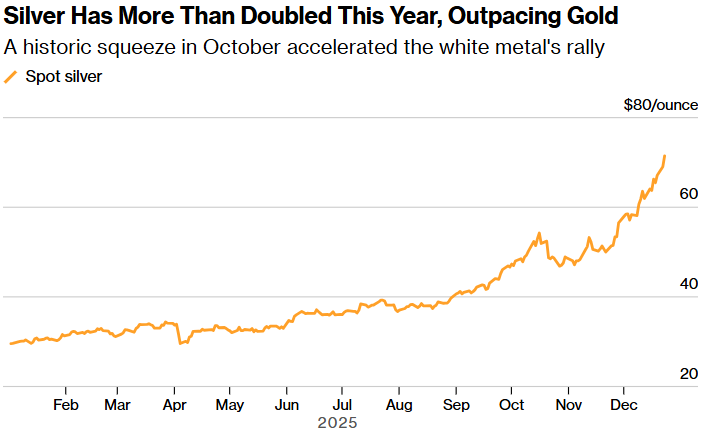
Core Viewpoint - The recent surge in silver prices is attributed to a combination of macroeconomic factors, industrial demand, and valuation corrections, positioning silver as a strong investment option beyond just being a "shadow" of gold [1][5]. Group 1: Silver's Performance - On December 24, silver prices surged by 1,050 yuan per kilogram, averaging 17,405 yuan per kilogram, with a significant increase of 6.84% [1]. - International silver prices reached 72.189 USD per ounce, marking a 1.03% increase and hitting a historical high of 72.701 USD per ounce [1]. - Year-to-date, silver has seen a cumulative increase of 150%, significantly outperforming gold's 72% rise [1]. Group 2: Drivers of Silver's Surge - The surge in silver is driven by three main factors: macroeconomic uncertainty, industrial demand, and valuation recovery [1]. - Global economic uncertainties and rising inflation expectations have increased the demand for silver as a dual-purpose asset, serving both as an inflation hedge and an industrial metal [2]. - Industrial demand for silver is growing, particularly in the photovoltaic sector, where each gigawatt of solar capacity requires approximately 10 tons of silver, and in electronics, where silver is essential for components in 5G devices and electric vehicles [2]. Group 3: Valuation Metrics - The gold-silver ratio has improved from 104:1 to 64:1, indicating that silver has become relatively cheaper compared to gold, attracting more investment [3]. - Historically, when the gold-silver ratio falls below 50:1, silver prices tend to peak, suggesting that there is still room for growth at the current ratio of 64:1 [3]. Group 4: Investment Considerations - While the recent price surge may attract investors, silver's volatility is notably higher than that of gold, with potential for significant price drops [4]. - Silver's liquidity is somewhat lower than gold, which may affect the speed of transactions and lead to price discrepancies in large trades [4]. - Long-term prospects for silver remain strong, supported by ongoing growth in the photovoltaic and electronics industries, which underpin its industrial demand [4]. Conclusion - The current rise in silver prices reflects a genuine reassessment of its industrial value and safe-haven attributes, marking a significant shift in market perception [5].


1224黄金点评:黄金短线波动加剧,盘中突破4500关口
Xin Lang Cai Jing· 2025-12-24 03:17
Core Viewpoint - The precious metals market continues to show strength, with gold prices surpassing $4500 per ounce, driven by strong economic data and ongoing interest in rate cuts from the U.S. President [2][6]. Economic Data - The U.S. GDP for Q3 grew significantly by 4.3%, marking the fastest growth in two years, primarily due to robust consumer spending [2][6]. - The PCE price index for the U.S. showed a year-on-year quarterly increase of 2.9%, aligning with expectations but higher than the previous value of 2.6%, which may suppress future rate cut expectations from the Federal Reserve [2][6]. Market Reactions - Following the strong GDP data, there was a temporary weakening in precious metals, but the market quickly recovered, with gold, silver, and copper all showing strength [2][6]. - The U.S. President has reiterated the desire for the next Federal Reserve Chair to consider rate cuts when the economy and markets are performing well, rather than preemptively acting due to inflation concerns [2][6]. Investment Implications - Given the resilient economic performance and potential for continued monetary easing from the Federal Reserve, alongside fluctuating geopolitical conditions, gold remains a significant asset allocation option [2][6].

期货日报:黄金、白银价格持续攀升并刷新历史纪录,后市怎么走?
Qi Huo Ri Bao· 2025-12-24 02:01
Core Viewpoint - The recent surge in precious metals prices, including gold and silver, is primarily driven by a loose monetary environment and liquidity, following signals from the Federal Reserve regarding interest rate cuts and quantitative easing [1][2]. Group 1: Market Dynamics - The Federal Reserve's unexpected announcement of restarting quantitative easing and potential future interest rate cuts has shifted market expectations, leading to a significant increase in precious metal prices [1]. - Gold prices are projected to rise from $2,650 per ounce at the beginning of 2025 to over $4,400 per ounce by December, reflecting a year-on-year increase of over 68% [1]. - The current market shows a unique characteristic where gold prices are rising despite high real interest rates, breaking the traditional inverse relationship [1][2]. Group 2: Demand Drivers - The demand for gold is being driven by emerging markets increasing their gold reserves due to concerns over the credibility of the US dollar, alongside a surge in retail investment in physical gold [2]. - The current demand structure for precious metals is characterized by a tripartite model of official reserves, institutional investment, and industrial applications, with central bank purchases remaining high [3]. - The supply of gold is constrained, with only 60,000 to 70,000 tons of economically viable reserves available, which is expected to last until 2032, creating a strong price support [3]. Group 3: Short-term and Long-term Factors - Short-term factors influencing precious metal prices include financial conditions and geopolitical risks, while long-term factors are tied to the monetary attributes of gold and the ongoing devaluation of currency purchasing power [4]. - The ongoing central bank gold purchasing trend, especially among non-US central banks, is expected to continue, supporting long-term price increases [5]. - The structural supply shortage of silver, which has been in deficit for five consecutive years, adds to the long-term support for precious metals [5]. Group 4: Future Outlook - In the short term (3-6 months), precious metal prices are expected to remain strong, potentially reaching bubble levels, while a longer-term view suggests a cautious approach [6]. - Gold prices are anticipated to range between $4,200 and $4,700 per ounce in the near term, with silver prices expected to follow suit [6]. - Long-term projections indicate that gold prices could rise from $4,400 per ounce to $5,000 per ounce over the next 1-2 years, representing a cumulative upside of 13.6% [6]. Group 5: Potential Variables - Key variables that could disrupt the upward trend in precious metal prices include changes in overseas financial conditions, advancements in AI technology applications, and the recovery of the Chinese economy [7].
突破70美元!白银暴涨140%碾压黄金,银矿股有哪些投资机会?
智通财经网· 2025-12-24 00:23
智通财经APP获悉,受经济压力和地缘政治紧张局势的双重影响,黄金和白银价格在12月均创下新高。 周二,黄金价格飙升至每盎司4499.94元的历史新高,较去年同期上涨超过71%。然而,白银价格涨幅 更为强劲,年初至今的涨幅超过了黄金价格。周二,白银价格突破70美元大关,较年初上涨约140%, 也创下这种贵金属的历史新高。 专家表示,这可能与这两种金属之间独特的关系有关。Orrell Capital Management 和 OCM Gold Fund 的 副总裁兼投资组合经理 Steven Orrell 表示:"从历史数据来看,在贵金属牛市期间,白银价格通常会落 后于黄金,随后出现大幅上涨,就像我们看到的那样。过去五年,白银的表现一直落后于黄金,直到上 个月才出现大幅飙升。考虑到黄金今年的表现堪称历史性,白银与黄金作为贵金属的紧密联系无疑是推 动其价格上涨的重要因素。" 尽管金银价格都在飙升,但白银的表现远超黄金。从金银比(即一盎司黄金的价格与多少盎司白银的价 格相等)来看,两者之间的差距已经大幅缩小。今年4月,该比率为104比1,而如今已降至64比1。 专家认为,白银价格涨幅超过黄金的原因可能有多种。 Orr ...
从“点目标”到“区间目标”?美财长提议重估美联储通胀框架
智通财经网· 2025-12-23 15:59
智通财经APP获悉,美国财政部长贝森特表示,一旦美国能够可持续地将通胀率降回2%水平,政府层 面可以考虑重新评估美联储现行的通胀目标框架,探讨是否应从单一目标转向区间目标。 贝森特在近日采访中表示:"当我们回到2%,我认为这一目标已在视野之内,就可以展开讨论:设定一 个区间是否更明智?在重新锚定目标之后,再谈区间才更合适。" 他进一步指出,潜在的调整方案可能包括1.5%—2.5%或1%—3%的通胀区间,并称围绕这一问题"存在 非常充分的讨论空间"。贝森特同时强调,在通胀仍高于目标水平时贸然调整目标,可能会向市场传 递"通胀一旦超标就会不断向上修正"的错误信号,从而损害政策公信力。 美联储在2012年正式、公开确立2%通胀目标,并成为全球多家央行的共同参照。贝森特认为,对"精确 到小数点后一位的确定性"过度执着并不现实,但他也承认,只有在真正实现并维持目标后,才有条件 重新锚定通胀预期。 数据显示,11月美国消费者价格指数同比上涨 2.7%。美联储更为关注的个人消费支出价格指数在截至9 月的12个月内上涨 2.8%。 在谈及民生影响时,贝森特表示,要在未达标的情况下重新锚定通胀预期"非常困难",并承认高物价已 ...
美国12月消费者信心指数降至89.1 低于预期的91.0
Xin Lang Cai Jing· 2025-12-23 15:31
47位经济学家的预测中值为91.0(预期范围为86.8至96.9)。 11月数据由88.7修正为92.9。 现状指数从126.3降至116.8。 世界大型企业联合会的数据显示,美国12月份消费者信心指数降至89.1,前一个月为92.9。 47位经济学家的预测中值为91.0(预期范围为86.8至96.9)。 预期指数维持在70.7不变。 11月数据由88.7修正为92.9。 通胀预期中值为4.6%,低于前一个月的4.8%。 现状指数从126.3降至116.8。 责任编辑:李桐 预期指数维持在70.7不变。 通胀预期中值为4.6%,低于前一个月的4.8%。 责任编辑:李桐 世界大型企业联合会的数据显示,美国12月份消费者信心指数降至89.1,前一个月为92.9。 ...
金价破4400续刷新高 战略配置背后暗藏何动因
Jin Tou Wang· 2025-12-23 11:25
Core Insights - Gold prices have reached historical highs, surpassing the $4,400 mark, demonstrating strong resilience and attracting widespread market attention [1] - The recent rise in gold prices is attributed to a complex set of factors rather than panic buying due to geopolitical conflicts or economic crises, indicating a strategic shift in investment behavior [1] - Central banks have moved past aggressive interest rate hikes, and inflation expectations remain stable, which typically does not favor non-yielding assets like gold; however, demand for gold is transforming, positioning it as a stabilizer in investment portfolios [1] Market Trends - The trend of increasing gold prices is expected to continue until 2026, potentially becoming a central theme in asset allocation strategies [2] - As long as global policy adjustments remain uncertain and geopolitical dynamics are in flux, gold's value as a "strategic anchor asset" is unlikely to diminish [2] - Price corrections in gold are viewed as opportunities for positioning rather than endpoints in the upward trend, with the $4,400 level serving as a critical reference point for assessing trend continuity [2] Technical Analysis - Technically, gold prices have entered a consolidation phase after approaching the $4,500 region, without showing signs of a peak [2] - The key support level is identified at $4,400; maintaining prices above this level is essential for sustaining the overall upward structure [2]
大越期货贵金属早报-20251223
Da Yue Qi Huo· 2025-12-23 02:21
交易咨询业务资格:证监许可【2012】1091号 贵金属早报—— 2025年12月23日 大越期货投资咨询部 项唯一 从业资格证号: F3051846 投资咨询证号: Z0015764 联系方式:0575-85226759 重要提示:本报告非期货交易咨询业务项下服务,其中的观点和信息仅作参考之用,不构成对任何人的投资建议。 我司不会因为关注、收到或阅读本报告内容而视相关人员为客户;市场有风险,投资需谨慎。 CONTENTS 目 录 1 前日回顾 2 每日提示 3 4 5 今日关注 基本面数据 持仓数据 利多: 利空: 逻辑: 1、基本面:圣诞假期,科技股再撑美股走高,金价跟随银价上涨,刷新历史最高; 美国三大股指全线收涨,欧洲三大股指收盘小幅下跌;美债收益率集体上涨,10年 期美债收益率涨2.74个基点报4.165%;美元指数跌0.46%报98.26,离岸人民币对美 元小幅贬值报7.0336;COMEX黄金期货涨2.13%报4480.60美元/盎司;中性 2、基差:黄金期货1000.86,现货994.2,基差-6.62,现货贴水期货;偏空 3、库存:黄金期货仓单91716千克,不变;偏空 4、盘面:20日均线 ...
宏观与大宗商品周报:冠通期货研究报告-20251222
Guan Tong Qi Huo· 2025-12-22 10:21
Report Overview - Report Title: Macro and Commodity Weekly Report - Report Author: Wang Jing - Release Date: December 22, 2025 - Report Institution: Guantong Futures Co., Ltd. 1. Market Summary - Overseas, Japan's interest rate hike was uneventful, and the competition for the Fed Chair heated up. The market showed a dull performance approaching the year - end. Investors were cautious, the VIX index declined slightly, and risk - assets were mixed. Global stocks and commodities mostly fell, A - shares oscillated and pulled back, and the BDI index continued to decline. Commodities were under pressure with internal style transformation. Precious metals and non - ferrous metals weakened, oil prices remained weak, and the black series rebounded strongly [5][8]. - In the domestic market, the bond market rebounded with short - term weakness and long - term strength. Stock indices oscillated and were mostly down, with the growth - style stocks underperforming value - style stocks, and the Shanghai Composite 50 Index rising against the trend. The domestic commodity sectors showed mixed performance. The weekly change of the Wind Commodity Index was 1.5%, with 5 out of 10 commodity sub - indices rising and 5 falling. The black series was strong, with the coal, coke, steel, and ore and non - metallic building materials sectors rising over 4%. The chemical sector followed, while precious metals barely rose, and soft commodities were nearly flat. Other sectors fell, especially the oilseeds, grains, and agricultural products sectors. Non - ferrous metals turned down, and the energy sector continued to slump [5][14]. - In the futures market capital aspect, the overall capital of the commodity futures market slightly flowed out. The agricultural products and soft commodities sectors saw obvious capital inflows, while many sectors had capital outflows, with significant outflows in the non - metallic building materials, energy, and grain sectors [16]. 2. Volatility and Interest Rate Expectations - The volatility of the international CRB commodity index slightly increased, the domestic Wind Commodity Index had a small upward volatility, and the volatility of the Nanhua Commodity Index declined. By sector, the volatility of commodity futures sectors was mixed, with obvious volatility declines in the energy and oilseeds sectors and notable increases in the non - ferrous and soft commodities sectors [6][22]. - According to the CME's FedWatch tool, the probability of the Fed keeping the interest rate unchanged at 3.5 - 3.75% in January was 75.2%, little changed from last week's 72.7%. The probability of a 25 - bp rate cut to 3.25 - 3.5% remained below 30%. The market expected 1 - 3 rate cuts in 2026 [6]. 3. Upcoming Events - Due to the approaching Christmas and New Year holidays, macro - economic data is scarce this week. The focus will be on a small amount of US economic data, especially GDP data. The initial estimate of US Q3 GDP will be released on December 23. Investors will assess the US economic performance and look for clues about the Fed's next rate - cut time. In addition, investors will seek guidance on the Bank of Japan's policy path from Governor Ueda Kazuo's speech on December 25 and the release of the meeting's opinion summary on December 29. The US stock market will close three hours early on December 24 and be closed on December 25 [7]. 4. Fed Chair Candidates - Kevin Hassett, the "insider" most likely to be nominated, is an economic policy "spokesperson" and political ally of Trump. He publicly supports rate cuts and has criticized the Fed's past policies [70]. - Kevin Warsh, the "returner" favored by Wall Street, has Fed experience and is strongly supported by the financial community. He has publicly advocated rate cuts and balance - sheet reduction [71]. - Christopher Waller, the "dark horse" with solid policy experience, is a current Fed governor. He has rational and consistent policy discussions on rate cuts and has promoted conservative reforms within the Fed [72]. 5. Other Key Information - US inflation data for November was lower than expected, with the CPI rising 2.7% year - on - year and the core CPI rising 2.6%. Many economists were puzzled by this, and the data was affected by the government shutdown [77]. - On December 19, the Bank of Japan raised the policy rate to 0.75%. However, Governor Ueda Kazuo's cautious remarks on policy prospects pressured the yen, and the lack of a clear future rate - hike schedule confused investors. The market expects the Bank of Japan's future tightening to be gradual [84]. - This week's key economic data and events include UK Q3 GDP final value, US Q3 GDP initial estimate, and speeches from central bank governors [90].
美联储延续降息进程 沪银期货有望维持偏强走势
Jin Tou Wang· 2025-12-22 06:03
Group 1 - The main contract of Shanghai silver futures experienced a rapid increase, with a minimum drop to 16,282.00 yuan and a current price of 16,075.00 yuan, reflecting a rise of 5.18% [1] Group 2 - According to Xinyi Futures, the Shanghai silver 02 contract should be held with a stop-loss strategy, as the current market shows a high degree of crowded long positions, and new positions should be observed cautiously [2] - Zhongcai Futures indicates that the price center of precious metals still has upward potential, supported by macroeconomic factors and industrial demand, despite some negative influences from inflation expectations [3] - Guoxin Futures suggests that the precious metals sector is likely to maintain a strong trend in the short term, while cautioning about increased volatility after significant price increases [3]