
AI概念

Search documents
行情走到了十字路口 | 谈股论金
水皮More· 2025-08-21 09:28
Core Viewpoint - The market is at a crossroads, debating between continuing speculative trading in concept stocks or returning to value stocks, indicating a need for rational investment decisions [3][5]. Market Performance - The three major A-share indices showed mixed results, with the Shanghai Composite Index rising by 0.13% to 3771.10 points, while the Shenzhen Component Index fell by 0.06% to 11919.76 points, and the ChiNext Index decreased by 0.47% to 2595.47 points [2]. - The total trading volume in the Shanghai and Shenzhen markets reached 242.41 billion, a slight increase of 15.8 billion from the previous day [2]. Sector Analysis - The current market rally has two main themes: large financials and technological innovation, with the latter showing signs of overheating and potential bubble risks [3][4]. - The semiconductor sector in the U.S. has been experiencing a downward trend, with notable declines in stocks like Nvidia (down 3.87%), Intel (down 7%), and TSMC (down 1.7%), raising concerns about similar trends in domestic tech stocks [3][4]. Individual Stock Performance - Key stocks contributing to the Shanghai Composite's rise include Agricultural Bank of China (up 2.2%), China Mobile (up 1.24%), and PetroChina (up 1.57%), which collectively added 5.62 points to the index [4]. - Notable individual stock movements include Oriental Fortune (down 1.03%), CATL (down 0.07%), BYD (down 1.06%), and NewEase (up 1.07%) [4]. Speculative Risks - The market is witnessing a significant increase in margin trading, which amplifies risks, especially at high price levels. A potential market correction could lead to substantial losses for investors [5]. - The concept of "liquid cooling" has shown vulnerability, with three companies hitting the daily limit down, indicating the fragility of speculative trends [5].


8.20午间观察:缩量拉升显端倪,主力资金亮底牌,午后大盘大概率这么走
Sou Hu Cai Jing· 2025-08-21 02:38
Core Viewpoint - The A-share market is experiencing a significant shift, characterized by a stark contrast between the performance of major indices and the majority of individual stocks, indicating a potential manipulation of market dynamics by institutional investors [1][2]. Group 1: Market Dynamics - The Shanghai Composite Index opened positively but saw over 3,000 stocks decline, highlighting a "red fat green thin" scenario [1]. - Institutional investors executed a strategy of "robbing the poor to give to the rich," with large orders totaling 5.8 billion yuan, while retail investors sold off 9.2 billion yuan [1]. - A sudden 24 billion yuan sell-off caused the index to drop close to the 3,700-point mark, followed by a rapid recovery in the liquor sector, showcasing a "pitfall" strategy [2]. Group 2: Sector Performance - The software development sector faced a 1.7% decline, while AI concept stocks saw a significant drop in interest [1]. - Liquor stocks, particularly Wuliangye and Moutai, experienced substantial gains, with Wuliangye's trading volume exceeding 5 billion yuan [2]. - The traditional Chinese medicine sector, previously favored, became neglected, indicating rapid sector rotation [2]. Group 3: Capital Flow and Investor Behavior - Northbound capital showed a split, with 1.28 billion yuan entering the Shanghai Stock Exchange while 730 million yuan exited the Shenzhen Stock Exchange [2]. - Investors are reportedly shifting from tech stocks to blue-chip stocks in the liquor and banking sectors, indicating a cautious approach to high-valuation tech stocks [2]. - The financing balance remained stable at 1.52 trillion yuan, despite rising concerns reflected in the VIX index climbing to 18.5 [9]. Group 4: Economic Indicators and Future Outlook - The GC001 rate surged to 3.2%, signaling tightening liquidity conditions [3]. - Three potential market scenarios were outlined: a bullish breakout above 3,746 points, a neutral consolidation between 3,720-3,740 points, or a bearish drop below 3,700 points [3][5][7]. - The earnings season revealed that 35% of the 2,100 reported financial results fell short of expectations, particularly in the new energy sector [11].
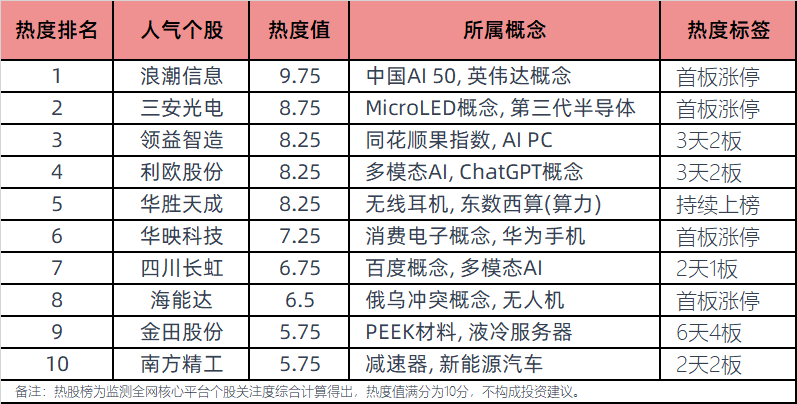
今日十大热股:浪潮信息、三安光电首板涨停领衔,AI概念、液冷服务器持续爆炒
Jin Rong Jie· 2025-08-21 01:12
Core Viewpoint - A-shares experienced a collective rise, with the Shanghai Composite Index reaching a ten-year high, driven by significant trading volume and structural market trends [1] Group 1: Market Performance - The total trading volume in the two markets reached 2.4 trillion yuan, with over 3,600 stocks rising and 86 non-ST stocks hitting the daily limit [1] - Semiconductor and liquor sectors led the market rally, indicating a notable structural market trend [1] Group 2: Popular Stocks - The top ten popular stocks as of August 21 include Inspur Information, Sanan Optoelectronics, Lingyi iTech, Leo Group, Huasheng Tiancheng, Huaying Technology, Sichuan Changhong, Hainengda, Jintian Co., and Southern Precision [2] Group 3: Key Influencing Factors - Inspur Information's stock price is driven by the explosive demand for AI computing power and the company's technological advantages, with a 165% year-on-year revenue growth in Q1 [3] - Sanan Optoelectronics benefited from multiple positive news releases, including a $239 million acquisition of Lumileds and a 21.23% year-on-year revenue increase in Q1 [3] - Lingyi iTech's growth is supported by strategic acquisitions and significant orders from Apple, with a projected net profit increase of 31.57%-66.66% for the first half of the year [3] Group 4: Additional Stock Insights - Leo Group's stock performance is influenced by multiple hot concepts and a doubling of net profit in the mid-year report [4] - Huasheng Tiancheng's expected net profit growth of 148%-173% is driven by its partnership with Huawei and participation in key projects [4] - Huaying Technology's revenue growth of 9.73% in high-margin products is supported by significant funding from its controlling shareholder [4] - Sichuan Changhong's stock is propelled by its partnership with Huawei and AI initiatives, alongside a share buyback plan [4] - Hainengda's stock performance is boosted by innovative solutions and a significant increase in operating cash flow [5] - Jintian Co. experienced a 203.86% year-on-year net profit increase, driven by advancements in liquid cooling technology [5] - Southern Precision's stock is influenced by policy catalysts and a projected net profit increase of over 286 times [5]


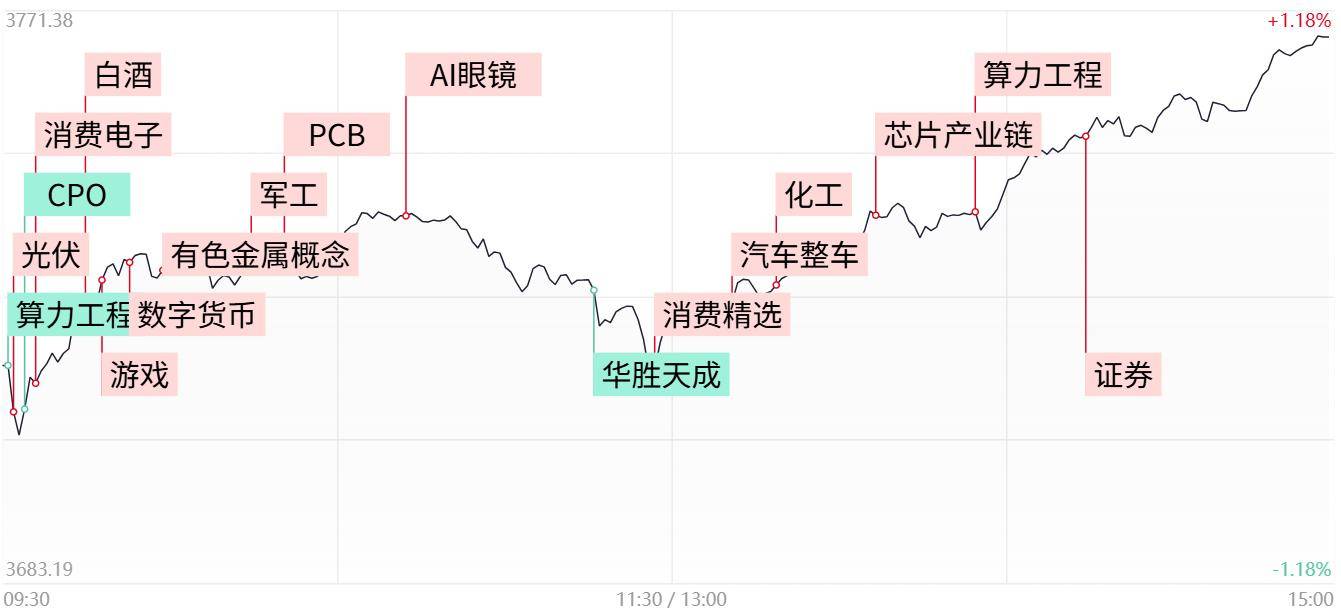
涨停复盘:机器人概念持续强势 汽车零部件、消费电子概念走强
Sou Hu Cai Jing· 2025-08-20 11:36
Market Performance - The Shanghai Composite Index rose by 1.04% to close at 3766.21 points, while the Shenzhen Component Index increased by 0.89% to 11926.74 points. The ChiNext Index saw a smaller gain of 0.23%, closing at 2607.65 points. The STAR Market 50 Index surged by 3.23% to 1148.15 points. The total trading volume in the Shanghai and Shenzhen markets reached 24082.34 billion yuan [1]. Sector Movements - The robotics sector continued its strong performance, with companies like Kosen Technology hitting the daily limit. The consumer electronics sector also saw a rise, with Anjie Technology reaching the daily limit. Additionally, the automotive parts sector was active, with Jin Qilin and others hitting the daily limit [1]. Notable Stocks - Several stocks hit their daily limit, including: - Wuchan Jinlun (002722.SZ) for its involvement in AI applications and textile equipment [6]. - Hainengda (002583.SZ) for its focus on robotics and AI communication networks [6]. - Inspur Information (000977.SZ) for growth in AI servers and domestic computing power [6]. - Kosen Technology (603626.SH) for its connection to consumer electronics and robotics [7]. - Huabao Health (002004.SZ) for its growth in skin health and innovative drugs [7]. Industry Trends - In the consumer electronics sector, reports indicate that Apple's iPhone 17 has entered mass production, with Foxconn preparing for increased hiring to meet demand. Analysts expect upgrades in AI capabilities and other components, suggesting potential for price increases in related supply chains [8].


纳指创四月来最大跌幅!科技股集体承压,英伟达暴跌3.5%引发连锁反应,市场静候鲍威尔“鹰语”
Jin Rong Jie· 2025-08-20 00:06
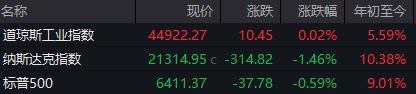
美东时间周二(8月19日),美股三大指数涨跌分化,道指微涨0.02%至44922.27点,标普500指数下跌 0.59%,纳指重挫1.46%至21314.95点,创下自4月"关税恐慌"以来第二大单日跌幅。 | 名称 | 现价 涨跌幅 年初至今 涨跌 | | | | --- | --- | --- | --- | | 道琼斯工业指数 | 44922.27 10.45 0.02% 5.59% | | | | 纳斯达克指数 | 21314.95 c -314.82 -1.46% | | 10.38% | | 标普500 | 6411.37 -37.78 | -0.59% | 9.01% | 科技股集体承压,英伟达领跌引发连锁反应 科技股的集体下挫成为拖累市场的主要力量。英伟达当日股价暴跌3.5%,创四个月来最大跌幅,直接 带动"美股七巨头"指数单日下挫1.69%。Meta、特斯拉、亚马逊、微软等头部科技公司也均跌幅超1%, 显示出市场对高估值科技股的短期抛售压力。 国际贸易形势复杂化,关税政策影响深远 在国际贸易领域,美国商务部宣布将407个产品类别纳入钢铁和铝关税清单,适用税率为50%,这一决 定立即引发了市场的 ...

中泰国际每日晨讯-20250818
ZHONGTAI INTERNATIONAL SECURITIES· 2025-08-18 01:55
Market Performance - The Hang Seng Index rose 1.7% last week, closing at 25,270 points[1] - The Hang Seng Tech Index increased by 1.5%, ending at 5,543 points[1] - Average daily trading volume in Hong Kong stocks increased by 8.2% to HKD 242.8 billion[1] Capital Flows - Net inflow through the Hong Kong Stock Connect reached HKD 38.12 billion last week, with a record single-day inflow of HKD 35.88 billion on Friday[1] - Cumulative net inflow into Hong Kong stocks over the past 20 days amounted to HKD 159 billion, indicating strong market sentiment[1] Economic Indicators - In July, the US CPI showed a moderate inflation slowdown, with a probability of a 25 basis point rate cut by the Federal Reserve exceeding 90%[2] - China's economic indicators showed a marginal slowdown, with July's consumption, investment, production, and credit data all falling short of expectations[2] Real Estate Sector - Real estate development investment in China fell by 17.1% year-on-year in July, a larger decline than June's 12.4%[3] - New housing starts and completions dropped by 15.2% and 29.5% year-on-year, respectively, both exceeding June's declines[3] Industry Highlights - The automotive sector saw significant stock price increases, with Great Wall Motors rising 12.9% and Geely Auto up 4.5% last week[4] - The healthcare index surged by 7.1%, driven by strong performance from companies like Fosun Pharma, which saw an 8.7% increase in stock price[5] Renewable Energy - The photovoltaic sector experienced notable gains, with stocks like Xinyi Solar and GCL-Poly Energy rising by 7.0% and 9.7%, respectively[6] - Honghua Wisdom Energy reported a 2.0% increase in net profit, contributing to positive investor sentiment[6]
注意,两大重磅大消息,下周行情稳了……
Sou Hu Cai Jing· 2025-08-17 11:57
Group 1 - The core focus is on the ongoing Russia-US talks regarding the Russia-Ukraine situation, which, although not yielding expected results, is seen as a positive step towards dialogue [1] - The latest monetary policy report from the central bank indicates a significant shift in macroeconomic regulation, suggesting further improvement in service sector valuations [1] - The market is experiencing increased liquidity, with the Federal Reserve canceling its regulatory plans concerning cryptocurrencies, which is viewed positively for capital flow [1] Group 2 - The recent robotics conference highlighted the success of Yushu Technology, raising questions about potential opportunities in chip and AI sectors [1] - There is speculation about whether the semiconductor industry will see more opportunities, particularly in domestic substitution [1] - The consumer loan policy starting September 1 may indicate a shift in consumer preferences, especially in the automotive sector, suggesting potential growth areas [1] Group 3 - The stock market's performance, particularly the inability to maintain above the 3700-point mark, reflects a cautious sentiment among retail investors, while foreign capital remains significant [2] - The current market dynamics suggest that patience is required, as many small and mid-cap stocks have not performed well, indicating a need for strategic investment [2] - The metaphor of nurturing flowers is used to emphasize the importance of understanding stock characteristics and market conditions before making investment decisions [2]

第三届中国(海南)东坡文化旅游大会第三次筹备会议召开
Hai Nan Ri Bao· 2025-08-17 01:04
Core Points - The third preparatory meeting for the Third China (Hainan) Dongpo Cultural Tourism Conference was held to advance the next steps of the event [2] - The conference aims to enhance the integration of culture and tourism in Hainan, aligning with national policies and promoting the province's cultural and tourism industries [3] Group 1 - The conference emphasizes the importance of high-quality organization of the Dongpo Cultural Tourism Conference as a practical implementation of Xi Jinping's cultural thought and a tribute to the self-trade port's operational closure [2][3] - The event is positioned as a key vehicle for promoting the integration of culture and tourism, with a focus on improving the level, quality, and reputation of Hainan's tourism and cultural industries [3] - The opening musical "Heart of Dongpo," recognized as China's first AI concept national style musical, aims for nationwide and overseas tours, highlighting the commitment to high-quality content and production [3] Group 2 - Relevant departments and Chao Mai County are tasked with efficiently preparing for various activities, including the protection and restoration of Dongpo cultural relics and hosting international forums and competitions [3] - The meeting called for a collaborative effort between government and enterprises to enhance marketing and promotion, aiming to create a phenomenon-level cultural product that expands Hainan's cultural influence [3]
周末IPO等股市要闻述评
Sou Hu Cai Jing· 2025-08-16 11:51
Group 1 - Next week, there will be one IPO subscription, indicating a stable IPO environment which is positive for the market [1] - A total of 25 stocks will be unlocked next week, with a total market value exceeding 79.5 billion, which may negatively impact the funding environment and the stocks being unlocked [2] - The 2025 World Humanoid Robot Games have commenced, with Yuzhu Technology winning the first gold medal, highlighting the ongoing development and potential in the robotics, AI, 5G communication, and data sectors [2] - Trump's announcement of potential import restrictions on steel and semiconductors could stimulate domestic alternatives, benefiting related sectors such as semiconductors, AI, and robotics [2] - The central bank's focus on promoting reasonable price recovery is likely to lead to increased money supply, positively impacting consumption and inflation concepts [2] Group 2 - The first cross-border share swap in A-shares has been approved, attracting foreign strategic investments, which is beneficial for the A-share funding environment [3] - The issuance of total control indicators for rare earth mining and separation for 2025 is favorable for the rare earth industry [4] - The Ministry of Commerce's response regarding China's WTO complaint against Canada's steel import restrictions is positive for the steel industry [5] - The surge in market demand for liquid cooling technology is beneficial for the liquid cooling sector [6] - The recent financial data shows a significant decrease in household and corporate deposits, indicating a potential shift of funds into the stock market, which is positive for the funding environment [6] - The upcoming meeting for solar companies suggests a positive direction for the solar industry, especially with new clean energy tax credit regulations in the U.S. [6] Group 3 - Warren Buffett's significant cash holdings and reduced stock value may indicate a potential investment opportunity in the A-share market [7] - The Shanghai Stock Exchange is monitoring stocks with severe price fluctuations, which may impact market stability [7] - The regulatory approach of managing market volatility remains unchanged, indicating ongoing challenges in balancing market support and speculation [8] - The meeting between Putin and Trump did not yield agreements, maintaining a neutral impact on the market [8] - The mixed performance of global markets, with U.S. indices reaching new highs, is generally positive for Chinese concept stocks [8]
段永平增持苹果与英伟达,投资策略彰显对科技巨头的坚定信心
Xin Lang Cai Jing· 2025-08-15 19:29
Group 1 - H&H International Investment, managed by Duan Yongping, reported a total portfolio value of $11.53 billion as of the end of Q2, with Apple being the largest holding at $7.2 billion, accounting for over 62% of the portfolio [1][2] - Apple's stock price experienced a decline due to "reciprocal tariffs," reaching a near two-year low, but rebounded nearly 15% within two weeks following CEO Tim Cook's market activities, prompting Duan to increase his Apple holdings by 894,000 shares, a 2.61% increase [1] - Duan Yongping showed significant interest in AI stocks, particularly Nvidia, increasing his holdings by 320,000 shares, a 49.56% rise, as Nvidia's stock price doubled since the beginning of the year [1] Group 2 - In the Chinese concept stock sector, Duan Yongping demonstrated confidence by purchasing over 900,000 additional shares of Pinduoduo in Q2, resulting in an 11.72% increase in holdings, making it the third-largest position in his portfolio [2] - Duan's investment strategy reflects a cautious yet opportunistic approach, focusing on companies with strong business models and demonstrating a commitment to industry giants and trends, particularly in technology and AI sectors [2]
