
Agent

Search documents
【兴证计算机】Agent:海外巨头财报及GPT5验证高景气
兴业计算机团队· 2025-08-10 14:45
Group 1 - The core viewpoint emphasizes a strategic increase in investment in the computer sector, particularly focusing on leading companies in the Agent space, as the market shows positive growth trends both domestically and internationally [1][2] - The report highlights the acceleration of major model iterations since July, including Grok4, Kimi K2, GLM4.5, Genie3, and GPT5, indicating a trend towards open-source, low-cost, low-hallucination, and multi-modal features, which are expected to enhance AI application deployment [1][2] - The report suggests actively seizing market fluctuations to build positions in leading companies, especially in the commercial and military AI sectors, as evidenced by Palantir's impressive Q2 2025 performance, where its commercial Agent-driven revenue grew by 93% year-on-year [2] Group 2 - The second chapter of the report provides a focused analysis on overseas AI application leaders and the implications of GPT5, reinforcing the high growth potential in this sector [3]


一文读懂GPT-5发布会:新功能乏善可陈
Hu Xiu· 2025-08-08 00:56
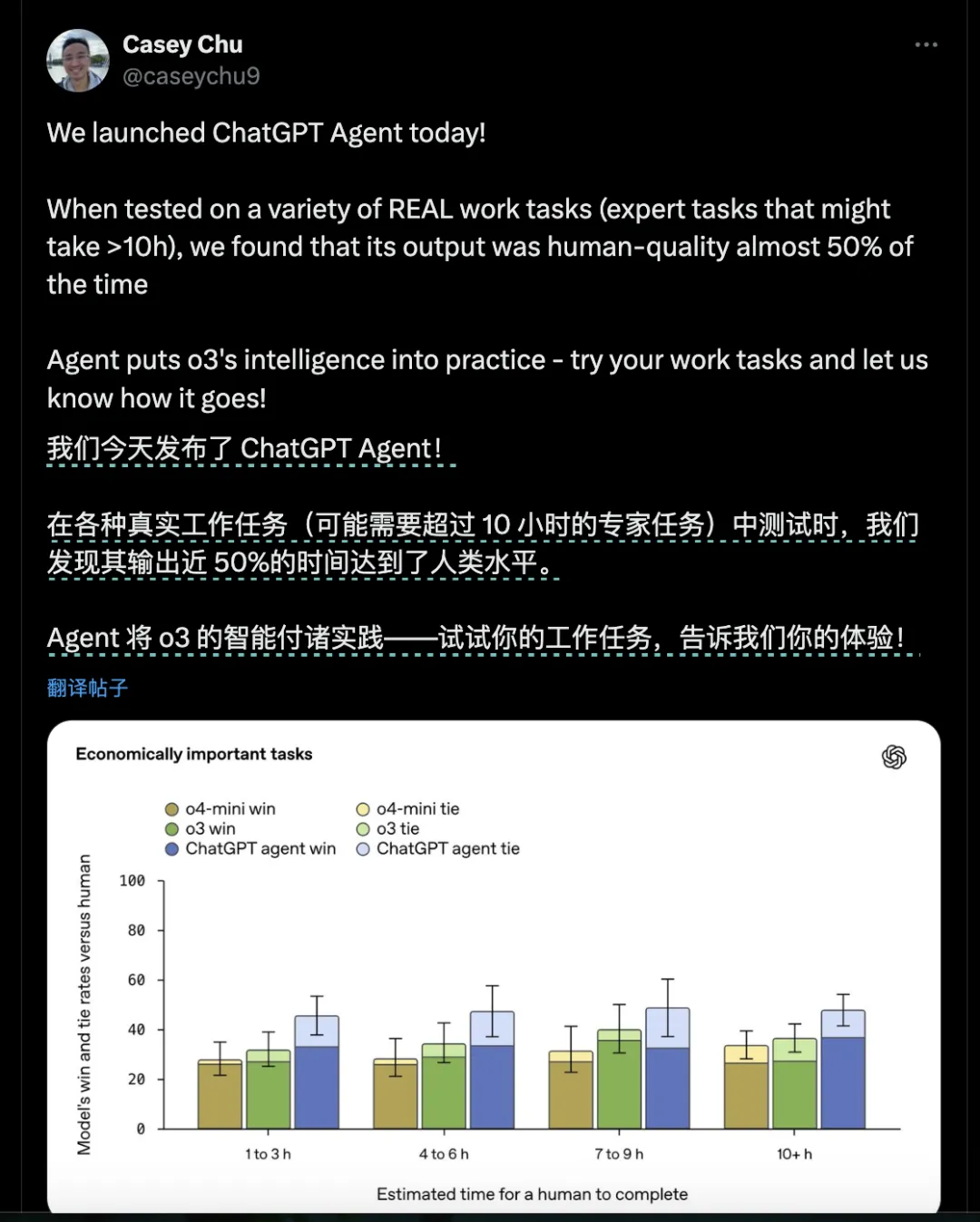
Core Insights - OpenAI has launched ChatGPT Agent, a universal AI agent that represents a significant advancement in AI technology [2][4][16] - The ChatGPT Agent integrates capabilities from previous projects, Operator and Deep Research, into a unified system that can perform complex tasks autonomously [16][20] - The agent operates in a virtual sandbox environment, allowing users to observe its actions in real-time while ensuring task context is maintained [18][23] Technical Features - ChatGPT Agent utilizes a new model trained through reinforcement learning, enabling it to switch seamlessly between various tools for complex tasks [20][21] - It includes a visual browser, text-based browser, terminal, and API access, allowing for diverse interactions and task execution [21][23] - The agent can autonomously execute tasks based on natural language commands, such as generating reports or analyzing data [23][24] Performance Metrics - In benchmark tests, ChatGPT Agent achieved a record score of 41.6% on the HLE task, surpassing the recently released Grok4 [26][27] - It demonstrated high accuracy in real-world data science tasks, with analysis and modeling accuracy rates of 89.9% and 85.5%, respectively [33] - The agent's ability to edit spreadsheets outperformed competitors, achieving a score of 45.5% in SpreadsheetBench [36] Availability and User Interaction - The ChatGPT Agent is available to Pro users immediately, with other tiers to follow in the coming days [42] - Users can interact with the agent by switching to "agent mode" and providing task descriptions, with real-time visibility into its operations [44] - The agent allows for periodic task execution, enhancing user convenience [45] Competitive Landscape - ChatGPT Agent's innovation lies in its integrated virtual machine environment, a feature not present in other models [51] - OpenAI acknowledges that while the agent is advanced, it is still in early stages, with ongoing improvements planned for functionality and user experience [53] - A comparison with Anthropic's Claude highlights differences in operational philosophy, with ChatGPT focusing on autonomous task execution within a virtual environment [54]
发布多款新产品,360也要争夺Agent市场
Xin Lang Cai Jing· 2025-08-07 02:38
Core Viewpoint - 360 Group has unveiled its new strategy "AllinAgent" at the Internet Security Conference, emphasizing the need for AI capabilities to produce tangible results rather than just suggestions or answers [1] Group 1: AI Development and Strategy - The company is focusing on developing intelligent agents across all departments to automate tasks, allowing employees to balance work and personal life without layoffs [1] - 360's upgraded Nano AI has transformed into a "multi-agent swarm," capable of generating high-quality videos and reports, and addressing user queries in various domains [1][3] - The development of intelligent agents is categorized into four levels, with the newly introduced L4 level aiming for collaborative efforts among multiple agents to enhance service capabilities [3] Group 2: Cybersecurity and Market Challenges - 360 is also targeting the B2B market by providing AI-driven cybersecurity services, recognizing the increasing threat posed by AI-enabled attacks [4] - The emergence of intelligent agents in hacking has created an asymmetry in cybersecurity, necessitating the integration of AI in defense strategies [4][5] - The newly launched security intelligent agent can identify threats three times more effectively than human efforts, with a tenfold increase in detection speed and a 20% improvement in accuracy [5] Group 3: Business Dynamics and Future Outlook - The company anticipates continuous rapid changes in its business model, asserting that the evolution of intelligent agents is ongoing and that execution and adaptability are key competitive advantages [5]


深度对话未来智能CTO王松:小米阿里引爆智能眼镜,AI耳机还是个好赛道吗?
Guan Cha Zhe Wang· 2025-08-07 02:22
Core Insights - The article discusses the shift of traditional tech giants like Xiaomi, Alibaba, and Baidu towards smart glasses, while a startup called "Future Intelligence," spun off from iFlytek, focuses on AI conference headphones, indicating a niche strategy in a competitive landscape [1][3]. Company Strategy - Future Intelligence has developed a unique approach by deeply engaging in vertical scenarios and optimizing Bluetooth protocols, which has helped them create a differentiated "moat" in the market [1][10]. - The company has successfully completed multiple rounds of financing, including a Pre A+ round led by Qiming Venture Partners, highlighting investor interest in their innovative approach [1]. Product Development - The first generation of iFLYBUDS headphones faced criticism due to basic experience issues, but the core value of AI meeting recording was validated through user feedback [1][7]. - The company adopted a "5+X" principle, emphasizing five essential elements (sound quality, battery life, noise cancellation, comfort, and design) before adding AI functionalities to ensure market success [9]. Market Positioning - Future Intelligence believes that AI headphones will play a crucial role in future human-computer interaction, especially as smart glasses face limitations in supply chain maturity and ergonomic design [1][10]. - The company asserts that while many consumer electronics giants are developing AI headphones, their deep understanding of specific vertical scenarios provides a competitive edge that larger companies may overlook [11].

营收超1亿美元!可灵,凭什么?
第一财经· 2025-08-06 15:22
Core Viewpoint - The article discusses the rapid evolution and commercialization of AI-generated video content, highlighting the success of creators like Hashem AI-Ghaili and the advancements in video generation technology, particularly through the company KuaLing, which has achieved significant user growth and revenue in a competitive landscape [6][11][12]. Group 1: AI Video Generation Success - Hashem AI-Ghaili created the short film "Kira" using multiple AI tools, costing only $500 and taking 12 days to produce, contrasting with traditional high-budget productions [6][7]. - KuaLing's annual revenue surpassed $100 million as of March 2023, with user numbers growing from 6 million to 4.5 million in a short span, indicating strong market demand [11][20]. - The video generation sector is experiencing rapid growth, with KuaLing outperforming competitors like MiniMax and Tencent in user acquisition and revenue generation [12][22]. Group 2: Technological Advancements - KuaLing has introduced several innovative features in its video generation models, such as "first and last frame" functionality, which enhances the coherence of generated videos [14][46]. - The introduction of multi-modal interaction capabilities allows users to upload images and videos as references, significantly improving the controllability and quality of the generated content [19][50]. - The company has successfully integrated user feedback into its product development, leading to significant improvements in user experience and satisfaction [47][58]. Group 3: Market Dynamics and Competition - The competitive landscape for AI video generation is intensifying, with new entrants like ByteDance's Jimo and Luma AI rapidly gaining traction [25][26]. - KuaLing's market share in video generation tools is substantial, but maintaining this position will require continuous innovation and adaptation to user needs [23][25]. - The industry is witnessing a shift in perception, with AI tools being embraced as valuable assets rather than threats, leading to the emergence of new job roles focused on AI content creation [61][62]. Group 4: Future Directions - KuaLing plans to explore the development of AI agents to automate the video creation process, further lowering barriers for users and enhancing creative workflows [66]. - The company envisions a future where AI-generated content not only serves existing media formats but also creates new, interactive content forms [68].


海外重磅AI大模型接连发布!恒生科技ETF基金(513260)连续7天净流入,港股通科技30ETF(520980)收涨近1%三连阳!
Xin Lang Cai Jing· 2025-08-06 08:48
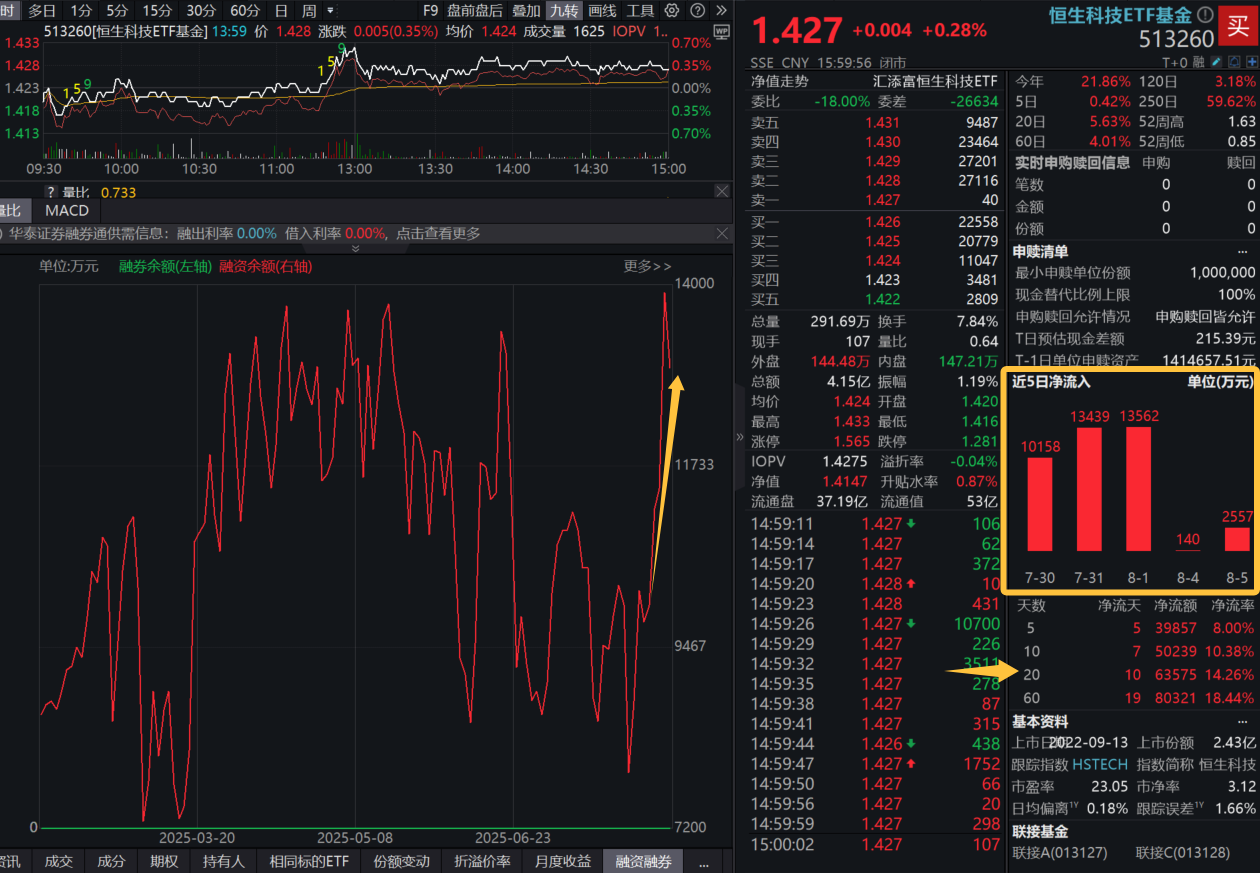
Group 1: Market Performance - The Hong Kong stock market showed a positive trend, with the Hang Seng Tech ETF (513260) rising by 0.28%, achieving three consecutive days of gains, and a total trading volume exceeding 400 million [1] - The Hang Seng Tech ETF (513260) saw a net inflow of over 500 million in the past week, reaching a record high of over 5.2 billion in total assets [1] - The Hang Seng Tech ETF's financing balance remains high at over 120 million, indicating strong investor interest [1] Group 2: AI Developments - Google, OpenAI, and Anthropic made significant advancements in AI models, with Google launching Genie 3, which can generate interactive 3D environments, a substantial improvement over its predecessor [5] - Anthropic released Claude Opus 4.1, enhancing programming and reasoning capabilities, while OpenAI introduced two open-weight models, GPT-oss-120b and GPT-oss-20b, which are designed for local computer use [5][6] - Citic Securities anticipates that the next generation of models, such as GPT-5, will drive significant advancements in technology and application across various industries [7] Group 3: Future Trends in AI - The next generation of AI models is expected to achieve a 10-fold increase in intelligence with a 2-3 times increase in scale, particularly benefiting the Agent and multi-modal directions [8] - The demand for computational power is projected to rise significantly due to the expansion of model sizes and data volumes, with a focus on system-level solutions to meet this demand [8] - AI applications are nearing a revenue inflection point, with expectations that by 2025, AI business contributions from core AI companies will reach approximately 2-5% of total business [9] Group 4: Hong Kong Stock Market Outlook - The Hong Kong stock market is expected to continue its bullish trend, outperforming the A-share market, driven by sectors such as innovative pharmaceuticals, new consumption, and AI applications [9][11] - The scarcity of technology assets in Hong Kong is anticipated to provide greater upward potential, with leading companies across the AI value chain poised to benefit from the ongoing AI industry transformation [10][11]
对话格灵深瞳CEO吴一洲:穿透WAIC热度,透视AI落地的“硬功夫”
Guan Cha Zhe Wang· 2025-08-06 08:28
【文/王力 编辑/周远方】 2025年世界人工智能大会(WAIC)期间,"一票难求"的现象成为今年热度高涨的显著注脚。在这一背 景下,人工智能技术如何从概念加速走向实际应用、企业如何在机遇与挑战并存的环境中布局与发展, 成为业界深入探讨的核心议题。 观察者网在大会现场与格灵深瞳CEO吴一洲及副总裁罗楷进行深度交流,围绕行业趋势演变、技术落地 瓶颈、格灵深瞳的战略聚焦以及对未来发展的思考等多个维度展开了对话。 以下为访谈实录: 观察者网:今年的WAIC(世界人工智能大会)出现了"一票难求"的现象,相较往年,这一现象显得尤 为突出。您能否分享一下,今年AI行业的整体氛围较往年有哪些显著变化? 吴一洲:确实能感受到今年WAIC与往届的不同。去年大会更像是一场行业交流,而今年,随着 DeepSeek、阿里等头部企业的积极布局和技术突破,整个行业对AI的关注度、认知度显著提升,大众 对AI技术的接受度与参与热情也呈现爆发式增长。 这种变化对产业发展而言无疑是积极信号,WAIC的"出圈"标志着AI正从专业领域走向大众视野。 观察者网:您认为当前这种关注热度是否会继续保持快速攀升,还是会出现走平或回落? 吴一洲:在我看来, ...


对话启明创投周志峰:科技投资要追求「逐浪而行」,也要讲究「以史为鉴」
IPO早知道· 2025-08-06 02:42
Core Viewpoint - Qiming Venture Partners is a leading investment institution in the AI sector in China and Asia, actively participating in the development of AI technologies and applications, and has hosted the WAIC forum for three consecutive years to discuss investment opportunities in AI [2][4]. Group 1: Investment Strategy and Market Trends - Qiming Venture Partners has invested in over 100 AI projects, covering the entire AI industry chain, and has supported the rise of several industry benchmark companies [4]. - The firm emphasizes the importance of forming an independent investment methodology to navigate the noise in the early investment field, particularly addressing the challenge of FOMO (Fear of Missing Out) [5][12]. - The current landscape of AI investment is characterized by a significant influx of new companies, particularly in the field of embodied intelligence, with over 100 new companies established in the past two years [11]. Group 2: Insights on AI Technologies - The firm believes that the development of embodied intelligence is closely linked to foundational large models, which provide the necessary architecture and intelligence for advancements in robotics [10][11]. - The competitive landscape for large models is dynamic, with no clear long-term leaders emerging, as any model's competitive advantage is expected to last no more than three months [23][24]. - The firm predicts that the evaluation of large model companies will shift from technical characteristics to application implementation and revenue scale in the coming years [6][20]. Group 3: Commercialization and Future Outlook - The firm anticipates that 2023 will be a pivotal year for the commercialization of humanoid robots, with expectations of significant orders and deployments in various commercial scenarios [15]. - Challenges remain in the commercialization of humanoid robots, including matching human efficiency and the need for high-quality training data [16][17]. - The firm sees potential for "super AI applications" to emerge as model capabilities improve and costs decrease, making large-scale user adoption feasible [27][28]. Group 4: Historical Context and Future Predictions - Qiming Venture Partners emphasizes the importance of understanding historical technological trends, asserting that current innovations are evolutionary rather than revolutionary [40]. - The firm believes that the AI era's pricing models will not differ significantly from existing models, focusing on delivering user value [33]. - The firm is cautious about the potential for market bubbles in the AI sector, likening it to the natural occurrence of foam in beer, where a portion of the market may be inflated without lasting value [19].

百度智能云发布全球首批AI数字员工 打造企业级Agent最佳实践
Zheng Quan Ri Bao Wang· 2025-08-05 11:12
Group 1 - Baidu Smart Cloud launched the world's first AI digital employees, covering key business functions such as marketing manager, repayment assistant, and product manager, leveraging AI capabilities for immediate deployment and effectiveness [1][2] - The digital employees are designed to redefine enterprise-level intelligent service capabilities with three characteristics: understanding business, delivering results, and being evolvable [1][2] - The integration of Baidu's decade-long experience in intelligent customer service and advanced digital human technology has led to a transformation from functional execution to business decision-making and outcome delivery [2] Group 2 - The digital employees have already been applied in Baidu's customer service center, achieving a 60% increase in user claim success rates and an 18-hour improvement in service efficiency [2] - Baidu Smart Cloud aims to expand the application of digital employees in four key industries: education, automotive, finance, and fast-moving consumer goods, with low entry barriers for businesses [3] - The core technological advantages of digital employees include an intelligent brain, human-like appearance, industry-specific knowledge, and an evolutionary capability, facilitating the transition of AI from a tool to a business partner [2]

量子位智库2025上半年AI核心成果及趋势报告
2025-08-05 03:19
Summary of Key Points from the AI Industry Report Industry Overview - The report discusses the rapid development of artificial intelligence (AI) and its significance as one of humanity's most important inventions, highlighting the interplay between technological breakthroughs and practical applications in the industry [4][7]. Application Trends - General-purpose agents are becoming mainstream, with specialized agents emerging in various sectors [4][9]. - AI programming is identified as a core application area, significantly changing software production methods, with record revenue growth for leading programming applications [14][15]. - The introduction of Computer Use Agents (CUA) represents a new path for general-purpose agents, integrating visual operations to enhance user interaction with software [10][12]. - Vertical applications are beginning to adopt agent-based functionalities, with natural language control becoming integral to workflows in sectors like travel, design, and fashion [13]. Model Trends - The report notes advancements in reasoning model capabilities, particularly in multi-modal abilities and the integration of tools for enhanced performance [18][21]. - The Model Context Protocol (MCP) is accelerating the adoption of large models by providing standardized interfaces for efficient and secure external data access [16]. - The emergence of small models is highlighted, which aim to reduce deployment barriers and enhance cost-effectiveness, thus accelerating model application [33]. Technical Trends - The importance of reinforcement learning is increasing, with a shift in resource investment towards post-training and reinforcement learning, while pre-training still holds optimization potential [38][39]. - Multi-Agent systems are emerging as a new paradigm, enhancing efficiency and robustness in dynamic environments [42][43]. - The report discusses the evolution of transformer architectures, focusing on optimizing attention mechanisms and feedforward networks, with multiple industry applications [45]. Industry Dynamics - The competitive landscape is evolving, with leading players like OpenAI, Google, and others narrowing the gap in model capabilities [4]. - AI programming is becoming a critical battleground, with significant revenue growth and market validation for applications like Cursor, which has surpassed $500 million in annual recurring revenue [15]. - The report emphasizes the need for practical evaluation metrics that reflect real-world application value, moving beyond traditional static benchmarks [34]. Additional Insights - The report highlights the challenges of data quality and the diminishing returns of human-generated data, suggesting a shift towards models that learn from real-time interactions with the environment [44]. - The integration of visual and textual reasoning capabilities is advancing, with models like OpenAI's o3 excelling in visual reasoning tasks [24][25]. - The report concludes with a focus on the future of AI, emphasizing the potential for models to autonomously develop tools and enhance their problem-solving capabilities [21][44].