
科创板

Search documents
光模块CPO回调,创业板人工智能ETF(159381)盘中跌超1%,天孚通信跌超5%
Mei Ri Jing Ji Xin Wen· 2025-08-04 02:47
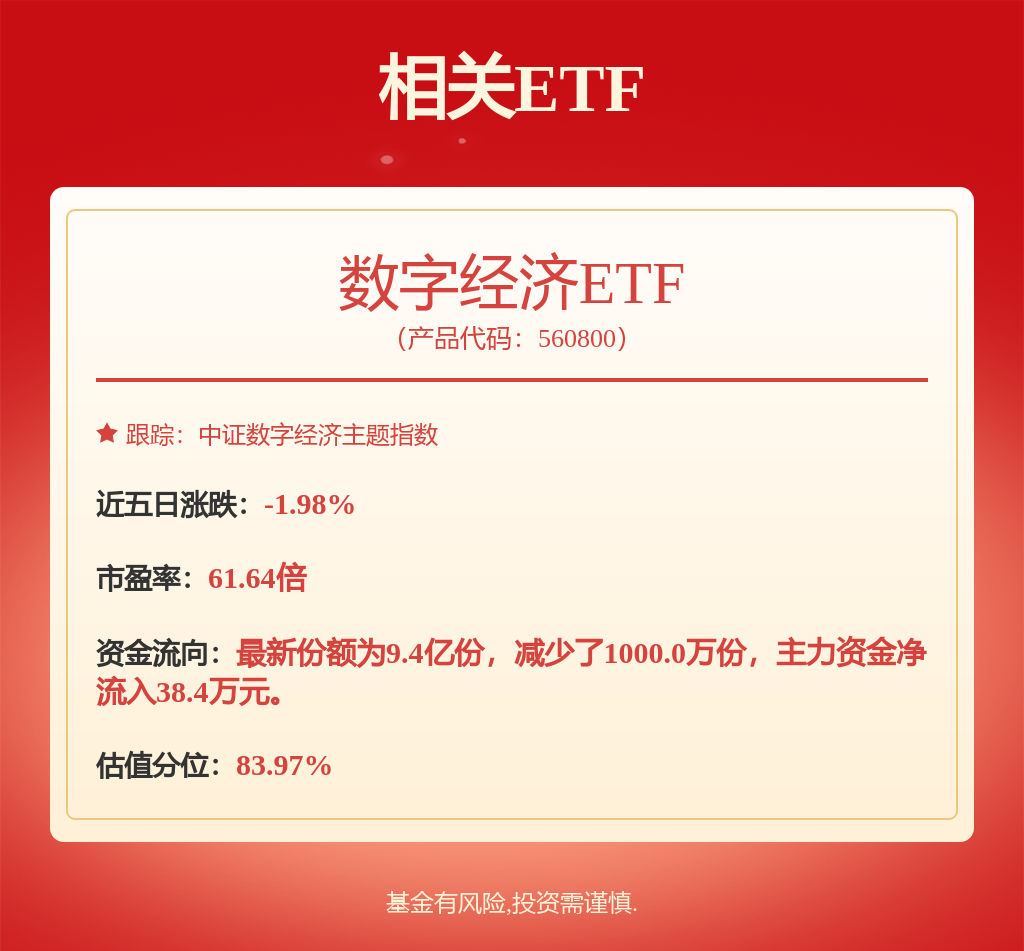
Core Viewpoint - The A-share computing power industry chain, particularly the optical module sector, has experienced a decline, with the AI index on the ChiNext board dropping by 0.78% and key stocks like Tianfu Communication falling over 5% [1] Group 1: Market Performance - The ChiNext AI index, which has a high concentration of optical components, has seen a decline, indicating a cooling trend in the market [1] - The recent two-day pullback in the computing power industry chain reflects a broader market adjustment, with significant declines in several key stocks [1] Group 2: Investment Opportunities - The Huaxia ChiNext AI ETF (159381) has attracted over 33 million yuan in inflows over the past 10 trading days, indicating strong investor interest [1] - This ETF tracks the ChiNext AI index and focuses on AI-related companies listed on the ChiNext board, with over 33% of its weight in optical modules [1] Group 3: Key Holdings - The top three holdings in the ETF include leading optical module companies: Zhongji Xuchuang, Xinyisheng, and Tianfu Communication, alongside other industry leaders such as Beijing Junzheng and Allwinner Technology [1] - The ETF has the lowest comprehensive fee rate among comparable funds, with a management fee of 0.15% and a custody fee of 0.05% [1]

解锁科创板新地图:“科创成长层”开通攻略在此!
申万宏源证券上海北京西路营业部· 2025-08-04 02:04
Core Viewpoint - The article discusses the establishment and operational guidelines of the "Science and Technology Innovation Growth Layer" on the STAR Market, aimed at supporting unprofitable but promising technology companies [5][19]. Group 1: Introduction to the Science and Technology Innovation Growth Layer - The Science and Technology Innovation Growth Layer was officially launched on July 13, 2025, by the Shanghai Stock Exchange, with the goal of fostering the development of technology enterprises that are not yet profitable but have significant growth potential [5]. - This layer is designed to enhance the inclusivity for technology companies with bright prospects, allowing them to access capital markets more easily [9][17]. Group 2: Access and Participation Guidelines - Investors who already have STAR Market trading permissions and have a risk tolerance assessment result of C4 (active) or above can trade stocks or depositary receipts listed after the new regulations on the Science and Technology Innovation Growth Layer, provided they sign a risk disclosure statement [7][11]. - For investors who have not yet opened STAR Market trading permissions, they must first meet the basic requirements and then sign the risk disclosure statement to participate in trading [11][12]. Group 3: Eligibility Requirements for Investors - To open trading permissions for the STAR Market, individual investors must have an average daily asset of no less than RMB 500,000 in their securities and funds accounts over the past 20 trading days, excluding funds and securities borrowed through margin trading [12]. - Investors must have at least 24 months of trading experience and pass a knowledge test regarding STAR Market trading risks [12]. Group 4: Identification and Labeling of Stocks - Stocks of companies listed on the Science and Technology Innovation Growth Layer will have a "U" identifier to indicate their unprofitable status, with new registrations labeled as "成" and existing stocks labeled as "成1" to differentiate between new and existing stocks [17].


百亿私募加仓明显,多家机构热议8月A股机会
Huan Qiu Wang· 2025-08-04 01:52
但亦有券商也提示需应对可能存在波动,中信证券表示,行业逐步向趋势性品种聚焦,而高切低模式效率偏低;近期增量流动性边际上有所放 缓,行情需要降温才能行稳致远。目前重点关注的依然聚焦在AI、创新药、资源、恒科以及科创板。 总体来看,对于后市配置,机构建议聚焦产业趋势确定以及受外部扰动较少的板块,风格上继续偏好科技成长;8月为中报集中披露期,市场 或处于局部热点轮动行情之中,因此建议把握业绩确定性较强的机会。 另据最新数据,在近期A股市场震荡行情中,股票私募仓位略有回升,其中百亿级股票私募加仓明显。截至7月25日,所有股票私募机构平均 仓位为75.85%,较前一周上升0.76个百分点。其中,百亿级股票私募的平均仓位为78.47%,较前一周大幅提升5.69个百分点。 【环球网财经综合报道】上周A股市场在创下今年以来新高后,三大股指均出现一定幅度的回调。但这并未影响到7月份以来投资者情绪的明 显回暖,并推动A股市场交投活跃、量价齐升。 面对市场波动,业内机构认为,支撑市场上涨的核心逻辑未出现变化,短期扰动带来震荡休整,建议坚定多头思维。包括国泰基金、长城基 金、金鹰基金等在内的多家公募机构发布最新市场展望,普遍认为在国 ...

四大证券报精华摘要:8月4日
Zhong Guo Jin Rong Xin Xi Wang· 2025-08-04 00:35
Group 1 - Hong Kong Stock Exchange has implemented new IPO regulations to enhance market competitiveness and flexibility, effective from August 4 [1][8] - The initial public holding threshold for "A+H" issuers has been adjusted to 10% or a market value of HKD 30 billion, signaling support for more A-share companies to list in Hong Kong [1][8] - The new regulations require at least 40% of shares to be allocated to book-building investors while maintaining a six-month lock-up period for cornerstone investors [8] Group 2 - The Panda bond market has seen a cumulative issuance surpassing CNY 1 trillion, with 116.65 billion issued this year alone, indicating a growing interest from international institutions [2] - China Shenhua has initiated a significant asset restructuring plan to integrate 13 core asset companies from its controlling shareholder, enhancing its coal resource strategy and operational capabilities [3] - The A-share market has experienced a rebound, with significant inflows from various funds, including a notable increase in new fund issuance in July, reaching CNY 34.8 billion [4][6] Group 3 - Private equity confidence has risen, with the private equity confidence index reaching 125.52, and the proportion of fully invested and leveraged private equity increasing [5] - The public fund market has shown strong performance, with July seeing the issuance of 135 new funds raising CNY 104.87 billion, driven by the floating fee rate reform [6][7] - The capital market is witnessing a surge in innovative drug sector funds, with a total of 17 "doubling funds" launched this year, reflecting strong performance in this sector [6][7] Group 4 - The recent reforms in the STAR Market and ChiNext are aimed at supporting companies in emerging sectors like AI and commercial aerospace, facilitating their access to capital markets [7][8] - The public fund industry has reached a total scale of CNY 34.48 trillion by the end of July, indicating robust growth and a shift in asset allocation strategies [8]
盘前必读丨机械工业数字化转型实施方案印发;暑期档票房破70亿
Di Yi Cai Jing Zi Xun· 2025-08-03 23:32
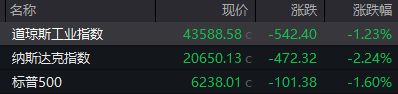
Market Overview - The U.S. stock market experienced a significant decline, with the Dow Jones Industrial Average falling by 542.40 points, or 1.23%, closing at 43,588.58 points. The Nasdaq Composite dropped 2.24% to 20,650.13 points, while the S&P 500 decreased by 1.60% to 6,238.01 points. This downturn was influenced by new tariffs imposed by Trump on several trade partners and a disappointing employment report, which showed a non-farm payroll increase of only 73,000, below the expected 104,000 [2][3]. Individual Stock Performance - Amazon's stock fell by 8.3% due to lower-than-expected revenue guidance for the third quarter. Other major tech stocks also saw declines, with Apple down 2.5%, Nvidia down 2.3%, and Tesla and Microsoft both down 1.8%. The Nasdaq China Golden Dragon Index decreased by 1.8%, with Alibaba down 2.9%, NetEase down 2.2%, Baidu down 2.0%, and JD down 1.8% [3]. Commodity Prices - Oil prices were pressured by economic uncertainty and expectations of increased production from OPEC+. WTI crude oil for the nearest month fell by 2.79% to $67.33 per barrel, while Brent crude oil dropped by 2.83% to $69.67 per barrel [3]. Gold Prices - Increased risk aversion led to a rise in gold prices, with October contracts on the New York Mercantile Exchange surpassing $3,400, marking a 2.02% increase [4]. Economic Policies - The People's Bank of China announced plans for a moderately loose monetary policy, including a reduction in the reserve requirement ratio and support for local government financing platforms. Additionally, a new tax policy on interest income from government bonds will take effect on August 8, 2025 [4][5]. Automotive Industry Performance - In July, several electric vehicle manufacturers reported their delivery figures: Li Auto delivered 30,731 vehicles, XPeng delivered 36,717 vehicles (up 229% year-on-year), NIO delivered 21,017 vehicles (up 25.2% year-to-date), and Leap Motor delivered 50,129 vehicles (up over 126% year-on-year). BYD reported July sales of 344,300 new energy vehicles, a slight increase from 342,400 vehicles in the same month last year [6][7][9]. Corporate Actions - China Shenhua announced plans to issue shares and pay cash to acquire assets from its controlling shareholder, with trading of its A-shares suspended starting August 4, 2025, for up to 10 trading days [8]. - Lianyi Intelligent Manufacturing is set to undergo a restructuring process, with a review by the Shenzhen Stock Exchange scheduled for August 8, 2025 [10].

中信证券:做趋势还是高切低?
券商中国· 2025-08-03 12:42
Core Viewpoint - The positioning of the market determines the behavior of dominant funds, which in turn influences the structure and pattern of rising industries. Historically, in liquidity-driven markets, leading industries tend to be concentrated rather than rotating between high and low positions. This reflects a pursuit of efficiency by funds, favoring high-consensus varieties over low-position varieties [1][4]. Group 1: Market Behavior and Trends - The market in July confirmed that industries are gradually focusing on trend-driven varieties, while the high-cut low model is less efficient [6][7]. - A review of the past 15 years shows that once a sector gains consensus, its strong performance tends to last until the end of the market cycle. Strong sectors often end later than mid-range sectors, and the excess returns of leading sectors over mid-range sectors tend to expand throughout the market cycle [3][4]. Group 2: Investment Focus Areas - Current focus areas include AI, innovative pharmaceuticals, resources, advanced technology, and the Sci-Tech Innovation Board [11]. - In the AI sector, there is uncertainty regarding the transition from North American supply chains to domestic ones. The demand for North American computing power is being reassessed, but the domestic supply chain lacks commercial closure [12]. - The innovative pharmaceutical sector is supported by potential business development expectations, with large pharmaceutical companies still having room for valuation growth compared to 2020-2021 [13]. - Resource stocks are currently well-matched in terms of fundamentals and valuations, with price increases reflecting earnings elasticity due to supply constraints and demand growth [13][14]. - The advanced technology sector is suitable for long-term investment despite some short-term fluctuations, driven by the potential of AI applications and semiconductor developments [14]. - The Sci-Tech Innovation Board presents opportunities for rebound, particularly in the semiconductor sector, which may receive a boost from optimistic guidance from key players [14]. Group 3: Market Liquidity and Fund Flows - Recent trends indicate a marginal slowdown in incremental liquidity, suggesting that the market needs to cool down for stability [9]. - In July, public mutual funds experienced a net outflow of approximately 25.1 billion, following a rare net inflow in June. This reflects a potential exhaustion of sales channels due to the previous issuance of floating rate products [10]. - Despite some outflows, industry and thematic ETFs saw significant net inflows, driven mainly by individual investors [10].

中信证券:目前重点关注的依然聚焦在AI、创新药、资源、恒科以及科创板
news flash· 2025-08-03 08:12
Core Viewpoint - The positioning of the market determines the behavior of leading funds, which in turn influences the structure and pattern of rising industries [1] Group 1: Market Behavior - Historically, market trends driven by incremental liquidity tend to concentrate on leading industries rather than rotating between high and low performers [1] - The essence behind this behavior is the pursuit of efficiency by funds, favoring high consensus stocks over low-positioned ones [1] Group 2: Recent Market Trends - The market performance in July confirmed that industries are gradually focusing on trend-driven stocks, while the high-cut low rotation model shows lower efficiency [1] - There has been a marginal slowdown in incremental liquidity recently, indicating that the market needs to cool down for stable long-term growth [1] Group 3: Focus Areas - Current key areas of focus include AI, innovative pharmaceuticals, resources, Hengke, and the Sci-Tech Innovation Board [1]

连年巨亏冲科创板 蓝箭航天成色如何?
Shang Hai Zheng Quan Bao· 2025-08-03 04:23
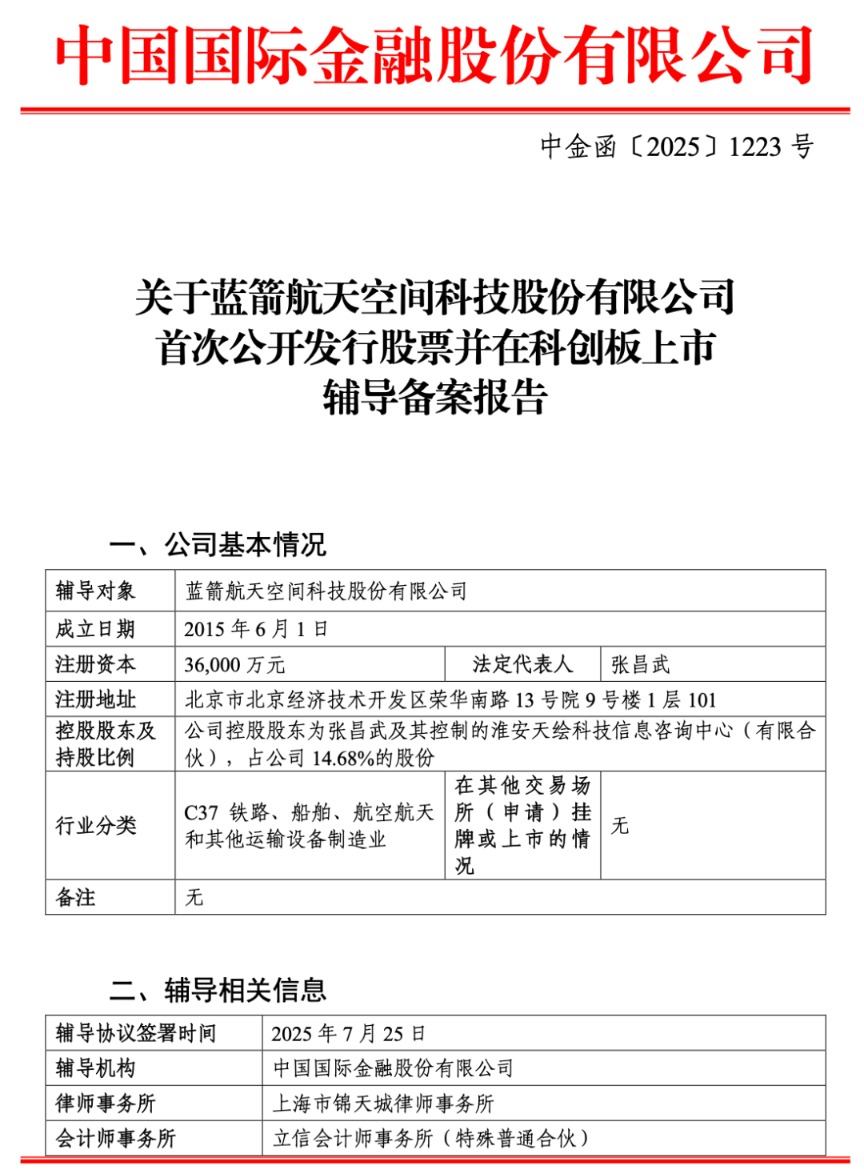
Core Viewpoint - Blue Arrow Aerospace, a leading private rocket company in China, has initiated guidance for its IPO on the Sci-Tech Innovation Board despite significant losses exceeding 1 billion yuan in the past two years, reflecting the high-risk nature of the commercial aerospace industry [1][12]. Company Overview - Blue Arrow Aerospace was established on June 1, 2015, with a registered capital of 360 million yuan, and is focused on developing a full industrial chain centered around medium and large liquid oxygen-methane launch vehicles [2][3]. - The company is controlled by Zhang Changwu and his investment firm, holding 14.68% of the shares [2][3]. Financial Performance - Blue Arrow Aerospace reported net losses of 1.015 billion yuan in 2024 and 1.178 billion yuan in 2023, with net assets of 3.916 billion yuan and 2.495 billion yuan respectively [8][12]. - The company has undergone multiple rounds of financing, raising billions, with significant investments from various venture capital firms, including a notable 900 million yuan investment from the National Manufacturing Transformation and Upgrade Fund in December 2024 [5][8]. Market Position and Challenges - The company is seen as a strong contender for being the first commercial aerospace stock on the Sci-Tech Innovation Board, but its substantial losses, heavy asset load, and low shareholding ratio of the controlling shareholder may raise regulatory concerns [1][18]. - Blue Arrow Aerospace has a unique position in the market, having invested heavily in developing a comprehensive supply chain and planning a large satellite constellation, which is the first of its kind by a private company in China [12][13]. Industry Context - The commercial aerospace sector is characterized by high technology, high investment, high risk, and long cycles, with Blue Arrow Aerospace being one of the few companies to have launched a liquid oxygen-methane rocket successfully [12][13]. - The recent reforms in the Sci-Tech Innovation Board have expanded the eligibility criteria for companies in emerging sectors like commercial aerospace, providing a potential pathway for Blue Arrow Aerospace to go public [17][18]. Future Prospects - The company anticipates a surge in demand for satellite launches as China enters a phase of high-density satellite constellation deployment, with plans for multiple rocket launches in the coming years [16][18]. - Blue Arrow Aerospace aims to leverage its technological advancements and market position to capitalize on the growing demand for space services, with expectations of significant operational capacity by 2026 [13][16].
66只科创板股获融资净买入超1000万元
Zheng Quan Shi Bao Wang· 2025-08-02 02:05
融资净买入金额最多的是瑞可达,该股最新融资余额9.44亿元,环比上一日增加2.43亿元,该股当日上涨19.99%,融资净买入金额居前的还有东 芯股份、九号公司、上海谊众等,净买入金额分别为8427.48万元、8298.09万元、7864.68万元。 获融资客净买入超1000万元的科创板股中,当日平均上涨1.10%,涨幅居前的有瑞可达、热景生物、科思科技等,分别上涨19.99%、11.03%、 8.37%,跌幅居前的有东芯股份、鼎通科技、影石创新等,跌幅分别为11.37%、6.13%、5.99%。分行业统计,这些融资客青睐的科创板中,电 子、医药生物、计算机等行业最为集中,分别有19只、14只、11只个股上榜。 (原标题:66只科创板股获融资净买入超1000万元) 科创板融资余额环比前一日增加4.16亿元,其中,66股融资余额环比增加超1000万元,融资净买入居前的有瑞可达、东芯股份、九号公司等股。 证券时报•数据宝统计显示,截至8月1日,科创板两融余额合计1736.50亿元,较上一交易日增加3.99亿元,其中,融资余额合计1730.33亿元,较 上一交易日增加4.16亿元。为连续15个交易日增加。 科创板股中 ...


科创板收盘播报:科创50指数缩量跌1.06% 生物制药类个股活跃
Xin Hua Cai Jing· 2025-08-01 07:58
换手率方面,磁谷科技换手率为28.29%,位居首位;天能股份换手率为0.17%,位居末位。 细分领域中,软件服务、生物制药、通信设备、电气设备、医疗保健类个股表现活跃,部分元器件、半 导体类个股下跌。 (文章来源:新华财经) 经新华财经统计,8月1日,科创板589只个股平均涨幅0.70%,平均换手率3.40%,合计成交额1554亿 元,成交额较上一交易日大幅萎缩,平均振幅为4.53%。 新华财经北京8月1日电 (王媛媛)科创50指数8月1日震荡回落,收跌逾1%,日线三连阴。至收盘时, 科创50指数报1036.77点,跌幅1.06%,指数振幅为2.57%,总成交额约330.5亿元。 个股表现方面,瑞可达涨20%,领涨成分股;东芯股份跌11.37%,跌幅居首。 从盘面上看,科创板个股多数上涨,上涨个股341只。高价股多数下跌,低价股则多数上涨。 成交额方面,东芯股份成交额61.6亿元,位居首位;ST帕瓦成交额418.2万元,位居末位。 ...