不动产投资信托基金

Search documents
北部湾港:拟开展港口基础设施公募REITs申报发行工作
Ge Long Hui· 2025-12-08 11:02
Core Viewpoint - Beibu Gulf Port (000582.SZ) is responding to national policy initiatives by expanding its financing channels and enhancing its market value through the establishment of a public real estate investment trust (REIT) focused on port infrastructure [1] Group 1: Company Initiatives - The company plans to utilize its wholly-owned subsidiary, Beibu Gulf Port Beihai Terminal Co., Ltd., to develop a public REIT based on the underlying assets of the North Mu berths 1 and 2 located in the Tieshan Port area of Beihai City, Guangxi Zhuang Autonomous Region [1] - This initiative aims to create a "dual-driven" development model for the listed company, improving asset operation efficiency and forming a positive investment and financing cycle [1] Group 2: Financial Strategy - The public REIT will focus on the port infrastructure sector, which is expected to enhance the company's overall market performance and facilitate better asset management [1]

关键一步,瞄准万亿级市场
Zhong Guo Ji Jin Bao· 2025-12-07 14:30
2025年11月28日,证监会发布《关于推出商业不动产投资信托基金试点的公告(征求意见稿)》(以下 简称《征求意见稿》),拟在"基础设施REITs"之外,单列"商业不动产REITs"创新项目,商业综合体、 商业零售、写字楼、酒店等商业物业将被纳入公募REITs投资范围。 业内人士表示,从全球成熟市场发展经验来看,商业综合体、商业零售、写字楼、酒店等商业不动产是 REITs重要的底层资产。我国商业不动产存量规模庞大,具有通过REITs盘活并拓宽权益融资渠道的内 在需求。 借鉴国际经验并结合我国实际,坚持市场化法治化方向,适时推出商业不动产REITs,可以更好发挥 REITs功能作用,支持构建房地产发展新模式,进一步提升多层次资本市场服务实体经济的质效。 商业不动产纳入公募REITs范围 【导读】商业不动产REITs要来了 迈出扩容关键一步 商业不动产REITs激活万亿级市场 中国基金报记者方丽陆慧婧 为贯彻落实党中央、国务院决策部署和资本市场新"国九条"要求,推动不动产投资信托基金(REITs) 市场高质量发展,丰富资本市场投融资工具,支持构建房地产发展新模式,持续增强多层次资本市场服 务实体经济质效,证监会就 ...
商业不动产REITs试点正积极推进
Zhong Guo Zheng Quan Bao· 2025-12-01 20:25
Core Viewpoint - The China Securities Regulatory Commission (CSRC) is drafting an announcement to launch a pilot program for commercial real estate investment trusts (REITs) to promote high-quality development of the REITs market and support a new model for real estate development [1][2]. Group 1: Market Potential - The commercial real estate sector in China is vast, with a strong demand for asset holders to access direct financing channels, indicating significant growth potential for commercial real estate REITs [1]. - According to Zhongtai Securities, the potential space for commercial real estate REITs is estimated to be between 800 billion to 1.5 trillion yuan [1]. Group 2: Financing and Risk Mitigation - The introduction of commercial real estate REITs is timely, providing market-based financing and exit channels for real estate companies and local state-owned enterprises, thereby alleviating liquidity pressures [2]. - The move is expected to help reduce leverage and mitigate risks by revitalizing existing assets and supporting a new model for real estate development [2]. Group 3: Regulatory Framework - The draft announcement establishes a classification management system for REITs, recognizing the differences between commercial real estate and infrastructure in terms of asset attributes and management [3]. - The regulatory approach will involve parallel development of commercial real estate REITs and infrastructure REITs, optimizing regulatory requirements for real estate companies [3]. Group 4: Policy Adaptability - Regulatory authorities will enhance the policy framework to ensure the smooth implementation of the commercial real estate REITs pilot, focusing on improving market efficiency and promoting a healthy investment cycle [3]. - There will be ongoing efforts to optimize the issuance and expansion mechanisms for REITs, encouraging participation and activity in the market [3]. Group 5: Review Process - The review process for REITs may see marginal changes, potentially accelerating the expansion of products, as the draft is released solely by the CSRC, suggesting a simplification of the approval chain [4].
新华财经晚报:我国基础设施REITs再迈关键一步 扩围至酒店、商业办公设施等领域
Xin Hua Cai Jing· 2025-12-01 11:48
Key Points - China's infrastructure REITs have expanded to include hotels, commercial office facilities, and other sectors, marking a significant breakthrough in the types of underlying assets [1] - The annual express delivery volume in China has surpassed 180 billion pieces for the first time, averaging over 16 billion pieces per month, reflecting the robust vitality of the Chinese economy [2] - The State Administration for Market Regulation is advancing the regulatory framework for infant liquid milk products, aiming to enhance safety and quality standards in the industry [1] - The Chinese government has implemented a new policy to support housing for low-income workers, expanding assistance to include both newly built and existing homes [3] - President Putin has signed a decree allowing Chinese citizens to enter Russia without a visa for up to 30 days, effective until September 14, 2026, promoting tourism and business travel [4] Domestic News - The National Development and Reform Commission has published a new list of eligible projects for infrastructure REITs, which now includes sports venues, commercial complexes, and urban renewal projects [1] - The express delivery sector's growth is seen as a key driver for consumption and economic stability, with the industry experiencing significant scale effects [2] - The Guangdong Provincial Development and Reform Commission reported that 1,500 key projects are planned for 2025, with an investment target of 1 trillion yuan, achieving 96% of the annual investment goal by October [2] International News - The Eurozone's manufacturing PMI for November was reported at 49.6, slightly below expectations, indicating a contraction in the manufacturing sector [5] - Germany's manufacturing PMI for November was 48.2, also below expectations, suggesting ongoing challenges in the manufacturing landscape [6] - France's manufacturing PMI remained stable at 47.8, while Italy's PMI improved to 50.6, indicating a slight expansion in the manufacturing sector [7][8]


中基协:10月ABS新增备案规模逾1300亿元
Zhong Guo Xin Wen Wang· 2025-11-26 13:57
Core Insights - The China Securities Investment Fund Industry Association (CSRC) reported that as of October 2025, there were 130 new asset-backed securities (ABS) registered, with a total registration scale of 133.86 billion yuan [1] - The top three ABS underlying assets in terms of registration scale were micro-loan receivables (32.92 billion yuan), financing lease receivables (25.82 billion yuan), and accounts receivable (22.97 billion yuan) [1] - As of the end of October 2025, there were 2,596 ABS in existence, totaling 2,237.377 billion yuan, with infrastructure public REITs accounting for 84 of these, amounting to 205.195 billion yuan [1] Summary by Category New Registrations - In October 2025, 130 new ABS were registered, with a total scale of 133.86 billion yuan [1] - Infrastructure public REITs contributed 2 new ABS registrations, totaling 2.682 billion yuan [1] Existing ABS - As of October 2025, there were 2,596 ABS in existence, with a total scale of 2,237.377 billion yuan [1] - Infrastructure public REITs accounted for 84 existing ABS, with a total scale of 205.195 billion yuan [1] - The combined scale of ABS with underlying assets such as accounts receivable, real estate holding ABS, CMBS, financing lease receivables, and micro-loan receivables was 17,621.94 billion yuan, representing 78.76% of the total existing scale [1]
一周文商旅速报(11.17—11.21)
Cai Jing Wang· 2025-11-21 08:12
Group 1 - The completion of the Alshan Huaren Hope Town marks the 16th such project by Huaren in China, covering an area of 4,050 acres and benefiting 655 households and 1,394 people [1] - The project includes the renovation of local residential areas and the construction of various facilities such as a visitor reception center, multi-functional conference center, restaurant, villas, supermarket, outdoor hot springs, and tennis courts, enhancing public service capabilities in the region [1] Group 2 - Zhangjiajie Tourism Group signed restructuring investment agreements with multiple investors, including Hunan Electric Media and Caesar Travel, with a total stock transfer of 366 million shares valued at approximately 1.586 billion yuan [1] - A total of 45 potential investors submitted restructuring investment proposals during the pre-restructuring phase [1] Group 3 - China Great Wall Asset Management and Huaren Asset Management signed a cooperation agreement for the Fengtai Majia堡 project, which involves a shopping center of over 60,000 square meters [2] - The project will follow a full-cycle revitalization model, including asset debt settlement, renovation, operational enhancement, and exit strategies [2] Group 4 - Huazhu Group reported a revenue increase of 8.1% year-on-year to 7 billion yuan in Q3 2025, with adjusted EBITDA rising by 18.9% to 2.5 billion yuan and a profit margin of 36.1% [2] - The company opened 749 new hotels in China during the third quarter, bringing the total number of operating hotels to 12,580 [2] Group 5 - Beijing's financial authorities issued a plan to enhance consumer services for the elderly, focusing on comprehensive financial services tailored to different stages and characteristics of the aging population [2] - The plan aims to support various consumer sectors, including goods, tourism, dining, and elder care, while optimizing financial products and services [2] Group 6 - Dayuecheng Real Estate successfully acquired four land parcels in Chengdu's Qingyang District for 2.65 billion yuan, covering a total area of approximately 134,500 square meters [2] - The land includes two commercial service plots and two residential plots, with a unified development plan for a large commercial complex and high-end residential project [2]

国家发展改革委:支持更多民间投资项目发行基础设施REITs
Yang Shi Xin Wen Ke Hu Duan· 2025-11-11 12:39
Core Insights - The National Development and Reform Commission (NDRC) is actively supporting qualified private investment projects to issue infrastructure REITs, which are real estate investment trusts in the infrastructure sector [1] - As of now, 18 private investment projects have been recommended to the China Securities Regulatory Commission (CSRC), with 14 projects successfully issued and listed, raising nearly 30 billion yuan [1] - The NDRC emphasizes that infrastructure REITs are an effective way to revitalize existing infrastructure assets and facilitate the integration of the real economy with capital markets [1] Summary by Sections - **Private Investment Projects**: The NDRC has recommended 18 private investment projects for infrastructure REITs, with 14 already listed, demonstrating a strong market response [1] - **Demonstration Effect**: The first projects in community commerce and agricultural markets have set a precedent, enhancing the quality and upgrading of consumer infrastructure [1] - **Future Plans**: The NDRC plans to strengthen collaboration with the CSRC to support more qualified private investment projects, aiming to broaden financing channels for private enterprises and promote a virtuous cycle of investment and financing [1]
公募REITs周报(2025.10.27-2025.11.02):公募REITs市场震荡波动,华夏中海商业REIT上市-20251102
Tai Ping Yang Zheng Quan· 2025-11-02 14:46
Report Industry Investment Rating No relevant content provided. Core Viewpoints of the Report - This week, the public REITs market fluctuated. The trading volume of the REITs market increased, and the indices of equity - type and concession - type public REITs showed differentiation. Most public REITs products rose. There are 24 public REITs funds waiting to be listed, and the market is expected to continue to expand. In the context of asset shortage, public REITs have the advantages of high dividends and medium - low risks, with a relatively high cost - performance ratio for allocation [2][5][38] Summary by Directory 1. Secondary Market: This Week, the Public REITs Market Fluctuated - **Index Performance**: As of October 31, 2025, the China Securities REITs Index fell 0.14% from last week to 814.9, while the China Securities REITs Total Return Index rose 0.16% from last week to 1045.73 [10] - **Trading Volume and Turnover**: The total trading volume of the REITs market this week was 784 million shares, a 24.44% week - on - week increase, and the trading amount was 3.303 billion yuan, a 21.48% week - on - week increase. The market's interval turnover rate was 3.19%, compared with 2.59% last week [11] - **Index Differentiation by Asset Type**: The equity - type public REITs index rose 1.82%, and the concession - type public REITs index fell 0.13%. Among equity - type REITs, new infrastructure, affordable rental housing, and consumer infrastructure REITs rose 3.13%, 2.09%, and 1.99% respectively, while warehousing and logistics, and park infrastructure REITs fell 0.24% and 0.21% respectively. Among concession - type public REITs, municipal facilities, water conservancy facilities, and ecological and environmental protection REITs rose 2.38%, 0.60%, and 0.50% respectively, while transportation infrastructure and energy infrastructure REITs fell 0.34% and 0.12% respectively [13][17] - **Trading Volume and Turnover Rate by Type**: Most types of public REITs saw an increase in trading volume. The trading volume of municipal facilities, consumer infrastructure, new infrastructure, ecological and environmental protection, warehousing and logistics, affordable rental housing, park infrastructure, and transportation infrastructure REITs increased by 308.33%, 50.47%, 44.41%, 36.98%, 30.76%, 28.78%, 27.26%, and 0.58% respectively week - on - week. The trading volume of water conservancy facilities and energy infrastructure REITs decreased by 24.11% and 19.17% respectively. In terms of turnover rate, the daily average turnover rates of new infrastructure and affordable rental housing REITs were greater than 1. The daily average turnover rates of most types of REITs increased, while those of water conservancy facilities and energy infrastructure REITs decreased [21] - **Single - Target Performance**: Among the 76 public REITs (excluding the newly listed Huaxia Zhonghai Commercial Asset REIT), 48 rose and 27 fell. The top gainers were Chuangjin Hexin Shounong REIT, Southern Wanguo Data Center REIT, and CICC Yinli Consumer Infrastructure REIT, with weekly gains of 4.2%, 4.1%, and 3.9% respectively. The top losers were Huaxia Hefei High - tech Industrial Park REIT, China Merchants Science and Technology Incubator REIT, and E Fund Guangzhou Development Zone High - tech Industrial Park REIT, with weekly losses of 7.8%, 4.7%, and 4.2% respectively [22] 2. Primary Market: 24 Public REITs Funds are Waiting to be Listed - **Issuance in 2025**: As of October 31, 2025, a total of 77 public REITs have been issued, with a total issuance scale of 198.1 billion yuan. In 2024, 29 REITs were issued, with a total scale of 64.6 billion yuan. Since 2025, 18 public REITs have been issued, and 2 new public REITs were issued in October 2025 [28] - **Pending Listings**: As of October 31, 2025, there are 24 public REITs funds waiting to be listed, including 11 initial offerings and 13 follow - on offerings. In terms of project status, 11 have passed, 6 have been feedbacked, 4 have been questioned, 2 have been accepted, and 1 has been declared. By type, among industrial REITs, there are 6 park - type REITs, 2 consumer infrastructure REITs, 4 warehousing and logistics REITs, and 5 affordable rental housing REITs; among concession - type REITs, there are 3 energy - type REITs, 2 transportation - type REITs, and 1 ecological and environmental protection REIT [30] 3. Public REITs Policies and Market Dynamics - **Policy Support for Commercial Real Estate REITs**: On October 29, the General Offices of 5 departments including the Ministry of Commerce issued the "Urban Commercial Quality Improvement Action Plan", which supports eligible commercial real estate projects to issue REITs [33] - **Approval of Huaxia Fund China Resources Youchao REIT's Follow - on Offering**: On October 29, the status of Huaxia Fund China Resources Youchao Rental Housing Closed - end Infrastructure Securities Investment Fund on the Shanghai Stock Exchange was updated to "approved" [35] - **Tianjin's Support for REITs in High - tech and Innovation Parks**: On October 31, 11 departments in Tianjin issued a notice on the "Special Plan for Financial Innovation Services for Scientific and Technological Innovation and Industrial Innovation", which supports high - tech and strategic emerging industry enterprises to issue bonds for financing and supports the issuance of REITs in new infrastructure and eligible science and technology innovation industrial parks [36] 4. Investment Suggestions - **Index and Market Performance**: This week, the REITs index fluctuated. The China Securities REITs Index fell 0.14% from last week, and the China Securities REITs Total Return Index rose 0.06% from last week. The trading amount in the public REITs market increased. By asset type, the equity - type public REITs index rose 1.82%, and the concession - type public REITs index fell 0.13%, with new infrastructure REITs having the highest increase and transportation infrastructure REITs having the highest decrease [37] - **Market Expansion and Investment Value**: This Wednesday, Huaxia Fund China Resources Youchao REIT's follow - on offering application was approved by the Shanghai Stock Exchange. This Friday, Huaxia Zhonghai Commercial REIT was listed. Since this year, 18 public REITs have been issued, with a total scale of over 30 billion yuan. In addition, 24 REITs funds are waiting to be listed, and the market is expected to continue to expand. In the context of asset shortage, public REITs have high dividends and medium - low risks, with a relatively high cost - performance ratio for allocation [38]
公募REITs首发将破2000亿
Shen Zhen Shang Bao· 2025-10-20 23:13
Group 1 - The public REITs market in China has seen a surge in new fund launches, with 19 new public REITs issued this year, and the total initial issuance scale expected to exceed 200 billion yuan [1] - Two recently launched REITs, Huaxia Zhonghai Commercial REIT and CITIC JianTou Shenyang International Software Park REIT, sold out their public offering in one day, leading to an early end of fundraising and a proportional allocation [1] - The effective subscription confirmation ratios for the two REITs were notably high, with Huaxia Zhonghai Commercial REIT seeing a public investor subscription ratio of 0.2763% and an institutional investor ratio of 0.312%, resulting in effective subscription multiples of 361.9 times and 320.5 times respectively [1] Group 2 - The performance of listed REITs has shown some divergence, with the CSI REITs Total Return Index declining recently, despite a year-to-date increase of 7.36% [2] - The best-performing REIT this year is E Fund Huawai Agricultural Market REIT, which has seen returns exceeding 75% [2] - There are 10 REITs that have reported negative returns this year, with Zhongjin Hubei Keti Guanggu REIT down nearly 18% and Dongwu Suyuan Industrial REIT down nearly 7% [2]
新发18只“日光”、存量业绩分化,公募REITs扩容进行时
Di Yi Cai Jing· 2025-10-15 12:21
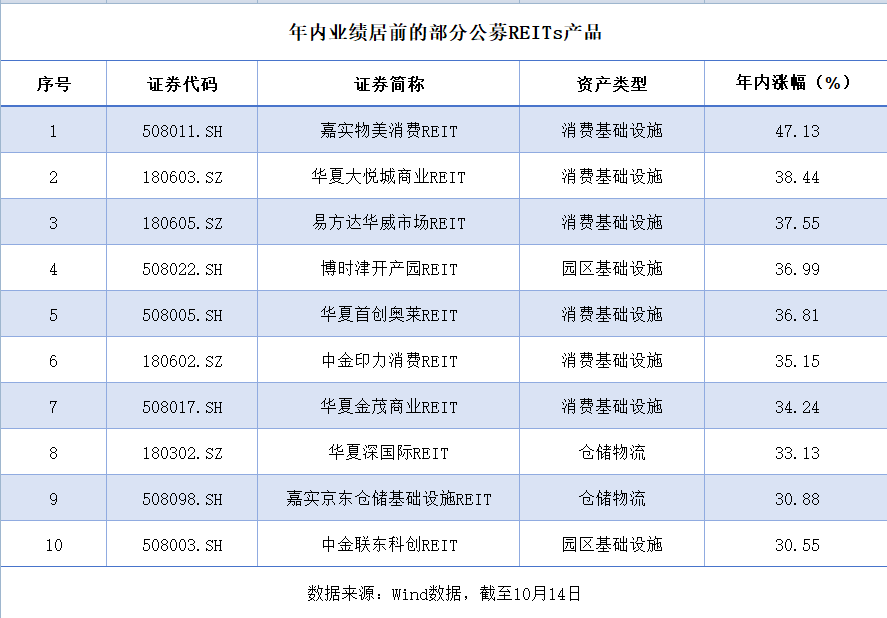
Core Insights - The public REITs market is experiencing a dual-driven expansion and performance surge, with significant interest from institutional investors and a notable increase in new product offerings [1][2][3] Market Expansion - In October, both Huaxia Fund and CITIC Construction Investment Fund announced that their public REITs offerings sold out in one day, leading to a total of 18 new products launched this year, with a total fundraising exceeding 36 billion yuan [1][3] - The total market capitalization of the 75 listed REITs has approached 220 billion yuan, with 6 additional products awaiting approval, indicating a clear trend of market expansion [1][4] Performance Disparity - The performance of public REITs has shown significant divergence, with the CSI REITs total return index rising by 9.05% year-to-date, while over 80% of the existing products have recorded gains, and three products have declined by more than 5% [5][6] - Consumer infrastructure REITs have emerged as the top performers, with an average return of 28.75%, and the top-performing product, the Jia Shi Wu Mei Consumer REIT, has achieved a 47.13% increase [5][6] Investor Composition - Institutional investors dominate the current REITs market, with an average holding ratio of 97.21%, reflecting a growing recognition and participation in this asset class, while individual investors remain largely on the sidelines [5][7] - The concentration of institutional investors may lead to liquidity issues, necessitating a more diverse investor base to enhance market stability [7][8] Strategic Insights - Analysts suggest that the high dividend yield and relatively controlled drawdown of REITs provide significant asset allocation value, despite existing liquidity concerns [7][8] - The market is expected to maintain a high proportion of institutional investors in the short term, with recommendations for improved public investor education to diversify participation [7][8]