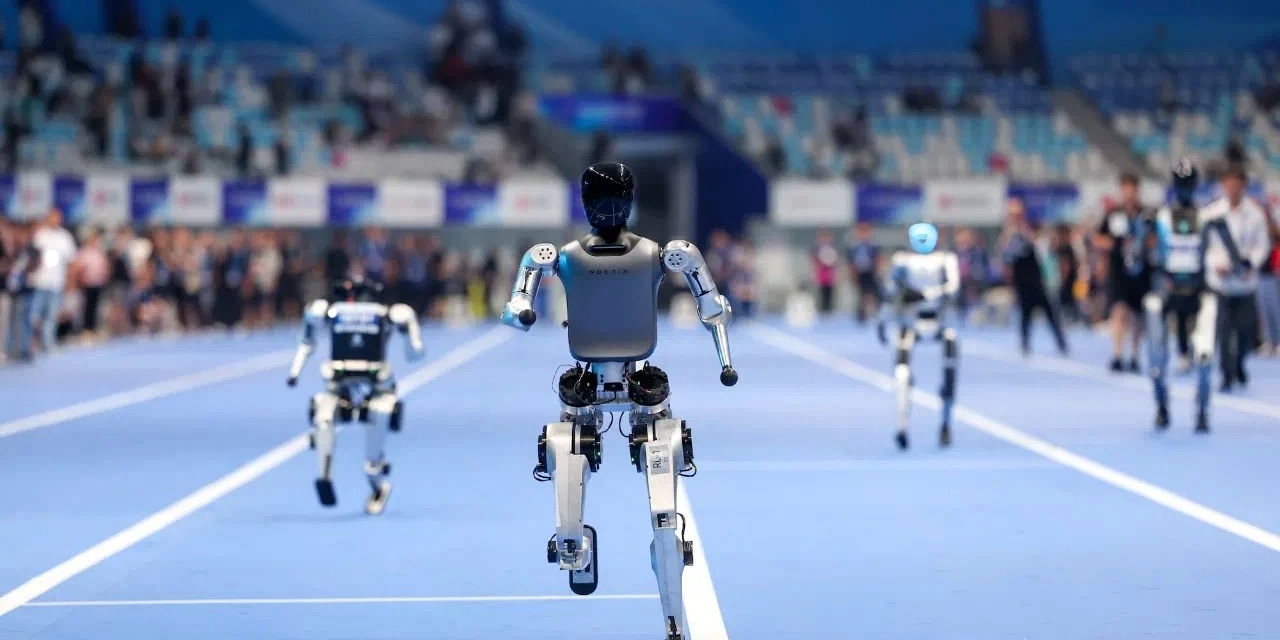
人形机器人产业化

Search documents
20cm涨停潮,跨年主线轮到机器人了?
3 6 Ke· 2025-12-04 11:58
Group 1 - The core viewpoint of the article emphasizes the critical role of tactile sensors in the industrial application of humanoid robots, marking a shift from mere demonstration to practical functionality in real-world environments [2][3][12] - The market for humanoid robots is experiencing renewed interest, with significant stock price increases for companies involved in this sector, indicating a revaluation of the industry's potential [1][3] - The development of tactile sensors is identified as a major bottleneck in the industry, with existing technologies facing challenges in durability, calibration, and cost, which hampers large-scale production [4][6][11] Group 2 - The article outlines three main technical routes for tactile sensors: resistive, capacitive, and piezoelectric/visual tactile, with the resistive route being the most feasible for industrial application due to its simplicity and cost-effectiveness [8][9] - The competition in the industry is shifting from technological prowess to supply chain efficiency, with companies needing to ensure high yield rates, cost control, and stable supply to succeed [10][11] - The global market for humanoid robot tactile sensors is projected to reach $756 million by 2030, highlighting the significant potential for growth in this sector [11] Group 3 - The article concludes that the transition of tactile sensors from laboratory prototypes to industrial components is crucial for the commercialization of humanoid robots, emphasizing the importance of engineering capabilities over flashy technology [12][13] - The next five years will see competition extend beyond algorithms and models to the foundational structures of global supply chains, determining the future landscape of the humanoid robot industry [13]




工业母机ETF(159667)涨超1%,人形机器人产业化落地加速
Mei Ri Jing Ji Xin Wen· 2025-12-01 07:47
Group 1 - The domestic policies are continuously promoting the development of humanoid robots, accelerating the industrialization process and application scenarios due to the updates in AI large models and dexterous hands [1] - Tesla's new dexterous hand is expected to be equipped with 50 actuators, leading to a significant demand for core components, which will result in steep growth for supply chain companies [1] Group 2 - The Industrial Mother Machine ETF (159667) tracks the China Securities Machine Tool Index (931866), which selects listed companies involved in machine tool manufacturing and key component supply from the Shanghai and Shenzhen markets [1] - The index covers related industries such as machinery and electronics, reflecting the overall performance of listed companies in the machine tool industry chain [1]
德昌股份发布“提质增效”行动方案,汽车EPS电机、机器人双赛道布局升级
Zheng Quan Shi Bao Wang· 2025-11-28 04:15
EPS电机作为电动助力转向系统(EPS)的动力源,是汽车转向系统的核心零部件。受技术壁垒与起步较 晚影响,EPS电机市场主要被以日电产(Nidec)为代表的国际巨头占据。在此背景下,德昌股份凭借深厚 的技术积累与产品实力,持续推动国产化替代,抢占市场份额,显示出了广阔的增长空间。据2025年半 年报披露,公司上半年汽车零部件业务实现营收2.81亿元,同比增长89.86%,新增定点项目8项,预期 全生命周期总销售金额将超过19亿元。 11月26日,德昌股份(605555)(605555.SH)董事会审议通过《"提质增效重回报"行动方案》,提出将 继续深耕新能源汽车与人形机器人驱动领域,从制造型向技术型平台企业转型。公司聚焦高水平业务突 破,既表示了公司创造核心价值、积极回报股东的决心,更展现了公司清晰长远的发展战略。 德昌股份是国产EPS电机头部企业,中国十大吸尘器出口企业。自2017年创办"德昌科技"切入汽车零部 件领域以来,经过近十年的技术攻坚与客户沉淀,公司汽车EPS无刷电机、制动电机产品受到市场的广 泛认可,客户覆盖耐世特、采埃孚等国内外知名转向、制动系统供应商。 针对公司远期发展,行动方案锚定了"全球 ...

人形机器人六维力传感器市场进一步集中 头部厂商市占率已超70%
Mei Ri Jing Ji Xin Wen· 2025-11-27 07:23
每经AI快讯,11月27日消息,高工机器人产业研究所(GGII)最新发布的《2025中国人形机器人六维力传 感器市场分析报告》(以下简称《报告》)显示,随着人形机器人产业化进程加速,六维力传感器作为实 现实时精准力控的关键部件,正迎来爆发式增长。《报告》预测,今年中国人形机器人六维力传感器出 货量预计1.23万台,同比激增510.1%。并且市场进一步集中,头部企业蓝点触控市占率已超70%,达到 72.6%。 ...
全球首批人形机器人店员深圳上岗!机器人ETF(159770)昨日成交额2.28亿元,规模冲百亿!机构:人形机器人产业化进程加速
2 1 Shi Ji Jing Ji Bao Dao· 2025-11-14 01:32
Market Performance - The market experienced a significant rally on November 13, with major indices closing higher; the Shanghai Composite Index reached a ten-year high, while the ChiNext Index rose over 2% [1] - By the end of the trading day, the Shanghai Composite Index increased by 0.73%, the Shenzhen Component Index rose by 1.78%, and the ChiNext Index gained 2.55% [1] ETF Highlights - The Robot ETF (159770) tracking the CSI Robot Index closed up by 0.74% with a trading volume of 228 million yuan on November 13 [1] - The Robot ETF (159770) saw a net subscription of 18 million units on November 12, bringing its total scale to 9.797 billion yuan [1] - The Robot ETF has experienced continuous net inflows for 20 consecutive trading days, accumulating over 1.68 billion yuan [1] Chip Sector Insights - The Chip ETF Tianhong (159310) tracking the chip industry index rebounded with a nearly 2% increase [2] - The Chip ETF has seen significant capital inflow, with net inflows for four consecutive trading days, totaling over 10 million yuan [2] - The chip industry is expected to see a 37.62% year-on-year growth in net profit attributable to shareholders in the first half of 2025, driven by policy support and surging demand [2] Robotics Industry Developments - The global first batch of cyber store clerks began operations in Shenzhen on November 11, indicating advancements in AI and robotics [3] - Michael Spence, a Nobel laureate, noted that the AI development gap between China and the U.S. is narrowing, with both countries accelerating their advancements [3] - The humanoid robot industry is progressing rapidly, with companies like Tesla, Xiaopeng, and Leju Intelligent releasing new humanoid robots [4] - The humanoid robot supply chain is categorized into three main segments: "brain—body—whole machine integration," with the core value concentrated in the midstream components [3]



全球产业趋势跟踪周报:存储芯片迎“超级周期”,人形机器人产业化进程加速-20251110
CMS· 2025-11-10 14:32
Core Insights - The storage chip industry is entering a "super cycle" driven by the unprecedented demand for AI computing power, particularly for large models and high bandwidth requirements, leading to a fundamental restructuring of the industry logic and cycle characteristics [2][3][17] - The humanoid robot industry is accelerating its industrialization process, with significant developments from companies like Tesla, XPeng, and Leju Intelligent, showcasing advancements in AI and robotics integration [2][3][41] Storage Chip Industry Trends - The storage chip sector is experiencing a structural prosperity period, with rapid advancements in high bandwidth memory (HBM) and high bandwidth flash (HBF) technologies, leading to a supply-demand imbalance and rising prices [3][16] - Major players like SK Hynix and Samsung Electronics are strengthening their profitability in the HBM market, which is driving growth in upstream equipment, materials, and packaging manufacturers, as well as downstream AI servers and cloud computing [3][19] - The current cycle is characterized by a shift from traditional inventory management to a demand-driven model, with AI's insatiable need for computing power redefining the value of memory [17][19] Humanoid Robot Industry Trends - The humanoid robot industry can be divided into three main segments: "brain," "body," and "system integration," with the core value concentrated in the midstream components [3][59] - Companies like Tesla are planning large-scale production of humanoid robots, with Tesla's Optimus expected to have a market capacity of billions of units, indicating a significant shift towards AI-driven manufacturing platforms [41][44] - XPeng's new humanoid robot, IRON, showcases advanced features and aims for mass production by the end of 2026, highlighting the competitive landscape in the humanoid robotics sector [50][52] Investment Recommendations - The report suggests focusing on sectors with marginal improvements, including AI applications, AI hardware, power equipment, non-ferrous metals, and innovative pharmaceuticals in the short term [4] - In the medium to long term, it emphasizes the importance of technological cycles, supply-demand dynamics, and the progress of intelligent infrastructure and AI ecosystems [5]


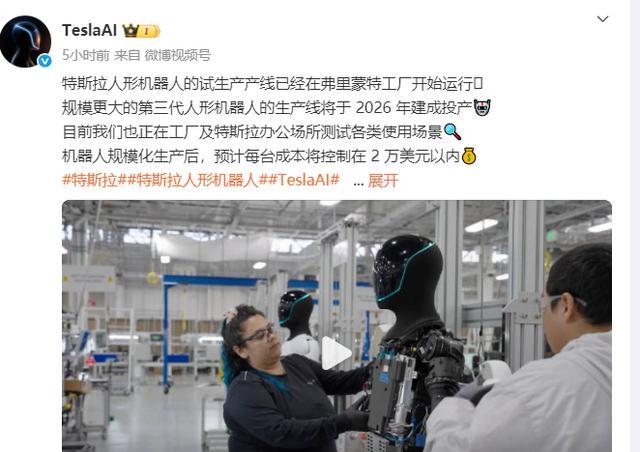
成本砍半近2万美元!特斯拉第三代人形机器人2026年投产
Huan Qiu Wang Zi Xun· 2025-11-07 07:13
Core Insights - Tesla has announced significant progress in its humanoid robot development, with the Fremont factory starting trial production lines and plans for a larger third-generation production line to be completed by 2026, aiming to reduce the cost of each unit to under $20,000 [1][4] Group 1 - The trial production line marks a critical step from technical research to practical production for Tesla's Optimus robot [4] - Tesla is currently testing various applications of the robot in its own factories and offices, including material handling and equipment inspection, to gather data for mass production [4] - The third-generation production line will leverage Tesla's automotive manufacturing expertise to enhance efficiency [4] Group 2 - Elon Musk has stated that humanoid robots could become Tesla's "largest product ever," with a market potential that may surpass its automotive business [4]
独家|泉智博再获过亿元融资,助力头部人形主机厂走入“万元时代”
Z Potentials· 2025-11-07 02:12
Core Viewpoint - The article highlights the emergence of Wuxi QuanZhiBo Technology Co., Ltd. as a leading player in the integrated robotic joint module sector, having recently completed significant funding rounds to support its growth and innovation in the industry [2][3]. Group 1: Financing and Growth - QuanZhiBo has successfully completed over 100 million RMB in A+ round financing, led by prominent investment firms, to scale production and enhance product development [2]. - The company has achieved rapid growth, with orders increasing several times annually, establishing a closed loop from technology development to mass production and customer repurchase [3]. Group 2: Product Development and Innovation - QuanZhiBo focuses on high-performance, high-reliability integrated joint modules, covering a torque range from 2Nm to 400Nm, applicable in various robotic scenarios [3]. - The company has developed a comprehensive self-research system, achieving breakthroughs in structural design, electromagnetic systems, and force control algorithms, with torque density reaching 210Nm/kg [5][6]. Group 3: Production and Quality Control - The company has established a smart manufacturing and quality control system, achieving a production line yield rate exceeding 98% and aiming for annual production capacity to increase from hundreds of thousands to millions [10][11]. - QuanZhiBo adheres to automotive-grade quality standards, collaborating with automotive industry partners to ensure long-term stability in product consistency and reliability [10]. Group 4: Future Vision and Industry Impact - The company aims to lead the standardization and platformization of robotic joints, creating a standardized product library to reduce development costs and time for robotic manufacturers [13]. - QuanZhiBo aspires to become the "Ningde Times" of the robotics industry, facilitating the widespread adoption of humanoid robots as they approach a price point of around 10,000 RMB [14].

人形机器人逼近产业化关口,谁在买?
3 6 Ke· 2025-11-05 12:11
Core Viewpoint - The humanoid robot industry is transitioning from showcasing demos to securing substantial orders, marking a significant step towards industrialization with several companies achieving orders of over a thousand units, indicating a shift in focus towards real-world applications and sales [2][3][4]. Group 1: Market Dynamics - In the past two months, multiple companies have entered the "thousand-unit club," with eight firms reporting significant orders, reflecting a growing demand in the humanoid robot sector [2][3]. - The price range for humanoid robots varies, with educational and performance models priced between 20,000 to 100,000 yuan, while industrial models start at 200,000 yuan, suggesting that large orders often correspond to contracts worth hundreds of millions [3][4]. - The recent surge in orders is attributed to increased public awareness following high-profile appearances and the emergence of actual demand in sectors like manufacturing and education [3][4]. Group 2: Industrialization and Challenges - The shift to thousand-unit orders signifies a pivotal moment for the humanoid robot industry, moving from experimental models to real-world deployment, akin to the early days of electric vehicles [4][5]. - Key questions arise regarding the buyers and their intended applications, as the industry transitions from a focus on demos to a competitive landscape centered on delivery capabilities [5][6]. - Major clients in manufacturing and education are driving demand, with manufacturing firms facing challenges such as labor shortages and rising costs, making humanoid robots a viable solution for automation [6][7]. Group 3: Product Development and Feedback - Manufacturers are increasingly acting as "invisible product managers," providing feedback that drives product iterations and adaptations to meet diverse operational needs [10][12]. - Companies like Star Dust Intelligent are adjusting their product offerings based on client feedback, leading to modular solutions that enhance flexibility and adaptability in various industrial scenarios [10][12]. Group 4: Sales and Market Strategy - The sales landscape is evolving, with companies focusing on building robust sales teams and distribution networks to effectively market humanoid robots across different sectors [24][25]. - Competitive pricing strategies are emerging, with companies like Songyan Power introducing models priced below 10,000 yuan to explore new market segments and drive adoption [25][26]. - The industry is witnessing a shift towards a more sustainable business model, emphasizing delivery capabilities and customer satisfaction over merely securing large orders [18][21]. Group 5: Future Outlook - The humanoid robot industry is expected to accelerate in 2026, driven by ongoing projects and increased focus on delivery and customer engagement [27][28]. - Companies are also looking to expand their international presence, with expectations of significant revenue contributions from overseas markets in the near future [27].

经观头条|人形机器人站在产业化门口
Jing Ji Guan Cha Wang· 2025-11-05 11:38
Core Insights - The humanoid robot industry is transitioning from showcasing demos to focusing on actual orders, with several companies entering the "thousand-unit club" in recent months [3][4] - The surge in orders is attributed to increased public awareness and real demand in sectors like manufacturing and education, creating viable deployment scenarios [4][5] - The shift to "thousand-unit orders" marks a significant milestone in the industrialization of humanoid robots, indicating their movement from experimental models to real-world applications [5][6] Industry Demand - Major clients for humanoid robots are primarily from the manufacturing and education sectors, with manufacturing showing a more rigid demand due to labor shortages and rising costs [7][8] - The flexibility of humanoid robots allows for easier adaptation to changing production needs compared to traditional automation solutions [7][8] - Educational institutions are adopting humanoid robots through small pilot programs, focusing on their integration into teaching and learning environments [14][15] Sales and Delivery Challenges - The industry is experiencing a shift from securing orders to ensuring successful delivery, with companies facing challenges in product design and supply chain management [18][19] - Companies are increasingly focusing on building robust sales teams and distribution channels to effectively market humanoid robots [23][24] - Pricing strategies are evolving, with some companies introducing lower-priced models to stimulate demand and explore new market segments [24][25] Future Outlook - The humanoid robot industry is expected to accelerate in 2026, driven by ongoing projects and increased attention from potential investors [25][27] - Companies are also looking to expand their presence in international markets, with expectations of significant revenue contributions from overseas operations [25][27]