
可回收火箭

Search documents
ETF盘中资讯|屡创新高后首回调!一键打包航空航天龙头的通用航空ETF(159231)暴跌逾6%,机构:2026年可回收火箭有望迎来密集试飞
Sou Hu Cai Jing· 2026-01-13 02:52
Group 1 - The aerospace and satellite navigation sectors experienced a significant pullback after a period of rapid growth, with stocks like Guolian Aviation, Aerospace Hanyu, Aerospace Hongtu, and Huace Navigation dropping over 10% [1] - Despite the market adjustment, the Huabao General Aviation ETF (159231) saw a net subscription of 4 million shares, indicating continued investor interest, with over 70 million yuan net inflow in the previous five days [1] - The ETF covers 50 aerospace stocks, with over 88% exposure to the low-altitude economy, over 65% to commercial aerospace, and over 47% to satellite navigation, making it a comprehensive tool for investing in China's aerospace industry [3] Group 2 - According to CITIC Securities' latest report, China successfully completed the maiden flights of two reusable rockets, Zhuque-3 and Long March 12A, in 2025, with further technological iterations needed for stage recovery [2] - Looking ahead to 2026, approximately 10 reusable rockets are expected to be ready for their first or second flights, with some models anticipated to achieve successful recovery [2] - The gradual construction and utilization of domestic commercial rocket launch sites, along with improved supporting infrastructure, are expected to shorten rocket test flight cycles, potentially increasing the total launch count from 92 in 2025 to over 100 in 2026 [2]

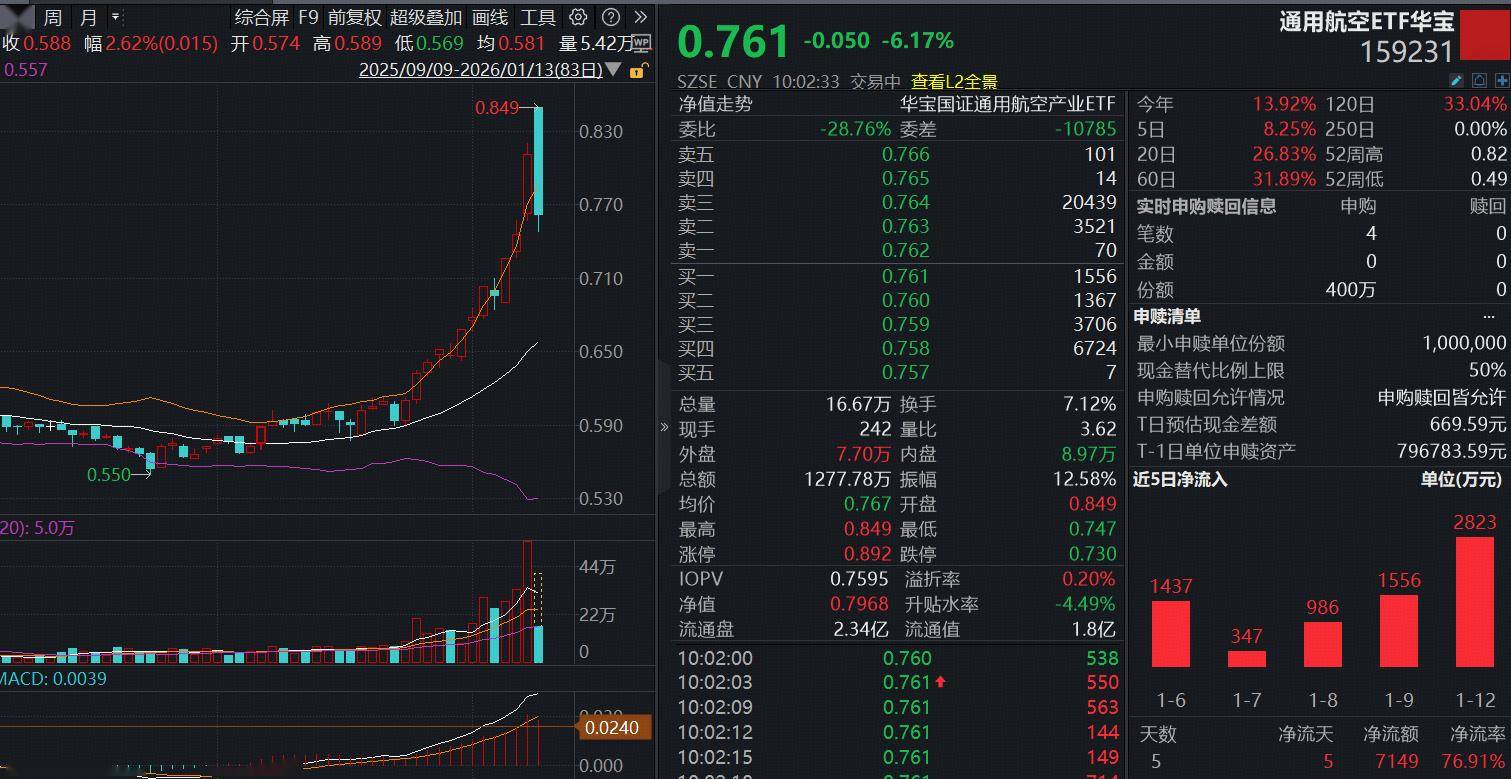
屡创新高后首回调!通用航空ETF(159231)暴跌逾6%,机构:2026年可回收火箭有望迎来密集试飞
Xin Lang Cai Jing· 2026-01-13 02:49
Group 1 - Aerospace and satellite navigation sectors experienced a significant pullback after a period of rapid growth, with stocks like Guolian Aviation, Aerospace Hanyu, Aerospace Hongtu, and Huace Navigation dropping over 10% [1][4] - The General Aviation ETF Huabao (159231) saw a price decline of 6.17%, yet it recorded a net subscription of 4 million shares, indicating strong investor interest despite the market adjustment [1][4] - Over the past five days, the ETF attracted a net inflow of over 70 million yuan, showcasing continued confidence in the sector [1][4] Group 2 - CITIC Securities' latest report highlights that by 2025, China successfully completed the maiden flights of two reusable rockets, Zhuque-3 and Long March 12甲, with further technological iterations needed for stage recovery [6] - Looking ahead to 2026, approximately 10 reusable rockets are expected to be ready for their first or repeated flights, with some models anticipated to achieve successful recovery [6] - The gradual establishment and utilization of domestic commercial rocket launch sites, along with improved supporting infrastructure, is expected to shorten rocket test flight cycles, potentially increasing the total number of launches from 92 in 2025 to over 100 [6] Group 3 - The General Aviation ETF Huabao (159231) and its linked funds comprehensively cover 50 aerospace stocks, including sectors like low-altitude economy, commercial aerospace, satellite navigation, large aircraft, drones, and military aircraft [3][6] - The ETF's composition indicates that over 88% is related to low-altitude economy, over 65% to commercial aerospace, and over 47% to satellite navigation, making it a strategic tool for investing in China's aerospace industry [3][6]
深蓝航天“星云一号”进入首飞倒计时,可回收赛道持续升温
Sou Hu Wang· 2026-01-12 02:41
Core Viewpoint - The Chinese commercial aerospace sector is focusing on "reusable" technology as a key area of development, with the "Star Cloud No. 1" reusable rocket developed by Deep Blue Aerospace set for its maiden flight around the Spring Festival [1] Industry Focus - The emphasis on reusability in the aerospace industry reflects a growing trend and competitive landscape among companies [1] - The upcoming flight of the "Star Cloud No. 1" rocket signifies a significant milestone for Deep Blue Aerospace and the broader commercial space industry in China [1]
中信建投证券:预计我国可回收火箭年内迎来密集试飞 更好满足卫星发射需求
Ge Long Hui· 2026-01-12 02:31
Core Viewpoint - CITIC Securities predicts that China's reusable rockets will undergo intensive test flights by 2026, which will help reduce launch costs and increase launch frequency to better meet the surging demand for satellite launches [1] Group 1: Reusable Rocket Development - By 2025, China successfully completed the maiden flights of two reusable rockets, Zhuque-3 and Long March 12A, with both launches achieving success [1] - Further technological iterations and validations are needed for the recovery of the first stage of these rockets [1] - It is expected that around 10 models of reusable rockets will be ready for their maiden or recovery flights by 2026, with some models anticipated to achieve successful recovery [1] Group 2: Launch Frequency and Infrastructure - The gradual construction and utilization of domestic commercial rocket launch sites, along with the improvement of related support systems, are expected to shorten the rocket test flight cycle [1] - The total number of launches in 2026 is projected to exceed 100, up from 92 launches in 2025, laying a solid foundation for the normalization of reusable rocket launches and enhancing satellite transportation capacity [1]

上海港湾20260109
2026-01-12 01:41
Summary of Shanghai Port Bay Conference Call Industry and Company Overview - **Company**: Shanghai Port Bay - **Industry**: Satellite Energy Management and Soft Soil Foundation Treatment - **Key Focus**: Development of satellite energy management systems, particularly gallium-based batteries and emerging perovskite battery technology [2][5][6] Core Points and Arguments - **Low Earth Orbit Satellite Network**: China is systematically advancing its low Earth orbit satellite network, with over 100 satellite constellation plans expected by 2025, aiming for more than 60,000 satellites in orbit [4] - **Recyclable Rocket Development**: More than 10 recyclable rockets are under development, including vertical recovery and sea landing methods, with recent experiments on the Zhuque 3 and Long March 12 rockets [4] - **Foundation Treatment Technology**: Shanghai Port Bay specializes in soft soil foundation treatment, which is crucial for high-water-content and easily settling foundations, with applications in notable projects like Dubai Palm Island and Shanghai Airport [7] - **Market Expansion Opportunities**: The company sees significant growth potential in coastal and riverine areas, particularly in Southeast Asia and the Middle East, with projects like the relocation of Indonesia's capital and Saudi Arabia's The Line [7] Additional Important Insights - **Battery Technology Development**: The company is transitioning from high-cost gallium-based batteries to more cost-effective perovskite batteries, which are currently in testing and validation stages [5][6] - **Strategic Shift**: Shanghai Port Bay aims to leverage its commercial space business to offset pressures on its core operations, focusing on innovative energy management systems to enhance market competitiveness and achieve growth [8]

商业航天深度:技术收敛引爆“奇点”,蓝海市场破晓已至(附62页PPT)
材料汇· 2026-01-09 15:20
Group 1 - The article emphasizes that the commercial aerospace industry is experiencing explosive growth driven by supportive policies and technological advancements, leading to a significant increase in demand across the industry chain [4][20][25]. - The transition from traditional aerospace, characterized by government-led initiatives, to commercial aerospace, driven by private enterprises, marks a fundamental shift in the industry, focusing on cost reduction and service-oriented models [10][12][15]. - The U.S. and China are establishing a bipolar competitive landscape in the aerospace sector, with the U.S. leading in commercial launches and satellite deployments, while China is rapidly catching up with its burgeoning private sector [24][28]. Group 2 - The article outlines the core tracks of the industry chain, including satellites, launch vehicles, ground equipment, and terminal applications, highlighting their interconnectivity and importance in the overall ecosystem [29][30]. - It discusses the competitive landscape and industry trends, noting that the U.S. has a dominant position in commercial launches, with SpaceX accounting for a significant portion of global satellite deployments, while China's commercial space sector is on the rise [24][28]. - Investment recommendations are provided, suggesting that stakeholders should focus on companies involved in satellite manufacturing, launch services, and ground equipment, as these areas are expected to see substantial growth [39][40].


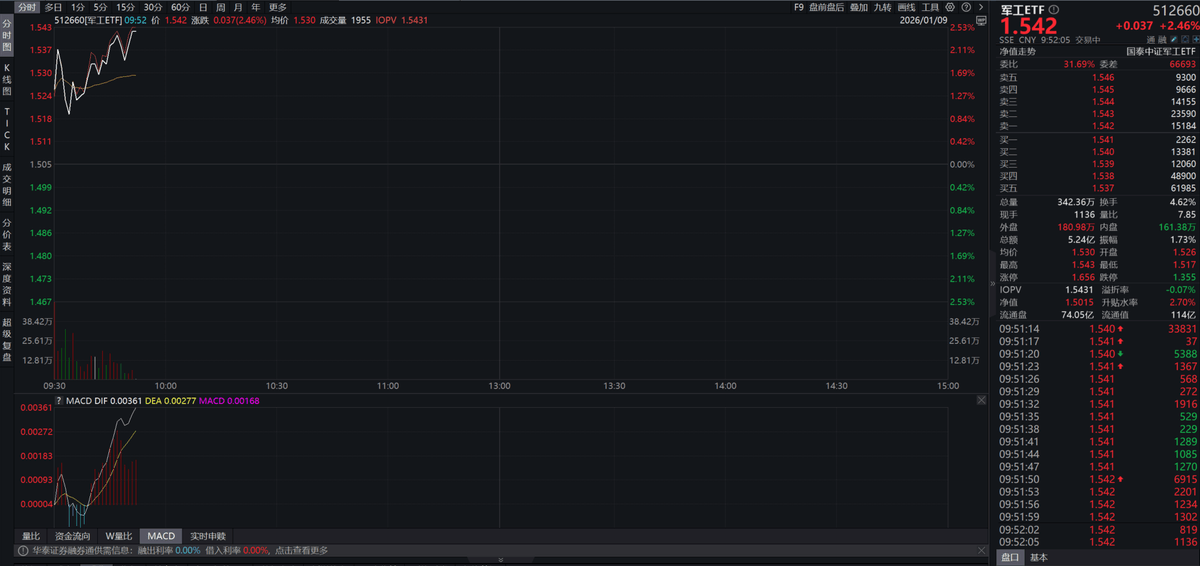
商业航空催化持续密集,军工ETF(512660)涨超2.4%
Sou Hu Cai Jing· 2026-01-09 02:32
Core Viewpoint - The commercial aerospace industry is experiencing significant changes and opportunities, with a focus on the acceleration of reusable rocket technology and the upcoming milestones in 2026, which is expected to mark a transition from technology validation to engineering and scaling [2][3]. Industry Trends - The global competition in aerospace is intensifying, and China's aerospace capabilities are continuously advancing, with 2026 seen as a pivotal year for commercial aerospace in China [2]. - The growth of the military aerospace industry chain remains highly certain, with expectations for simultaneous advancements in rocket capacity, satellite networking, and manned space missions [2]. Rocket Segment - Reusability is crucial for cost optimization in commercial aerospace, with China entering a key phase of multi-route verification and rapid technological evolution [3]. - By 2026, several large-capacity rockets are expected to complete their maiden flights or key validation tasks, leading to a decrease in launch costs [3]. - The construction of launch facilities is progressing, which will alleviate current capacity constraints and facilitate the deployment of low-orbit satellite constellations [3]. Satellite Segment - The demand for communication satellites is accelerating, with significant advancements in satellite networking expected soon [3]. - The introduction of computing constellations is creating new opportunities by enhancing data processing efficiency in orbit, addressing traditional data utilization bottlenecks [3]. Strategic Perspective - Space capabilities are becoming a critical measure of national technological strength and security, with ongoing acceleration in manned spaceflight, low-orbit satellites, and deep space exploration [4]. - The military aerospace industry chain is characterized by long cycles and high certainty in growth [4]. ETF Insights - The military ETF (512660) covers the entire aerospace and defense industry chain and is the largest in its category, providing a significant tool for capturing industry allocation opportunities [5][7]. - The ETF tracks the China Securities Military Index, reflecting the overall performance of representative listed companies in the defense sector [7]. - As of January 8, 2025, the military ETF's scale is 11.119 billion, ranking first among 12 similar products [8].
商业航天深度:技术收敛引爆“奇点”,蓝海市场破晓已至(附62页PPT)
材料汇· 2026-01-08 16:01
Group 1 - The article emphasizes the explosive growth of the commercial space industry driven by supportive policies and technological advancements [4][19] - The transition from traditional space (government-led) to commercial space (private sector-driven) is highlighted, showcasing the shift in funding and operational models [10][12] - The U.S. and China are establishing a bipolar competitive landscape in the space industry, with the U.S. leading in commercial launches and satellite deployments [24][28] Group 2 - Key sectors in the space industry include satellites, launch vehicles, ground equipment, and terminal applications, which are experiencing increased demand [3][29] - The competitive landscape is maturing, with significant advancements in technology such as reusable rockets and cost-effective satellite manufacturing [20][23] - Investment recommendations suggest focusing on companies that are well-positioned within the rapidly evolving commercial space ecosystem [3][39] Group 3 - The article outlines the historical development of commercial space, noting critical milestones from the 1980s to the present, including the rise of companies like SpaceX and Blue Origin [11][16] - The U.S. has shifted its procurement model from cost-plus contracts to fixed-price contracts, incentivizing cost reduction and innovation in the space sector [14][15] - China's commercial space sector is rapidly developing, with government initiatives aimed at fostering innovation and investment in the industry [19][27] Group 4 - The article discusses the structure of the space industry supply chain, which includes upstream (manufacturing), midstream (launch services), and downstream (applications) segments [30][32] - The total addressable market (TAM) for the space industry is projected to grow significantly, with commercial space revenues expected to dominate [39][40] - The article highlights the high barriers to entry in the space industry, particularly in the upstream segment, which contributes to high profit margins [41]
商业航天深度报告:技术收敛引爆奇点,蓝海市场破晓已至
Guoxin Securities· 2026-01-06 13:51
Investment Rating - The report maintains an "Outperform" rating for the commercial aerospace industry [1] Core Insights - The commercial aerospace sector in China is transitioning from a "state-led" model to a "private-led, cost-prioritized" model, marking a significant shift in business dynamics [3] - The report identifies 2024-2025 as a pivotal period for the explosion of commercial aerospace in China, driven by the launch of national and commercial satellite constellations [3] - Four key technological convergences are driving a "cost revolution" in the industry, significantly reducing launch costs [4] Summary by Sections 1. Industry Overview - The commercial aerospace industry is experiencing a policy-driven boom, with technological convergence leading to explosive demand across the supply chain [6][8] 2. Core Drivers - The report highlights four technological advancements: 1. Reusable launch vehicles reducing costs from $50,000/kg to $200/kg [4] 2. Liquid oxygen-methane as the next-generation fuel, enhancing reusability [4] 3. Industrialized manufacturing through 3D printing, reducing production time and costs [4] 4. Commercial off-the-shelf (COTS) components replacing expensive aerospace-grade chips, significantly lowering satellite costs [4] 3. Market Demand - The report anticipates a significant increase in launch demand, estimating a need for approximately 8,750 tons of launch capacity in China from 2026 to 2030, translating to a market potential of several hundred billion yuan [4] 4. Investment Opportunities - The report suggests focusing on high-barrier, high-elasticity segments of the industry, including: 1. Engine manufacturing and materials like high-temperature alloys and titanium [4] 2. Satellite manufacturing, particularly in advanced components like phased array T/R modules [4] 3. Downstream applications, including high-performance antennas and baseband chips for consumer electronics [4] 5. Competitive Landscape - The report notes a dual-polarity competitive landscape between China and the U.S., with the industry moving towards maturity [6]
国金证券:可回收火箭从0到1迈入黄金发展期 动力系统等组成环节有望受益
智通财经网· 2026-01-05 08:45
Core Insights - The report by Guojin Securities emphasizes that reusability is a key method to reduce launch vehicle costs and is crucial for overcoming bottlenecks in commercial space development [2][4] - The commercial rocket industry is entering a rapid iterative development phase, transitioning from 0 to 1, driven by the frequent launches of reusable rockets [1][4] Group 1: Reusable Rockets Development - Domestic reusable rockets are entering a phase of intensive launches, marking a new stage in low-cost exploration of commercial space [2] - The "Zhuque-3" rocket, developed by Blue Arrow Aerospace, successfully completed its maiden flight, while the Long March 12甲 rocket also attempted recovery during its first flight [2] - Current average launch costs for expendable rockets range from 110 million to 180 million yuan, while some reusable rockets are priced around 67 million USD; with full recovery, costs could drop to 2 to 5 million USD [2] Group 2: Global Competition and Cost Advantages - The Falcon 9 rocket, the world's first orbital-class reusable rocket, has completed 580 launches with a recovery success rate of 534 landings and 501 reuses [3] - Following the normalization of reusability, SpaceX's launch frequency increased significantly from 13 launches in 2019 to 138 in 2024 [3] - The launch cost for Falcon 9 is approximately 18,000 yuan/kg, and if fully reusable, it could drop to 5,000 yuan/kg, significantly lower than current operational rockets [3] Group 3: Demand from Satellite Internet Construction - The construction of satellite internet in China is accelerating, with plans to launch 44,816 satellites, leading to a projected demand for 150 commercial rocket launches per year [4] - Policy support for the commercial rocket industry is evident, with the Shanghai Stock Exchange issuing guidelines for the listing of commercial rocket companies on the Sci-Tech Innovation Board [4] - The commercial rocket industry is transitioning into a new phase of engineering and industrialization, poised for a golden development period alongside the satellite industry [4][6]
