
长征12号甲

Search documents
国金证券:可回收火箭从0到1迈入黄金发展期 动力系统等组成环节有望受益
智通财经网· 2026-01-05 08:45
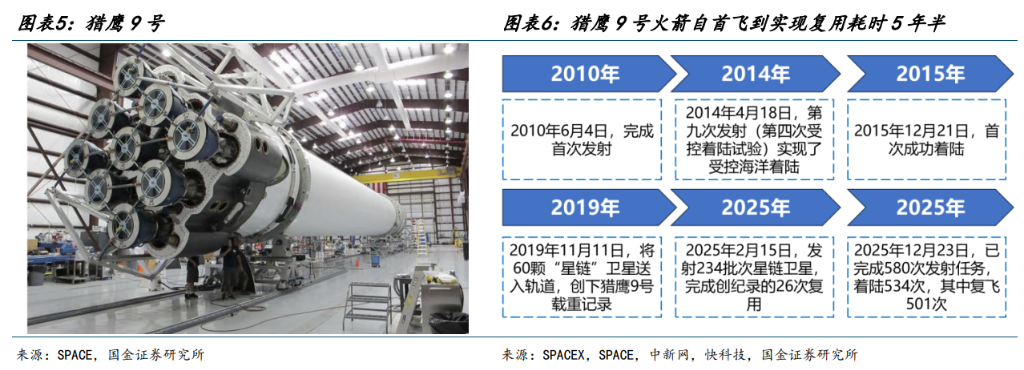
Core Insights - The report by Guojin Securities emphasizes that reusability is a key method to reduce launch vehicle costs and is crucial for overcoming bottlenecks in commercial space development [2][4] - The commercial rocket industry is entering a rapid iterative development phase, transitioning from 0 to 1, driven by the frequent launches of reusable rockets [1][4] Group 1: Reusable Rockets Development - Domestic reusable rockets are entering a phase of intensive launches, marking a new stage in low-cost exploration of commercial space [2] - The "Zhuque-3" rocket, developed by Blue Arrow Aerospace, successfully completed its maiden flight, while the Long March 12甲 rocket also attempted recovery during its first flight [2] - Current average launch costs for expendable rockets range from 110 million to 180 million yuan, while some reusable rockets are priced around 67 million USD; with full recovery, costs could drop to 2 to 5 million USD [2] Group 2: Global Competition and Cost Advantages - The Falcon 9 rocket, the world's first orbital-class reusable rocket, has completed 580 launches with a recovery success rate of 534 landings and 501 reuses [3] - Following the normalization of reusability, SpaceX's launch frequency increased significantly from 13 launches in 2019 to 138 in 2024 [3] - The launch cost for Falcon 9 is approximately 18,000 yuan/kg, and if fully reusable, it could drop to 5,000 yuan/kg, significantly lower than current operational rockets [3] Group 3: Demand from Satellite Internet Construction - The construction of satellite internet in China is accelerating, with plans to launch 44,816 satellites, leading to a projected demand for 150 commercial rocket launches per year [4] - Policy support for the commercial rocket industry is evident, with the Shanghai Stock Exchange issuing guidelines for the listing of commercial rocket companies on the Sci-Tech Innovation Board [4] - The commercial rocket industry is transitioning into a new phase of engineering and industrialization, poised for a golden development period alongside the satellite industry [4][6]

从0到1迈入黄金发展期:中国商业火箭产业链全景拆解
Hua Er Jie Jian Wen· 2026-01-05 08:34
Core Insights - China's commercial space industry is at a critical turning point similar to SpaceX in 2015, with the recent test flights of Zhuque-3 and Long March 12A marking the transition of reusable rocket technology from experimental to engineering implementation [1][2] - The opening of the fifth set of standards for the Sci-Tech Innovation Board has cleared obstacles for IPOs of rocket companies, indicating a significant market opportunity driven by the rigid demand for satellite internet and the cost revolution brought by reusable technology [1][10][13] Market Opportunity - The satellite internet construction is expected to create a trillion-dollar market, driven by the rapid deployment of satellite constellations such as GW and G60, which plan to deploy up to 44,816 satellites [1][7][9] - The annual replacement demand for nearly 9,000 satellites will create a substantial capacity gap, further fueling the demand for commercial launches [1][7] Technological Development - Reusable rocket technology is identified as the key to breaking the cost bottleneck in space transportation, with China currently in a phase similar to SpaceX's early technical ramp-up [2][18] - The recent test flights of Zhuque-3 and Long March 12A, despite not achieving complete recovery, signify the start of a concentrated exploration period for reusable rockets in China [2] Cost Advantages - The cost advantages of high-frequency reuse are significant, as demonstrated by SpaceX's Falcon 9, which has achieved a marginal reuse cost of $15 million per launch, compared to the average cost of $110 million to $180 million for expendable rockets [5] - If China's commercial rockets can achieve similar breakthroughs, launch costs could be drastically reduced, supporting the large-scale deployment of satellite internet [5] Investment Focus - Analysts suggest that investment should focus on the most valuable segments of the supply chain, particularly engine manufacturing and rocket structure, which will benefit first from high consumption before reusable technology matures [1][18] - The core components of a typical liquid rocket, such as engines and structures, account for a significant portion of hardware costs, with the first-stage engine and structure comprising 77.8% of the total [14][18] Policy and Capital Market - The improvement of policy frameworks and the opening of capital market exit channels are accelerating the transition of commercial space from a storytelling phase to a performance-driven phase [10][17] - The new IPO guidelines for the Sci-Tech Innovation Board directly pave the way for leading commercial rocket companies like Blue Arrow Aerospace and Interstellar Glory [10][13]

新年寄语:2026,叩开新世界的大门
Xin Lang Cai Jing· 2026-01-01 01:16
Group 1 - Meta's acquisition of the startup Manus has surprised the venture capital community, highlighting the rapid wealth creation in AI entrepreneurship and the potential energy of a new technological revolution [1] - The launch of the "AI Six Little Dragons" company, Zhiyuan AI, on the Hong Kong Stock Exchange, and the 1000% surge in the stock price of the newly listed optical component company, Hengtong Light, reflect the excitement surrounding technological advancements [1] - The release of the Deepseek-R1 in early 2025 ignited enthusiasm in China's tech sector, showcasing innovations such as exoskeleton robots and liquid rockets, indicating a shift towards a new era of technological exploration [2] Group 2 - The Nobel Prize in Economic Sciences awarded to economists including Joel Mokyr emphasizes the importance of innovation-driven economic growth, aligning with the optimistic view of technology's role in societal advancement [2] - The narrative of technological progress is intertwined with historical reflections on human aspirations, suggesting that optimism about technology can drive societal progress despite geopolitical and social challenges [3] - The focus for the future should be on technologies that enhance human courage and empathy rather than merely replacing human roles, advocating for a future that prioritizes human values alongside technological advancements [3]

可复用火箭应在实战中前行
Jing Ji Ri Bao· 2025-12-06 21:56
Core Insights - The recent launch of the Zhuque-3 reusable rocket achieved orbit but failed in recovery, highlighting the iterative nature of reusable rocket technology development [1] - Developing reusable rockets is essential for China to become a space power and compete in the global space economy [1] Industry Overview - Reusable rocket technology is a global trend, with the potential to reduce launch costs by 80% to 90%, addressing the increasing demand for space access [1] - The Chinese government is actively promoting the development of commercial space, with policies supporting the establishment of industrial clusters in regions like Hainan, Beijing, and Shanghai [2] Technological Development - China is currently behind the U.S. in reusable rocket technology, with SpaceX's Falcon 9 achieving 31 successful recoveries since its first in December 2015, while China has yet to complete a successful orbital recovery [2] - Despite the gap, China has advantages such as the ability to learn from SpaceX's experiences and leverage new technologies like AI and 3D printing for potential advancements [2] Market Demand - China's large-scale satellite constellation plans, including GW, Qianfan, and Honghu, require breakthroughs in transportation capabilities provided by reusable rockets, which could unlock a trillion-dollar space economy [2] - The successful mass production of reusable rockets could lead to the emergence of 2 to 3 major companies with high-capacity, low-cost launch capabilities within the next five years [3] Project Progress - The Zhuque-3 launch marks the beginning of practical applications for China's reusable rocket technology, successfully delivering payloads to orbit while providing valuable data despite the recovery failure [3] - The development of other reusable rockets, such as the Long March 12 and Tianlong 3, is underway, with infrastructure like the Hainan commercial space launch site being established to support future recovery operations [3]
华泰证券今日早参-20251204
HTSC· 2025-12-04 01:43
Group 1: Macroeconomic Insights - The Japanese central bank's potential interest rate hike in December could lead to an increase in government bond yields, influenced by high inflation and upcoming fiscal stimulus [2][3] - Global macroeconomic and policy expectations have been recalibrated, with service sector PMIs in the US, Europe, and Japan remaining high, while manufacturing PMIs have declined [3] - The market is experiencing fluctuations in response to the Federal Reserve's interest rate outlook, with mixed performances in US stock indices and a decline in oil prices [3] Group 2: Fixed Income Analysis - Cross-period price differences in interest rate derivatives are influenced by the CTD bond's coupon rate, full price, and three-month repo rates, along with market sentiment [4] - The movement of contracts during the roll period indicates strong participation in positive spreads, leading to an initial increase in cross-period price differences [4] Group 3: Consumer Sector Opportunities - The consumer sector is witnessing structural changes driven by technology and innovation, with new consumption trends emerging in areas like trendy toys, beauty products, and ready-to-drink beverages [6] - Investment strategies should focus on four main themes: the rise of domestic brands, technology-enabled consumption, emotional spending, and undervalued high-dividend blue-chip stocks [6] Group 4: Aerospace and Defense - The development of reusable rockets is crucial for reducing costs and increasing capacity in space activities, with companies like SpaceX leading the way [7] - China's advancements in reusable rocket technology, such as the Zhuque-3 and Long March 12, are expected to enhance space launch capabilities and reduce costs [7] Group 5: Energy Sector Analysis - Xin'ao Energy's privatization process is progressing, with key regulatory approvals completed, and the company is showing strong operational performance in natural gas retail [8] - The company's fundamentals are improving, supported by expanding projects and increasing customer penetration rates, leading to a positive long-term outlook [8] Group 6: Rating Changes - Recent adjustments in stock ratings include upgrades for companies like Hayuan Engineering and new buy ratings for firms such as Aerospace Intelligence Manufacturing and BOSS Zhipin, reflecting positive earnings forecasts [9]