
可回收火箭技术

Search documents
为什么中国要一口气申报20万颗卫星?
Xin Lang Cai Jing· 2026-01-13 11:27
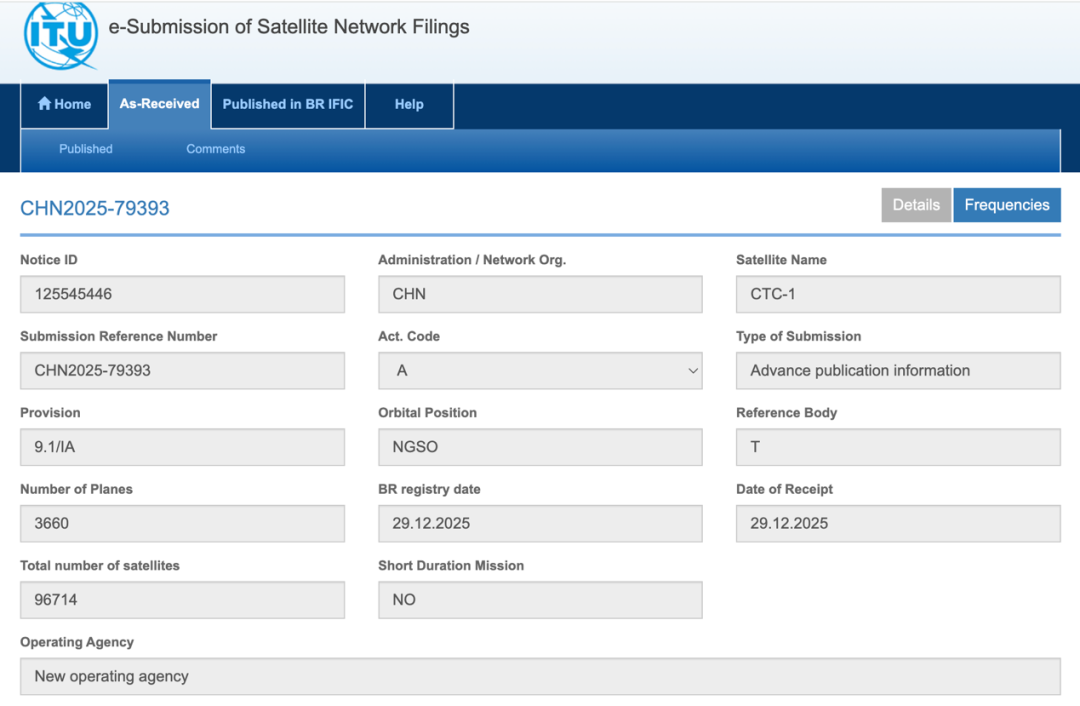
Core Viewpoint - China has submitted an application to the International Telecommunication Union (ITU) for approximately 203,000 satellites, covering 14 satellite constellations, which is nearly five times the scale of SpaceX's Starlink program, currently capped at about 42,000 satellites [1][21]. Group 1: Application Details - The application includes nearly 190,000 satellites from a newly established institution, the Radio Spectrum Development and Utilization and Technology Innovation Research Institute, which was registered on December 30, 2025 [2][21]. - The application features two massive constellations, CTC-1 and CTC-2, each requesting 96,714 satellites, along with additional constellations from China Mobile and other commercial space enterprises [4][22]. Group 2: Strategic Intent - The large-scale application aims to secure orbital and frequency resources early, preventing later entrants from occupying these resources, in line with the ITU's "first come, first served" principle [8][26]. - The application reflects a strategic shift in China's frequency resource layout, potentially covering traditional Ku and Ka bands, as well as future 6G communication bands [13][31]. Group 3: Competitive Landscape - The competition for low Earth orbit (LEO) satellites is intensifying, with the need for increased launch frequency and satellite manufacturing capacity becoming critical [9][28]. - SpaceX has demonstrated the ability to deploy nearly 10,000 Starlink satellites in a short time due to its reusable Falcon 9 rocket technology, significantly reducing launch costs [9][27]. Group 4: Industry Challenges - Achieving the deployment of approximately 19,400 satellites within nine years to retain frequency resources poses a significant challenge for China's space industry, requiring a substantial increase in launch capabilities [9][27]. - The theoretical limit for satellites in LEO is estimated at around 60,000, indicating a crowded orbital environment [10][29]. Group 5: Regulatory and Safety Concerns - The ITU's "milestone rules" require that satellite constellations must launch their first satellite within seven years of obtaining frequency resources, with subsequent deployment milestones [8][26]. - Recent close encounters between SpaceX's Starlink satellites and China's space station highlight the safety risks associated with increased satellite traffic in LEO [5][23].

2026开年最强赛道,引爆下一场星辰大海?
Ge Long Hui· 2026-01-13 08:45
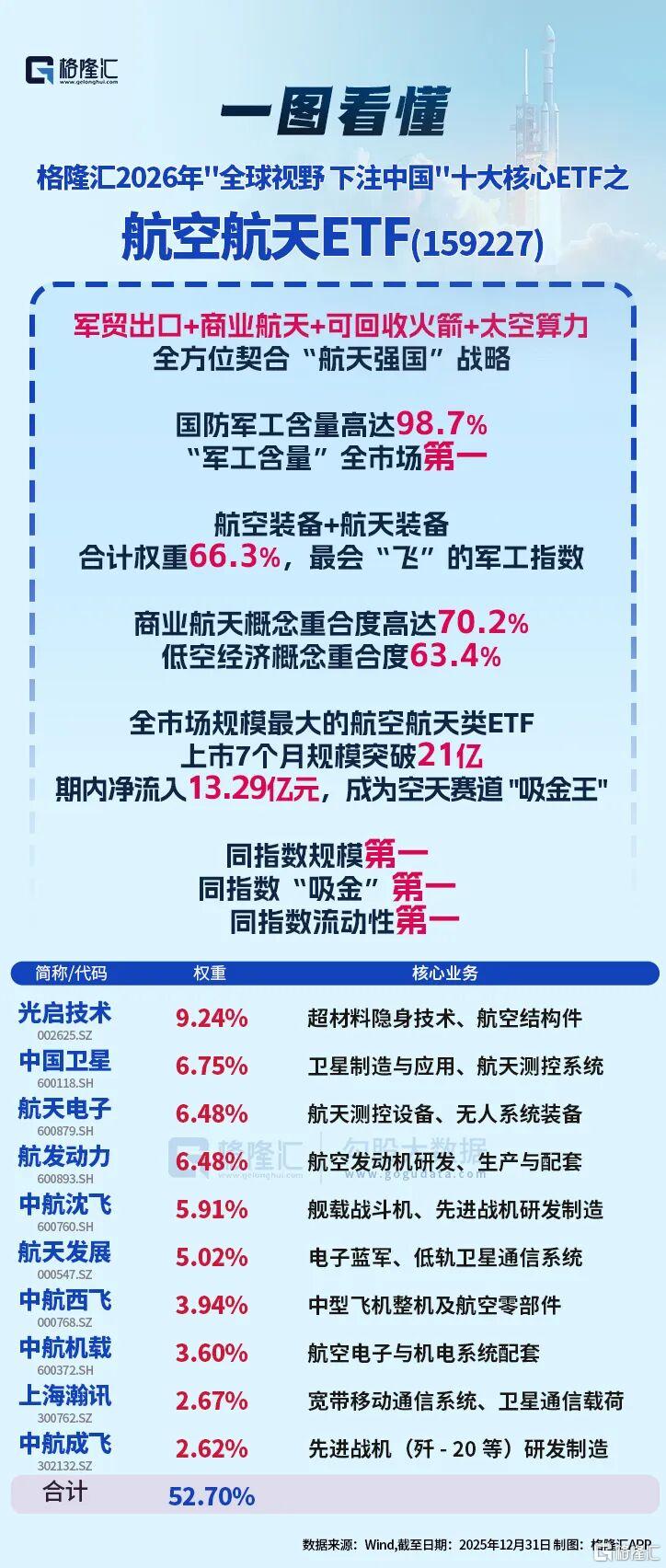
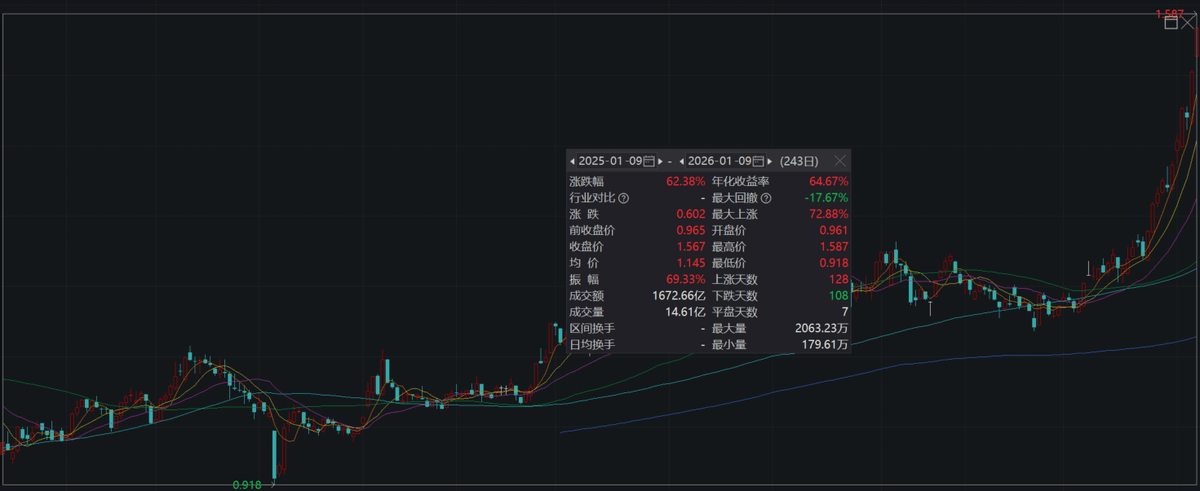
近期,全球对稀缺太空战略资源争夺白热化。 中国向国际电信联盟(ITU)一次性提交了涉及约20.3万颗卫星的频谱与轨道资源申请,覆盖14个星座,创下国内单次申报纪录。 美国联邦通信委员会(FCC)也批准了SpaceX新增部署7500颗第二代星链卫星。 马斯克提出了航天业有史以来最雄心勃勃的制造目标之一:每年生产1万艘星舰飞船。 广州推动商业航天人才、资本和企业集聚广州,构建完整商业航天产业生态。 过去一个多月,航空航天板块一直是市场焦点,表现甚至超过AI等科技板块。 其中,航空航天ETF(159227)自2025年11月24日-2026年1月12日的34个交易日上涨53.33%,净值屡创新高。 航空航天的爆发,源于一场深刻且持久的产业变革,是一场由大国战略、市场爆发与技术革命共同催生的黄金机会。 基于这些逻辑,航空航天ETF(159227)入选了2026年格隆汇"全球视野 下注中国"十大核心ETF。 | of the Come In below in | 6. 1- 10 | 上星制道与应用、机大测径系统 | | --- | --- | --- | | 600118 SH | | | | 新京 FF | 6.4 ...
2026开年最强赛道,引爆下一场星辰大海?
格隆汇APP· 2026-01-13 08:25
Core Viewpoint - The global competition for scarce space strategic resources has intensified, with significant developments in satellite deployment and commercial space initiatives, particularly from China and the U.S. [2][3][4] Group 1: Industry Developments - China submitted a record application to the International Telecommunication Union (ITU) for approximately 203,000 satellites, covering 14 constellations [3] - The U.S. Federal Communications Commission (FCC) approved SpaceX's plan to deploy an additional 7,500 second-generation Starlink satellites [4] - Elon Musk proposed an ambitious target for the aerospace industry, aiming to produce 10,000 Starship spacecraft annually [5] Group 2: Market Performance - The aerospace sector has been a market focus, outperforming even AI and other tech sectors in recent months [7] - The Aerospace ETF (159227) saw a 53.33% increase over 34 trading days, reaching new net asset value highs [8] Group 3: Strategic Importance - Aerospace has been designated as a key emerging pillar industry by the Chinese government, with initiatives to promote commercial space and low-altitude economies [13] - The establishment of the Commercial Space Administration by the National Space Administration in November 2025 has improved administrative efficiency for launch approvals and licensing [14] Group 4: Technological Advancements - The emergence of reusable rocket technology is a significant breakthrough, drastically reducing space launch costs and facilitating the commercialization of the space economy [15] - The rapid development of technology and market dynamics has heightened competition and underscored the urgency for advancements [17] Group 5: Investment Trends - The commercial space industry in China is projected to reach a scale of 2.5 to 2.8 trillion yuan, with an annual growth rate exceeding 20% [22] - Funding for the aerospace sector is increasing, with total industry financing expected to reach 18.6 billion yuan in 2025, a 32% year-on-year increase [25] - The Aerospace ETF (159227) has become a leading investment vehicle, with significant inflows and a growing market presence [31] Group 6: Future Outlook - The aerospace sector is positioned at the intersection of national security, technological self-reliance, and new economic growth points [45] - 2026 is anticipated to be a critical year for validating China's aerospace technologies, with advancements in rocket recovery and satellite production lines [46][47] - The Aerospace ETF (159227) is well-positioned to capture investment opportunities arising from the commercial space and low-altitude economy sectors [48]




申请卫星数量超20万颗!关注军工ETF(512660)投资机会,同类规模第一
Sou Hu Cai Jing· 2026-01-12 01:41
Core Viewpoint - China has submitted a record application for over 200,000 satellites to the ITU, indicating a strong commitment to low Earth orbit satellite construction and boosting the military industry sector [4]. Group 1: Satellite Deployment and Industry Impact - In December 2025, China reported a total of over 200,000 satellite constellation deployment plans, setting a new record for satellite applications [4]. - The low Earth orbit satellite internet development in China is still in its early stages, but the new applications highlight the strategic determination and capability of the country [4]. - The military industry sector is experiencing a positive outlook, with the military ETF (512660) rising over 60% in the past year, reflecting market recognition of the high prosperity in the military sector [1][4]. Group 2: Commercial Space Industry Dynamics - The commercial space sector is driven by unprecedented policy support, industry breakthroughs, and capital influx, indicating a robust market rather than short-term sentiment [5]. - The establishment of the Commercial Space Administration has resolved regulatory challenges, providing clear management for the industry [5]. - The Shanghai Stock Exchange has opened direct financing opportunities for commercial rocket companies, marking a historic change in market access rules [5]. Group 3: Technological Advancements and Future Prospects - The core support for the current market rally is the verification phase of reusable rocket technology, with multiple test flights planned for late 2025 to 2026 [5]. - The alleviation of rocket capacity bottlenecks is expected to open up downstream application scenarios, including satellite communication and innovative fields like "space computing" [5][6]. - The commercial space sector is anticipated to have a significant market space, with numerous projects advancing in 2026, indicating a clear upward trend in industry prosperity [6]. Group 4: Military and Aerospace Sector Outlook - The military aerospace sector is at a critical turning point, transitioning from capability building to systematic application [7]. - The demand for new-generation main battle equipment and new operational capabilities is expected to enhance order certainty, leading to a growth cycle in the defense industry until 2027 [7]. - The military ETF (512660) is positioned as a key tool for capturing industry allocation opportunities, covering a wide range of sectors within the defense industry [10].
“绝不错过2026年大热门”!资本加速卡位商业航天,“太空算力”争夺战一触即发
Xin Lang Cai Jing· 2026-01-09 00:25
Group 1 - The commercial space sector in China is gaining momentum, with companies like Blue Arrow Aerospace, Tianbing Technology, Xinghe Power, and others aiming to become the "first commercial rocket stock" with valuations exceeding 10 billion yuan [1][12] - The U.S. counterpart, SpaceX, is advancing its IPO plans with a valuation potentially reaching $1.5 trillion, indicating a competitive race for space resources [1][12] - The primary market is experiencing renewed activity as capital rushes to secure project shares, leading to rising valuations for related companies [1][12] Group 2 - Investors are showing increased interest in acquiring old shares of commercial space projects, with notable demand from institutions that previously did not engage in this sector [2][13] - Many leading companies in the sector are not planning to raise additional funds, focusing instead on the secondary market, which is creating a scarcity of available shares [2][13][14] - The market sentiment is characterized by a strong buying interest in old shares, reflecting a bullish outlook on the sector's future [2][13] Group 3 - Despite the high demand for old shares, many holders are reluctant to sell, especially those with stakes in companies valued at over 10 billion yuan, anticipating even higher valuations post-IPO [3][14] - There are potential opportunities for share transfers in the commercial radar satellite segment, which has shown signs of mergers and acquisitions [3][14] - The current enthusiasm for the sector contrasts sharply with the previous downturn before 2021, when investment interest was minimal [3][15] Group 4 - The Chinese government has encouraged private sector participation in the space industry since 2014, leading to the emergence of several startups [5][16] - The initial wave of investment in the sector began around 2018-2019, but many companies faced challenges in commercial progress during that period [5][16] - Recent years have seen a resurgence of interest from both dollar and yuan funds, with local government funds also entering the market [6][16] Group 5 - The demand for low-orbit satellite launches is expected to increase, with approximately 51,300 low-orbit satellites planned for launch in China [6][17] - The introduction of the "1+6" reform policy for the Sci-Tech Innovation Board has improved investor confidence by establishing clear listing standards for commercial space companies [7][17] - The competitive landscape between China and the U.S. in the space sector is intensifying, with SpaceX's achievements prompting a faster response from Chinese companies [7][18] Group 6 - The commercial space sector is witnessing significant valuation increases, particularly in the core commercial rocket segment, where leading companies now have valuations exceeding 10 billion yuan [8][19] - The industry is transitioning from technology validation to large-scale commercialization, indicating substantial future growth potential [8][19] - There are concerns about some companies' valuations outpacing their revenue growth, highlighting the need for careful evaluation of individual projects [8][20] Group 7 - Investment opportunities are emerging in critical areas of the supply chain, including aerospace chips, specialized batteries, and 3D printing for engine manufacturing [9][20] - The new "space computing" sector is gaining traction, with major tech companies like Google and SpaceX exploring opportunities in this area [9][21] - The key to reducing costs in the commercial space sector lies in the development of reusable rocket technology, which is currently mastered by only a few companies [10][21]
资本狂热卡位商业航天:产业链投资空间广阔,太空算力争夺战一触即发
Zheng Quan Shi Bao· 2026-01-08 23:29
Core Insights - The commercial space industry is experiencing a surge in interest and investment, driven by companies like SpaceX and OpenAI, with valuations potentially reaching $1.5 trillion for SpaceX [1] - The market is witnessing a rush for project shares, leading to increased valuations and a shrinking investment window as competition for quality projects intensifies [1] Investment Trends - Investors are actively seeking to acquire old shares in commercial space projects, indicating a strong demand for established companies in the sector [2] - Many top companies in the space industry are focusing on secondary market listings rather than new financing, making it challenging for investors to acquire stakes [2] - The commercial space sector is characterized by a long investment horizon, with opportunities for share transfers in non-core areas of the industry [2] Market Dynamics - The commercial radar satellite segment is showing signs of mergers and acquisitions, which may create opportunities for investors [3] - The current investment climate contrasts sharply with the pre-2021 period when the commercial space sector was largely overlooked [3] - Recent capital influx from both dollar and RMB funds has reignited interest in the commercial space sector, with local government funds also participating [4] Policy Support - Government policies have played a crucial role in fostering the growth of the commercial space sector, with initiatives encouraging private sector participation [4] - The introduction of new listing standards for commercial space companies has bolstered investor confidence and facilitated capital exit strategies [5] Competitive Landscape - The competition between the U.S. and China in the space sector is intensifying, with SpaceX achieving profitability and planning an IPO, prompting China to accelerate its efforts [6] - The domestic low-orbit satellite launch plans are significant, with approximately 51,300 satellites projected, although current deployment is below 1% of planned numbers [5] Valuation Insights - The valuation of commercial space companies has significantly increased, with leading firms now valued over 10 billion yuan [7] - Despite high valuations, some investors express concerns about the disconnect between valuations and actual revenue growth [7] - The long-term growth potential remains strong as the industry transitions from technology validation to commercialization [7] Future Opportunities - Investment opportunities are expected to arise in key areas of the supply chain, including aerospace chips, specialized batteries, and 3D printing for engine components [8] - The emerging "space computing" sector is seen as a new frontier, with major tech companies vying for dominance, indicating a shift in focus from mere launch capabilities to computational power in space [8] - Cost reduction through reusable rocket technology is critical for the industry's future, with only a few companies currently possessing this capability [9]

资本狂热卡位商业航天:“绝不错过2026年大热门”
Zheng Quan Shi Bao· 2026-01-08 22:33
Core Viewpoint - The commercial space industry in China is experiencing significant momentum, with several companies, referred to as the "Chinese version of SpaceX," aiming to become the first publicly listed commercial rocket company, all achieving valuations exceeding 10 billion yuan [1] Group 1: Market Dynamics - The recent surge in interest from investment institutions, even those previously uninvolved in the space sector, indicates a strong belief in the potential of the commercial space market, particularly looking towards 2026 as a pivotal investment year [2][3] - Existing shareholders are reluctant to sell their stakes, especially in companies valued at over 10 billion yuan, as they anticipate substantial market growth post-IPO [3] - The commercial space sector is characterized by a long and broad market landscape, with opportunities for stake transfers in segments like commercial radar satellites, which have shown signs of mergers and acquisitions [3] Group 2: Investment Trends - The investment landscape for commercial space has evolved since 2014, with a notable increase in capital influx around 2018-2019, although initial enthusiasm waned due to slow commercial progress [6] - Recent years have seen a resurgence in investment interest, driven by the profitability of companies like SpaceX and the increasing demand for low-orbit satellite launches, with projections indicating a significant number of satellites planned for deployment [6][7] - The introduction of favorable policies, such as the new listing standards for commercial space companies, has bolstered investor confidence and created a more favorable exit environment for capital [7] Group 3: Valuation and Growth Potential - Current valuations in the commercial space sector have risen significantly, with leading companies achieving valuations above 10 billion yuan, although there are concerns about the sustainability of these valuations relative to actual revenue growth [8] - The industry is transitioning from technology validation to large-scale commercialization, suggesting substantial future growth potential as reusable rocket technology matures and satellite networks expand [8] - Investment opportunities remain in critical supply chain segments, including aerospace chips, specialized batteries, and satellite control services, as well as in emerging areas like space computing [9][10] Group 4: Technological Advancements - The focus on cost reduction through reusable rocket technology is crucial for the industry's future, with only a few companies currently possessing the necessary capabilities [10] - The competitive landscape is shifting towards the acquisition of space-based computing power, with major tech companies vying for dominance in this new frontier [10]
资本狂热卡位商业航天:“绝不错过2026年大热门” 产业链上下游投资空间广阔 “太空算力”争夺战一触即发
Zheng Quan Shi Bao· 2026-01-08 18:10
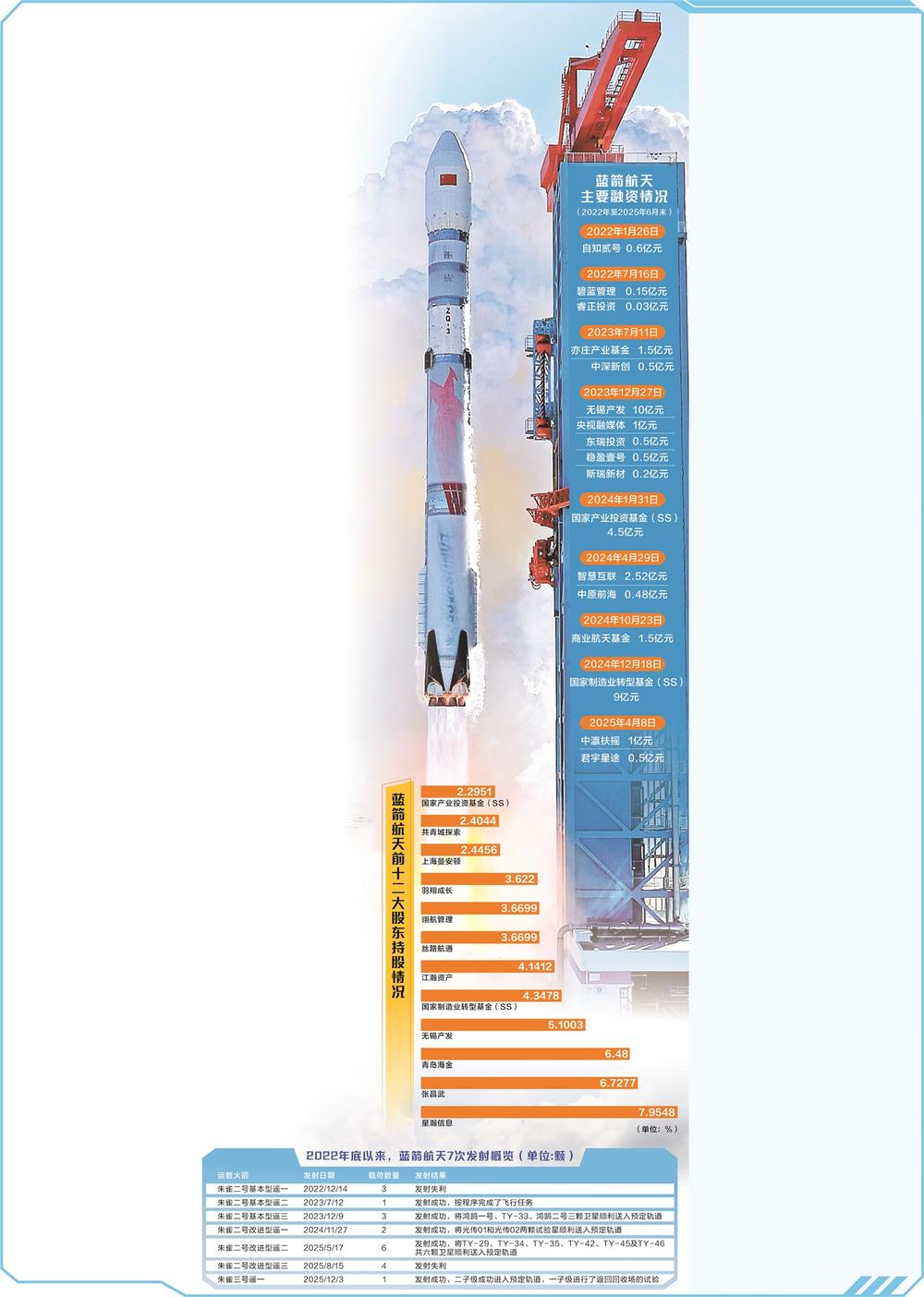
Core Insights - The commercial space sector in China is experiencing significant momentum, with companies like Blue Arrow Aerospace, Tianbing Technology, Xinghe Power, and others aiming to become the "first commercial rocket stock" [2] - The valuation of these companies has surpassed 10 billion yuan, reflecting a broader trend of increasing investment interest in the sector [2] - The competitive landscape is intensifying, driven by policy support and a growing demand for space resources, leading to a rush for capital and project shares [2][3] Financing Overview - Blue Arrow Aerospace has secured multiple rounds of financing from various investors, totaling approximately 27.5 billion yuan from 2022 to mid-2025 [1] - Notable funding rounds include 10 billion yuan from Wuxi Industrial Development and 9 billion yuan from the National Manufacturing Transformation Fund [1] Market Dynamics - There is a growing interest from investors in acquiring shares of established companies in the commercial space sector, with many original shareholders reluctant to sell [3] - The market is witnessing a surge in demand for secondary shares, indicating a strong appetite for investment in this rapidly evolving sector [3] Investment Opportunities - The commercial radar satellite segment is showing signs of mergers and acquisitions, which may provide opportunities for domestic funds to enter the market [4] - The increasing competition in the space sector, particularly with the success of SpaceX, is pushing Chinese companies to accelerate their development and market entry [7] Policy and Regulatory Environment - The Chinese government has implemented supportive policies to encourage private sector participation in the space industry, which has led to the emergence of several startups [5] - Recent reforms in the STAR Market have made it easier for commercial space companies to go public, enhancing investor confidence [6] Future Growth Potential - The commercial space sector is expected to see significant growth as the demand for low Earth orbit satellites increases, with plans for over 51,300 satellite launches in the pipeline [6] - The successful implementation of reusable rocket technology is seen as a critical factor for reducing costs and increasing launch frequency [10] Emerging Trends - The concept of "space computing" is gaining traction, with major tech companies exploring opportunities in this new frontier, indicating a shift from merely launching satellites to leveraging space for data processing [9] - The focus on reducing launch costs through technological advancements and supply chain optimization presents further investment opportunities across the industry [10]
中国商业火箭的现状与展望
2026-01-08 02:07
Summary of Key Points from the Conference Call on China's Commercial Rocket Industry Industry Overview - The conference discusses the current status and future prospects of the commercial rocket industry in China, emphasizing the significant demand for large liquid launch vehicles capable of carrying over 10 tons, driven by satellite internet projects [1][4]. Core Insights and Arguments - **Regulatory Framework**: The new policies from the Sci-Tech Innovation Board require companies to demonstrate reusable technology and successful launches of medium to large liquid launch vehicles [1][3]. - **Market Demand**: The commercial space market in China is characterized by a high demand for satellite launches, with projections of 200-400 launches annually over the next 20 years, leading to a market size exceeding 100 billion RMB [1][4]. - **Global Comparison**: In 2025, SpaceX's Falcon 9 is expected to complete 165 launches, accounting for 90% of the global payload weight, highlighting the disparity in launch capabilities between China and the U.S. [1][5]. - **Cost Reduction Goals**: The company aims to reduce the cost of launching payloads to below 10,000 RMB per kilogram, significantly cheaper than the Falcon 9 [1][6]. Development Goals of the Company - The company, established in 2022, aims to develop medium to large liquid launch vehicles with a base capacity of 15 tons, upgradeable to 25 tons, and to become the lowest-cost rocket manufacturer globally [6]. Technical Innovations - **Recovery Technology**: The company proposes an innovative recovery method that increases recovery rates to approximately 85% and shortens assembly cycles, facilitating rapid and frequent launches [8]. - **Fuel and Material Choices**: The discussion includes the pros and cons of different rocket fuels and materials, emphasizing the need for a balance between cleanliness, density, and cost [7]. Challenges and Pain Points - The primary challenge in the commercial rocket industry is the manufacturing process, which has not kept pace with the increasing demand for frequent and cost-effective launches [10]. - Key technical challenges for reusable rockets include thrust control, guidance, and thermal protection during re-entry, which are more complex than those faced by traditional expendable rockets [15]. Future Outlook - The year 2026 is anticipated to be pivotal for China's space industry, with potential breakthroughs in reusable rockets and commercial listings [11][12]. - The U.S. market, particularly SpaceX's planned IPO in 2027, is expected to boost confidence in the global commercial space sector [13][14]. Additional Considerations - The conference highlights the importance of product competitiveness in the commercial space market, suggesting that the ability to provide cost-effective and reliable launch services will determine success [14]. - Despite potential price reductions due to technological advancements, the complexity of rocket systems means that costs will not decrease to the level seen in the electric vehicle market [16][17].
硬蛋创新再涨超13% 公司近期发布自研新品 布局商业航天前沿赛道
Zhi Tong Cai Jing· 2026-01-07 02:35
Group 1 - The core point of the article highlights that Hard Egg Innovation (00400) has seen a significant stock increase of over 30% this week, with a current price of 4 HKD and a trading volume of 52.41 million HKD [1] - Hard Egg Innovation's subsidiary, Kepler Lab, has achieved breakthroughs in self-developed products, launching two new products aimed at the commercial satellite internet sector and high-bandwidth special detection [1] - The expansion of the fifth set of listing standards on the Sci-Tech Innovation Board to include the commercial aerospace sector indicates that the industry is moving towards a critical point of industrialization, which may lead to a systematic revaluation of the commercial aerospace industry chain [1] Group 2 - The new products developed by Kepler Lab include the "KPL-Multi-Channel RF SOM" based on AMD's next-generation core chip authorization and the "KPL-High-Speed Edge AI SOM" based on Versal Gen2 VE3858 VE3558 [1] - The strategic alignment of Hard Egg Innovation's new product development with its traditional chip distribution business is noted, leveraging the company's understanding of global top-tier chip technologies [1] - The successful mass deployment of several self-developed products in downstream sectors demonstrates the company's capability and market readiness [1]