国际化消费环境建设

Search documents
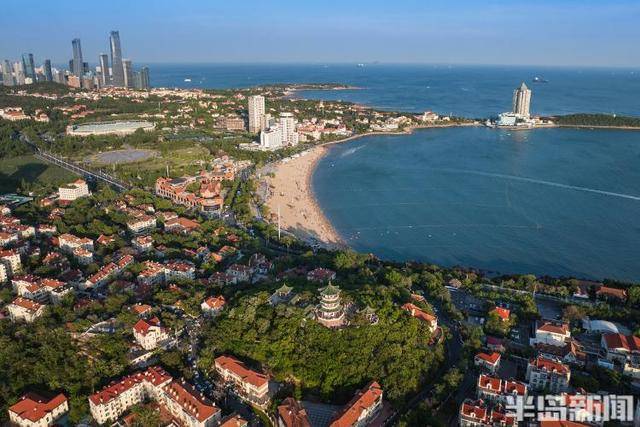
5亿元!青岛上榜国家级“消费双试点”城市,享真金白银支持
Sou Hu Cai Jing· 2025-12-22 07:26
Core Insights - The Ministry of Commerce has officially announced the list of "New Consumption Pilot Cities" and "International Consumption Environment Construction Pilot Cities," with Qingdao successfully included, which will bring a total of 5 billion yuan in financial subsidies to the city [1][3][4] Group 1: Financial Support and Policy Implementation - Qingdao will receive 400 million yuan for the "New Consumption Pilot" and 100 million yuan for the "International Consumption Environment Construction" [1][3] - The implementation period for both pilot policies is two years, aimed at guiding systematic upgrades in consumption through financial support and precise policy direction [4] Group 2: Objectives and Focus Areas - The "New Consumption Pilot" aims to enhance the service system for new economic launches, innovate diverse service consumption scenarios, and support cross-industry collaborations to improve consumption quality and stimulate consumer activity [3][4] - The "International Consumption Environment Construction" will focus on cultivating an international consumption environment, enhancing the "Buy in China" brand, and innovating international and diversified consumption scenarios to attract foreign tourists [3][4] Group 3: Qingdao's Economic Performance - Qingdao's total retail sales of consumer goods reached 658.45 billion yuan in 2024, maintaining its position as the "second consumption city in the north" [6] - The city has implemented various initiatives to boost consumption, including issuing 130 million yuan in consumer vouchers, which stimulated 3.66 billion yuan in consumption [6] - New consumption formats are emerging, with 95 new brand stores established this year, and online retail sales growing by 9.5% from January to October [6] Group 4: Strategic Planning and Future Goals - The "14th Five-Year Plan" for Shandong Province emphasizes supporting Qingdao in becoming an international consumption center and enhancing its economic scale [8][13] - The plan includes upgrading consumption clusters and developing high-quality commercial districts, which will benefit from the central government's financial support [13]

杭州“双上榜”国家级消费试点项目 申报通道现已开启
Mei Ri Shang Bao· 2025-12-09 06:54
Core Viewpoint - Hangzhou has been designated as a pilot city for new consumption formats, models, and scenarios, as well as for the construction of an international consumption environment, aiming to enhance quality consumption supply and promote consumption transformation and upgrading [1] Group 1: Pilot Projects - The application period for the two major consumption pilot projects is from December 3, 2025, to December 31, 2025 [2] - The "Three New" consumption pilot supports the establishment of a first-release economic service system, including first-release centers and economic clusters with Hangzhou characteristics, as well as flagship and concept stores from leading domestic and international brands [2] - The international consumption environment construction pilot supports the enhancement of high-quality consumption supply, focusing on the renovation of key business districts and the cultivation of local brands with fashion leadership and international influence [2] Group 2: Application Requirements - Applicants for the pilot projects must be legally registered entities in Hangzhou with good operational status and sound financial systems, and must not have any negative credit records or serious legal violations in the past three years [3] - Projects must be implemented within Hangzhou and are required to be completed and operational by June 30, 2027 [3] - Applications must align with the support directions of the pilot projects and cannot involve fraudulent activities to obtain funding; projects previously funded by other central financial support cannot reapply [3]
年内离境退税销售额已达4500万元 昆明打造“南亚东南亚入境消费第一城”
Zhong Guo Jing Ying Bao· 2025-12-02 12:49
Core Insights - Kunming is rapidly growing as a destination for inbound consumption, with significant increases in international tourism and retail sales [1][2][4] Group 1: Inbound Tourism Growth - In the first three quarters of the year, Kunming received 952,100 inbound tourists, marking a year-on-year increase of 47.71% [2] - International tourism revenue reached $1.044 billion, reflecting a year-on-year growth of 46.49% [2] - The expansion of the departure tax refund policy has contributed to a substantial increase in consumer spending [2] Group 2: Economic and Infrastructure Advantages - Kunming is positioned as a strategic hub for South Asia and Southeast Asia, benefiting from low labor costs and abundant mineral resources [3] - The city has developed a comprehensive international transportation network, including 369 flight routes and extensive rail and highway connections [3] Group 3: New Consumption Models and Policies - Kunming was selected as one of the 15 pilot cities for new consumption models, with a funding support of up to 4 billion yuan for super-large cities over two years [4][5] - The city has seen a 2.6% year-on-year increase in total retail sales of consumer goods, amounting to 314.51 billion yuan from January to October [5] - The retail sales of household appliances and audio-visual equipment surged by 101.9%, while communication equipment sales increased by 57.8% [5] Group 4: Business Engagement and Future Prospects - The recent closed-door investment promotion meeting attracted interest from various companies, highlighting Kunming's potential as a gateway to South Asia and Southeast Asia [5] - By 2025, Kunming aims to achieve five national-level pilot projects focused on business development and international consumption environment [5]
长三角议事厅·周报|从国际化消费试点看长三角城市新梯度
Xin Lang Cai Jing· 2025-12-02 03:47
Core Insights - The Ministry of Commerce and the Ministry of Finance have jointly announced the list of "Pilot Cities for International Consumption Environment Construction," with Shanghai leading the Yangtze River Delta as an international consumption center, while Nanjing and Hangzhou have made their debut on the list [1][3][4] Group 1: Consumption Landscape - Shanghai remains at the top of the consumption hierarchy, with projected international tourism revenue of $11.09 billion in 2024, a growth of 79.3%, and domestic tourism revenue of approximately ¥497.26 billion, a growth of 35.2% [3] - Hangzhou is recognized as the "E-commerce Capital," with online retail sales exceeding ¥1 trillion in 2022, supported by over 128 e-commerce platforms and 1.25 million online stores [3][4] - Nanjing excels in offline shopping districts and cultural scenes, with a focus on revitalizing historical areas and enhancing night economy, leading to a higher density of cultural offerings compared to similar cities [4] Group 2: Absence of Strong Manufacturing Cities - Notable absences from the pilot list include major manufacturing cities like Suzhou, Ningbo, and Wuxi, which, despite their economic strength, have not developed corresponding international consumption environments [5][6] - Suzhou is projected to surpass ¥1 trillion in retail sales in 2024, yet its service sector's contribution to GDP is only about 52.4%, indicating a reliance on manufacturing income rather than a robust consumer market [5][6] - Ningbo and Wuxi also exhibit similar trends, with low inbound tourism numbers and a lack of international consumption experiences, highlighting a disconnect between industrial strength and consumer engagement [5][6] Group 3: Regional Consumption Gradient - The Yangtze River Delta has established a preliminary consumption gradient, with Shanghai at the internationalization peak, followed by Hangzhou and Nanjing as innovation hubs, while Suzhou, Ningbo, and Wuxi lag behind in consumer engagement [6][7] - This entrenched structure may weaken the overall domestic demand potential of the Yangtze River Delta and create new imbalances in urban capabilities and regional roles [6] Group 4: Challenges in Consumption Coordination - Despite advancements in transportation integration, the consumption landscape has not evolved correspondingly, with a lack of clear regional consumption function division [7][8] - The absence of a unified data framework hampers regional collaboration, as cities rely on disparate data sources, leading to a fragmented understanding of consumer behavior across the region [8] Group 5: Recommendations for Regional Benefits - To transform the pilot cities' advantages into regional benefits, it is essential to address institutional shortcomings and establish unified standards for cross-city operations [9][10] - Shanghai should continue to serve as a global entry point, while Nanjing and Hangzhou can focus on cultural and digital consumption experiences, respectively, to create a cohesive regional consumption ecosystem [9][10] - Developing a regional consumption big data platform could enhance policy precision and foster sustainable cross-city consumption habits [10]
经济观察|建设国际化消费环境 中国15城迎国家级试点
Zhong Guo Xin Wen Wang· 2025-11-25 02:40
Core Insights - China has announced national-level policy support for 15 cities in the "international consumption" sector, aiming to enhance their roles as international consumption centers [1][3] Group 1: Selected Cities and Their Economic Impact - The selected cities include Beijing, Shanghai, Guangzhou, Tianjin, and Chongqing, which have already been recognized as international consumption center cities since 2021 [1] - As of July this year, these five cities accounted for over 12.5% of the national retail sales of consumer goods and over 50% of the country's consumer goods imports [1] - The newly added cities, including Shenzhen and Chengdu, are also significant consumption hubs, with retail sales expected to exceed 1 trillion yuan in 2024 [1] Group 2: Characteristics of New Cities - Cities like Xi'an, Nanjing, Changsha, Wuhan, and Hangzhou are provincial capitals with strong economic growth and renowned tourist attractions, making them popular among international visitors [1] - Kunming, Qingdao, and Xiamen have distinct geographical advantages, with Kunming serving as a gateway to South and Southeast Asia, Qingdao being a major northern consumption city, and Xiamen having significant port and expatriate resources [2] Group 3: Development Strategies - Many cities have already proposed specific action plans to build international consumption centers, leveraging their unique industrial resources and cultural advantages [4] - For instance, Chongqing plans to focus on developing its night economy, with projections indicating that over 60% of its retail sales will occur at night in 2024 [4] - The Ministry of Finance and the Ministry of Commerce have outlined support for enhancing high-quality consumption supply, optimizing foreign payment services, and improving international service levels [4]
国际消费中心城市“扩容”?这15座城市被委以重任
3 6 Ke· 2025-11-25 02:33
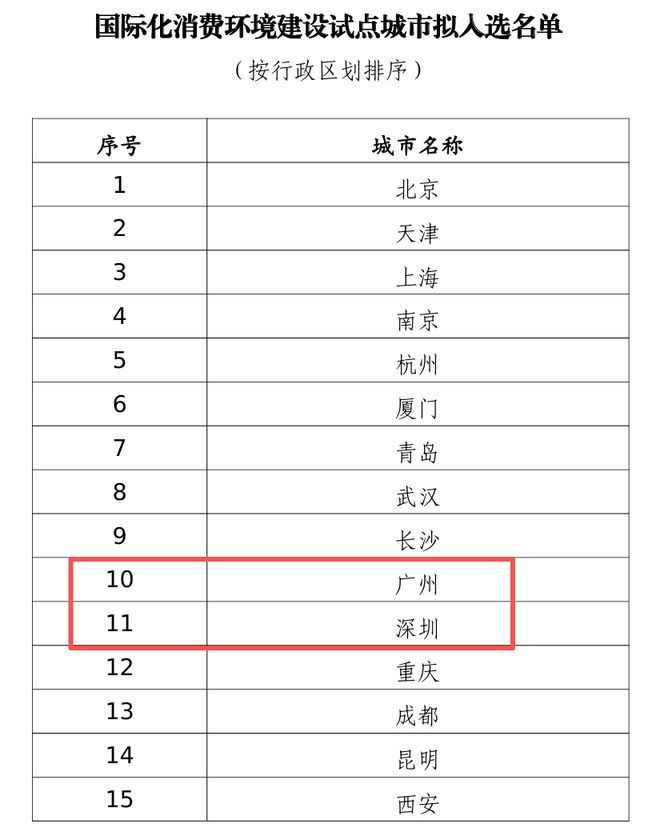
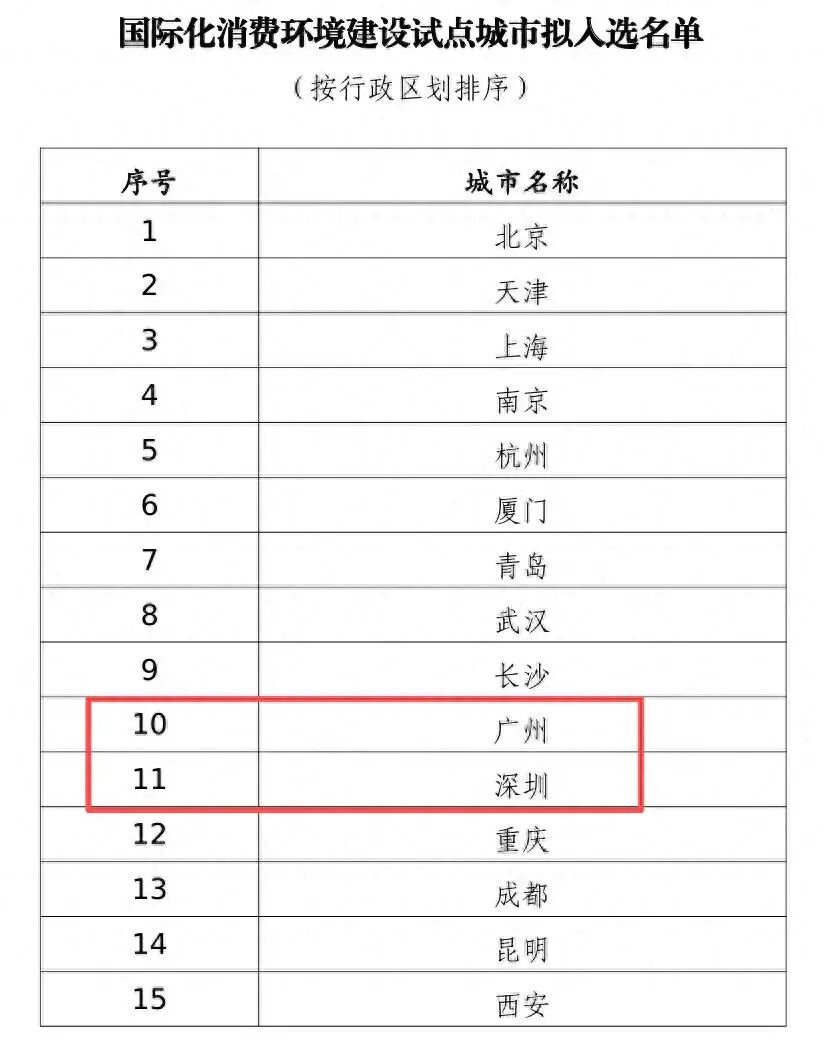
Core Viewpoint - The expansion of international consumption center cities in China is underway, with the addition of 10 new cities to the initial five recognized by the Ministry of Commerce, indicating a strategic move to enhance the country's consumption environment and attract international visitors [1][3]. Group 1: International Consumption Center Cities - The five initial international consumption center cities are Shanghai, Beijing, Guangzhou, Tianjin, and Chongqing, which were approved for development in July 2021 [1]. - A new list of 15 cities has been announced, including the original five and ten additional cities: Nanjing, Hangzhou, Xiamen, Qingdao, Wuhan, Changsha, Shenzhen, Chengdu, Kunming, and Xi'an [1][2]. - The Ministry of Finance and the Ministry of Commerce issued a notice in September 2023 to support the development of an international consumption environment in these cities, with a funding period of two years [2]. Group 2: Funding and Support - Each international consumption center city will receive a total subsidy of 200 million yuan, while the other selected cities will receive 100 million yuan each [2][5]. - The support will focus on enhancing high-quality consumption supply, optimizing foreign payment services, and improving international service levels [2]. Group 3: Assessment and Progress - The initial five cities have completed a mid-term assessment, leading to their designation as "international consumption center cities" without the "cultivation" label [4][5]. - This change suggests that these cities have successfully met the preliminary assessment criteria [5]. Group 4: Selection Criteria for New Cities - The selection of the ten new cities reflects a multifaceted consideration by the Ministry of Commerce, moving beyond a simple GDP ranking approach [6]. - Notably, cities like Suzhou, Ningbo, and Wuxi were not selected despite their strong economic performance, while cities like Xi'an and Kunming were included due to their unique consumption characteristics and potential [6]. Group 5: Guangzhou's Achievements - Since being approved as an international consumption center city, Guangzhou has seen significant progress, with its retail sales exceeding 1 trillion yuan for four consecutive years and an average growth rate of 4.5% [7][8]. - In 2024, Guangzhou's international appeal has increased, ranking 22nd in the GaWC world city rankings, with 501.1 million overnight visitors and cultural tourism consumption reaching 3.57 billion USD [8].
(经济观察)建设国际化消费环境 中国15城迎国家级试点
Zhong Guo Xin Wen Wang· 2025-11-24 12:07
Core Insights - China has announced national-level policy support for 15 cities in the field of "international consumption" [2] Group 1: Selected Cities and Their Characteristics - The Ministry of Commerce and the Ministry of Finance have published a list of 15 cities selected for the "International Consumption Environment Construction Pilot Cities" [2] - The selected cities include Beijing, Shanghai, Guangzhou, Tianjin, and Chongqing, which have been recognized as international consumption center cities since 2021 [2] - As of July this year, these five cities accounted for over one-eighth of the national total retail sales of consumer goods and over half of the country's consumer goods imports [2] - The newly added cities, such as Shenzhen and Chengdu, are also significant consumption cities, with retail sales expected to exceed 1 trillion yuan in 2024 [2] Group 2: Economic and Cultural Advantages - Cities like Xi'an, Nanjing, Changsha, Wuhan, and Hangzhou are provincial capitals with strong economic growth and renowned tourist attractions, making them popular among international visitors [2] - Kunming, Qingdao, and Xiamen possess distinct geographical advantages, with Kunming serving as a key gateway to South Asia and Southeast Asia [3] Group 3: Future Development and Strategies - The newly selected pilot cities are seen as potential "reserve forces" for future international consumption center city development [4] - Many cities have already proposed specific action plans to enhance their international consumption capabilities, leveraging unique local resources and cultural advantages [5] - The Ministry of Finance and the Ministry of Commerce have outlined future support for international consumption environment construction, focusing on enriching high-quality consumption supply, optimizing foreign payment services, and improving international service levels [5]
城市24小时 | 这条“短线”高铁,为何“砸锅卖铁也要上”
Mei Ri Jing Ji Xin Wen· 2025-11-20 15:22
Core Viewpoint - The Hangzhou-Qichun High-Speed Railway (杭衢高铁) has entered the trial operation phase, marking a significant step towards its full opening, which is expected by the end of December 2025. This railway is seen as a vital development for the Qichun region, enhancing connectivity and economic growth opportunities [3][5][6]. Summary by Sections Project Overview - The Hangzhou-Qichun High-Speed Railway spans approximately 131 kilometers with a design speed of 350 km/h, featuring six stations including JianDe, LongYou, and Jiangshan. The project commenced construction in May 2020 and is characterized by a bridge-tunnel ratio of 78.7% [5][6]. Economic Impact - The railway is anticipated to significantly reduce travel time between Hangzhou and Qichun from about 1 hour to approximately 40 minutes, and travel to Shanghai will decrease from over 2 hours to 90 minutes. This improvement is expected to mitigate Qichun's marginalization in the economic landscape of Zhejiang Province [5][6]. Strategic Importance - The Hangzhou-Qichun High-Speed Railway is positioned as a key channel for enhancing Zhejiang's connectivity with neighboring provinces such as Anhui, Jiangxi, and Fujian, facilitating the integration of the Yangtze River Delta with central regions [6]. Investment and Construction Model - This railway is notable for being the first in China to adopt a "PPP+EPC" model, with a total investment of approximately 23.63 billion yuan. The project is led by the China Railway Fourth Survey and Design Institute Group [6]. Operational Considerations - Experts suggest that the operational frequency of the railway should be optimized to enhance connectivity with other rail lines, such as the Hukun Railway and Jiujiang-Qichun Railway, to better serve a wider range of passengers. There is also a push for the railway to serve as a pilot for intercity rail operations [7].
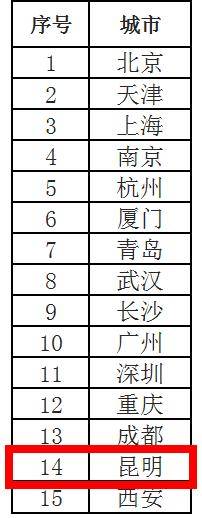
昆明拟入选国际化消费环境建设试点城市
Sou Hu Cai Jing· 2025-11-20 13:36
Core Points - The Ministry of Commerce and the Ministry of Finance have organized a competitive evaluation for cities to be selected as pilot cities for the construction of an international consumption environment [1] - A total of 15 cities are proposed to be included in the pilot program, with the results now publicly announced [1] - The public announcement period for the proposed cities is from November 20, 2025, to November 28, 2025 [1] Summary by Categories - **Government Initiative** - The initiative is based on the notice issued by the Ministry of Finance and the Ministry of Commerce regarding the construction of an international consumption environment [1] - **Pilot Cities Selection** - A competitive evaluation has been conducted to determine the cities that will be included in the pilot program [1] - The proposed list includes 15 cities, which are now subject to public review [1] - **Public Announcement** - The public announcement period for the proposed pilot cities is set for November 20, 2025, to November 28, 2025 [1]
广州、深圳入选!国际化消费环境建设试点城市拟入选名单公示
Nan Fang Du Shi Bao· 2025-11-20 13:22
Core Viewpoint - The Ministry of Finance has announced the selection of cities for the pilot program aimed at building an international consumption environment, with Guangzhou and Shenzhen being included in the list [1]. Group 1: Pilot Cities and Policy Framework - The pilot program will support around 15 cities that meet specific criteria, focusing on those with strong consumption influence, development potential, and a high number of foreign travelers [3]. - The policy implementation period is set for two years, aligning with the central government's strategy to boost consumption [3]. Group 2: Support Directions - The program aims to enhance high-quality consumption supply, optimize foreign payment services, and improve international service levels [3]. - Key themes for the international consumption environment include intellectual property, digitalization, green initiatives, smart technology, cultural tourism, sports, and domestic brands [3]. Group 3: Infrastructure and Service Enhancements - The initiative will support the renovation of key commercial areas and the creation of internationally recognized consumer scenarios, including international consumption clusters and tourist-friendly shopping districts [3]. - There will be a focus on developing tax refund services for outbound travelers, increasing the number of refund stores, and optimizing refund services [3]. Group 4: Multilingual and Convenience Services - The program will enhance multilingual signage in key areas such as commercial districts, tourist attractions, hotels, and transportation hubs, along with the introduction of luggage storage and guidance services for foreign travelers [4]. - It will also support the provision of multilingual product and service lists by key merchants in sectors like dining, accommodation, and retail [4].