国际收支

Search documents
外汇局,最新报告!
证券时报· 2025-10-01 04:49
Core Viewpoint - The report indicates that China's international balance of payments is expected to remain stable, with a reasonable equilibrium in the current account and a positive outlook for cross-border investment and financing [2]. Group 1: Current Account and Trade Performance - In the first half of 2025, China's current account surplus was $294.1 billion, remaining within a reasonable equilibrium range [4]. - Goods trade showed resilience, with total imports and exports increasing by 2% year-on-year, while service trade grew more actively, with service imports and exports rising by 6% [4]. - Goods exports reached $1.7 trillion, a 7% increase year-on-year, while imports were $1.2 trillion, a 4% decrease [4]. - Travel income surged by 42% to $24.3 billion, marking a historical high for the same period, while travel expenditure increased by 5% to $126.2 billion [4][5]. Group 2: Foreign Debt and Investment - As of June 2025, China's total external debt was $2.4368 trillion, a slight decrease of 0.6% from March 2025 [2]. - China's foreign financial assets and liabilities exceeded $11 trillion and $7.2 trillion, respectively, with net foreign assets growing by 16% compared to the end of 2024 [7]. - Direct investment in China accounted for 51% of total foreign liabilities, while securities investment made up 30%, an increase of 1.8 percentage points from the end of 2024 [7]. Group 3: Future Outlook and Policy Directions - The report anticipates that external conditions will remain complex, with potential pressures from trade protectionism and geopolitical risks [9]. - The foreign exchange management department plans to steadily expand reforms and open up the foreign exchange sector, aiming to support stable development of foreign trade and investment [10]. - Measures will include optimizing foreign exchange fund settlement for new foreign trade entities and enhancing the efficiency of service trade enterprises [10].


来华直接投资继续位列外债首位!外汇局报告:预计跨境旅游收入稳步增长
Zheng Quan Shi Bao Wang· 2025-10-01 03:00
Core Insights - The report indicates that China's current account is expected to maintain a reasonable balance in the second half of 2025, with cross-border investment and financing likely to improve steadily [1] Group 1: Foreign Exchange Market and Debt - As of June 2025, China's total external debt was $2.4368 trillion, a slight decrease of 0.6% from March 2025, with a stable scale and currency structure [1][4] - The report highlights that China's foreign financial assets and liabilities exceeded $11 trillion and $7.2 trillion respectively, resulting in a net foreign asset of $3.8 trillion, which grew by 16% compared to the end of 2024 [4] - The proportion of domestic currency debt remained stable at 52.1%, while the share of medium- and long-term debt increased by 0.2 percentage points to 42.4% [4] Group 2: Trade Performance - In the first half of 2025, China's current account surplus was $294.1 billion, remaining within a reasonable range, with total goods trade imports and exports increasing by 2% year-on-year [2] - Goods exports reached $1.7 trillion, a 7% increase year-on-year, while imports were $1.2 trillion, down 4% year-on-year [2] - Service trade showed robust growth, with total service imports and exports rising by 6% year-on-year, and travel income increasing by 42% to $24.3 billion, marking a historical high for the same period [2][3] Group 3: Future Outlook and Policy Directions - The report anticipates that external economic conditions will remain complex, with potential pressures from trade protectionism and geopolitical conflicts [5] - The foreign exchange management department plans to expand reforms and facilitate cross-border trade and investment, including optimizing foreign exchange settlement for new foreign trade entities [6] - Measures will be taken to enhance monitoring of cross-border capital flows and maintain the stability of the foreign exchange market, while also combating illegal cross-border financial activities [6]
2025年上半年我国经常账户顺差2941亿美元 继续处于合理均衡区间
Zheng Quan Ri Bao Wang· 2025-09-30 11:00
Core Insights - The report highlights the increasing volatility in international financial markets and the complex geopolitical situation, which poses significant external risks to China's economy [1] - China's economy is showing resilience and stability, with a focus on high-quality development and proactive macroeconomic policies [1] Economic Performance - In the first half of 2025, China's current account surplus reached $294.1 billion, remaining within a reasonable equilibrium range [2] - The total import and export volume of goods increased by 2% year-on-year, while service trade grew more actively with a 6% increase in service imports and exports [2] - Investment income improved, with China's outbound investment income and foreign investment income in China growing by 13% and 7% respectively [2] Financial Stability - By the end of June 2025, China's foreign financial assets and liabilities exceeded $11 trillion and $7.2 trillion respectively, resulting in a net foreign asset of $3.8 trillion, a 16% increase from the end of 2024 [2] - The non-reserve financial account deficit and current account surplus formed a self-balancing pattern, indicating a stable investment environment [2] Future Outlook - The report anticipates continued challenges from a complex external environment and downward pressure on the global economy, but expects the current account to maintain a reasonable equilibrium [3] - China's efforts to establish a new development pattern and enhance macroeconomic policy effectiveness are expected to support stable international payments [3] - The foreign exchange management department will implement policies to ensure a more convenient, open, secure, and intelligent foreign exchange management system [3]
国际宏观资讯双周报-20250928
Zhong Cheng Xin Guo Ji· 2025-09-28 06:56
Economic Developments - The Federal Reserve lowered the federal funds rate by 25 basis points to a target range of 4.00%-4.25%, marking its first rate cut since December 2024[9] - Turkey's central bank reduced the benchmark interest rate by 250 basis points to 40.5%, exceeding market expectations[13] - Indonesia announced an economic stimulus package worth 16.23 trillion Indonesian rupiah (approximately $1 billion) to boost consumption and employment[15] Sovereign Credit Ratings - Moody's downgraded Poland's credit outlook from stable to negative while maintaining an A2 rating, citing weakened fiscal and debt indicators[41] - Fitch upgraded Italy's credit rating from BBB to BBB+ with a stable outlook, reflecting improved fiscal policies and revenue growth[42] - Fitch raised Portugal's credit rating from A- to A with a stable outlook, noting a significant reduction in public debt as a percentage of GDP[43] - Fitch downgraded France's credit rating from AA- to A+ with a stable outlook, highlighting rising public debt and persistent fiscal deficits[45] Geopolitical Risks - Recent drone incidents involving Russia have heightened geopolitical tensions in Eastern Europe, impacting the sovereign credit ratings of affected countries[7] - The ongoing conflict in Gaza has led to increased military spending in Israel, with an additional budget of $9 billion primarily for defense purposes[20] Trade and Investment - South Korea recorded a current account surplus of $10.78 billion in July, the highest for that month in history, with a cumulative surplus of $60.15 billion for the first seven months of the year[31] - The U.S. and India are set to complete the first phase of their trade agreement negotiations by November 2025[29]
外汇局:8月我国国际收支货物和服务贸易顺差710亿美元
Zheng Quan Ri Bao Wang· 2025-09-26 11:47
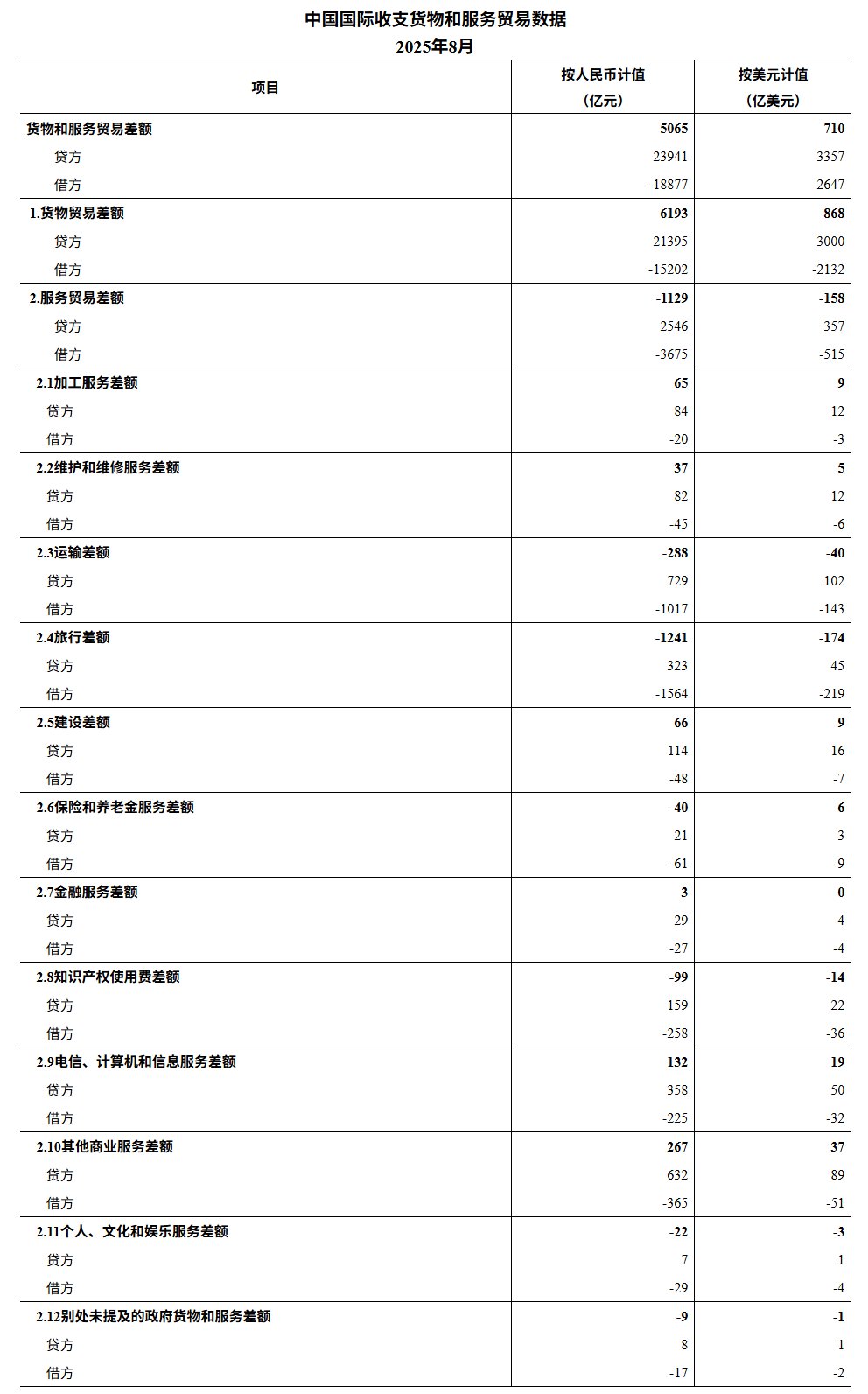
Core Insights - In August 2025, China's international balance of payments for goods and services trade reached a total import and export scale of 42,818 billion yuan, marking a year-on-year growth of 2% [1] Trade Data Summary - Goods trade exports amounted to 21,395 billion yuan, while imports were 15,202 billion yuan, resulting in a surplus of 6,193 billion yuan [1] - Service trade exports totaled 2,546 billion yuan, with imports at 3,675 billion yuan, leading to a deficit of 1,129 billion yuan [1] Service Trade Breakdown - Major components of service trade included: - Travel services with an import and export scale of 1,887 billion yuan - Transportation services with an import and export scale of 1,745 billion yuan - Other commercial services with an import and export scale of 996 billion yuan - Telecommunications, computer, and information services with an import and export scale of 583 billion yuan [1] Dollar Value Summary - In USD terms, exports for August 2025 were valued at 3,357 million USD, imports at 2,647 million USD, resulting in a surplus of 710 million USD [1]
国家外汇局:8月我国国际收支货物和服务贸易进出口规模42818亿元 同比增长2%
智通财经网· 2025-09-26 09:14
Core Insights - In August 2025, China's international balance of payments for goods and services trade reached a total import and export scale of 42,818 billion yuan, marking a year-on-year increase of 2% [1] - The goods trade surplus was 6,193 billion yuan, with exports at 21,395 billion yuan and imports at 15,202 billion yuan [1] - The services trade recorded a deficit of 1,129 billion yuan, with exports at 2,546 billion yuan and imports at 3,675 billion yuan [1] Goods Trade Summary - Total goods trade exports amounted to 21,395 billion yuan (3,000 billion USD) and imports were 15,202 billion yuan (2,132 billion USD) [2] - The goods trade surplus was 6,193 billion yuan (868 billion USD) [2] Services Trade Summary - Total services trade exports were 2,546 billion yuan (357 billion USD) and imports were 3,675 billion yuan (515 billion USD) [2] - The services trade deficit was 1,129 billion yuan (158 billion USD) [2] - Major components of services trade included: - Travel services: exports of 323 billion yuan (45 billion USD) and imports of 1,564 billion yuan (219 billion USD), resulting in a deficit of 1,241 billion yuan (174 billion USD) [4] - Transportation services: exports of 729 billion yuan (102 billion USD) and imports of 1,017 billion yuan (143 billion USD), leading to a deficit of 288 billion yuan (40 billion USD) [4] - Other commercial services: exports of 632 billion yuan (89 billion USD) and imports of 365 billion yuan (51 billion USD), resulting in a surplus of 267 billion yuan (37 billion USD) [4]
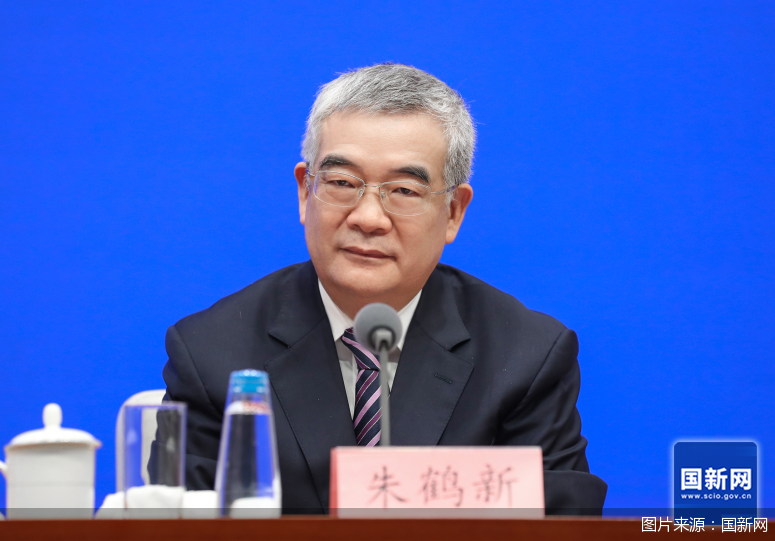
朱鹤新:我国外汇市场运行平稳 活力和韧性都在增强
Jin Rong Shi Bao· 2025-09-23 02:01
Core Insights - Since the beginning of the "14th Five-Year Plan," China's foreign exchange sector has effectively coordinated development and security, steadily advancing high-level openness, which provides strong support for constructing a new development pattern [1] Group 1: International Balance of Payments - China's international balance of payments has become more stable, with a reasonable ratio of current account surplus to GDP [1] - By the end of July, foreign institutions and individuals held over 10 trillion yuan in domestic stocks, bonds, and deposits [1] Group 2: Cross-Border Capital Flows - In 2024, China's cross-border capital flow scale is projected to reach 14 trillion USD, a 64% increase from 2020, with an average annual growth rate 8 percentage points higher than during the "13th Five-Year Plan" [2] - The trading volume in the foreign exchange market is expected to be 41 trillion USD in 2024, a 37% increase from 2020, indicating sufficient capacity to accommodate various transactions [2] Group 3: Foreign Exchange Market Resilience - The ratio of enterprises using foreign exchange hedging has increased from 17% in 2020 to around 30%, while the proportion of the renminbi in cross-border trade has risen from 16% to nearly 30% [2] - The macro-prudential management system of the foreign exchange market is gradually improving, with a richer toolbox for counter-cyclical adjustments [2] Group 4: Future Outlook - The long-term positive fundamentals of China's economy and steady progress in high-level openness lay a solid foundation for a stable international balance of payments [3] - The foreign exchange reserve has remained stable above 3 trillion USD, exceeding 3.2 trillion USD in recent years, serving as an important stabilizer for the national economy [4]
外汇市场活力和韧性增强 应对外部风险挑战底气更足
Sou Hu Cai Jing· 2025-09-22 22:20
Core Insights - The People's Bank of China and the State Administration of Foreign Exchange reported that China's cross-border capital flows have remained generally balanced despite high volatility in international markets, with the RMB exchange rate performing steadily against major currencies [1][2] - The cross-border receipts and payments scale is projected to reach $14 trillion in 2024, a 64% increase from 2020, with an average annual growth rate during the 14th Five-Year Plan period being 8 percentage points higher than the previous period [1] - The ratio of enterprises using foreign exchange hedging has increased from 17% in 2020 to around 30%, and the RMB's share in cross-border trade has risen from 16% to nearly 30% [1] Market Resilience - The international balance of payments has remained fundamentally balanced during the 14th Five-Year Plan, with the current account surplus to GDP ratio staying within a reasonable range [2] - Foreign exchange reserves have consistently remained above $3 trillion, stabilizing at over $3.2 trillion in recent years, serving as a crucial stabilizer for the national economy and finance [2] - The State Administration of Foreign Exchange has facilitated nearly $4.6 trillion in trade-related foreign exchange receipts and payments since the beginning of the 14th Five-Year Plan [2] Policy Initiatives - The foreign exchange authority has implemented reforms to enhance the efficiency of trade foreign exchange receipts and payments, as well as to promote high-level openness in cross-border trade and investment [2] - Efforts to improve the convenience of cross-border investment and financing have led to nearly $300 billion in related transactions during the 14th Five-Year Plan [2] - The foreign exchange business reform has included over 23,000 quality clients from small and medium-sized enterprises, private enterprises, and foreign-funded enterprises, with cumulative transactions exceeding $500 billion [2]
中国人民银行副行长、国家外汇局局长朱鹤新: 外汇市场活力和韧性增强 应对外部风险挑战底气更足
Zheng Quan Shi Bao· 2025-09-22 18:03
Core Insights - The People's Bank of China and the State Administration of Foreign Exchange reported that China's cross-border capital flows have remained generally balanced despite high volatility in international markets, with the RMB exchange rate showing stability among major currencies [1][2] Group 1: Market Performance - In 2024, China's cross-border receipts and payments are projected to reach $14 trillion, a 64% increase from 2020, with an average annual growth rate during the 14th Five-Year Plan period being 8 percentage points higher than the previous period [1] - In the first eight months of this year, cross-border receipts and payments increased by 10% year-on-year, indicating sustained activity in cross-border trade and investment [1] - The ratio of enterprises using foreign exchange hedging has risen from 17% in 2020 to approximately 30%, while the RMB's share in cross-border trade has increased from 16% to nearly 30% [1] Group 2: Foreign Exchange Reserves and Stability - China's international balance of payments has remained fundamentally balanced during the 14th Five-Year Plan, with the current account surplus to GDP ratio staying within a reasonable range [2] - Foreign exchange reserves have consistently remained above $3 trillion, stabilizing above $3.2 trillion in recent years, serving as a crucial stabilizer for the national economy and finance [2] Group 3: Policy and Reform Initiatives - The State Administration of Foreign Exchange has implemented reforms to enhance the efficiency of trade foreign exchange receipts and payments, processing nearly $4.6 trillion in related business since the beginning of the 14th Five-Year Plan [2] - To improve cross-border investment and financing convenience, approximately $300 billion in related business has been processed during the same period [2] - The foreign exchange business reform has included over 23,000 quality clients from small and medium-sized enterprises, private enterprises, and foreign-funded enterprises, with cumulative business transactions exceeding $500 billion [2]
朱鹤新表态!外汇市场交易理性有序,应对外部风险挑战的底气更足
Bei Jing Shang Bao· 2025-09-22 14:07
Core Insights - The press conference highlighted the achievements of China's financial sector during the "14th Five-Year Plan" period, emphasizing the effective coordination of development and security in the foreign exchange sector [1][3]. Group 1: Foreign Exchange Market Developments - The international balance of payments has remained stable, with a current account surplus to GDP ratio maintained within a reasonable range, reflecting resilience in foreign trade and investment [3]. - By the end of July, foreign institutions and individuals held over 10 trillion yuan in domestic stocks, bonds, and deposits, indicating active cross-border investment [3]. - The foreign exchange service environment has improved significantly, with the number of enterprises able to conduct business with just instructions increasing more than fivefold since the end of 2020 [3]. Group 2: Foreign Exchange Reserves and Market Stability - Foreign exchange reserves have remained stable above 3 trillion USD, exceeding 3.2 trillion USD for the past two years, serving as a crucial stabilizer for the national economy [4]. - The cross-border payment and receipt scale is projected to reach 14 trillion USD in 2024, a 64% increase from 2020, with an average annual growth rate 8 percentage points higher than the previous five-year period [4][5]. - The trading volume in the foreign exchange market is expected to reach 41 trillion USD in 2024, a 37% increase from 2020, indicating a well-developed market capable of accommodating various transactions [5]. Group 3: Currency and Risk Management - The flexibility of the RMB exchange rate has increased, with the hedging ratio for enterprises rising from 17% in 2020 to around 30%, and the RMB's share in cross-border trade increasing from 16% to nearly 30% [5]. - The macro-prudential management framework for the foreign exchange market is being continuously improved, enhancing the ability to respond to external risks [5]. - Future stability of the RMB will largely depend on the performance of the USD and domestic macroeconomic policies, with ongoing growth policies expected to be a key factor in stabilizing the exchange rate [6].