
战略资产配置

Search documents
工银瑞信基金周崟: 力争捕捉多重收益 FOF战略配置需量体裁衣
Zheng Quan Shi Bao· 2025-08-24 21:04
Group 1 - The core viewpoint emphasizes that multi-asset risk hedging is a significant source of capturing multiple returns, with strategic allocation providing systematic beta returns as the main source of portfolio returns [1][3] - The investment strategy should be tailored according to the nature of the funds, with tactical asset allocation focusing on short to medium-term opportunities to achieve alpha returns [1][3] - The growth sectors to watch include those characterized by technology and manufacturing [1][4] Group 2 - As of now, six FOF products managed by the company have shown good returns, with the "工银睿智进取一年A" fund achieving a 14.88% return year-to-date and a 31.62% net value growth over the past year [2] - The fund's asset allocation is diversified, with over 90% of its positions in various ETFs, including those focused on internet, innovative pharmaceuticals, chips, and gold [2] - The investment philosophy combines subjective and quantitative methods, utilizing macroeconomic analysis to assess economic cycles and systematic multi-perspective industry comparisons for asset allocation [2][3] Group 3 - Strategic asset allocation is crucial for investment, requiring an analysis of the risk-return characteristics and correlations of various asset classes to determine allocation ratios [3] - The principles for strategic asset allocation include a preference for equities over the long term and diversification to expand the investment scope [3][5] - The upcoming structural reforms in the capital market, represented by the new "国九条," are expected to reshape the A-share ecosystem positively [4][5] Group 4 - The macroeconomic outlook suggests that the domestic inventory cycle and global semiconductor cycle may be bottoming out, potentially enhancing risk appetite [4] - The focus on structural opportunities in equity assets will depend on policy support and profit recovery, with supply-demand improvements benefiting certain sectors [5] - The company highlights the importance of investing in technology and manufacturing sectors, particularly in the context of the digital economy and AI technology [5]
3600点再现!与其琢磨抄底逃顶,不如做好这件事
雪球· 2025-08-09 13:31
Core Viewpoint - The article discusses the limitations of market timing in investment strategies, emphasizing that long-term asset allocation is more critical for achieving investment success than attempting to time the market [3][16]. Group 1: Market Timing Analysis - Peter Lynch's analysis from 1965 to 1995 shows that even with perfect timing, the difference in annualized returns between the best and worst timing investors is minimal, with only a 1.1% difference [4][6]. - In the Chinese A-share market, from 2005 to 2024, the annualized return for the worst timing investor is 3.71%, while the best timing investor achieves 7.82%, indicating a 4.11% difference in a more volatile market [9][10]. - The costs associated with active management in China are approximately 2.2% annually, which can diminish the perceived benefits of market timing [12][15]. Group 2: Asset Allocation vs. Market Timing - Research by Brinson, Hood, and Beebower indicates that 91.5% of investment returns are determined by asset allocation, far exceeding the impact of market timing and stock selection [18]. - Asset allocation is defined as a long-term strategy (5-10 years) that involves creating a diversified portfolio based on risk-return objectives, while market timing is a short-term strategy focused on buying low and selling high [20][21]. - Tactical asset allocation can enhance returns during market cycles but should be a disciplined adjustment around a strategic asset allocation framework [23]. Group 3: Costs of Market Timing - The article highlights that market timing is a probability game that can lead to significant costs, including missing out on market rebounds and compounding returns [25][29]. - A hypothetical scenario illustrates that even with a 70% success rate in timing, the actual benefits may be negligible when considering transaction costs and the risk of missing out on bull markets [30][31]. - The importance of being invested during market opportunities is emphasized, as asset allocation allows investors to remain engaged in the market without the need for precise predictions [31].


近2年、1年收益全部位列前3,是时候了解这位配置高手的投资框架了
中泰证券资管· 2025-07-11 06:18
Core Viewpoint - The article emphasizes the investment framework of Tang Jun, a FOF fund manager, focusing on a "configuration-first" approach to achieve stable and high-risk-adjusted returns for investors [2][3]. Group 1: Investment Philosophy - "Configuration-first" means establishing a personal allocation framework and viewpoint before selecting fund managers or products that align with these views [3]. - The ability to have an independent and objective analysis framework is crucial for making allocation decisions [5]. - A strict and scientific risk budgeting framework is necessary to ensure long-term asset allocation success [5]. Group 2: Tactical Asset Allocation - Tactical asset allocation is based on analyzing expected differences in asset prices, which may not solely depend on fundamentals [10]. - An example of tactical allocation was provided, where long-duration bond funds were reduced due to overheated market expectations and weakening fundamentals [12]. Group 3: Asset Classes and Return Streams - Different asset classes such as stocks, bonds, gold, and commodities are viewed as distinct return streams, especially when they exhibit low correlation [9]. - The importance of identifying and separating different return streams, including strategies within the same asset class, is highlighted [9]. Group 4: Gold Allocation - The consistent allocation to gold since the product's inception is attributed to macroeconomic factors, particularly the declining status of the US dollar as a reserve currency [13]. Group 5: ETF Utilization - ETFs are preferred for equity holdings due to their ability to efficiently reflect style configurations and enhance capital utilization [14]. Group 6: Active Fund Selection - The selection of active funds focuses on stable styles and the ability to generate alpha after removing style beta [15]. - The process of stripping away style beta is essential for accurately assessing a fund manager's alpha contribution [16]. Group 7: Future Aspirations - The goal is to create a stable, high-risk-adjusted return fund similar to the all-weather strategy of Bridgewater Associates [18].

全球最大资产管理机构重磅发声!
Zhong Guo Ji Jin Bao· 2025-07-09 07:19
Group 1: Core Insights - AI is becoming a new anchor point for global markets, despite high valuations of US tech stocks, due to strong profitability of related companies [1][5] - The current global environment is complex, with a lack of long-term macro anchors affecting investment strategies, leading to a focus on tactical asset allocation over strategic allocation [4][5] Group 2: Market Analysis - The US tech sector remains the strongest performer in the stock market, achieving approximately 20% returns in Q1, significantly outperforming the market average [8] - AI infrastructure investments are seen as having a clear outlook, driven by strong structural forces that will take years to fully materialize [7] Group 3: Investment Opportunities - The "Tech Seven" companies have shown significant earnings growth despite only slight stock price increases, indicating a disconnect between market performance and profitability [5][8] - China and Europe are emerging as new opportunities in the AI sector, with a neutral outlook on Chinese stocks but a focus on sectors benefiting from structural forces or policy support [9] Group 4: Economic Considerations - The US bond market is viewed with caution, as current pricing reflects excessive rate cut expectations, which may not align with ongoing inflation pressures [13] - The dynamics of global supply chains are highlighted, indicating that abrupt changes could lead to significant consequences, including inflation and supply issues [11]

全球最大资产管理机构重磅发声!
中国基金报· 2025-07-09 07:02
Core Viewpoint - Artificial Intelligence (AI) is becoming a new anchor point for global markets, despite high valuations of US tech stocks compared to historical levels, due to strong profitability of related companies [2][4][6]. Group 1: Market Environment and Investment Strategy - The current global environment is complex, with a lack of macroeconomic anchors affecting investment strategies. Traditional strategic asset allocation is challenged by the absence of long-term anchors [4][5]. - Investors should allocate more risk budget to tactical asset allocation (6-12 months) rather than strategic asset allocation (over 3 years) in the current environment [5]. - AI is identified as a significant driving force for long-term returns, surpassing macroeconomic predictions, and is currently in its first phase of development [6]. Group 2: AI and Investment Opportunities - AI infrastructure investment prospects are promising, driven by strong structural forces that will take years to fully materialize. There is confidence in infrastructure investments, particularly in renewable energy [8]. - The "Tech Seven" companies in the US have shown significant profitability growth, although their stock prices have only slightly increased this year. This disconnect between market performance and profitability presents tactical investment opportunities [6][9]. Group 3: US Tech Stocks Valuation - The technology sector remains the strongest performer in the US stock market, achieving approximately 20% returns in Q1, with a year-on-year growth of 18-19%, significantly exceeding the market average of 14% [9]. - Despite slightly high valuations compared to long-term averages, traditional mean reversion principles may not apply in the new paradigm, making valuation just one of several considerations [9][10]. Group 4: Global Investment Landscape - In the next 6-12 months, a neutral stance is taken on Chinese stocks, with a preference for sectors benefiting from structural forces or policy support, particularly technology and healthcare [12]. - European tech companies are seen as having favorable conditions, especially in a local tech preference environment, while European financial stocks offer attractive dividend yields [12]. Group 5: US Treasury Market and Gold Investment - Caution is advised regarding the US Treasury market, as current pricing reflects excessive rate cut expectations, which may not align with ongoing inflation pressures [19]. - Gold is viewed as a sustainable investment, with increasing importance in portfolio diversification. Central banks are playing a larger role in gold allocation as international investors reconsider US Treasury investments [18].

兴银理财:多资产多策略下的理财+
点拾投资· 2025-05-27 07:21
Core Viewpoint - The article discusses the innovative strategies employed by Xingyin Wealth Management to adapt to the changing landscape of wealth management, particularly in response to declining bank wealth management yields. It emphasizes the importance of multi-asset investment strategies and a systematic approach to asset allocation to meet the investment goals of clients [1]. Summary by Sections Investment Strategy and Client Needs - Clients of wealth management products typically have low risk tolerance and seek to preserve wealth while achieving returns that outpace deposit rates and inflation. They also require liquidity [3]. - Xingyin Wealth Management's innovation team offers various product lines, including options + wealth management products, quantitative + wealth management products, and multi-asset + wealth management products, all aimed at enhancing returns while ensuring absolute returns [3]. Strategic Asset Allocation - Unlike traditional bank wealth management, Xingyin Wealth Management retains control over key asset allocation during product design, which is crucial for achieving desired returns [5]. - The first layer of asset allocation focuses on low correlation among assets, including bonds, stocks, gold, and quantitative neutral strategies [6]. - The second layer emphasizes market neutrality and macro neutrality, allowing the asset combination to adapt to various market conditions [7]. Industrialized Production Model - Xingyin Wealth Management employs an industrialized production model for multi-asset investment, where each strategy functions as a component that is assembled through top-level asset allocation and undergoes regular quality checks [9]. - This approach enables the management of a wider range of assets while minimizing the amplification of individual investment styles [9]. Product Lines and Innovations - The options + wealth management products provide a defined risk and potential upside, ensuring a basic return even in extreme market conditions [12]. - The quantitative + wealth management products utilize quantitative signals for asset timing and alpha stock selection, aiming for a more uniform return distribution compared to traditional public funds [12][14]. - The multi-asset + wealth management products represent a new product form that focuses on strategic asset allocation, adapting to changing market environments while providing clear return expectations [16]. Tactical Asset Allocation - Tactical asset allocation adjustments are informed by a historical database that tracks asset performance during various market conditions, allowing for proactive risk management [19]. - The strategy includes avoiding significant drawdowns during high inflation and capitalizing on assets with favorable valuations [19]. Team Structure and Strategy Development - The investment team is structured to ensure dual-driven strategies, where each manager has relevant investment experience and can manage both proprietary accounts and outsourced strategies [28]. - The team has developed approximately 15 main strategies, each with sub-strategies, ensuring a comprehensive approach to asset management [27]. Conclusion - Xingyin Wealth Management's systematic and industrialized approach to multi-asset investment, combined with a focus on strategic and tactical asset allocation, positions it well to meet the evolving needs of clients in a challenging investment environment [33].

调研317个家办,看看现在大家都在投啥
Hu Xiu· 2025-05-23 07:59
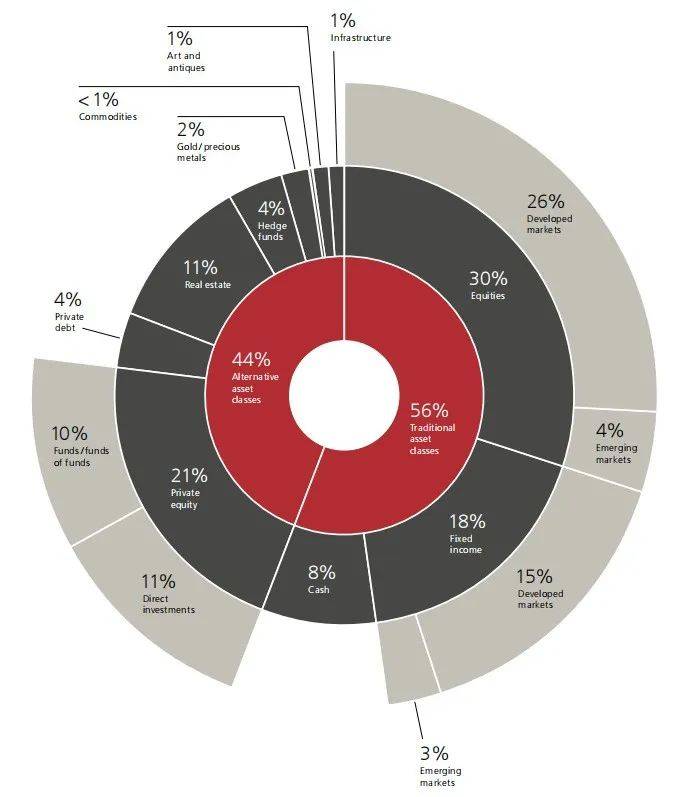
Key Insights - UBS released the "2025 Global Family Office Report," summarizing insights from 317 single-family offices across over 30 markets, with an average net worth of $2.7 billion and average assets under management of $1.1 billion [1][2] Group 1: Strategic Asset Allocation - Family offices are focusing on structural growth, yield enhancement, and diversification, reducing cash holdings while increasing investments in developed market equities to capture long-term growth opportunities in AI and healthcare [3] - The average allocation of family offices to North America and Western Europe is nearly 80%, with U.S. family offices showing a historical peak in domestic allocation, indicating a significant withdrawal from international markets [4][20] - Family offices prioritize healthcare, electrification, and artificial intelligence in emerging technologies, with a high sensitivity to opportunities in both public and private markets [5] Group 2: Investment Risks and Management - The global trade war is identified as the largest investment risk for 2025, with family offices concerned about geopolitical conflicts, economic recession, and debt crises [6] - Family offices emphasize internal management functions, focusing on expertise, privacy, and control rather than cost considerations [7] Group 3: Succession Planning and Recruitment - Just over half of family offices have established wealth succession plans, but many do not prioritize this due to a perception of having ample time [8] - When hiring new employees, family offices prioritize trust and personality traits over educational background or qualifications [9] Group 4: Asset Allocation Trends - Family offices are increasing allocations to public equities and private debt, with 35% planning to adjust their strategic asset allocation in 2025, the second-highest rate recorded in six years [10] - The allocation to developed market equities is set to rise from 24% in 2023 to an average of 29% in 2025, while private debt allocation is expected to double from 2% to 5% [12][13] - Real estate allocations are increasing, with U.S. family offices raising their allocation from 10% to 18%, while Latin American and Southeast Asian family offices are reducing their allocations [15] Group 5: Emerging Markets and Geopolitical Concerns - Family offices are cautious about emerging markets, with allocations to emerging market equities at 4% and bonds at 3%, reflecting a trend of increased caution from U.S. and European family offices [18] - Geopolitical concerns are the primary barriers to investing in emerging markets, with 56% citing these as a significant risk [19] Group 6: Future Outlook - Family offices expect to increase allocations to developed market equities and private markets, with 46% planning to significantly or moderately increase their exposure to developed market stocks [23] - Long-term, private market allocations are expected to grow, with over one-third of family offices planning to increase private equity investments despite short-term challenges [24] - Attitudes towards real estate investments are mixed, with 29% of family offices anticipating growth while 19% expect declines [26]

新华保险:尽快推进试点基金三期相关工作 提高港股配置比例
news flash· 2025-05-20 12:30
Core Viewpoint - The National Financial Supervisory Administration has approved New China Life Insurance to participate in the third batch of insurance fund long-term investment reform pilot, collaborating with China Life and other institutions to establish the Honghu Fund Phase III [1] Group 1: Investment Strategy - New China Life Insurance emphasizes both "strategic asset allocation" and "tactical asset allocation" in its investment approach [1] - "Strategic asset allocation" focuses on long-term strategic layout, with the underlying logic of serving the real economy as the basis for investment portfolio construction [1] - "Tactical asset allocation" involves strict rebalancing strategies, timely initiation of pilot funds, increasing holdings of equity base assets, and raising the proportion of Hong Kong stock allocations [1]
