数字存款货币

Search documents
大消息!工行、农行、中行、建行、交行、邮储,国有六大行集体宣布
中国基金报· 2025-12-31 08:42
Core Viewpoint - The six major state-owned banks in China announced that starting January 1, 2026, the balance in digital RMB wallets will earn interest based on the current deposit rate, marking the end of the "interest-free era" for digital RMB [2][5]. Group 1: Interest Payment Mechanism - The digital RMB wallets (including personal and corporate wallets) will earn interest according to the bank's published current deposit rates, while balances in certain wallet types (fourth category personal wallets) will not earn interest [5]. - Currently, the current deposit rate across these banks is set at 0.05% [6]. Group 2: Future Development and Regulatory Framework - The People's Bank of China (PBOC) has outlined a new action plan to enhance the management and service system for digital RMB, which will officially launch on January 1, 2026 [6][7]. - The future digital RMB will be a modern digital payment and circulation method, supported by the central bank and possessing characteristics of commercial bank liabilities, with functionalities including value measurement, value storage, and cross-border payments [7]. Group 3: Adoption and Usage Statistics - As of November 2025, digital RMB has processed 3.48 billion transactions, amounting to 16.7 trillion yuan, with 230 million personal wallets and 18.84 million corporate wallets opened [8]. - The mBridge initiative has processed 4,047 cross-border payment transactions, with a total transaction amount equivalent to 387.2 billion yuan, where digital RMB accounted for approximately 95.3% of the transaction volume [8].








三大行集体公告数字钱包生息机制,数字人民币告别“无息时代”
2 1 Shi Ji Jing Ji Bao Dao· 2025-12-31 06:42
Core Viewpoint - The digital renminbi will officially end its "interest-free era" as of January 1, 2026, with major banks announcing that interest will be paid on the balances of real-name digital renminbi wallets based on the current deposit rates [1][6][10]. Group 1: Interest Payment Policy - Starting January 1, 2026, the balance in real-name digital renminbi wallets will earn interest according to the People's Bank of China's current deposit interest rate [6][7]. - The interest calculation will follow the same rules as regular savings accounts, with interest credited on the 21st of each quarter [6][10]. - Balances in anonymous wallets will not earn interest, maintaining a distinction between different wallet types [6][10]. Group 2: Transition to Digital Deposit Currency - The implementation of the interest payment policy marks the transition from "digital cash" to "digital deposit currency," indicating a significant evolution in the digital renminbi's role [7][10]. - The digital renminbi will now be considered a liability of commercial banks, allowing it to earn interest and be subject to deposit insurance, similar to traditional bank deposits [10]. - This change enhances the monetary elasticity of the digital renminbi, enabling it to support credit activities and deposit expansion mechanisms [10]. Group 3: Background and Development - The policy change is part of a broader initiative by the People's Bank of China to strengthen the management and service system for digital renminbi [7]. - The digital renminbi has been in development for over ten years, expanding its pilot programs from select cities to entire provinces [8]. - As of November 2025, the digital renminbi has processed 3.48 billion transactions, amounting to 16.7 trillion yuan, indicating significant adoption and usage [9].

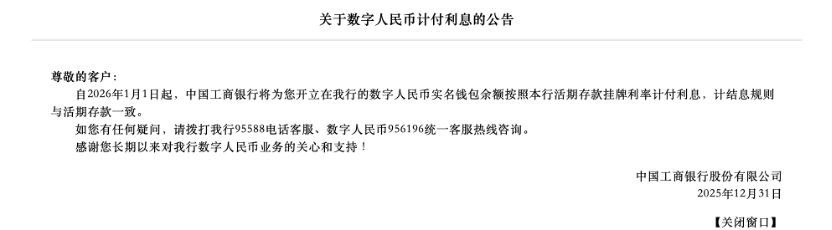
多家银行宣布:2026年起数字人民币钱包余额可计付利息
Sou Hu Cai Jing· 2025-12-31 05:40
Group 1 - The core announcement is that starting from January 1, 2026, major Chinese banks including Agricultural Bank of China, Postal Savings Bank, and others will pay interest on digital RMB wallet balances according to the same rates as regular demand deposits [1][4][8] - The interest calculation rules for digital RMB wallets will align with those of demand deposits, indicating a significant shift in how digital currency is treated [1][8] - This transition marks the evolution of digital RMB from a "digital cash era" to a "digital deposit currency era," following a decade of research and pilot programs [8] Group 2 - The People's Bank of China has introduced a plan to enhance the management and service system for digital RMB, which will officially launch on January 1, 2026 [8] - The new framework will include a measurement system, management structure, operational mechanism, and ecosystem for digital RMB [8]
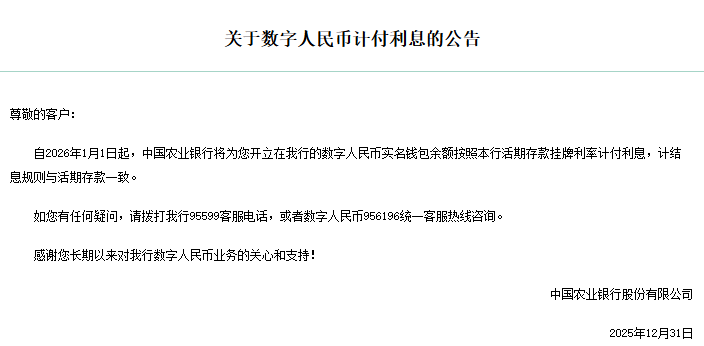
多家银行官宣:2026年1月1日起,为数字人民币实名钱包余额计付利息
Bei Jing Shang Bao· 2025-12-31 05:25
Core Viewpoint - Major Chinese banks including Industrial and Commercial Bank of China, Agricultural Bank of China, Postal Savings Bank of China, Bank of Communications, and China Construction Bank will start paying interest on digital RMB wallet balances at the same rate as current deposit rates from January 1, 2026, marking a significant transition in the digital currency landscape in China [1][4][5] Group 1: Bank Announcements - Industrial and Commercial Bank of China, Agricultural Bank of China, and Postal Savings Bank of China will apply interest to digital RMB wallet balances according to the current deposit rate, with interest calculation rules consistent with those for current deposits [4] - Bank of Communications will also apply the current deposit rate to digital RMB wallet balances, including various types of personal and corporate wallets, while balances in type four wallets will not earn interest [4] - China Construction Bank will revise its customer service agreement to reflect that digital RMB wallet balances will earn interest based on the current deposit rate starting January 1, 2026 [4] Group 2: Digital RMB Framework - The People's Bank of China has introduced a plan to enhance the management and service system for digital RMB, which will officially implement a new measurement framework and operational mechanism on January 1, 2026 [5] - This transition signifies a shift from the "digital cash era" to the "digital deposit currency era" after a decade of research and pilot programs [5]
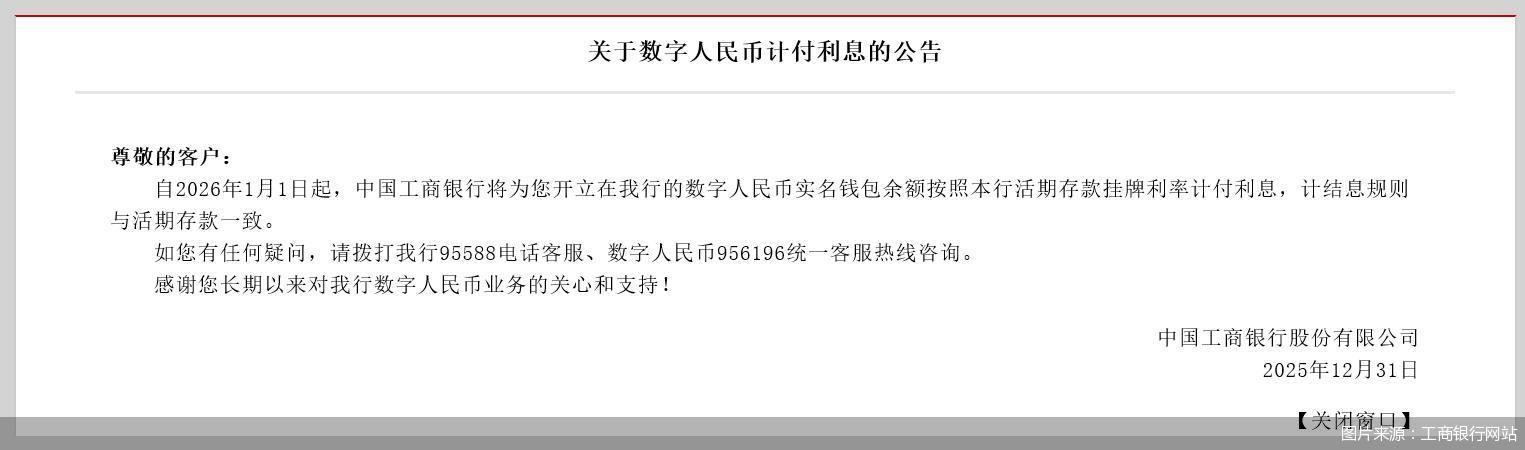
告别“零利息”时代 数字人民币开始“钱生钱”
Mei Ri Shang Bao· 2025-12-30 22:55
Core Viewpoint - The digital renminbi will transition from "digital cash" to "digital deposits" starting January 1, 2026, allowing users to earn interest on their digital currency holdings, marking a significant evolution in its role as a financial asset [1][2]. Group 1: Digital Renminbi Transition - The People's Bank of China has issued an action plan that allows commercial banks to pay interest on customer-held digital renminbi wallets based on the bank's current deposit rates [1][2]. - This change signifies a fundamental shift in the positioning of digital renminbi from cash in circulation (M0) to deposits within the commercial banking system [1][2]. - The transition will enable users to benefit from both the efficiency of traditional payment accounts and the innovative features of smart contracts [2]. Group 2: Security and Insurance - Digital renminbi deposits will be included in the deposit insurance scheme, providing a safety net of up to 500,000 yuan in case of bank failure [2]. - This enhancement significantly increases the attractiveness of digital renminbi as a wealth storage vehicle, combining security with potential returns [2]. Group 3: Current Status and Growth - As of November 2025, the digital renminbi has processed 3.48 billion transactions, with a total transaction value exceeding 16.7 trillion yuan [3]. - The number of personal digital wallets has reached 230 million, while corporate wallets stand at 1.884 million [3]. - In the cross-border payment sector, the mBridge initiative has successfully processed 4,047 transactions, with a transaction value equivalent to 387.2 billion yuan, of which 95.3% involved digital renminbi [3].
迈入数字存款货币时代:稳步发展数字人民币的动态与前景
Sou Hu Cai Jing· 2025-12-30 10:01
Core Viewpoint - The People's Bank of China (PBOC) is set to officially launch a new generation of the digital renminbi (e-CNY) on January 1, 2026, transitioning from a cash-based model to a deposit currency model, enhancing the resilience and security of the payment system [1][5][8]. Group 1: Development Progress of Digital Renminbi - The development of digital renminbi began in 2014, with theoretical research and closed testing initiated by the PBOC [2]. - The pilot program for digital renminbi officially started at the end of 2019, initially in cities like Shenzhen and Suzhou, and has since expanded significantly [2]. - By November 2025, digital renminbi had processed 3.48 billion transactions, amounting to 16.7 trillion yuan [4]. Group 2: Reasons for Adjustment - The need to respond to rapidly evolving digital payment tools and the challenges they pose to central bank monetary control is a primary reason for the adjustment [6]. - There is a necessity to balance the development of digital cash with the risks of financial disintermediation and to ensure the responsibilities of commercial banks are upheld [6][7]. - The adjustment aims to integrate centralized management with decentralized blockchain characteristics, ensuring compliance with regulatory requirements [7]. Group 3: Content and Feasibility of Adjustments - The action plan outlines a shift from a digital cash model to a digital deposit currency model, with the PBOC providing technical support and regulatory oversight [8]. - The dual-layer operational framework will be optimized, where the central bank issues the currency and designated operating institutions manage wallet services for individuals and non-financial enterprises [9][12]. - The digital renminbi will be treated as a commercial bank liability, allowing for interest payments on wallet balances, thus enhancing user incentives [14][21]. Group 4: Technological Choices - The digital renminbi will be based on an account system, leveraging the advantages of existing banking infrastructure while incorporating smart contract technology for enhanced functionality [16][17]. - Blockchain technology will be utilized to ensure security and traceability in transactions, particularly in complex financial scenarios [18]. Group 5: Financial Regulation - The PBOC will establish a management committee for digital renminbi to oversee operations and ensure system security and continuity [19]. - A separation of management and operational functions will be implemented to enhance regulatory effectiveness while fostering innovation [19]. Group 6: Strategic Confidence and Development - The steady development of digital renminbi is seen as a necessary response to external pressures and a means to strengthen national strategic confidence [20]. - The transition from M0 to M1 and M2 for digital renminbi aims to enhance its usability and integration into the broader financial system, supporting macroeconomic stability [21][22].
跨年资金波动,债市大幅走弱
Dong Fang Jin Cheng· 2025-12-30 07:45
Report Summary 1. Investment Rating - No investment rating for the industry is provided in the report. 2. Core View - On December 29, overnight funds were abundant, but the contradiction of cross - year stratification still existed. The concern over ultra - long bond supply and cross - year fund fluctuations led to a significant weakening of the bond market. The main indexes of the convertible bond market closed down collectively, and most convertible bond issues declined. Yields of U.S. Treasuries across all maturities generally decreased, and yields of 10 - year government bonds of major European economies also generally declined [2]. 3. Summary by Directory 3.1 Bond Market News - **Domestic News** - The People's Bank of China issued an action plan for digital RMB, and a new generation of digital RMB measurement framework, management system, operation mechanism, and ecosystem will be officially launched on January 1, 2026 [4]. - From January to November, the total operating income of state - owned enterprises was 756257.6 billion yuan, a year - on - year increase of 1%; the total profit was 37194.5 billion yuan, a year - on - year decrease of 3.1%; the payable taxes were 52803 billion yuan, a year - on - year increase of 0.2%. As of the end of November, the asset - liability ratio of state - owned enterprises was 65.2% [4]. - Starting from January 1, 2026, the State Council Tariff Commission will adjust the import tariff rates and tariff items of some commodities, including implementing temporary import tariff rates lower than the most - favored - nation rates for 935 commodities and canceling the temporary import tariff rates of some commodities [5]. - As of the end of November, the net asset value of public funds in China reached 37.02 trillion yuan, an increase of about 60 billion yuan from the end of October, breaking through the 37 - trillion - yuan mark for the first time and setting a new high for eight consecutive months [6]. - **International News** - The minutes of the December meeting of the Bank of Japan suggested more interest rate hikes as many members thought the real interest rate was still very low. The meeting raised the benchmark interest rate to 0.75%, a 30 - year high. Economists expect another rate hike in about six months, with most believing the terminal rate of this hiking cycle will be 1.25% [7]. - **Commodities** - On December 29, WTI February crude oil futures rose 1.84% to $58.08 per barrel; Brent February crude oil futures rose 2.14% to $61.94 per barrel; COMEX gold futures fell 4.47% to $4349.20 per ounce; NYMEX natural gas prices fell 10.81% to $3.943 per ounce [8]. 3.2 Funding Situation - **Open Market Operations** - On December 29, the central bank conducted 4823 billion yuan of 7 - day reverse repurchase operations at a fixed - rate and quantity - tender method, with an operating rate of 1.40%. The net investment of funds on the day was 4150 billion yuan [10]. - **Funding Rates** - On December 29, the central bank increased the net investment scale. Overnight funds were abundant, but the cross - year stratification contradiction still existed. DR001 decreased by 1.39bp to 1.242%, and DR007 increased by 7.07bp to 1.594%. Other funding rates also showed different changes [12][13]. 3.3 Bond Market Dynamics - **Interest - rate Bonds** - The local bond issuance plan announced by Shandong on December 29 triggered concerns about ultra - long bond supply, and combined with cross - year funding fluctuations, the bond market weakened significantly. As of 20:00, the yield of the 10 - year Treasury active bond 250016 rose 2.25bp to 1.8580%, and the yield of the 10 - year CDB active bond 250215 rose 3.30bp to 1.9395% [15]. - **Credit Bonds** - One industrial bond, "H0 Zhongnan 02", had a trading price deviation of over 10% on December 29. There were also announcements from many real - estate and other companies regarding bond repayment, resumption of trading, debt restructuring, etc. [18][19]. - **Convertible Bonds** - On December 29, the three major A - share indexes showed different trends. The convertible bond market followed the equity market and adjusted. The main convertible bond indexes closed down collectively, and most convertible bond issues declined. Shenyu Convertible Bonds will be listed on December 30 [20][21]. - **Overseas Bond Markets** - **U.S. Bond Market**: Yields of U.S. Treasuries across all maturities generally decreased on December 29. The 2 - year U.S. Treasury yield decreased by 1bp to 3.45%, and the 10 - year yield decreased by 2bp to 4.12%. The 2/10 - year U.S. Treasury yield spread narrowed by 1bp to 67bp; the 5/30 - year yield spread remained unchanged at 113bp. The 10 - year inflation - protected Treasury (TIPS) break - even inflation rate decreased by 1bp to 2.22% [22][23][24]. - **European Bond Market**: Yields of 10 - year government bonds of major European economies generally decreased on December 29. The 10 - year German government bond yield decreased by 3bp to 2.83%, and those of France, Italy, Spain, and the UK also decreased [25][26]. - **Price Changes of Chinese - funded U.S. Dollar Bonds**: The report shows the daily price changes of some Chinese - funded U.S. dollar bonds as of the close on December 29, including the daily and monthly changes in yields and prices of different bonds [27].
元旦起,数字人民币开始“钱生钱”
Zhong Guo Zheng Quan Bao· 2025-12-30 04:33
Core Viewpoint - The People's Bank of China has introduced an action plan to strengthen the management and service system of digital RMB, which will officially start on January 1, 2026, marking the transition from digital cash to digital deposit money. Group 1: Digital RMB Interest Payment - Banks will pay interest on the balances of real-name digital RMB wallets, adhering to self-discipline agreements on deposit interest rates [2][4]. - After January 1, 2026, digital RMB held by commercial bank customers will be converted into bank deposits, generating interest income [4]. - The interest payment standards for digital RMB deposits will reference the current interest rates for demand deposits set by operating institutions, with strict adherence to self-discipline agreements on deposit rates [6][7]. Group 2: Deposit Insurance and Security - Digital RMB deposits will have the same attributes as ordinary bank deposits and will be included in the deposit insurance scheme, providing a maximum compensation limit of 500,000 yuan in case of bank risk [9]. - Only real-name digital RMB wallet balances will earn interest due to the need for clear identification of fund ownership, which aligns with anti-money laundering regulations and supports deposit insurance implementation [11]. Group 3: Digital RMB Operating Institutions - There are currently 10 designated operating institutions for digital RMB, including 6 large state-owned commercial banks, 2 joint-stock commercial banks, and 2 internet banks [13][15]. - The People's Bank of China is working on expanding the number of operating institutions for digital RMB [16].
首席点评:贵金属集体回调
Shen Yin Wan Guo Qi Huo· 2025-12-30 03:26
报告日期:2025 年 12 月 30 日 申银万国期货研究所 首席点评: 贵金属集体回调 中国人民银行副行长陆磊发文称,《关于进一步加强数字人民币管理服务体系和 相关金融基础设施建设的行动方案》从机制上明确了数字人民币将从数字现金时 代迈入数字存款货币(Digital Deposit Money)时代。特朗普暗示,他已经有 了一位心目中的美联储下一任主席人选,但并不急于宣布,可能会在 1 月宣布。 特朗普承认,乌克兰领土问题实际上"仍未谈妥",顿巴斯地区的非军事化区划 设等"棘手"问题尚待解决。日本央行 12 月政策会议纪要显示,多位委员认为 该国实际利率仍处于极低水平,暗示未来将继续加息。 贵金属: 贵金属波动加剧,白银大幅调整。美国 11 月 CPI 同比 2.7%,低于 预期的 3.1%,核心 CPI 同比 2.6%,低于预期的 3%。CPI 大幅不及预期,引 发市场质疑,但 CPI 整体下行趋势为降息提供空间。美国 11 月非农数据分 化,新增就业人口 6.4 万人,好于市场预期的 5 万人,但失业率上行至 4.6%。 疲软的就业数据支持美联储继续降息,流动性宽松预期仍对贵金属价格形 成提振。从长期 ...
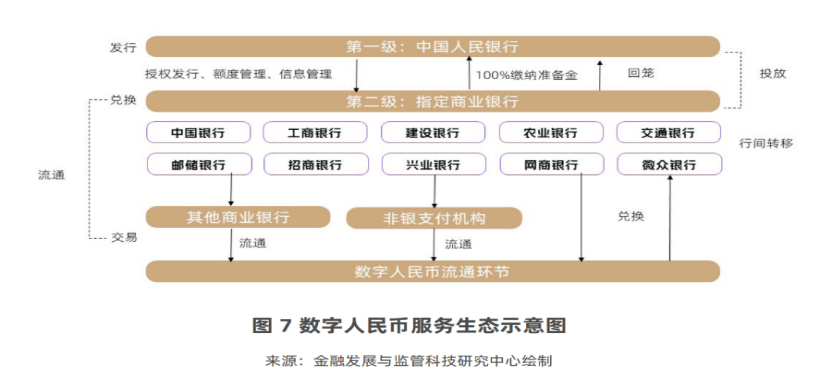
明年起迈入数字存款货币时代
Sou Hu Cai Jing· 2025-12-29 23:20
Core Viewpoint - The People's Bank of China (PBOC) is set to transition the digital renminbi from a digital cash era to a digital deposit currency era, with a new action plan to be implemented on January 1, 2026 [1] Group 1: Digital Renminbi Transition - The action plan marks a significant change in the positioning of the digital renminbi, shifting from digital cash to digital deposit currency, which fundamentally alters its nature from a central bank liability to a commercial bank liability [2] - This transition addresses major issues of the previous version, such as financial disintermediation risks and the reduction of the money multiplier, enhancing liquidity management for banks [2] Group 2: Market Impact - The new digital deposit currency will provide users with cash-like convenience, including offline payments, real-time settlement, and enhanced security and yield for deposits, significantly increasing the attractiveness of the digital renminbi [2] - Banks will gain asset-liability management rights over the digital renminbi, allowing them to activate wallet funds through wealth management and credit services, thus boosting participation [2] Group 3: Regulatory Framework - The action plan optimizes the "dual-layer architecture" under the DC/EP theoretical framework, with the central bank responsible for business rules and technical standards, while commercial banks will manage digital renminbi wallets for individuals and entities [3] - Non-bank payment institutions will provide digital renminbi that customers can exchange with their bank deposits, which will be subject to regulatory oversight [3] Group 4: Market Reaction - Following the announcement, the digital currency sector and related stocks experienced a significant surge, with notable increases in share prices for companies such as Lakala (up 12.57%) and ST Tianyu (up 11.40%) [3]