智能化升级

Search documents
2026年中国离子风枪行业概述、产业链上下游、市场规模及趋势研判:产业向着精密化与智能化转型,市场需求结构性升级[图]
Chan Ye Xin Xi Wang· 2026-01-26 01:33
内容概况:作为精密制造中的关键工具,近年来,随着电子制造、半导体、新能源汽车等高端制造业向 精密化、智能化转型,离子风枪在静电控制、粉尘清除环节的不可替代性凸显。2024年,中国离子风枪 行业市场规模约为32.54亿元,同比增长5.92%。 相关上市企业:天华新能(300390) 相关企业:中钨高新材料股份有限公司、中国联塑集团控股有限公司、中国铝业集团有限公司、宝鸡钛 业股份有限公司、美的集团股份有限公司、特变电工股份有限公司、中芯国际集成电路制造有限公司、 上海汽车集团股份有限公司、裕同科技集团股份有限公司、中国航空工业集团有限公司、中国兵器装备 集团有限公司 关键词:离子风枪、离子风枪市场规模、离子风枪行业现状、离子风枪发展趋势 一、行业概述 离子风枪行业产业链上游主要包括钨、塑料、铝材、钛、高压发生器、风扇、高压电源线等原材料及零 部件。产业链中游为离子风枪生产制造环节。产业链下游主要应用于半导体与电子制造(半导体封装、 SMT贴片、精密仪器组装)、汽车工业(车身喷涂、零部件除尘、锂电池制造)、塑料、印刷包装、 航空、军工、科研实验室等领域。 离子风枪行业产业链 电极针是离子风枪中最核心、最精密的消耗 ...


智能化、绿色化、融合化步伐加快 制造业“压舱石”作用更加凸显
Zhong Guo Zheng Quan Bao· 2026-01-22 00:21
Core Insights - The analysis by the National Taxation Administration indicates that by 2025, the sales revenue of China's manufacturing industry will grow 1.7 percentage points faster than the overall national sales growth rate, with manufacturing accounting for 29.7% of total sales, an increase of 0.5 percentage points from the previous year [1][2] Group 1: Intelligent Upgrading - The implementation of the "Artificial Intelligence + Manufacturing" initiative is accelerating, with manufacturing enterprises expected to increase their purchases of automation and digital equipment by 11.3% and 10% year-on-year, respectively, by 2025 [1] - The intelligent transformation and digital upgrade of the manufacturing sector are driving the development of related industries, with sales revenue in the intelligent equipment manufacturing sector projected to grow by 28.1% year-on-year, including a 17.4% increase in industrial robots and a 42.1% increase in special operation robots [1] Group 2: Green Transformation - The sales revenue of high-energy-consuming manufacturing industries is expected to decrease by 1.1 percentage points as a proportion of total manufacturing revenue, indicating ongoing optimization of the industrial structure [2] - Manufacturing enterprises are increasing their investment in environmental governance services, with a year-on-year growth of 7.3%, and high-energy-consuming sectors seeing a 14.6% increase in such expenditures [2] - The renewable energy sector is rapidly developing, with sales revenue in the new energy vehicle manufacturing and lithium-ion battery manufacturing industries expected to grow by 14.3% and 25.1% year-on-year, respectively [2] Group 3: Digital Integration - The sales revenue of digital product manufacturing is projected to grow by 9.4% year-on-year, with manufacturing enterprises increasing their procurement of digital technologies by 10.4%, an acceleration of 3.5 percentage points compared to the previous year [2] - Specific sectors such as automotive manufacturing and computer communication equipment manufacturing are expected to see significant increases in digital technology procurement, with year-on-year growth rates of 24.5% and 11.8%, respectively [2]
制造业“压舱石”作用更加凸显
Zhong Guo Zheng Quan Bao· 2026-01-21 21:08
Group 1 - The core viewpoint of the articles indicates that China's manufacturing industry is expected to see a sales revenue growth rate that exceeds the national average by 1.7 percentage points by 2025, with manufacturing accounting for 29.7% of total sales, an increase of 0.5 percentage points from the previous year [1][2] Group 2 - The acceleration of intelligent upgrades in manufacturing is highlighted, with a projected year-on-year increase of 11.3% in the purchase of automation equipment and 10% in digital equipment by 2025, indicating a faster pace of intelligent transformation and digital renovation [1] - The sales revenue of the intelligent equipment manufacturing sector is expected to grow by 28.1% year-on-year, with industrial robots and special operation robots seeing increases of 17.4% and 42.1% respectively [1] Group 3 - The ongoing green transformation is noted, with high-energy-consuming manufacturing's sales revenue share decreasing by 1.1 percentage points, reflecting an optimization of the industrial structure [2] - The amount spent by manufacturing enterprises on environmental governance services is projected to increase by 7.3% year-on-year, with high-energy-consuming sectors seeing a 14.6% increase [2] - The sales revenue of the new energy vehicle manufacturing sector and lithium-ion battery manufacturing sector is expected to grow by 14.3% and 25.1% respectively [2] Group 4 - The deepening digital integration is emphasized, with a projected 9.4% year-on-year growth in sales revenue for digital product manufacturing and a 10.4% increase in the purchase of digital technologies by manufacturing enterprises, which is 3.5 percentage points faster than the previous year [2] - The automotive manufacturing and computer communication equipment manufacturing sectors are expected to see year-on-year increases of 24.5% and 11.8% in their purchases of digital technologies [2] Group 5 - The tax authorities are committed to implementing policies that support the transformation and upgrading of the manufacturing sector, ensuring that tax benefits reach enterprises effectively to contribute to high-quality development in manufacturing [2]
制造业经济“压舱石”作用更加凸显
Xin Lang Cai Jing· 2026-01-21 18:32
Core Insights - The manufacturing sector in China is projected to have a sales revenue growth rate that exceeds the national average by 1.7 percentage points by 2025, with its share of total sales reaching 29.7%, an increase of 0.5 percentage points from the previous year [1] Group 1: Intelligent Upgrading - The procurement of automation and digital equipment by manufacturing enterprises is expected to grow by 11.3% and 10% year-on-year, respectively, indicating a rapid advancement in intelligent transformation and digitalization [1] - The sales revenue of the intelligent equipment manufacturing sector is anticipated to increase by 28.1% year-on-year, with industrial robots and special operation robots seeing growth rates of 17.4% and 42.1%, respectively [1] Group 2: Green Transformation - The sales revenue of high-energy-consuming manufacturing industries is projected to decrease by 1.1 percentage points as a share of total manufacturing, reflecting ongoing structural optimization [1] - The amount spent by manufacturing enterprises on environmental governance services is expected to rise by 7.3% year-on-year, with high-energy-consuming sectors increasing their spending by 14.6% [1] Group 3: Digital Integration - The sales revenue of the digital product manufacturing sector is forecasted to grow by 9.4% year-on-year, with manufacturing enterprises' procurement of digital technologies increasing by 10.4%, a 3.5 percentage point acceleration compared to the previous year [2] - The automotive manufacturing and computer communication equipment sectors are expected to see procurement of digital technologies grow by 24.5% and 11.8%, respectively, indicating a deepening integration of the digital economy with the real economy [2]
2026年中国工程机械液压系统行业政策、产业链、市场规模、重点企业及趋势研判:国产化突破与基建需求共同驱动液压系统市场规模持续扩张[图]
Chan Ye Xin Xi Wang· 2026-01-20 01:05
Core Insights - The hydraulic system is a critical component of construction machinery, acting as its "muscle" by transmitting pressure through liquids to perform various tasks [1][10] - The market size of China's construction machinery hydraulic system industry is projected to grow from 24.477 billion yuan in 2016 to 41 billion yuan in 2024, with a compound annual growth rate (CAGR) of 6.66% [11] - By 2025, the market size is expected to reach 43.747 billion yuan, driven by increased investment in major engineering projects and the transition towards intelligent and green manufacturing [11] Industry Overview - The hydraulic system consists of power components (pumps), actuating components (cylinders and motors), control components (valves), auxiliary components (oil tanks, pipelines, seals), and hydraulic oil [4][10] - Hydraulic systems can be classified into open, closed, and semi-closed systems based on their degree of closure [6][7] Market Dynamics - The construction machinery hydraulic system industry has seen a significant increase in demand due to ongoing infrastructure development, urbanization, and advancements in industrial automation [11] - In 2022, the construction machinery industry faced challenges with a revenue drop to 797.7 billion yuan, a 12% year-on-year decrease, but is expected to rebound to 876.6 billion yuan in 2024 [9] Policy Support - Various policies have been implemented to support the hydraulic system industry, including plans to accelerate the replacement of outdated equipment and promote innovation in the sector [8] Industry Chain - The upstream of the hydraulic system industry chain includes raw materials such as steel, cast iron, non-ferrous metals, and rubber products, which are essential for production [9] - The midstream involves the research, production, and sales of hydraulic components, while the downstream focuses on applications in construction machinery [9] Key Companies - Notable companies in the hydraulic system industry include Eddie Precision Machinery, Hengli Hydraulic, and Changling Hydraulic, which are making strides in technology and market presence [2][13] - Eddie Precision has become a leading manufacturer of hydraulic components, with a revenue of 2.374 billion yuan in the first three quarters of 2025, reflecting a 16.49% year-on-year growth [14] - Hengli Hydraulic reported a revenue of 7.79 billion yuan in the same period, with a 12.31% increase [15] Future Trends - The hydraulic system industry is expected to advance towards integration with electromechanical systems and smart technologies, enhancing operational precision and efficiency [16] - There will be a focus on energy efficiency and sustainability, with the adoption of variable pumps and eco-friendly hydraulic fluids [16] - Customized solutions tailored to specific operational environments will become increasingly important as the industry addresses diverse application needs [17]


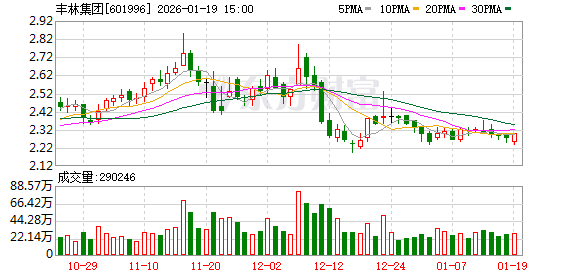
丰林集团:公司长期专注人造板主业发展,主营业务仍聚焦于人造板产业的智能化升级与绿色制造
Zheng Quan Ri Bao· 2026-01-19 14:15
Core Viewpoint - Fenglin Group emphasizes its commitment to the artificial board industry, focusing on intelligent upgrades and green manufacturing, while clarifying that the chairman's previous experience at Mitsubishi Electric is a personal career matter [2] Group 1 - The company responded to investor inquiries on January 19, indicating that the chairman, Liu Nian, has a background in the semiconductor division of Mitsubishi Electric [2] - The company remains dedicated to the development of its main business in the artificial board sector [2] - Any significant strategic adjustments in the future will be disclosed in accordance with information disclosure regulations [2]

永利股份:公司下属上海尤利璞智能设备制造有限公司的模组带分拣机已通过国内头部快递公司和电商企业的产品认证
Zheng Quan Ri Bao Wang· 2026-01-19 12:13
Core Viewpoint - The company, Yongli Co., Ltd. (300230), has successfully passed product certification for its sorting machines from leading domestic express delivery companies and e-commerce enterprises, indicating a strong market position and product acceptance [1] Group 1: Product Development - Yongli's subsidiary, Shanghai Youlipu Intelligent Equipment Manufacturing Co., Ltd., has launched its modular sorting machines into mass production [1] - The sorting machines are complemented by advanced separation equipment that utilizes leading visual detection and scheduling algorithms [1] Group 2: Technological Collaboration - The company is currently exploring preliminary discussions with relevant technology partners to enhance the material recognition accuracy in special scenarios for its sorting and conveying systems [1] - The ongoing work is still in the exploratory phase, and the company plans to proceed cautiously based on market demand and technological maturity [1]

【新华解读】量稳质升、向“新”而行 2025外贸结构优化动能凸显
Xin Hua Cai Jing· 2026-01-14 08:51
Core Insights - In 2025, China's total goods trade import and export value reached 45.47 trillion yuan, marking a historical high and a 3.8% year-on-year increase, maintaining growth for nine consecutive years [2][3] - The export value was 26.99 trillion yuan, up 6.1%, while imports reached 18.48 trillion yuan, a 0.5% increase [2] - The dual engines of green transformation and intelligent upgrading are expected to provide new momentum for China's foreign trade growth in 2026 [1][6] Trade Performance - The total import and export value in December 2025 was 4.26 trillion yuan, a 4.9% increase year-on-year, with exports at 2.54 trillion yuan (5.2% growth) and imports at 1.73 trillion yuan (4.4% growth) [2] - The resilience of exports is highlighted by strong performance in high-tech products, which saw a 13.2% year-on-year increase [4] Structural Changes - China's trade partner network has become more diverse, with 249 countries and regions engaging in trade, and the concentration of the top ten trade partners decreased to 47.7% of total trade [4] - The export structure is shifting towards high-end and intelligent products, with significant growth in industrial robots (48.7% increase) and specialized equipment [4] Brand Development - Chinese companies are moving away from reliance on OEM and actively seeking new paths for brand development abroad, with notable sales growth in Southeast Asia for smart home products [5] Green and Intelligent Growth - Green manufacturing is becoming a key growth area, with exports of lithium batteries and wind turbines increasing by 26.2% and 48.7% respectively [6] - The application of artificial intelligence in manufacturing is expected to sustain export growth, particularly in high-tech products like chips and vehicles [7]

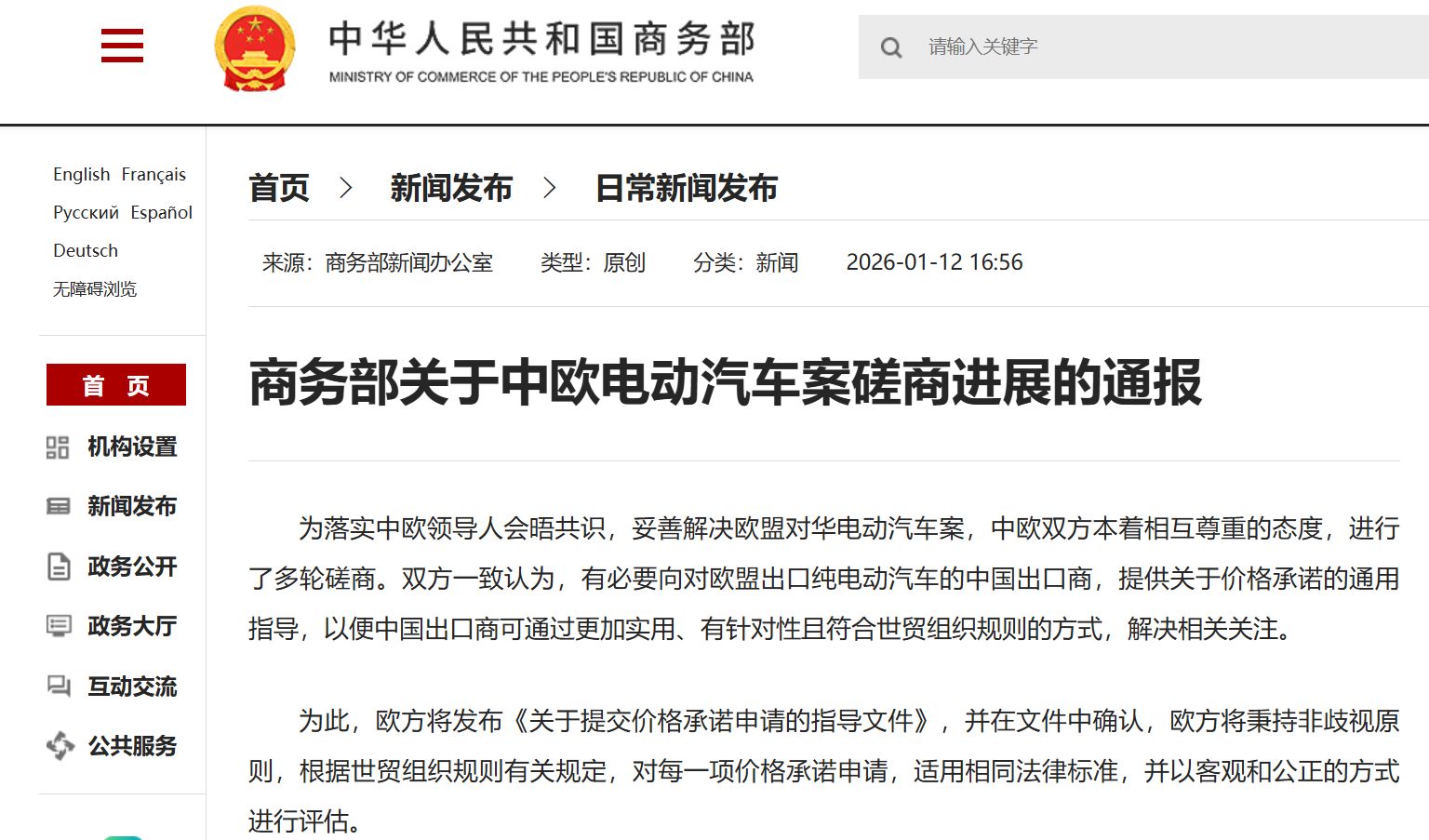
“价格承诺”方案落地!中欧电动汽车反补贴案达成积极成果 专家:能极大提升进口商积极性 把利润留给中国车企
Mei Ri Jing Ji Xin Wen· 2026-01-13 13:47
Core Viewpoint - The EU has made significant progress in negotiations with China regarding anti-subsidy tariffs on electric vehicles, replacing high tariffs with a "price commitment" mechanism to facilitate exports of Chinese electric vehicles to the EU [1][3][4]. Group 1: Negotiation Outcomes - The "price commitment" mechanism is a result of mutual discussions between the EU and China, aimed at managing trade frictions and maintaining a rules-based international trade order [3][4]. - The Chinese automotive industry sees the adoption of the "price commitment" as a major positive outcome, signaling enhanced cooperation between China and the EU in the automotive sector [3][4]. Group 2: Impact on Export Pricing - Previously proposed high anti-subsidy taxes could have reached nearly 45%, significantly impacting the cost structure and pricing of Chinese electric vehicles in the EU market [4]. - The EU's decision to implement a "price commitment" mechanism is intended to allow Chinese exporters to raise vehicle prices, thereby mitigating potential impacts on the local automotive market [4][6]. Group 3: Guidelines for Price Commitment - The EU has published guidelines for submitting price commitments, which will be evaluated based on non-discrimination and fairness principles, in accordance with WTO rules [5][6]. - The guidelines outline two potential methods for determining the minimum import price (MIP), ensuring that prices do not fall below those of comparable non-subsidized electric vehicles produced in the EU [6][10]. Group 4: Market Dynamics and Growth Potential - The agreement is expected to stabilize market access for Chinese electric vehicles in the EU, with projections indicating an annual growth rate of approximately 20% for Chinese electric vehicles in the EU market [9][10]. - The "price commitment" mechanism is anticipated to encourage Chinese automakers to shift from a low-cost strategy to a focus on high-end products and local production in Europe [9][10]. Group 5: Industry Reactions - Various industry associations have expressed support for the resolution of the EU's anti-subsidy case, highlighting the importance of dialogue in maintaining stable economic and trade relations between China and the EU [11][12]. - The consensus reached is viewed as a significant step towards fostering cooperation and stability in the automotive supply chain between the two regions [11][12].

从福田开始,商用车迈入高质量发展新纪元!
Jin Tou Wang· 2026-01-12 03:37
Core Viewpoint - Foton Motor has achieved significant growth in 2025, with total sales exceeding 650,000 units, driven by a doubling of heavy truck sales and a nearly 90% increase in new energy vehicles, indicating a shift from traditional growth metrics to a focus on quality and market adaptation [1][4][16] Group 1: Sales Performance - In 2025, Foton's heavy truck sales reached over 140,000 units, marking a 104% year-on-year increase, while new energy commercial vehicle sales hit 101,000 units, up 87% [4][5] - The overall growth of Foton outpaced the industry average, which saw only a 10% increase in the total truck market, highlighting Foton's successful strategy [4] Group 2: Market Strategy - Foton's strategy involves a collaborative approach across different vehicle segments, with heavy trucks targeting long-haul logistics, light and micro trucks focusing on urban delivery, and new energy products penetrating various scenarios [3][4] - The company is embedding new energy and intelligent technologies into operational efficiency, adapting to the low-carbon and intelligent trends in commercial vehicle applications [3][7] Group 3: Product Development - Foton has shifted from a traditional focus on scale to a more nuanced approach that emphasizes how products are sold, with a focus on high-end configurations and safety in its heavy truck orders [5][11] - The company has developed a range of products tailored to specific operational scenarios, such as the Qixing platform for urban delivery, which addresses real-world challenges faced by drivers [8][11] Group 4: Technological Innovation - Foton's R&D investment in 2025 was 1.379 billion yuan, accounting for 3.03% of revenue, with a focus on enhancing operational efficiency through targeted technological advancements [8][12] - The company has developed proprietary technologies, such as the Aiyike power battery and the HWP highway pilot system, which have been validated through extensive real-world testing [9][11] Group 5: Global Expansion - Foton is moving beyond traditional export models to a localized production and service approach, establishing factories and service networks in regions like Thailand, South Africa, and Brazil [5][15] - This strategy aims to build long-term relationships in local markets, enhancing the company's ability to meet specific regional demands [5][15] Group 6: Industry Transformation - The commercial vehicle industry is undergoing a transformation driven by dual carbon goals, intelligent upgrades, and globalization, necessitating a systemic reconfiguration of productivity and production relationships [12][13] - Foton's comprehensive strategy of internationalization, new energy adoption, and intelligent solutions aligns with these industry trends, providing a model for addressing the challenges faced by the sector [12][16]