
港股红利资产

Search documents
长江证券另类策略首席陈洁敏:下半年配置天平或仍倾斜港股高股息资产,保险增量资金为港股红利行情重要支撑
Ge Long Hui· 2025-06-20 09:54
Core Insights - The Hong Kong dividend assets have strengthened this year, primarily benefiting from defensive allocation needs after a relative decline in risk appetite. As growth stocks continue to narrow, these defensive assets with stable absolute return capabilities have become a consensus among both domestic and foreign investors [1][3] - Insurance capital has frequently targeted Hong Kong dividend assets this year, driven by the positioning of insurance OCI accounts and a domestic asset shortage. Additionally, the relatively smaller market capitalization of Hong Kong banks compared to A-shares makes them more susceptible to triggering the takeover mechanism [1][4] - The pricing logic of Hong Kong dividend assets is influenced by multiple factors, including foreign investor preferences, changes in global risk-free interest rates, and liquidity discounts relative to A-shares [1][6] - The significant contraction of the AH premium this year has limited its impact on Hong Kong dividend assets in the medium to long term, as the majority of allocation funds come from long-term investors like insurance and social security, which have strong dividend capabilities and high long-term value [1][8] - There is a potential for a filling rights market after the ex-dividend date for high-dividend stocks in both Hong Kong and A-shares, with statistical data indicating that many stocks may see this filling rights market occur around July and August [1][9] Industry Outlook - The second half of the year is a turning point for insurance OCI allocation and accounting standard shifts, with expected incremental insurance funds favoring high-dividend stocks in both A-shares and Hong Kong, providing support for the Hong Kong dividend market [2][11] - As of June 17, the Hang Seng High Dividend Low Volatility Index has increased by 20.91% since the low on April 8, indicating strong performance in Hong Kong's high-dividend assets, especially in contrast to the pullback of the A-share dividend index [3] - The total cash dividend for Hong Kong stocks in 2024 is projected to reach HKD 1.38 trillion, with a year-on-year growth rate exceeding 10%. The dividend payout ratio is close to 40%, and the average dividend yield is expected to reach 4%, showing improvements compared to 2023 [5] - The pricing of Hong Kong dividend assets is also affected by the ability to short sell, which allows for more efficient pricing compared to A-shares, where liquidity is generally lower, leading to potential undervaluation of many Hong Kong stocks [6][8] - In a potential interest rate cut scenario by the Federal Reserve, Hong Kong dividend assets may benefit from a more favorable liquidity environment, increasing foreign capital interest [7]

狂揽400亿,低利率时代港股红利资产成“避风港新宠”
Jin Rong Jie· 2025-06-18 02:26
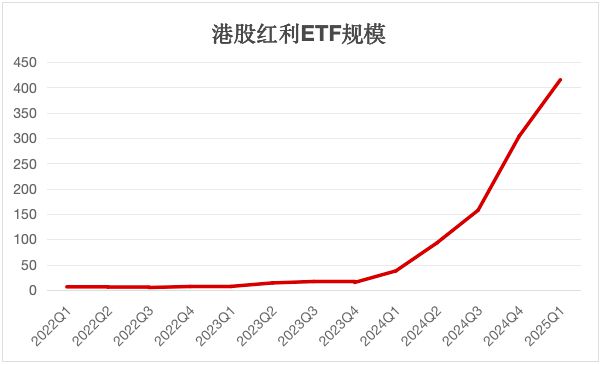
Group 1 - The core viewpoint highlights the strong performance and increasing popularity of the Hong Kong Dividend Low Volatility ETF (520550), which has reached historical highs multiple times since 2025, with a net inflow exceeding 20 million on June 17 and a total inflow of 533.3 million over the past five days, bringing its total scale to over 500 million [1] - The Hong Kong dividend assets have been consistently favored by investors, with the total scale of the Hong Kong Dividend ETF exceeding 40 billion, and an inflow of 10.7 billion in 2025, representing a growth of 40% [1][3] - Southbound funds have shown a continuous inflow into high-dividend sectors such as banks and public utilities, with net purchases of bank stocks exceeding 200 billion over the past year, indicating a strong preference for high-dividend, low-valuation assets [3][4] Group 2 - In the current low interest rate environment, dividend assets exhibit relatively stable profitability and high dividends, making them attractive compared to one-year and three-year deposit rates [4][5] - The Hang Seng Hong Kong Stock Connect High Dividend Low Volatility Index has a dividend yield of 8.1%, significantly higher than the China Securities Bank Index at 5.75% and the CSI 300 Index at 3.39% [5][8] - The index currently has a PE (TTM) of 7 times and a PB of 0.6 times, indicating a lower valuation compared to similar indices and a higher safety margin [9][10] Group 3 - The Hong Kong Dividend Low Volatility ETF (520550) implements monthly dividend assessments, currently distributing 0.04 yuan per ten shares, with a dividend ratio of approximately 0.37% [12] - The ETF has a management fee of 0.2%, the lowest among similar products in the market, making it a cost-effective long-term investment option [12]

红利策略热度不减!港股红利ETF成资金布局重点
券商中国· 2025-06-13 09:05
Core Viewpoint - The article highlights the increasing popularity of Hong Kong dividend ETFs as a key investment strategy amid rising interest in dividend investments, with significant inflows and performance metrics indicating strong market interest [1][2][8]. Group 1: Performance of Hong Kong Dividend ETFs - As of June 11, the overall scale of dividend ETFs has increased by over 20 billion yuan this year, with several Hong Kong dividend ETFs achieving net growth exceeding 1 billion yuan [1][3]. - Notable performers include the Morgan Stanley S&P Hong Kong Low Volatility Dividend ETF, which saw a net increase of 5.071 billion yuan, and the Huaan Hang Seng Hong Kong Central State-Owned Enterprise Dividend ETF, which grew by 1.636 billion yuan [3][4]. Group 2: Advantages of Hong Kong Dividend Assets - Hong Kong dividend assets offer a dual characteristic of "bond-like yield + equity flexibility," making them an attractive option for investors seeking both defense and returns in a complex market environment [2][5]. - The dividend yield of the CSI Hong Kong Stock Connect High Dividend Investment Index stands at 7.95%, significantly higher than the 10-year government bond yield of 1.70%, providing a stable income source in a low-interest-rate environment [6]. - The valuation of the CSI Hong Kong Stock Connect High Dividend Investment Index is low, with a price-to-earnings ratio (TTM) of just over 6, making it a cost-effective investment opportunity compared to the Hang Seng Index and CSI Dividend Index [7]. Group 3: Market Dynamics and Future Outlook - The article notes that the Hong Kong dividend sector is experiencing a re-evaluation phase due to multiple favorable factors, including policy support, valuation advantages, and inflows from southbound capital [8][10]. - The resilience of the Hong Kong market is expected to continue, supported by improved asset supply structure and quality, as well as liquidity trends amid the return of overseas capital [9]. - The Hong Kong government has implemented several supportive policies aimed at enhancing market liquidity and attractiveness, which are expected to further focus attention on Hong Kong central state-owned enterprise dividends [10][11].
更高股息,港股红利板块持续吸引资金流入
Bei Jing Shang Bao· 2025-06-11 07:56
Core Viewpoint - The discussion around dividend assets has intensified, with Hong Kong dividend assets attracting attention due to their valuation and dividend yield advantages, leading to increased investments from long-term funds such as insurance capital [1][4]. Group 1: Market Trends - As of May 2025, insurance capital has made 16 significant investments in Hong Kong dividend assets, surpassing the total of 20 for the entire year of 2024, with a focus on sectors like banking, public utilities, and energy [1]. - The low interest rate environment and policy guidance are key factors driving insurance capital to increase its allocation to high-quality equity assets, particularly dividend-paying stocks [1][4]. Group 2: Dividend Yield Comparison - Hong Kong dividend assets offer higher dividend yields compared to A-share dividend assets, with the Hong Kong Stock Connect High Dividend ETF's yield rising from 6.65% at the end of 2020 to 7.79% as of June 10, 2025, compared to 5.73% for the China Dividend Index [2]. - The cash dividend ratio in Hong Kong was 48.9% in 2024, higher than A-shares at 41.8%, indicating a more mature dividend culture among institutional investors in Hong Kong [2]. Group 3: Performance Metrics - The Hong Kong Stock Connect High Dividend Total Return Index has outperformed the China Dividend Total Return Index over various time frames, with returns of 20.52%, 50.85%, and 65.95% over the past year, two years, and three years, respectively [3]. - The performance of Hong Kong dividend assets has been superior to that of A-share dividend assets in recent years, reflecting their higher yield and greater flexibility [3]. Group 4: Policy and Future Outlook - Policies aimed at enhancing dividend regulation, combined with a low interest rate environment, are expected to boost the dividend-paying propensity and sustainability of listed companies in both A-shares and Hong Kong [4]. - The Hong Kong dividend ETF has seen significant inflows, with its scale increasing by 15.195 billion yuan, a 51% rise from the end of 2024 [4].
港股红利资产表现强劲!港股通红利ETF(513530)发布分红公告
Xin Lang Ji Jin· 2025-06-11 03:03
Group 1 - The Hong Kong stock market experienced fluctuations on June 10, with high dividend assets performing well amid a low interest rate environment, attracting capital attention [1] - The Hong Kong Stock Connect Dividend ETF (513530) has seen continuous net inflows for 30 trading days since April 24, 2025, reaching new highs in both share and scale since its establishment on April 8, 2022, with shares at 1.318 billion and scale at 2.133 billion yuan as of June 10, 2025 [1] - The Hong Kong Stock Connect Dividend ETF (513530) announced a dividend of 0.20 yuan per 10 fund shares, with the record date on June 13, ex-dividend date on June 16, and cash distribution date on June 19 [1] Group 2 - The Hong Kong Stock Connect Dividend ETF (513530) is the first ETF to invest in the CSI Hong Kong Stock Connect High Dividend Investment Index through the QDII model, offering a more favorable tax structure compared to traditional Hong Kong Stock Connect channels, potentially reducing dividend tax costs for long-term holders [2] - The fund aims to assist investors in allocating quality Hong Kong dividend assets, backed by Huatai-PB Fund's over 18 years of experience in index investment and early strategic layout in the dividend-themed ETF sector [2] - The two largest dividend-themed ETFs in the A-share market, with scales exceeding 15 billion yuan, are the Dividend ETF (510880) and the Low Volatility Dividend ETF (512890), with respective scales of 19.864 billion yuan and 17.751 billion yuan as of June 10, 2025 [2]
港股通红利ETF(513530)连续20个交易日获资金净流入!资金加速布局港股红利类资产
Jin Rong Jie· 2025-05-27 03:42
Core Viewpoint - The overall market sentiment has declined recently, leading to increased investment in high-yield assets, with Hong Kong dividend assets potentially serving as a long-term investment option for capital [1] Group 1: Market Trends - The Hong Kong Dividend ETF (513530) has seen net inflows for 20 consecutive trading days since April 24, 2025, reaching new highs in both scale and shares [1] - As of May 26, 2025, the scale and shares of the Hong Kong Dividend ETF are 1.188 billion shares and 1.869 billion CNY respectively [1] - Mid to long-term interest rates have entered a downward trend since April, leading to a sustained focus on dividend stocks for cash yield supplementation [1] Group 2: Investment Opportunities - The latest dividend yield of the Hong Kong Dividend ETF (513530) is 7.90%, significantly higher than the China Securities Dividend Index (6.37%) and Shenzhen Dividend Index (3.88%) [1] - The Hong Kong Dividend ETF (513530) is the first ETF to invest in Hong Kong stocks through the QDII model, offering a more favorable tax structure compared to traditional channels [1] - The period from May to July is expected to see a concentrated dividend payout from listed companies, enhancing the value of high-yield asset allocation [1] Group 3: Company Background - Huatai-PineBridge Fund has over 18 years of experience in index investment and has been proactive in the dividend-themed ETF sector since 2006 [1] - The two largest dividend-themed ETFs in the A-share market, with scales exceeding 15 billion CNY, are the Dividend ETF (510880) and the Low-Volatility Dividend ETF (512890), with scales of 20.05 billion CNY and 16.595 billion CNY respectively [1]
红利港股ETF(159331)涨超0.4%,机构表示港股红利资产具备底仓配置价值,盘中溢价交易
Mei Ri Jing Ji Xin Wen· 2025-05-22 05:21
Group 1 - The core viewpoint is that Hong Kong dividend assets have value for bottom-line allocation, especially considering the downward pressure on the mainland economy and the historical performance of these assets during similar economic conditions [1] - The mainland economy is experiencing downward pressure, with a slowdown in private sector credit growth following the weakening of the "9.24" policy pulse and reduced necessity for policy hedging due to unexpected developments in US-China tariff negotiations [1] - Historically, during phases of weakened private sector credit, Hong Kong dividend assets have shown relative superiority [1] Group 2 - There is increasing uncertainty regarding the decline in US Treasury yields, as the US economy faces "stagflation" risks and the Federal Reserve remains in a wait-and-see mode, maintaining its stance during the May FOMC meeting [1] - The uncertainty surrounding Trump's policies has cast a shadow over US dollar credit, presenting challenges for the decline in US Treasury yields [1] - The Hong Kong dividend ETF (159331) tracks the Hong Kong Stock Connect High Dividend (HKD) Index (code: 930914), which selects high dividend yield securities listed in Hong Kong, primarily covering transportation, resources, and consumer sectors [1]
港股红利资产成资金“避风港”,机构仍然看好哑铃型配置策略
news flash· 2025-05-18 22:31
Core Viewpoint - The Hong Kong stock market has become a "safe haven" for funds, particularly in high-dividend sectors such as finance, energy, public utilities, and real estate, attracting significant inflows of risk-averse capital [1] Group 1: Market Trends - The Hong Kong stock market has remained active this year, benefiting from a low interest rate environment [1] - Insurance capital has been increasingly acquiring high-dividend stocks in the Hong Kong market, indicating a shift towards dividend-focused investments [1] Group 2: Investment Strategies - Industry institutions expect that high-dividend assets in the Hong Kong market will be a key focus for insurance capital in their future equity asset allocations [1] - The ongoing public fund reforms may further increase domestic demand for Hong Kong stocks, particularly in the technology and consumer sectors, which are relatively undervalued and supported by policy [1] Group 3: Investment Insights - High-dividend assets are recommended as a foundational investment, with a focus on companies that have stable performance as indicated by their quarterly reports [1]
港股红利资产成资金“避风港”
Zhong Guo Zheng Quan Bao· 2025-05-18 21:27
Group 1 - The Hong Kong stock market has been active this year, with a low interest rate environment attracting risk-averse funds into high dividend sectors such as finance, energy, utilities, and real estate, resulting in over 130 billion HKD net inflow into these sectors from southbound funds in the past three months [1][2] - The total scale of domestic Hong Kong dividend-themed ETFs has rapidly increased from less than 30 billion to over 42 billion HKD, with net inflows of approximately 10 billion HKD [2] - Insurance funds have frequently increased their stakes in high dividend Hong Kong stocks, indicating a strong preference for dividend-yielding assets among long-term investors [3] Group 2 - Insurance funds have made over ten significant purchases of Hong Kong stocks this year, primarily in sectors like banking, utilities, and non-bank financials, with a focus on high dividend characteristics [3] - The preference for Hong Kong stocks by insurance funds is attributed to their attractive discount rates and dividend yields, along with tax benefits for long-term holdings [3] - The demand for dividend assets is expected to remain strong due to the continuous growth in insurance premium income and the pursuit of absolute returns by institutions [3] Group 3 - Southbound funds have also shown significant interest in new consumption and technology sectors, with net purchases of Alibaba exceeding 70 billion HKD and substantial investments in Meituan and Tencent [4] - The top three Hong Kong-themed ETFs have collectively attracted over 40 billion HKD in net inflows this year, indicating a strong market interest [4] - The Hong Kong market is seen as a leader in the current asset revaluation trend in China, with expectations of continued inflows from southbound funds [4] Group 4 - A "barbell" investment strategy is recommended, balancing high-growth technology and new economy sectors with stable dividend-yielding assets to mitigate external volatility [5] - The focus on sectors benefiting from domestic policy support and economic transformation is emphasized, alongside attention to cyclical sectors related to domestic demand [5]


股息率超8%!
Zhong Guo Ji Jin Bao· 2025-05-16 03:17
Core Viewpoint - The attractiveness of high-yield assets in the low-interest-rate environment is highlighted, with some Hong Kong Stock Connect high dividend indices showing yields exceeding 8% [1][5]. Group 1: Market Trends - The Hong Kong stock market has shown resilience, achieving four consecutive weeks of gains since early April, following a period of volatility [3]. - As of May 15, 2023, the total net inflow into Hong Kong dividend-themed ETFs has exceeded 11 billion yuan, with a total scale approaching 46.2 billion yuan, marking a growth of over 40% compared to the end of 2022 [3][4]. - The Morgan Fund's Hong Kong dividend index ETF has seen a net inflow of 3.767 billion yuan this year, becoming the first ETF in this category to exceed 10 billion yuan in scale, nearly doubling since the end of last year [3]. Group 2: Performance Metrics - The Hong Kong Stock Connect high dividend index has risen by 16.63% over the past year, significantly outperforming the China Securities Dividend Index, which fell by 2.37% [6]. - As of May 15, 2023, the latest dividend yield for the Hang Seng Hong Kong Stock Connect high dividend low volatility index is 8.31%, while the overall Hong Kong Stock Connect high dividend index yields 8.08% [6]. Group 3: Investment Strategy - The "technology + dividend" strategy is suggested as a superior asset allocation approach, balancing the volatility of tech assets with the stability of dividend-paying stocks [8]. - The low valuation and high dividend yield of Hong Kong dividend assets present a dual opportunity for undervaluation recovery and high dividend returns [8]. - The composition of the China Securities Hong Kong Stock Connect high dividend index is primarily large-cap stocks, with a significant proportion of state-owned enterprises, indicating that its performance will largely depend on the recovery of the domestic economy [8].