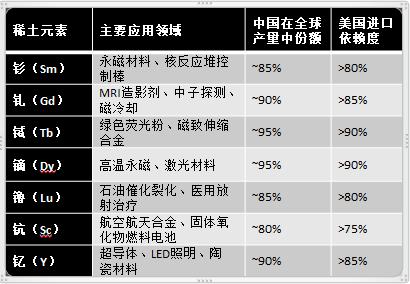
稀土战略

Search documents
禁令立即生效!巴铁刚要和美国合作稀土,中方通告全球:稀土技术管控
Sou Hu Cai Jing· 2025-10-10 02:53
Core Insights - The article discusses the strategic implications of a $500 million deal between Pakistan and the U.S. for rare earth minerals, highlighting the challenges faced by Pakistan in meeting quality standards and the dominance of China in the rare earth supply chain [1][3]. Group 1: Rare Earth Supply Chain - The value of rare earth minerals lies not in the raw materials themselves but in the complex processing chain required to produce high-purity materials, which China currently dominates [3][5]. - China's recent export controls on rare earth technologies signify a comprehensive strategy to secure its position in the entire supply chain, from raw materials to advanced processing [5][9]. Group 2: U.S. Supply Chain Concerns - Despite significant investments, the U.S. has struggled to achieve self-sufficiency in rare earth production, with many domestic operations facing technical challenges [5][9]. - The U.S. has been attempting to address its "rare earth anxiety" for over a decade, yet its self-sufficiency remains in single digits, indicating a deep reliance on Chinese technology [5][9]. Group 3: Pakistan's Strategic Position - Pakistan aims to attract U.S. investment through the development of the Pasni port, hoping to balance Chinese and American interests, but risks falling into a "resource curse" similar to other resource-rich countries [7][11]. - The article warns that without developing its own technological capabilities, Pakistan may end up as a mere supplier of raw materials, with little benefit to its domestic industry [7][11]. Group 4: Technological Advancements - The focus of the "rare earth war" has shifted from raw material acquisition to technological superiority, with China leading in high-end magnetic material production [9][11]. - China's advancements in low-rare-earth magnetic materials and recycling technologies are setting new benchmarks in the industry, further solidifying its competitive edge [9][11]. Group 5: Future Implications - The article concludes that the future of the rare earth industry will be defined by technological breakthroughs rather than raw material availability, emphasizing the importance of innovation in maintaining competitive advantage [11].

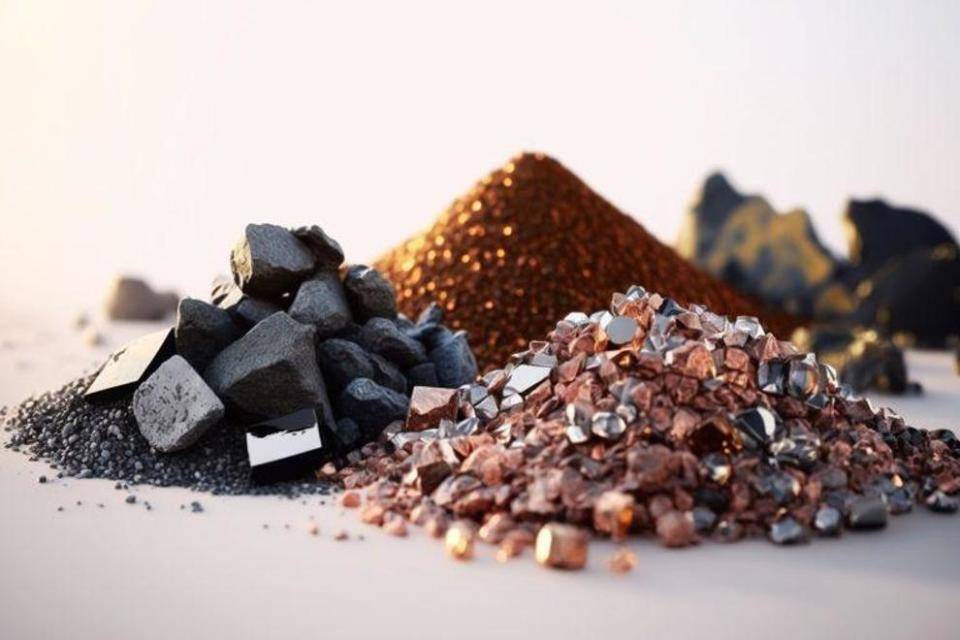
突发特讯!7国集团竟想设稀土价格下限,还要对中国出口加税
Sou Hu Cai Jing· 2025-09-26 09:42
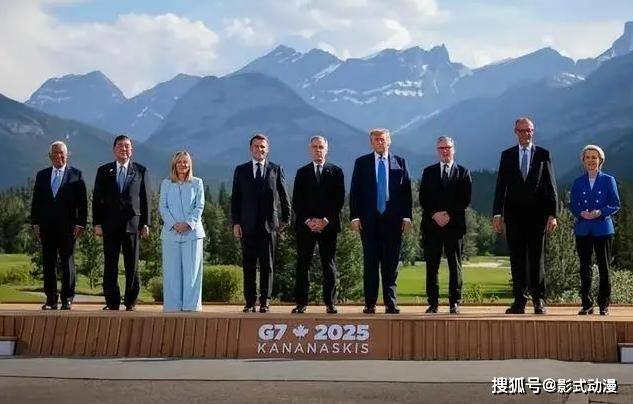
令人尴尬的是,除了日本,G7其他成员国的稀土依赖度竟高达90%以上。这种极度不平衡的局面,催生了一种奇特的"焦虑综合征":一方面,他们将中国对 稀土的合理管控解读为"武器化",另一方面,却又无法割舍对中国供应链的深度依赖。今年6月启动的"关键矿产行动计划",本质上是西方国家在稀土领域 的一场突围战。然而,内部消息显示,G7在战略方向上依然存在严重分歧——是选择直接对抗,还是采取更为隐晦的限制手段?这如同在迷雾中摸索,充 满了不确定性。 "价格下限"与"碳税":自欺欺人的游戏与荒唐的指责 G7提议的"价格下限",无疑是这场博弈中最具讽刺意味的一环。在鼓吹市场经济的西方国家,竟然有人提出为企业产品设定最低售价,这本身就是对自由 市场原则的莫大讽刺。试想,如果中国稀土的生产成本是100元,市场价格为150元,G7却强行设定200元的"价格下限",其结果只会是西方制造商凭空多支 付50元,这笔成本最终将不可避免地转嫁给终端消费者。澳大利亚和加拿大对此提议表现出的积极性,不过是为本国稀土产业提供补贴的遮羞布,在绝对的 成本优势面前,任何价格干预都显得苍白无力。 更为荒唐的是所谓的"碳税"提议。西方国家在完成了自身的工业 ...
连德国媒体都佩服中国了!德国媒体报道:在中美关税战中,东方大国的强硬态度让全球震惊
Sou Hu Cai Jing· 2025-09-10 15:45
Core Viewpoint - The article discusses the shift in global media perception towards China, particularly in Europe, highlighting a growing respect for China's strategic use of resources, especially rare earth elements, in the context of trade tensions with the United States [1][3]. Group 1: Trade War and Rare Earth Elements - The U.S.-China trade war began in 2018, with the U.S. imposing tariffs on steel, aluminum, and semiconductors, amounting to over a hundred billion dollars [3]. - China responded to U.S. tariffs by leveraging its dominance in rare earth elements, which are crucial for high-tech and military applications, with over 70% of U.S. rare earth imports coming from China [3][6]. - In April 2025, China announced new export management rules for rare earths, prioritizing domestic needs, showcasing its strategic leverage in the supply chain [3][6]. Group 2: Germany's Perspective - Germany, as a supply chain-driven economy, recognizes the risks of resource supply disruptions, which could halt entire industries [5]. - German media noted that China's assertive stance is part of a broader strategy to upgrade its industrial capabilities rather than merely exporting raw materials [5][10]. - The respect from Germany stems from China's long-term planning in the rare earth sector, as evidenced by the 2023 "Rare Earth Industry Development Plan" aimed at achieving self-sufficiency in key technologies [6]. Group 3: Technological Advancements - China is not only rich in rare earth resources but is also making significant technological advancements, such as developing room-temperature superconductors and enhancing 5G transmission speeds [8]. - The integration of rare earths with green technologies, such as CO2 conversion into gasoline, demonstrates China's innovative approach to resource utilization [8]. - China's dominance in rare earth-related patents, accounting for 83% of global patents, indicates a shift from merely selling raw materials to selling technology [8]. Group 4: Strategic Implications - The U.S. miscalculated by believing that tariffs would force China to concede, but instead, it has led to China's self-sufficiency in the rare earth supply chain [10]. - The article suggests that the long-term implications of this trade war could result in China becoming increasingly stronger in the global market [10].
提前囤稀土,捡15年“垃圾”,日本的稀土大计摆脱中国了吗?
Sou Hu Cai Jing· 2025-08-15 08:08
Core Viewpoint - Japan has been heavily reliant on China's rare earth resources, and despite efforts over the past decade to reduce this dependency, it remains largely unachieved due to various challenges in technology and supply chain management [2][5][16]. Group 1: Japan's Rare Earth Strategy - Japan's government initiated the "Rare Metal Strategy" in 2009, focusing on improving recycling rates, seeking new overseas supply sources, increasing strategic reserves, and developing alternative resources [5][16]. - The recycling of rare earth elements has proven to be a significant technical challenge, with low recovery rates and high costs associated with extracting rare earths from electronic waste [5][16]. - Japan has attempted to source rare earth materials from countries like Mongolia and Brazil, but these countries lack the refining capabilities, necessitating reliance on Chinese processing [5][7]. Group 2: Strategic Reserves and Deep-Sea Mining - Increasing strategic reserves of rare earths was proposed to mitigate supply risks during emergencies; however, without a complete industrial chain, this strategy is ineffective [7][16]. - Japan's government launched the "Mineral Resource Security Strategy" in 2012 to develop deep-sea rare earth resources, particularly around Minami-Torishima, with estimated reserves of 1.6 million tons [11][16]. - The deep-sea mining initiative faces significant technical and cost barriers, with extraction costs estimated at 12 billion yen (approximately 83 million USD) per ton of rare earths, making it a challenging endeavor [11][16]. Group 3: Alternative Technologies - Some Japanese companies have explored developing rare earth-free technologies, particularly in magnet production, but these alternatives face limitations in heat resistance and magnetic strength compared to traditional rare earth magnets [15][16]. - Despite advancements in technology, the maturity and market acceptance of these alternatives remain significant hurdles for widespread adoption [15][16]. Group 4: Conclusion on Dependency - Overall, Japan's extensive efforts to address rare earth supply issues have not yielded the expected results, with ongoing technological bottlenecks and an incomplete supply chain [16]. - The reality of dependency on Chinese rare earths persists, and without breakthroughs in technology or significant changes in external conditions, Japan's rare earth strategy is unlikely to fundamentally alter its current situation [16].
中美瑞典经贸谈判结束,特朗普发声,我国的态度让欧洲出乎意料
Sou Hu Cai Jing· 2025-07-31 15:05
Group 1 - The core outcome of the recent US-China-Sweden trade talks is the agreement to extend the suspension of tariffs, while other significant issues remain unresolved due to clear divergences [1] - US Treasury Secretary Mnuchin indicated that the decision to extend the tariff suspension lies with President Trump, and further discussions on China's rare earth resource circulation may occur within the next 90 days [1][3] - Trump's response to the talks suggests an openness to extending the agreement, reflecting a desire to avoid escalating the trade war in the short term [3] Group 2 - China's firm stance during the negotiations has led to a relatively mild response from the US, indicating China's unique leverage in this geopolitical game compared to the EU and Japan [4] - The EU officials were surprised by China's uncompromising position, which countered their expectations of potential concessions, highlighting China's strong resistance to US manufacturing revival efforts [6] - The US manufacturing sector is facing significant challenges due to China's dominance in rare earth materials, with no viable alternatives available to mitigate this pressure [6]
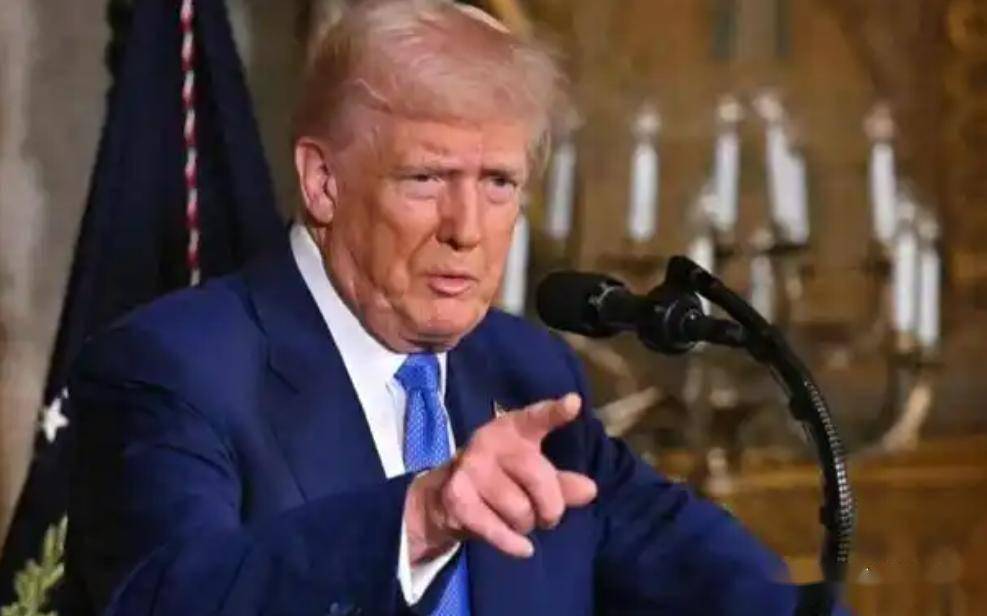
特朗普砸几百亿开发稀土,中国突然传来消息,对美出口暴涨6倍
Sou Hu Cai Jing· 2025-07-22 12:26
Group 1 - The core argument of the article highlights the failure of the Trump administration's efforts to establish an independent rare earth supply chain, as China's exports to the U.S. surged sixfold, undermining U.S. strategies [1][3][5] - The Trump administration invested hundreds of billions in acquiring rare earth resources from Ukraine and Southeast Asia, and recently engaged with five African nations to secure mining rights, all aimed at reducing reliance on China [3][5][7] - China's sudden increase in rare earth exports, particularly in rare earth magnets, is seen as a strategic move to disrupt U.S. plans while maintaining control over critical military-grade rare earth elements [5][9] Group 2 - The article suggests that China's strategy involves a "divide and conquer" approach, where U.S. investments in rare earth development are rendered ineffective, leading to internal conflicts within U.S. industries [7][11] - By controlling the export of rare earths and selectively increasing supply, China is able to profit while simultaneously applying pressure on the U.S. regarding technology and trade issues [9][11] - The situation illustrates the importance of resource control in global power dynamics, emphasizing that the nation that controls the supply chain holds significant leverage [11]
稀土战略重要性不断提升,稀土ETF嘉实(516150)近5日“吸金”超3亿元,成分股中钢天源涨停
Sou Hu Cai Jing· 2025-07-22 02:59
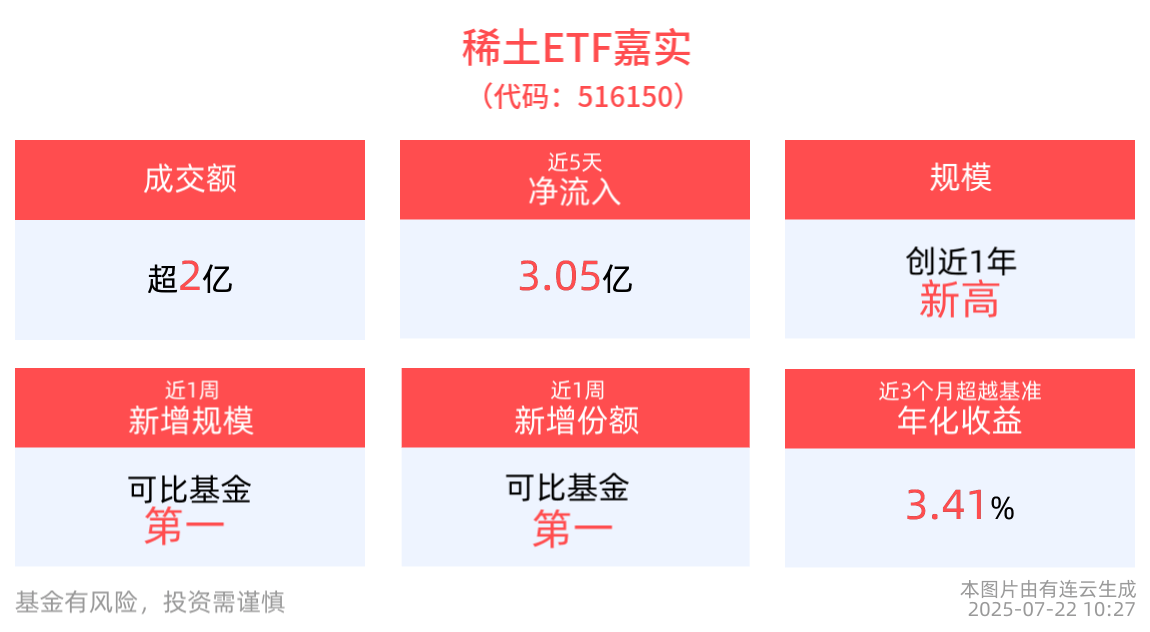
Group 1: Liquidity and Fund Performance - The liquidity of the rare earth ETF managed by Jiashi has a turnover rate of 6.85% with a transaction volume of 216 million yuan [3] - As of July 21, the Jiashi rare earth ETF has reached a scale of 3.145 billion yuan, marking a one-year high and ranking first among comparable funds [3] - In the past week, the Jiashi rare earth ETF has seen a significant increase in shares by 12 million, leading in new share growth among comparable funds [3] - The latest net inflow of funds into the Jiashi rare earth ETF is 78.4154 million yuan, with a total of 305 million yuan net inflow over four out of the last five trading days [3] - The Jiashi rare earth ETF has achieved a net value increase of 63.74% over the past year, ranking 131 out of 2929 in the index stock fund category, placing it in the top 4.47% [3] - Since its inception, the Jiashi rare earth ETF has recorded a highest monthly return of 41.25% and an average monthly return of 9.69% [3] Group 2: Market Trends and Price Movements - Since July, domestic rare earth product prices have shown signs of recovery, with the average market price of praseodymium and neodymium oxide reaching 477,000 yuan per ton, reflecting a week-on-week increase of 5.3% and a month-on-month increase of 8.2% [4] - The upcoming consumption peak season in September and October is expected to drive raw material procurement, leading to a positive outlook for rare earth prices [4] - Historical trends indicate that high overseas prices often lead to domestic price increases, potentially enhancing corporate profits and creating a dual opportunity for valuation and profit expansion in the sector [4] Group 3: Key Stocks in the Rare Earth Sector - The top ten weighted stocks in the rare earth industry index as of June 30, 2025, include Northern Rare Earth, China Rare Earth, and China Aluminum, collectively accounting for 55.58% of the index [4] - The performance of key stocks shows varied changes, with Northern Rare Earth down by 2.40% and Xiamen Aluminum up by 3.50% [6]




特朗普投资上百亿开发稀土,中国传来消息,对美出口暴涨6倍
Sou Hu Cai Jing· 2025-07-21 15:56
Core Viewpoint - The recent surge in China's rare earth magnet exports to the U.S. in June, which increased by 600% compared to May, reveals a strategic maneuver in China's rare earth policy aimed at maintaining control over the global supply chain while undermining U.S. efforts to establish independence from Chinese supplies [1][4]. Group 1: Export Dynamics - In June, China's rare earth magnet exports to the U.S. reached 353 tons, a significant increase from just a few dozen tons in May, indicating a return to normal levels after a period of near-zero exports [1][4]. - The focus of these exports is on rare earth magnets, a relatively low-end product, which is easier to produce compared to high-purity rare earth materials that are subject to strict export controls [4][6]. Group 2: Strategic Implications - China's export strategy is designed to create a "controlled release" mechanism, where each batch of rare earths is subject to stringent approval processes, allowing China to monitor buyer information and usage [4][6]. - This approach aims to maintain U.S. dependency on Chinese supplies while simultaneously reducing the incentive for U.S. companies to invest heavily in alternative supply chains [6][7]. Group 3: Long-term Strategy - China's rare earth strategy has evolved from "total control" to "structural control," allowing for selective export of low-end products while maintaining strict controls on high-end products to preserve its monopoly [6][7]. - By leveraging rare earths as a strategic tool, China seeks to influence discussions on technology restrictions and trade tensions, effectively using its resources to create a psychological dependency among U.S. firms [6][7].
被五角大楼看好的稀土巨头,还没开始振兴,先被自己人捅了一刀
Sou Hu Cai Jing· 2025-07-20 22:29
Group 1 - The U.S. Department of Defense invested $400 million in MP Materials, becoming the largest shareholder of the only operational rare earth mining company in the U.S. [2] - The Pentagon has locked in a procurement price of $110 per kilogram for rare earth products, nearly double the current market price of around $63 dominated by China [2] - Critics argue that the government's focus on MP Materials could disrupt the market and harm long-term U.S. industrial competitiveness [2][4] Group 2 - The controversy surrounding the rare earth strategy reflects deeper political struggles and interest distribution, with the Trump administration bypassing Congress to concentrate resources on specific companies [4] - The Pentagon's commitment to purchase 7,000 tons of magnets annually for ten years exceeds actual defense needs, raising concerns about the rationale behind such agreements [4] - The agreement allows the Pentagon to share in 30% of profits if market prices exceed $110, creating potential for corruption [4] Group 3 - The U.S. strategy appears to mimic China's model of state support for industries, but critics highlight the high costs associated with this approach [4][6] - The internal resource allocation imbalance in the U.S. reflects a broader issue of strategic misalignment in understanding China's industrial policies [6] - China's success in the rare earth sector is attributed to a comprehensive ecosystem of technology patents, supply chain control, and market competition, unlike the U.S. approach [6] Group 4 - The U.S. actions to secure rare earth supplies are inadvertently accelerating the decline of its hegemony, as allies seek diversification in supply chains [8] - Trade diversification efforts are emerging in response to U.S. tariffs, with countries like Canada and the EU seeking alternatives to U.S. dominance [8] - China's strategic measures, including advanced customs technology and resource monitoring, are effectively countering U.S. attempts to manipulate rare earth supply chains [8] Group 5 - Historical patterns indicate that U.S. attempts to bolster its rare earth industry may overlook the fragile foundation of its industrial ecosystem [10] - The cycle of high-priced procurement and technological dependency reflects a strategic anxiety rather than a sustainable industrial ambition [10] - True industrial security is rooted in innovation and systemic thinking, which are challenging for the U.S. to replicate [10]

从EDA软件解禁到稀土博弈:中美科技战的攻守转换
3 6 Ke· 2025-07-04 03:54
Group 1: EDA Software Market and Regulations - The U.S. Department of Commerce has lifted the requirement for Synopsys, Cadence, and Siemens to apply for government licenses when conducting business in China, following a previous ban imposed on May 23, 2025 [1] - By 2024, the global market shares for these EDA companies are projected to be 31%, 30%, and 13% respectively [1] - The lifting of the ban is linked to a framework established on June 27, 2025, where China agreed to review export applications for controlled items, leading to the U.S. canceling corresponding restrictions [1] Group 2: Rare Earth Elements and Strategic Importance - Rare earth elements consist of 17 metals and are crucial for over 200 commercial, high-tech, and military products, with China dominating the heavy rare earth separation sector [3][5] - China controls approximately 80% of the global rare earth refining capacity and produces 99% of the world's heavy rare earth elements [5] - The strategic value of rare earths has led China to implement export controls on key materials, which are essential for various industries [3][5] Group 3: U.S. Rare Earth Supply Chain Challenges - The U.S. has historically relied on outsourcing for rare earth production, leading to a significant dependency on China [6][7] - Recent U.S. initiatives aim to rebuild the domestic rare earth supply chain, with an estimated cost in the thousands of billions [7] - The U.S. Department of Defense has set a goal to establish a domestic supply chain for rare earths by 2027, covering all critical nodes from mining to magnet manufacturing [7] Group 4: Global Competition and Alternatives - Countries are investing resources to find alternatives to Chinese rare earths, but the transition will take years [9] - The EU has announced new mineral projects to diversify raw material sources, including rare earths, but faces environmental concerns and lengthy approval processes [9] - The trend of nationalizing key mineral resources is emerging in South America and Africa, as governments seek to maintain control over their mineral wealth [9]