能源强国

Search documents
国家能源局科技司司长刘德顺:谱写“十五五”高水平能源科技自立自强新篇章
Zhong Guo Dian Li Bao· 2026-02-11 09:34
Core Viewpoint - The article emphasizes the importance of accelerating high-level technological self-reliance and innovation in the energy sector to achieve high-quality development during the 14th Five-Year Plan period and beyond [1][2]. Group 1: Strategic Goals and Framework - The "15th Five-Year Plan" aims to establish a new energy system and strengthen the country's energy capabilities, focusing on enhancing the overall effectiveness of the energy technology innovation system [2][4]. - The plan highlights the need for original innovation and tackling key core technologies to support the construction of a new energy system [2][3]. - The integration of technological and industrial innovation is crucial, with a focus on developing new productive forces based on the actual development stages of industries [2][4]. Group 2: Implementation and Focus Areas - The energy sector will prioritize the construction of a robust energy technology innovation system, optimizing the layout of research and development platforms [6][7]. - Major technological equipment breakthroughs will be pursued, including the assessment and approval of significant energy equipment [6][7]. - The implementation of national technology projects in the energy sector will be emphasized, with a focus on smart grid initiatives and clean coal utilization [6][7]. Group 3: New Industries and Standards - The cultivation of new industries, business models, and scenarios in the energy sector will be promoted, particularly through the integration of artificial intelligence [7]. - The development of new energy storage and hydrogen energy industries will be prioritized, with pilot projects and regional development initiatives [7]. - The establishment of a comprehensive energy standards system will be pursued to enhance international standards and support the transition to green energy [7].
能源开新局丨谱写“十五五”高水平能源科技自立自强新篇章
Zhong Guo Dian Li Bao· 2026-02-11 09:28
Core Viewpoint - The article emphasizes the importance of advancing energy technology innovation and establishing a new energy system during the "15th Five-Year Plan" period, aligning with China's modernization goals and the strategic tasks outlined by the Communist Party [3][4]. Group 1: Energy Technology Innovation - The "15th Five-Year Plan" aims to build a strong energy nation, with a focus on high-quality development and technological self-reliance [3][4]. - The National Energy Administration will develop an energy technology innovation plan for 2026, providing robust technological support for the construction of a strong energy nation [3][4]. - Key areas of focus include enhancing the overall effectiveness of the energy technology innovation system and promoting original and core technology breakthroughs [4][6]. Group 2: Strategic Goals and Implementation - The strategic goals include establishing a new energy system and enhancing energy security through technological advancements [4][5]. - The plan emphasizes the integration of technological innovation with industrial innovation, particularly in areas like artificial intelligence and new energy storage [4][6]. - Specific actions include the implementation of major national technology projects and the promotion of energy efficiency and green development [7][8]. Group 3: Challenges and Opportunities - The energy sector faces both opportunities and challenges, including the need for green and low-carbon technology innovations and the competition in emerging fields like hydrogen and nuclear fusion [6][9]. - The integration of artificial intelligence into the energy sector is seen as a transformative factor that can reshape global energy competition [6][9]. - The article highlights the necessity for a proactive approach to maintain control over energy technology development amid international competition [6][9].
氢能产业有望进入加速发展期!我国现存超3800家氢能相关企业
Sou Hu Cai Jing· 2026-02-10 08:22
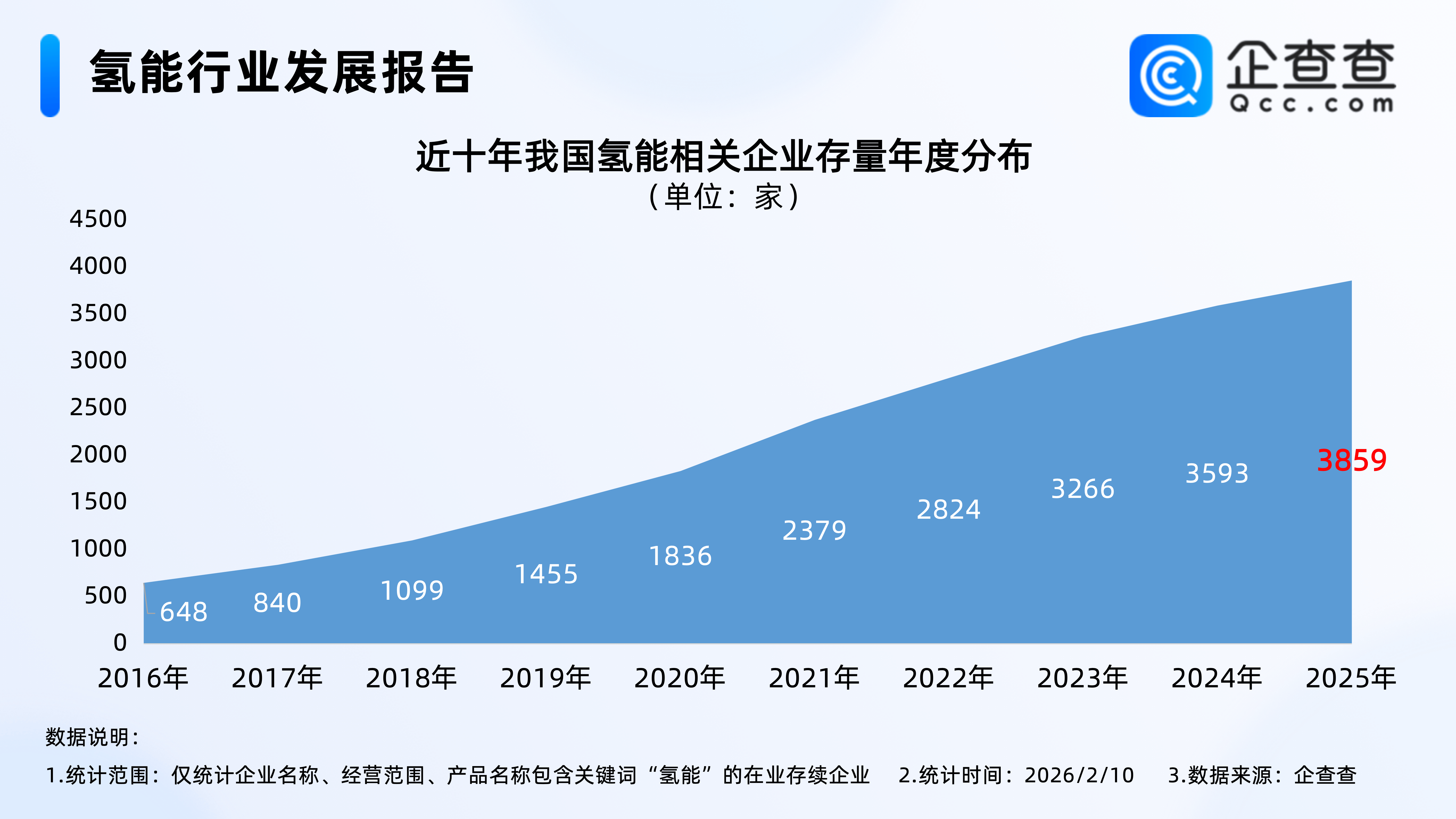
Core Viewpoint - The "14th Five-Year Plan" proposes the concept of "energy power," highlighting hydrogen energy as a significant future industry, which is expected to enter a policy opportunity period [1] Group 1: Industry Overview - Hydrogen energy has broad applications in traditional industries such as energy, chemicals, and transportation, with industrial applications likely becoming the main battlefield for hydrogen utilization [1] - The policy signal indicates a shift from transportation demonstration to industrial applications, with green hydrogen and hydrogen-based green fuels seen as optimal solutions for reducing carbon emissions in hard-to-abate sectors like steel, non-ferrous metals, chemicals, and building materials [1] Group 2: Company Statistics - As of February 9, 2026, there are 3,872 existing hydrogen-related enterprises in China, with a stable annual increase over the past decade [3][8] - The distribution of hydrogen-related enterprises shows that the East China region has the highest concentration at 34.0%, followed by North China at 20.7%, while Southwest and Northeast regions have the least, at 7.5% and 4.2% respectively [5][8] - In terms of establishment years, the majority of hydrogen-related enterprises were founded between 1 to 3 years ago, accounting for 27.8%, followed closely by those established between 5 to 10 years, which make up 26.3% [5][8]

新思想引领新征程丨构建坚强可靠电力体系 推动我国向能源强国稳步迈进
Yang Guang Wang· 2026-02-10 04:07
Core Viewpoint - The Chinese government emphasizes the acceleration of building a new energy system that is clean, low-carbon, safe, abundant, economically efficient, and flexible, aiming to enhance energy security and promote the revolution in energy production and consumption [1][2]. Group 1: Energy Production and Consumption - By 2025, China's total electricity consumption is expected to exceed 10 trillion kilowatt-hours, marking a historic first for any single country [1]. - The new power supply system is characterized by a collaborative effort among power sources, grids, and demand, contributing to the development of a strong energy nation [1]. - In Qinghai Province, the Yangqu Hydropower Station is a key hub for clean energy regulation, with a projected annual electricity generation of 4.21 billion kilowatt-hours by 2025 [1]. Group 2: Renewable Energy Development - The renewable energy generation capacity in China is expected to see significant growth, with over 430 million kilowatts of new wind and solar installations anticipated in 2025, leading to renewable energy accounting for over 60% of total generation capacity [2]. - The renewable energy generation in China is projected to exceed the total electricity consumption of the 27 EU countries combined [2]. - The western region of China is identified as a crucial energy base, with ongoing efforts to enhance energy resource security [1][2]. Group 3: Infrastructure and Technological Advancements - The construction of ultra-high voltage (UHV) projects is accelerating, forming a super grid that enhances energy security across the country [2]. - The Shaanbei-Anhui ±800 kV UHV direct current transmission project is set to begin operations by mid-2026, providing power supply assurance for peak summer demand [3]. - The development of new infrastructure, such as charging stations and 5G bases, is driving a significant increase in electricity consumption in related sectors, with growth rates exceeding 30% [3]. Group 4: Economic Impact and Future Projections - The total electricity consumption surpassing 10 trillion kilowatt-hours reflects the resilience of China's large-scale economy and indicates a trajectory towards industrial structure upgrades and green transformation [3]. - Guangdong Province is projected to become the first province in China to exceed 160 million kilowatts in electricity load by 2025, driven by the growth of the digital economy and advanced manufacturing [3]. - The production of integrated circuits in Guangdong is expected to reach 94.24 billion pieces by 2025, representing a 152% increase from 2020 [3].
北京大学能源研究院:面向新能源时代的能源强国建设
Zhong Guo Dian Li Bao· 2026-02-09 10:20
Core Viewpoint - The construction of an energy powerhouse has been officially included in China's national strategic tasks, marking a new phase in energy development with higher requirements for enhancing international competitiveness and achieving sustainable economic growth [1] Group 1: Foundations and Advantages of Building an Energy Powerhouse - China leads globally in renewable energy development and technological innovation, with the largest renewable energy system, and significant contributions from clean energy technologies to economic growth [2] - The country possesses abundant renewable energy resources and a robust energy production and supply system, providing a solid foundation for a diverse, secure, and clean energy system [2] - China has the largest energy consumption market and a complete industrial chain, offering unique advantages for technological iteration and commercial innovation in the energy sector [3] Group 2: Initial Understanding of the Concept of an Energy Powerhouse - An energy powerhouse is characterized by high energy development quality, industrial promotion capability, resource security, technological innovation, and international influence, supporting national modernization with an efficient, safe, green, and sustainable energy system [4] - To achieve this goal, China must establish a leading position in renewable energy and develop competitive green energy, promoting comprehensive high-quality economic development [4] Group 3: Major Challenges in Building an Energy Powerhouse - China's energy system faces structural and security shortcomings, including high reliance on coal and external oil and gas, which affects supply autonomy and stability [5][6] - There are significant constraints in the capability system and governance level, such as insufficient independent innovation in key energy technologies and an immature energy management and market mechanism [5][6] Group 4: Key Tasks and Recommendations for Building an Energy Powerhouse - Accelerate the green and low-carbon transformation of energy by promoting large-scale development and high consumption of renewable energy, and integrating it with various sectors [7] - Strengthen the energy security guarantee system by enhancing the strategic reserve of fossil energy and improving the flexibility of the power system [7] - Focus on energy technology innovation and industrial upgrading, enhancing self-control levels and promoting the development of digital energy and smart systems [7] - Deepen energy system reforms and market construction to create a regulated and effective market environment [8] - Enhance global energy governance and international cooperation capabilities to increase influence in international energy governance [8] - Improve the statistical evaluation system for energy powerhouses to support data-driven decision-making [8]
能源强国建设“大家谈”︱迈向能源强国:陆海统筹,向海图强,筑牢中国式现代化的能源基石
国家能源局· 2026-02-06 07:19
Core Viewpoint - The article emphasizes the importance of building a strong energy nation in China, highlighting the need for a new energy system that is secure, green, innovative, efficient, and open, as part of the broader goal of achieving socialist modernization [3][4]. Group 1: Strategic Goals and Phases - The construction of an energy strong nation is a significant strategic choice based on China's resource endowment and long-term needs, aiming for a historical leap from an energy power to a comprehensive energy strong nation [4]. - The new energy system should feature five characteristics: security resilience, green low-carbon transition, technological innovation, efficient governance, and cooperative openness [4]. - The next ten years are proposed to be divided into two key phases: the "15th Five-Year Plan" (2026-2030) focusing on foundational work and peak carbon emissions, and the 2035 vision aiming for a mature energy system and significant optimization of energy structure [5]. Group 2: Key Tasks for Energy Nation Construction - Strengthening energy security by expanding resource supply through strategic mineral exploration and development, while increasing oil and gas exploration efforts, particularly in marine areas [6][7]. - Accelerating the green low-carbon transition by increasing the share of renewable energy and optimizing the energy structure through the development of offshore wind power and carbon capture technologies [7]. - Enhancing technological innovation by focusing on key technologies in deep-water oil and gas development and promoting digital and intelligent technologies across the energy industry [7][8]. - Reforming oil and gas systems to create a unified energy market and improve governance mechanisms, fostering a competitive and efficient energy system [8]. - Expanding international energy cooperation to enhance global influence and participate in global energy governance [8]. Group 3: Global Resource Allocation and Energy Security - The article stresses the need to enhance global resource allocation capabilities while maintaining domestic energy supply resilience, emphasizing the importance of a dynamic and resilient energy security system [9]. - Strengthening domestic oil and gas supply capabilities through increased exploration and production, particularly in marine resources [9]. - Promoting renewable energy generation and ensuring a reliable transition from fossil fuels to mitigate supply risks [9]. - Utilizing the Belt and Road Initiative to enhance energy infrastructure connectivity and trade cooperation, thereby improving global resource allocation and risk management [9].

中石油经研院解析国内外油气行业“六变八稳”发展格局
Jing Ji Wang· 2026-02-04 10:38
Core Insights - The reports highlight that the global oil and gas industry is entering a period of profound transformation by 2025, characterized by intensified turmoil, system restructuring, and a reconfiguration of the landscape due to geopolitical conflicts, economic restructuring, and energy transition [1][2] Group 1: Global Oil and Gas Industry Trends - The global oil and gas sector is facing a complex "new situation" with increasing volatility and a reshaped framework, driven by intertwined geopolitical conflicts and economic changes [1] - By 2026, the global economy is expected to exhibit "low growth, high differentiation, and increased turmoil," posing severe challenges to global energy security and market stability [1] - The oil market is anticipated to shift from a tight balance to a state of oversupply, with Brent crude prices projected to range from $60 to $65 per barrel under normal conditions, and potentially rise to $70 to $75 per barrel amid geopolitical tensions [3] Group 2: China's Oil and Gas Industry Developments - China's oil and gas industry is demonstrating strategic confidence and resilience, aiming for progress while maintaining stability, with a focus on achieving the goals set for the 14th Five-Year Plan [1][4] - By 2025, China's energy self-sufficiency is projected to reach 84.4%, with non-fossil energy consumption accounting for 21.8% of total energy use, and this is expected to rise to over 23% by 2026 [4] - Oil and gas production in China is set to reach a historical high of 420 million tons of oil equivalent by 2025, with crude oil production expected to stabilize at 200 million tons in 2026 [4][5] Group 3: Energy Security and Policy Implications - The global energy security landscape is becoming increasingly complex, with the report indicating that while fossil energy remains relatively secure, the risks associated with electricity supply are rising [6] - The report calls for a more inclusive and cooperative approach to energy security, emphasizing the need for multilateralism and practical collaboration across various sectors, including energy investment and climate governance [6] - China's energy security situation is improving, marking a new phase in its journey towards becoming an energy powerhouse [6]

学习规划建议每日问答 | 为什么要建设能源强国
Xin Hua She· 2026-02-02 11:09
Core Viewpoint - The construction of an energy powerhouse is essential for modernizing the country and ensuring energy security, especially in the context of global geopolitical changes and the need for a green low-carbon transition [1][2][3][4]. Group 1: Energy Revolution and Modernization - The development of energy is a crucial indicator of national modernization, particularly for a large country like China, and is aligned with the "Four Revolutions and One Cooperation" strategy proposed by President Xi Jinping [2]. - The construction of an energy powerhouse is a strategic deployment responding to external environmental changes and domestic energy development needs, supporting high-quality development and new productive forces [2]. Group 2: Energy Security and Geopolitical Strategy - Enhancing energy security capabilities is urgent due to increasing geopolitical risks and the politicization of energy issues, necessitating a robust energy supply chain and innovation system [3]. - Building an energy powerhouse is vital for achieving energy security and providing momentum for manufacturing and transportation sectors, thereby strengthening China's strategic position in global power dynamics [3]. Group 3: Green Low-Carbon Development - The transition to a green low-carbon economy is a strategic priority for global competition, and developing a new energy system will facilitate this transition while promoting technological and industrial innovation [4]. - China's leadership in global energy transition can be reinforced through the construction of an energy powerhouse, contributing to international climate governance and enhancing its competitive edge in green industries [4]. Group 4: Development Foundations - China has favorable conditions for accelerating the construction of an energy powerhouse, with significant increases in energy production capacity since 2021, including coal production of 4.78 billion tons and natural gas production of 246.5 billion cubic meters in 2024 [5]. - The country has established itself as a leader in renewable energy, with wind and solar power installations surpassing coal power for the first time in 2024, and producing 80% of global solar components and 70% of key wind power parts [5]. - However, challenges remain with high dependence on foreign oil and gas, which exceeds 70% and 40% respectively, although this is expected to decrease as fossil fuel consumption peaks [5].
学习规划建议每日问答丨为什么要建设能源强国
Xin Hua She· 2026-02-02 08:55
Group 1 - The core viewpoint emphasizes the importance of building an energy powerhouse as a fundamental requirement for modernizing the country and ensuring energy security, especially in the context of global changes and the need for a green low-carbon transition [1][2] - The construction of an energy powerhouse is aligned with the new energy security strategy proposed by the government, which includes promoting energy consumption, supply, technology, and institutional revolutions, as well as enhancing international cooperation [2] - The urgency of enhancing energy security capabilities is highlighted due to increasing geopolitical risks and the politicization of energy issues, necessitating the development of a robust energy supply chain and innovation system [3] Group 2 - The need for green low-carbon development is identified as a strategic priority for enhancing global competitiveness, with a focus on transforming energy production and consumption patterns to achieve carbon neutrality goals [4] - China has made significant progress in energy supply capabilities since the proposal to build an energy powerhouse in 2021, with substantial increases in energy production expected by 2024, including coal, oil, and natural gas [5] - China is recognized as a leader in renewable energy, with the largest installed capacity for wind and solar power globally, and a complete supply chain for clean electricity, although there are challenges related to high dependence on foreign oil and gas [5]
经济日报丨构筑能源强国新格局
国家能源局· 2026-02-01 02:10
Core Viewpoint - The article emphasizes the importance of building a strong energy nation in China, highlighting the need for comprehensive improvements in energy technology, industrial chains, and system capabilities to enhance international competitiveness and support sustainable economic development [2]. Group 1: New Energy System Construction - The new energy system is a central theme in the transition to an energy powerhouse, with a focus on accelerating the construction of this system and achieving carbon peak goals [3]. - The development of non-fossil energy sources will be prioritized, with significant expansions in wind and solar power capacity, aiming for an additional 200 million kilowatts of installed capacity by 2026 [3]. - The integration of various energy sources, including biomass, geothermal, and marine energy, will complement the new energy system [3]. Group 2: Clean and Efficient Use of Fossil Fuels - The transition to cleaner and more efficient use of fossil fuels is essential during the period when new energy sources are not yet dominant [4]. - Coal power will be transformed into a flexible and clean energy source through technological upgrades and innovative mechanisms, ensuring energy supply security [4]. - By 2026, initiatives will be implemented to promote carbon capture and utilization in the oil and gas sector, facilitating the integration of fossil fuels with new energy [5]. Group 3: New Power System Development - A new power system must be established to ensure the efficient transmission and management of clean energy, requiring the construction of high-voltage transmission lines and smart grid systems [5]. - By 2026, a power supply alert mechanism will be established to enhance the interconnection of power grids and improve user-side responsiveness [5]. Group 4: Overcoming Bottlenecks in New Energy Development - China aims to lead global energy transformation, with a target of achieving a total installed capacity of wind and solar power reaching six times that of 2020 by 2035 [6]. - The challenges faced by the power system, such as the inability to transmit green energy from the west to the east and the volatility of renewable energy generation, need to be addressed through integrated and innovative development [6][7]. - The focus will shift from mere scale expansion to value creation through system collaboration, enhancing the reliability and market competitiveness of new energy [7]. Group 5: Coal Consumption Trends - Coal consumption in China has shown signs of decline, with a notable negative growth for the first time since 2017, but short-term demand remains resilient due to various factors [10]. - The long-term trend indicates a gradual reduction in coal consumption, with a peak expected around 2027, transitioning coal's role from a primary energy source to a backup energy source [11]. - The integration of coal and new energy will be emphasized, promoting the development of clean energy alternatives in coal mining areas [12][13]. Group 6: Future Industry Development - The "14th Five-Year Plan" outlines the need to cultivate future industries such as quantum technology, hydrogen energy, and nuclear fusion, which are crucial for energy security and sustainable development [15]. - Hydrogen energy is seen as a key component of the future energy system, with efforts to promote its commercialization and integration into the energy landscape [16]. - Nuclear fusion is positioned as a long-term solution for energy challenges, with significant investments and research expected to accelerate its development [17].