
资本回报率

Search documents
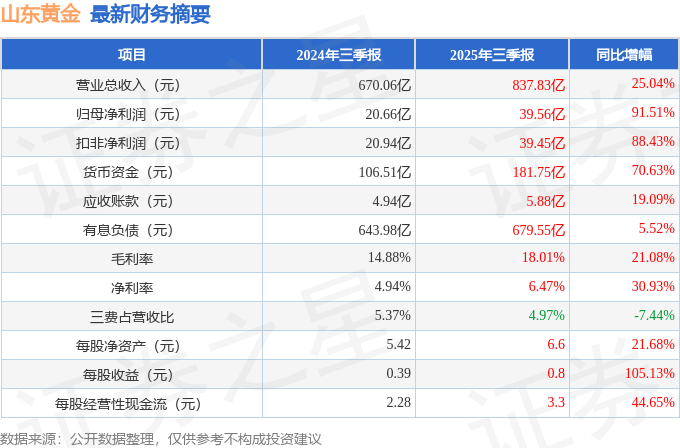
山东黄金(600547)2025年三季报简析:营收净利润同比双双增长,盈利能力上升
Sou Hu Cai Jing· 2025-10-30 22:31
Core Viewpoint - Shandong Gold's Q3 2025 financial report shows significant growth in revenue and net profit, indicating improved profitability and operational efficiency [1]. Financial Performance - Total revenue for Q3 2025 reached 83.783 billion yuan, a year-on-year increase of 25.04% compared to 67.006 billion yuan in Q3 2024 [1]. - Net profit attributable to shareholders for Q3 2025 was 3.956 billion yuan, up 91.51% from 2.066 billion yuan in Q3 2024 [1]. - The gross profit margin improved to 18.01%, reflecting a year-on-year increase of 21.08% [1]. - The net profit margin rose to 6.47%, with a year-on-year increase of 30.93% [1]. - Total operating expenses (selling, administrative, and financial) amounted to 4.168 billion yuan, accounting for 4.97% of revenue, down 7.44% year-on-year [1]. Key Financial Metrics - Earnings per share (EPS) for Q3 2025 was 0.8 yuan, a significant increase of 105.13% from 0.39 yuan in Q3 2024 [1]. - Cash flow from operations per share was 3.3 yuan, up 44.65% year-on-year [1]. - The company's net asset value per share increased to 6.6 yuan, a rise of 21.68% compared to the previous year [1]. Market Position and Analyst Expectations - Analysts project the company's 2025 earnings to be around 6.759 billion yuan, with an average EPS forecast of 1.51 yuan [3]. - The company is held by notable fund managers, including Han Chuang from Dacheng Fund, who is recognized for his ability to identify growth stocks [3]. Fund Holdings - The largest fund holding Shandong Gold is the Yongying CSI Hong Kong and Shanghai Gold Industry ETF, with a scale of 11.669 billion yuan and a recent net value increase of 0.17% [4]. - Other funds have also increased their holdings in Shandong Gold, indicating positive sentiment in the market [4].


大行评级丨小摩:上调新东方目标价13% 重申“增持”评级
Ge Long Hui· 2025-10-30 06:03
Core Viewpoint - Morgan Stanley has raised the target price for New Oriental (9901.HK) by 12.8%, from HKD 47 to HKD 53, while maintaining an "Overweight" rating, indicating a positive outlook for the company [1] Financial Performance - The adjusted performance of New Oriental is expected to exceed Bloomberg's estimates by over 10%, suggesting the end of a challenging downturn for the fiscal year 2025 [1] - The company's capital return rate is strong, currently exceeding 5% [1] Market Reaction - Despite an initial decline in the company's stock price in the US market, Morgan Stanley believes that New Oriental is on the path to profitability growth with a clear outlook [1]
露笑科技(002617)2025年三季报简析:净利润同比增长5.17%,盈利能力上升
Sou Hu Cai Jing· 2025-10-29 22:40
Core Insights - The company reported a total revenue of 2.761 billion yuan for Q3 2025, a slight decrease of 0.82% year-on-year, while the net profit attributable to shareholders increased by 5.17% to 246 million yuan [1] - In Q3 2025, the total revenue reached 1.009 billion yuan, reflecting a year-on-year increase of 13.99%, and the net profit attributable to shareholders surged by 78.57% to approximately 95.88 million yuan [1] - The company's profitability improved, with a gross margin increase of 1.68% to 21.98% and a net margin increase of 8.89% to 8.18% [1] Financial Performance - Total revenue for Q3 2025 was 2.761 billion yuan, compared to 2.784 billion yuan in Q3 2024, showing a decline of 0.82% [1] - Net profit attributable to shareholders for Q3 2025 was 246 million yuan, up from 234 million yuan in Q3 2024, marking a 5.17% increase [1] - The company reported a gross margin of 21.98% and a net margin of 8.18%, both showing improvements from the previous year [1] Cost and Expenses - Total selling, administrative, and financial expenses amounted to 228 million yuan, accounting for 8.26% of revenue, which is an 8.43% decrease year-on-year [1] - The company’s financial health is indicated by a significant increase in operating cash flow per share, which improved by 95.88% to -0.01 yuan [1] Asset and Liabilities - The company’s cash and cash equivalents decreased to 632 million yuan, down 4.23% from the previous year [1] - Accounts receivable increased by 24.18% to 2.56 billion yuan, indicating potential liquidity concerns [1] - Interest-bearing debt rose slightly by 1.37% to 2.98 billion yuan [1] Investment Returns - The company's return on invested capital (ROIC) was reported at 4.2%, with a historical median ROIC of 3.47% over the past decade, indicating weak investment returns [3] - The company has experienced three years of losses since its IPO, highlighting a fragile business model [3] Cash Flow and Financial Health - The cash flow situation is concerning, with cash and cash equivalents representing only 7.36% of total assets and 55.14% of current liabilities [4] - Financial expenses have reached 52.01% of the average operating cash flow over the past three years, indicating high financial burden [4] - Accounts receivable have reached 992.01% of profit, raising red flags about the company's collection efficiency [4]

老百姓抱怨无钱消费挣钱难,企业也说不挣钱,社会上的钱被谁赚走了?
Sou Hu Cai Jing· 2025-10-28 20:45
Core Insights - The article discusses the economic challenges faced by both individuals and businesses, highlighting a stagnation in real income growth and declining profit margins for companies, leading to questions about the distribution of wealth in society [1][3][11] Economic Indicators - The national per capita disposable income growth rate was 3.2% in Q1 2025, while the Consumer Price Index (CPI) rose by 3.1%, indicating that real purchasing power has not improved significantly [1] - The manufacturing Purchasing Managers' Index (PMI) has remained below the growth line for three consecutive months, reflecting a pessimistic business environment [1] Business Profitability - Over 65% of small and medium-sized enterprises reported a decline in profit margins compared to three years ago, with an average decrease of 2.8 percentage points [3] - Specific sectors like manufacturing, wholesale retail, and accommodation and catering have experienced the most significant profit margin declines [3] Wealth Distribution - There is an increasing disparity in profitability across industries, with high-tech, pharmaceutical, and financial sectors averaging profit margins above 15%, while traditional manufacturing and retail sectors average below 5% [3] - The average salary in high-paying sectors such as IT, finance, and biomedicine is over 2.5 times that of traditional manufacturing and service industries [4] Capital vs. Labor Income - Capital income has been growing at an annual rate of 6.8% from 2020 to 2025, compared to a 4.2% growth rate for labor income, indicating that "money makes money" is becoming more prevalent than earning through labor [4] Headwinds for Small Businesses - Small businesses are facing increased costs due to rising raw materials, labor, rent, and logistics, while being unable to raise product prices due to competition [3] - The average commission rates for e-commerce platforms are around 5-5%, with food delivery platforms charging up to 18.5%, impacting the profitability of small vendors [5] Hidden Costs - The rise of new spending categories such as education, healthcare, and digital services has increased household expenses, with significant portions of income now allocated to these areas [7] - Approximately 40% of consumers reported making poor spending decisions due to information asymmetry, leading to an average of 7% of their total consumption being wasted [7] Recommendations for Businesses - Companies are encouraged to move up the value chain through technological innovation and brand development, which can increase profit margins by 2-3 percentage points [10] - Embracing digital transformation can lead to an average cost reduction of 15% and efficiency improvement of 25% for small businesses [10] - Focusing on niche markets can help small businesses avoid direct competition and achieve higher survival and profit rates [10] Macro Perspective - The article emphasizes the need for collective efforts to address economic challenges, including regulatory reforms to promote fair competition and prevent excessive capital accumulation [10][11] - The increased emphasis on income distribution in economic development indicators suggests a potential shift towards improving wealth distribution in the future [11]


美高梅中国午后涨超5% 花旗预计其第三季EBITDA胜同业 里昂称公司具备重估潜力
Zhi Tong Cai Jing· 2025-10-23 06:55
Core Viewpoint - MGM China (02282) shares rose over 5%, reaching HKD 15.05, with a trading volume of HKD 87.37 million, driven by positive industry forecasts and analyst upgrades [1] Group 1: Industry Outlook - Citigroup forecasts a 7% year-on-year increase in EBITDA for the Macau gaming operators in Q3, with MGM China expected to achieve a 13% year-on-year growth [1] - The anticipated higher EBITDA growth for MGM China compared to the industry may provide positive stock momentum ahead of the company's earnings announcement on October 30 [1] Group 2: Analyst Ratings and Price Targets - Citigroup maintains a "Buy" rating for MGM China, setting a target price of HKD 19, and includes it in the positive catalyst watchlist for October 30 [1] - Credit Lyonnais believes MGM China has revaluation potential, noting that its 2026 EV/EBITDA and P/E multiples remain low among six Macau gaming companies [1] - Following an assessment of market share, profit margins, return on capital, and dividend growth, Credit Lyonnais raised its target price for MGM China from HKD 18.3 to HKD 22.7, maintaining an "Outperform" rating [1]

Snap-On (NYSE:SNA) Maintains Strong Market Position with "Buy" Rating from Tigress Financial
Financial Modeling Prep· 2025-10-22 00:06
Core Viewpoint - Tigress Financial maintains a "Buy" rating for Snap-On, raising its price target from $395 to $405, indicating confidence in the company's future performance [1][6] Financial Performance - Snap-On has achieved a five-year compound annual growth rate (CAGR) of approximately 18%, outperforming the S&P 500, which highlights its strong market position [2][6] - The company maintains stable gross margins above 50%, demonstrating effective cost management while generating substantial revenue [2][6] - Snap-On's return on invested capital has risen to over 15%, indicating efficient resource utilization to generate profits [3] - The company has a solid track record of dividend growth, with a 15-year streak and annual growth rates close to 14%, enhancing shareholder value [3] Market Activity - Snap-On's stock price recently increased by approximately 1.47% to $345.87, with a trading range between $338.14 and $347.63 for the day [4] - Over the past year, the stock has reached a high of $373.90 and a low of $289.81, indicating some volatility in its market performance [4] - The company's market capitalization stands at approximately $18.08 billion, reflecting its significant presence in the industry [5] - The trading volume for the day is 246,197 shares on the NYSE, suggesting active investor interest [5]


宗馥莉辞职,恰恰宣告了“家族接班”范式的终结
Hu Xiu· 2025-10-12 06:16
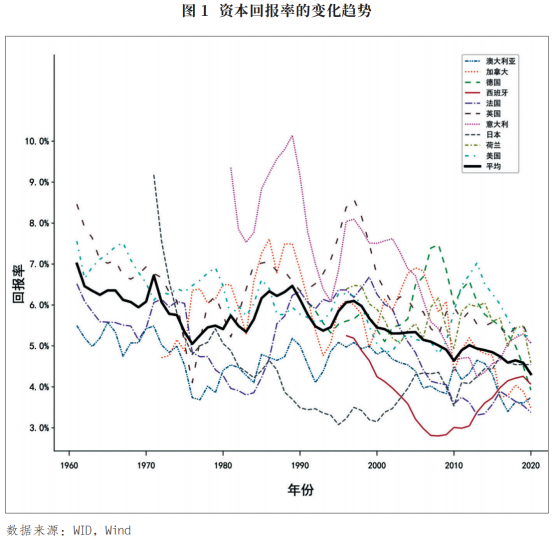
Core Viewpoint - The resignation of Zong Fuli from Wahaha Group's leadership has sparked discussions about the internal family conflict and the future of this iconic Chinese enterprise, highlighting issues related to offshore trusts, equity arrangements, and the transition of mixed-ownership enterprises in China [1] Group 1: "National Stock Private" Model - The ideal "National Stock Private" model involves the state allocating funds based on asset management plans' historical performance, decentralizing investment decisions to competing market institutions [2][3] - Implementing the "National Stock Private" model can potentially break the bottleneck of economic growth, transcending family interests and impacting the trajectory of Chinese enterprises and the economy [3] Group 2: Economic Challenges and Demand Shortage - Demand shortage has been a persistent issue since the industrial era, with various economic theories attempting to address it, yet fiscal policies have often led to increased national debt without the expected economic recovery [4][5] - The current economic landscape in China shows signs of demand shortage, with declining investments and a lack of private sector confidence attributed to policy risks in sectors like real estate and education [5][6] Group 3: Capital Return Rates and Investment Dynamics - The return rate on physical assets in China has decreased from 7% in 2001 to 4.2% in 2023, indicating a weakening profitability of physical assets [6][7] - The overall capital return rate is influenced by the distribution of capital and the economic growth rate, with a historical trend showing that capital return rates tend to decline when capital growth outpaces economic growth [8][9] Group 4: Implications of Wealth Concentration - Wealth concentration among high-income groups leads to a mismatch in demand, where those with capital do not consume enough, resulting in unsold goods and economic stagnation [10][11] - Historical patterns suggest that when wealth becomes overly concentrated, it can lead to social unrest and economic crises, necessitating interventions to redistribute wealth [13][14] Group 5: Future of Corporate Governance - As the founding generation of companies ages, the next generation may lack the management skills needed, leading to a shift from management to mere ownership, which could necessitate changes in governance structures to protect minority shareholders [24][25] - The "National Stock Private" model aims to create a more equitable management structure that aligns the interests of large shareholders, small shareholders, and public shareholders, ultimately benefiting all investors [25][26]
Avadel Pharmaceuticals plc (NASDAQ:AVDL) Financial Performance Analysis
Financial Modeling Prep· 2025-09-19 15:00
Company Overview - Avadel Pharmaceuticals plc (NASDAQ:AVDL) focuses on developing and commercializing innovative medicines, primarily targeting sleep disorders with its lead product LUMRYZ for treating narcolepsy [1] Financial Performance - Avadel's Return on Invested Capital (ROIC) is 0.86%, which is significantly lower than its Weighted Average Cost of Capital (WACC) of 11.64%, indicating inefficiencies in capital utilization [2][6] - Comparative analysis shows that Eyenovia, Inc. has a ROIC of -82.43% against a WACC of 15.56%, Aquestive Therapeutics, Inc. has a ROIC of -69.51% with a WACC of 14.86%, and Clearside Biomedical, Inc. has a ROIC of -177.13% with a WACC of 17.30% [3][4] - Intra-Cellular Therapies, Inc. has a negative ROIC of -10.08% but a lower WACC of 5.90%, resulting in a relatively better ROIC to WACC ratio of -1.71 [4] Industry Context - The analysis indicates that all companies, including Avadel, struggle to generate returns that exceed their cost of capital, reflecting the inherent risks of the biopharmaceutical industry [5][6] - The industry requires substantial investments in research and development before achieving profitability, contributing to the challenges faced by these companies [5][6]


Commerzbank (OTCPK:CRZB.F) FY Conference Transcript
2025-09-09 16:17
Commerzbank FY Conference Summary Company Overview - **Company**: Commerzbank (OTCPK:CRZB.F) - **Date of Conference**: September 09, 2025 Key Industry Insights - **German Macro Environment**: - Current GDP growth is flat at 0.2% for the year, with expectations to rise to 1.4% next year due to government investment packages totaling €1 trillion in defense and infrastructure [6][7] - Anticipated impacts on corporate loan demand and economic activity expected to materialize by early next year [8][9] Core Financial Insights - **Net Interest Income (NII)**: - NII is projected to be €8 billion for the year, with a stable outlook despite a challenging interest rate environment [11][12] - The bank has managed to maintain a deposit beta of 39% in the first half of the year, with expectations for a moderate increase in the second half [13][14] - **Cost Management**: - Targeting costs of €6.9 billion for the year, with personnel costs being the largest component [16][17] - The bank is actively managing costs through sourcing, shoring, and process simplification [17][18] - **Provisions and Credit Risk**: - Cost of risk is expected to be €850 million or less for 2025, with a current low variance in the portfolio [25][26] - Positive economic developments from government investment packages are expected to support the portfolio [26] Strategic Outlook - **Return on Tangible Equity (RoTE)**: - Current RoTE is 11% for H1, with a target of 9.6% for the full year and an ambitious target of 15% by 2028 [34][37] - The strategy focuses on income growth, strict cost management, and maintaining a capital ratio of 13.5% [39] - **M&A Considerations**: - The bank is focused on bolt-on acquisitions that enhance the business case rather than transformative deals [33][32] - M&A activity is expected to be in the range of 10-20 basis points of capital, aimed at supporting strategic goals [32] Additional Considerations - **Polish Subsidiary (mBank)**: - mBank is expected to see a decline in provisions related to FX mortgage portfolios, with a strong economic outlook for Poland [41][43] - The bank is reformulating its strategy in response to potential new taxes, but does not anticipate significant changes to its overall strategy [43][44] Audience Sentiment - Majority of audience expressed concerns about M&A risk (44%) and weaker earnings [10][30] - Positive sentiment regarding potential upside risks linked to better earnings and capital distributions [28][30] This summary encapsulates the key points discussed during the Commerzbank FY Conference, highlighting the company's financial outlook, strategic initiatives, and the broader economic context in which it operates.
债券分析框架及应用
2025-09-07 16:19
Summary of Key Points from Conference Call Industry Overview - The Chinese bond market has surpassed the total GDP, indicating a significant increase in its influence and a more diversified investor structure, with non-bank institutions gaining a larger share [1][3][4]. Core Insights and Arguments - **Bond Market Growth**: Over the past 20 years, the bond market has grown from less than 20% of GDP in 2005 to 120% by 2025, highlighting its increasing importance in the economy [3]. - **Investor Structure Changes**: Initially dominated by banks, the bond market now includes a significant presence of non-bank institutions such as funds and insurance companies, necessitating a broader analysis approach [4]. - **Factors Influencing Bond Market**: Analysis of the bond market requires consideration of macroeconomic factors, funding conditions, policy impacts, supply-demand dynamics, and market sentiment, with varying importance at different stages [5]. - **Role of AI in Analysis**: While AI can assist in data processing, it cannot fully replace human analysts due to the complexity and variability of market narratives [6]. - **Interest Rates and Supply-Demand**: Interest rates are closely tied to the supply-demand relationship; higher demand leads to rising rates, while excess supply results in lower rates. The Taylor rule is referenced, but real-world complexities necessitate a simplified analysis approach [7]. - **Macroeconomic Price Analysis**: Price fluctuations in various markets, including bonds, can be understood through supply-demand contradictions, which are essential for effective price analysis [8]. - **Financing Demand and Supply**: The contradiction between financing demand and supply can be assessed using the loan demand index and M2 growth rates, providing insights into interest rate movements [9][10]. Important but Overlooked Content - **Economic Driving Forces**: China's economic model has evolved through four phases: export-driven, investment-led, household leverage, and government-led, reflecting shifts in borrowing entities [11][12]. - **Government Financing via Bonds**: Bonds are the only legal means for government borrowing, with their share in social financing rising from about 5% to nearly 50% over the past two decades [14][15]. - **Real Estate Market Impact**: The real estate sector's financing share peaked at 70-80% during its height but has since dropped significantly, indicating its critical role in the economy [17]. - **Inflation and Policy Stimulus**: Weak inflation expectations in the second half of the year suggest the need for continued policy stimulus, particularly through monetary measures [31][32]. - **Comparison of Fiscal Pressures**: Both China and the U.S. face rising fiscal pressures due to increased debt issuance, with China aiming to lower interest rates to alleviate this burden [33][34]. - **Bond Market Outlook**: The bond market is expected to perform better in the second half of 2025, with anticipated interest rate declines leading to rising bond prices and benefiting related financial products [36][37].