
AI/AR

Search documents
机构:上半年国内消费级AI/AR眼镜市场销量同比增长73%
Zheng Quan Shi Bao Wang· 2025-09-05 00:17
Core Insights - The Chinese consumer-grade AI/AR glasses market is projected to reach sales of 262,000 units in the first half of 2025, representing a year-on-year growth of 73%, marking a historical high [1] - Screenless AI glasses are identified as the core growth driver with a remarkable year-on-year increase of 463, indicating a significant shift in consumer preferences [1] - Major brands such as Thunderbird and Xiaomi are leveraging technological advancements and ecosystem development to propel the industry into a new phase of large-scale adoption [1] Market Outlook - CINNO Research forecasts that the shipment volume of AI/AR glasses in China will reach 900,000 units by 2025, reflecting a year-on-year increase of 133%, with the industry expected to surpass a scale of 100 billion within three years [1] - Despite existing challenges, policy support and market potential continue to underpin optimistic expectations for the sector [1] Competitive Landscape - Domestic brands are building content ecosystem barriers through three dimensions: cross-device collaboration, cross-field applications, and cross-industry cooperation, which are crucial for competitive advantage [1] - Technological breakthroughs and ecosystem enhancements are identified as key variables determining success in the market [1]
CINNO Research:1H’25新品和政策助推 国内消费级AI/AR市场销量同比激增73%
智通财经网· 2025-09-04 23:49
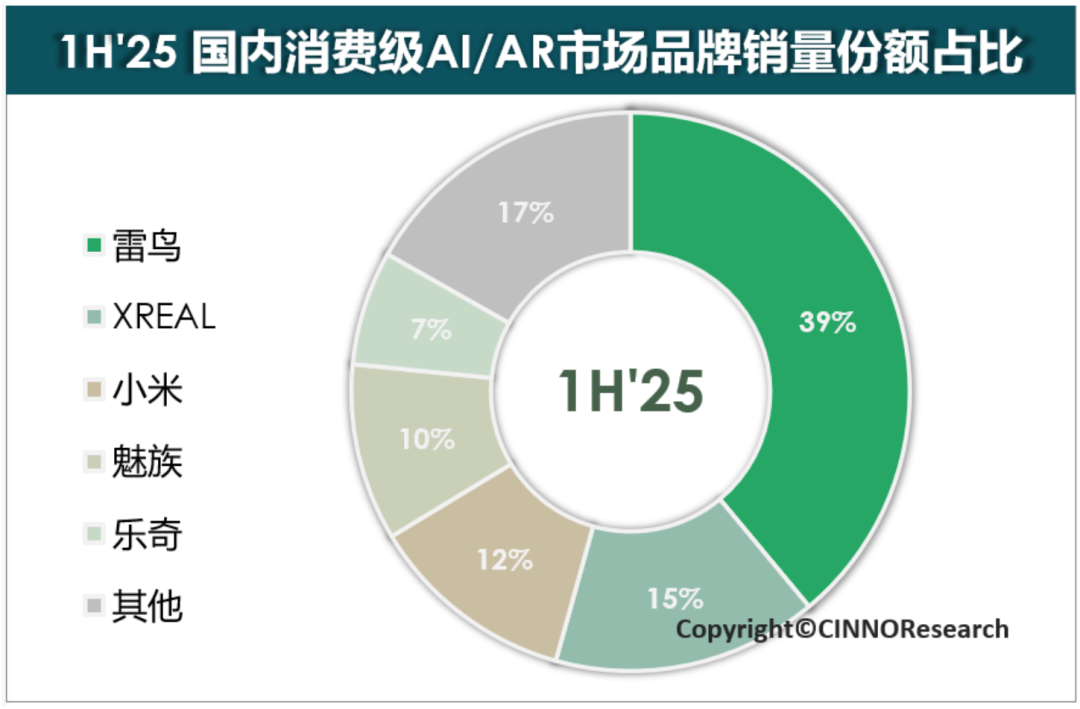
Group 1 - The Chinese consumer-grade AI/AR glasses market experienced explosive growth, with sales reaching 262,000 units in the first half of 2025, a year-on-year increase of 73% [1][2] - The market is driven by government subsidies and the 618 e-commerce promotion, leading to a new wave of product iteration across three major segments: split AR glasses, screen AI glasses, and non-screen AI glasses [2][6] - Non-screen AI glasses led the market with a staggering year-on-year growth of 463%, driven by products like Thunder V3 and Xiaomi AI smart glasses, which integrate AI voice interaction and health monitoring features [2][4] Group 2 - Local brands are diversifying the market, with Thunder leading with a 39% market share and a year-on-year sales increase of 113%, while Xiaomi entered the market with a 12% share, achieving rapid sales growth [4][5] - Thunder's new product launches, including the Air 3S series and X3 Pro AR glasses, have contributed to its strong market position, while Xiaomi's AI glasses achieved 31,000 units sold in the first week [4][5] Group 3 - The dual engines of government policy and e-commerce promotions have significantly boosted the AI/AR market, with consumers benefiting from a 15% subsidy and promotional discounts during the 618 shopping festival [6] - During the core promotional period from May 20 to June 20, sales of AI/AR products across major e-commerce platforms reached 59,000 units, with AR products seeing an increase of over 130% [6] Group 4 - Local brands are focusing on building a content ecosystem to achieve breakthroughs, emphasizing cross-device collaboration, cross-domain applications, and cross-industry cooperation [8] - The integration of AR devices with mobile phones and partnerships with cloud services and content platforms are key strategies for enhancing user experience and expanding market applications [8]


1H’25新品和政策助推,国内消费级AI/AR市场销量同比激增73%,雷鸟第一,小米入局
CINNO Research· 2025-09-04 23:33
Core Viewpoint - The Chinese consumer-grade AI/AR glasses market experienced explosive growth in the first half of 2025, with sales reaching 262,000 units, a year-on-year increase of 73%, driven by policy subsidies, major e-commerce promotions, and innovations from local brands [1][5]. Group 1: Market Growth - The domestic consumer-grade AI/AR market is witnessing a surge, with sales surpassing 262,000 units in the first half of 2025, marking a 73% year-on-year increase [1]. - The market is fueled by national subsidy policies and the 618 e-commerce festival, leading to a new wave of product iterations across three major subcategories [5]. Group 2: Product Segmentation - Split AR glasses achieved a steady growth of 39% year-on-year, supported by new product iterations from leading brands like Thunderbird [2]. - Screened AI glasses (integrated AR) saw a 14% increase in sales, driven by applications in business and cross-language interactions [2]. - Screenless AI glasses led the market with an explosive growth of 463% year-on-year, activating the mass consumer market through features like AI voice interaction and health monitoring [2]. Group 3: Competitive Landscape - Local brands are adopting a "hardware + ecosystem" strategy to capture market share, creating a differentiated competitive landscape [5]. - Thunderbird holds a 39% market share, with a 113% year-on-year sales increase, launching new products at competitive prices [7]. - Xiaomi entered the market strongly, capturing 12% of the overall sales with its AI glasses, which achieved 31,000 units sold in the first week [7]. Group 4: Policy and E-commerce Impact - The introduction of digital product consumption subsidy policies by the National Development and Reform Commission and the Ministry of Finance has been a key driver for market growth, offering consumers a 15% discount [5]. - During the core promotional period from May 20 to June 20, sales of AI/AR products reached 59,000 units across major e-commerce platforms, with AR products seeing an increase of over 130% [5]. Group 5: Future Outlook - CINNO Research predicts that the shipment of AI/AR glasses in China will reach 900,000 units by 2025, representing a 133% year-on-year increase, with the industry expected to exceed a trillion yuan in scale within three years [6]. - Local brands are building content ecosystems through cross-device collaboration, cross-domain applications, and cross-industry partnerships, which are crucial for future growth [6].

舜宇光学转型“汽车+AI”:高增长背后的机会与隐忧
经济观察报· 2025-08-31 11:28
Core Viewpoint - Sunny Optical is at a transformative crossroads, facing both opportunities and unprecedented challenges as it shifts from traditional consumer electronics to emerging markets, particularly in the automotive sector [2]. Financial Performance - In the first half of 2025, Sunny Optical reported revenue of 19.652 billion yuan, a year-on-year increase of 4.2%, and a net profit attributable to shareholders of approximately 1.646 billion yuan, up 52.56% [4]. - The gross profit margin improved to 19.8%, an increase of 2.6 percentage points year-on-year [4]. Business Segment Analysis - The mobile lens business saw a decline, with shipments in June 2025 totaling 95.056 million units, down 3.1% quarter-on-quarter and 12.7% year-on-year [5]. - The automotive business emerged as a new growth engine, with revenue reaching 3.4 billion yuan in the first half of 2025, a year-on-year increase of 18.2% [6]. - The company is focusing on high-end lenses to maintain profit levels, as the smartphone optical market is experiencing a significant downturn [5][6]. Market Trends - The global smartphone shipment growth forecast for 2025 was revised down from 2.3% to 0.6% due to increased smartphone penetration and longer replacement cycles [5]. - The automotive sector is expected to see a rise in camera installations per vehicle, with projections indicating an increase from 1.6 cameras in 2020 to 6 cameras by 2025 [6]. Strategic Partnerships - Sunny Optical is collaborating with GoerTek to develop AI glasses, leveraging each other's strengths in technology and market access [9][10]. - The partnership aims to enhance competitive advantages in micro-nano optical devices, particularly for AI and AR products [9][10]. Future Outlook - The company aims to become one of the top three suppliers of automotive lens modules globally within the next 3 to 5 years, with plans to increase overseas revenue from approximately 10% to 35% [7]. - However, competition in the automotive lens market is intensifying, with rivals accelerating technological advancements [13]. Emerging Business Challenges - The AI/AR industry is still in its early stages, facing technical challenges that could impact user experience and commercialization [12]. - The company has significant capital expenditure plans for 2025, estimated between 2 billion to 3 billion yuan, to support high-end driving component production [14].


光峰科技: 关于公司2025年度“提质增效重回报”行动方案的半年度评估报告
Zheng Quan Zhi Xing· 2025-08-29 14:20
Core Viewpoint - Shenzhen Guangfeng Technology Co., Ltd. is committed to high-quality development and enhancing investor confidence through its 2025 "Quality Improvement and Efficiency Enhancement" action plan, focusing on sustainable growth and capital market image [1] Group 1: Business Strategy and Development - The company focuses on core technologies and applications based on GaN and GaAs semiconductor laser technology, aiming for high-quality development and market leadership in high-margin businesses like cinema and specialized displays [1][2] - The company is actively exploring new applications in AR glasses and robotics, while adjusting its market strategies to avoid ineffective competition in the automotive sector [1][3] - The company has launched a compact AR optical engine at CES 2025, showcasing its commitment to innovation in the AR smart glasses market [2] Group 2: Research and Development - The company emphasizes R&D investment, with a team of 429 researchers, 26.34% of whom hold advanced degrees, to enhance its technological capabilities [5][6] - As of June 30, 2025, the company has filed 3,033 patent applications globally, with 2,372 granted, including 1,233 invention patents, reflecting its strong focus on innovation [6] Group 3: Financial Performance and Shareholder Returns - The company has implemented a stable cash dividend policy, distributing a total of 114.21 million yuan in cash dividends for the 2024 fiscal year, with cumulative dividends since 2019 reaching approximately 333 million yuan [7][8] - The company has conducted multiple share buybacks, totaling 9,440,792 shares since 2022, to enhance shareholder value and market confidence [8] Group 4: Corporate Governance and Investor Relations - The company is committed to improving corporate governance and has held multiple meetings of its audit and strategic committees to ensure compliance and effective decision-making [9] - The company actively engages with investors through various channels, including roadshows and online meetings, to communicate its value and maintain trust [10]

光学领域巨头整合,强强联合加快智能眼镜发展 | 投研报告
Zhong Guo Neng Yuan Wang· 2025-08-26 03:13
Core Viewpoint - Sunyu Optics announced a memorandum of understanding with Goer Group and Goer Optics, involving three companies from the Sunyu system and two from the Goer system, outlining a clear transaction process for equity acquisition [2][3]. Group 1: Partnership Details - The collaboration involves Sunyu Zhejiang Optics, Ningbo Aolai, and Shanghai Aolai from the Sunyu system, and Goer Group and Goer Optics from the Goer system [2][3]. - After the restructuring, Ningbo Aolai will acquire 100% of Shanghai Aolai's equity and subscribe to new shares of Goer Optics, resulting in Ningbo Aolai holding approximately 33.33% of Goer Optics, while Goer Group retains about two-thirds of the shares [2][3]. Group 2: Business Synergy - The partnership between Sunyu and Goer is characterized by complementary business strengths, with Shanghai Aolai having established a complete system from technology research to equipment implementation in the wafer-level micro-nano optics sector [3]. - Goer Optics has accumulated mature technology in optical waveguide components and has strong customer resources in the AI and AR sectors, enhancing the collaboration's market competitiveness [3]. Group 3: Technological Advancements - Silicon carbide (SiC) is emerging as an excellent solution in the AR glasses optical waveguide field, with Meta showcasing its potential in optical-grade refinement [4]. - SiC's application extends beyond optics, with potential uses in clean energy systems, aerospace, electric vehicles, telecommunications, and quantum computing, highlighting its versatility and growing importance in various industries [5]. Group 4: Strategic Collaborations - A strategic cooperation agreement was signed between Sunyu Aolai and Tianyue Advanced Semiconductor Materials, marking a new chapter in the collaboration between leading companies in the micro-nano optics and new materials sectors [6].

光学领域巨头整合,强强联合加快智能眼镜发展
Huaan Securities· 2025-08-25 11:35
Investment Rating - Industry investment rating: Overweight [1] Core Insights - The collaboration between Sunyu Optical and Goer Group aims to accelerate the development of smart glasses, with a clear transaction process outlined in their memorandum of understanding [4] - Sunyu's Shanghai Aolai has established a comprehensive system from technology research and development to equipment implementation, which serves as a solid foundation for mass production of AI/AR hardware components [5] - Goer Optical has accumulated mature technology in the optical waveguide component field and leverages its parent company's resources to connect with leading clients in the AI smart glasses and AR sectors [5] - The integration of Shanghai Aolai's production capacity and equipment into Goer Optical's existing system will enhance market competitiveness and shorten the production ramp-up cycle [5] - Silicon carbide (SiC) is emerging as an excellent solution in the AR glasses optical waveguide field, with applications extending to various sectors including renewable energy, aerospace, electric vehicles, telecommunications, and quantum computing [6] Summary by Sections - **Collaboration Details**: Sunyu and Goer Group have signed a memorandum to collaborate, with Sunyu's Ningbo Aolai acquiring a 33.33% stake in Goer Optical post-restructuring [4] - **Business Synergy**: The partnership is characterized by precise business complementarity, enhancing both companies' positions in the AI/AR industry [5] - **Material Innovation**: SiC's application in optical components is highlighted, showcasing its potential in various high-tech fields [6]


剑指AI/AR领域,歌尔股份、舜宇光学两大果链公司联手
2 1 Shi Ji Jing Ji Bao Dao· 2025-08-25 09:37
Core Viewpoint - The collaboration between GoerTek and Sunny Optical Technology marks a significant move in the AI/AR sector, enhancing their competitive edge in micro-nano optical devices and solidifying their business ties [1][4]. Group 1: Company Overview - GoerTek, a leading acoustic component supplier with a market value exceeding 100 billion RMB, and Sunny Optical, a major optical component manufacturer with a market value over 90 billion HKD, are deepening their partnership through a share acquisition deal [1]. - Sunny Optical's subsidiary, Ningbo Aolai, will exchange its 100% stake in Shanghai Aolai for shares in GoerTek Optical, resulting in Shanghai Aolai becoming a wholly-owned subsidiary of GoerTek Optical [1][3]. Group 2: Strategic Importance - This transaction is expected to enhance GoerTek Optical's core competitiveness in optical waveguides and other micro-nano optical devices, particularly for AI and AR products [1][4]. - The partnership allows both companies to leverage their strengths, with GoerTek gaining access to Shanghai Aolai's existing assets, thereby alleviating financial pressures and accelerating production capabilities [4][8]. Group 3: Market Positioning - GoerTek has made significant investments in the AR/AI field over the past year, acquiring key technologies in lenses, Micro-LEDs, and surface relief diffraction waveguides, reflecting confidence in the rapid development of the AR industry [2][6]. - The collaboration positions GoerTek to achieve self-sufficiency in critical AR components, enhancing its status as a global leader in XR manufacturing [6][8]. Group 4: Product Development - GoerTek Optical is focused on precision optical components and has established itself as a major supplier of VR optical products, with ongoing developments in AR optical modules that emphasize lightweight and high-performance features [7][8]. - The AR optical system, particularly the diffraction waveguide, is identified as a promising technology route, aligning with market demands for improved imaging quality and user experience [7][8].
舜宇光学科技(2382.HK):盈利能力持续优化 龙头地位不断巩固
Ge Long Hui· 2025-08-23 12:00
Core Viewpoint - The company reported a strong performance in H1 2025, with revenue and net profit growth driven by advancements in mobile camera technology and strategic positioning in emerging markets [1][2][3] Group 1: Financial Performance - In H1 2025, the company achieved revenue of 19.652 billion yuan, representing a year-over-year increase of 3.56% [1] - The net profit for the same period was 1.646 billion yuan, showing a significant year-over-year growth of 52.56% [1] - The gross margin was reported at 19.8%, up by 2.6 percentage points year-over-year, while the net profit margin reached 8.8%, an increase of 1.9 percentage points year-over-year [1] Group 2: Mobile and Automotive Lens Market - The company maintained its position as the global leader in mobile camera products, benefiting from the high-endization of smartphone cameras and its advanced technology [1] - In the automotive sector, the company also held the top market share for vehicle-mounted lenses, with successful development of a new de-fogging technology [2] - The company is expanding its product matrix in the automotive module sector through strategic partnerships with major players in the smart driving platform market [2] Group 3: Emerging Markets and Innovations - The rapid growth of the AI/AR glasses market presents significant opportunities for the company's XR-related products, maintaining its leading position in the smart glasses imaging module sector [2] - The demand for optical components and optoelectronic products in the IoT market is increasing, with the company expanding its business in handheld photography devices and robotics [3] - The company is well-positioned to benefit from the ongoing optical innovation cycle, with projected revenues of 43.724 billion yuan, 48.699 billion yuan, and 53.279 billion yuan for 2025-2027 [3]
歌尔股份(002241):盈利能力持续向上 深度受益AI/AR眼镜产业发展
Xin Lang Cai Jing· 2025-08-22 10:35
Core Viewpoint - The company reported its mid-year results for 2025, showing a decline in revenue but an increase in net profit, indicating a mixed performance with potential for future growth driven by new product launches in the AI/AR sector [1][2][3]. Financial Performance - For H1 2025, the company achieved revenue of 37.55 billion yuan, a year-over-year decrease of 7.0%, while net profit attributable to shareholders was 1.42 billion yuan, up 15.7% year-over-year. The non-recurring profit was 380 million yuan, with foreign exchange derivatives contributing approximately 420 million yuan [1]. - In Q2 2025, revenue reached 21.24 billion yuan, reflecting a year-over-year increase of 0.8% and a quarter-over-quarter increase of 30.3%. Net profit attributable to shareholders was 950 million yuan, up 12.1% year-over-year and 102.2% quarter-over-quarter [1]. Product Segments - In H1 2025, revenue from smart hardware, smart acoustic systems, and precision components was 20.34 billion yuan, 8.32 billion yuan, and 7.60 billion yuan, respectively, with year-over-year changes of -2.5%, -34.9%, and +20.5%. Gross margins for these segments were 11.5%, 9.9%, and 23.5%, showing slight improvements [2]. - The decline in revenue from smart acoustic systems was attributed to a transition period between old and new headphone products. The company is focusing on optimizing internal operational efficiency and improving product line efficiencies [2]. Future Growth Potential - The company anticipates revenue and profit growth in H2 2025 and 2026, driven by the launch of multiple new products, including AI/AR glasses and AirPods Pro. The company is positioned to benefit significantly as a core manufacturer for Meta's upcoming eyewear products [2][3]. - The company is enhancing its vertical integration capabilities in the AI/AR sector by acquiring key technologies and companies, such as Plessey, a leading MicroLED manufacturer, which is expected to strengthen its position in the industry [3]. Investment Outlook - Based on the mid-year performance and adjustments for stock incentive expenses, the company has revised its revenue forecasts for 2025-2027 to 103.4 billion yuan, 131.9 billion yuan, and 163.6 billion yuan, with net profits projected at 3.3 billion yuan, 4.3 billion yuan, and 5.5 billion yuan, respectively. The corresponding PE ratios are estimated at 31, 24, and 19 times, maintaining a "buy" rating [3].