
AI科技

Search documents
2月最后一个交易日 沪指“精准”收于本月新高!什么信号?
Mei Ri Jing Ji Xin Wen· 2026-02-27 07:37
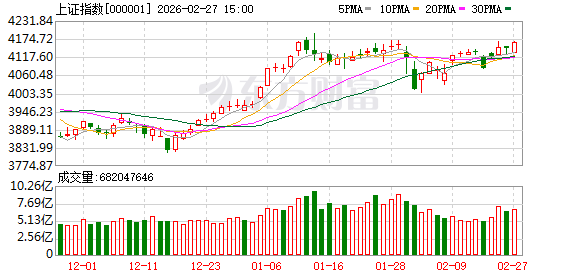
Market Overview - The three major indices showed mixed results, with the Shanghai Composite Index rising by 0.39% and the ChiNext Index falling by 1.04% [2] - Rare metal stocks experienced a surge, while sectors like steel, gas, coal, electricity, and environmental protection saw significant gains. In contrast, cloud computing, AI applications, and computing power leasing were active, while computing hardware, semiconductors, and commercial aerospace stocks adjusted [2] - In February, the Shanghai Composite Index recorded a cumulative increase of 1.09%, showing a "high after narrow fluctuations" trend, achieving three consecutive monthly gains. The Shenzhen Component Index rose by 2.04%, while the ChiNext Index fell by 1.08% [2] Trading Activity - Daily trading volume exceeding 1 trillion yuan has become the norm, with the market remaining active post-Spring Festival, as the Shanghai and Shenzhen stock exchanges recorded over 2 trillion yuan in trading volume for four consecutive trading days [2] - The latest closing point for the Shanghai Composite Index reached 4162.88, marking a new high for the month and the second-highest this year, just below the January 12 high of 4165.29 [2] Key Indicators - The Wind All A and average stock price indices both reached new highs recently, indicating a positive market sentiment [4] - The average stock price for the All A index was reported at 30.43, reflecting a slight increase of 0.37% [6] Future Expectations - The market is anticipated to enter a "Two Sessions market," with expectations of policy shifts and increased capital inflow from foreign and domestic sources, which could bolster the spring market [7] - Analysts suggest focusing on structural opportunities, particularly in AI technology stocks, while also considering defensive allocations and stocks benefiting from "anti-involution" trends [7] Sector Performance - The rare metals sector has shown the largest cumulative gains this week, driven by price increase logic, although it has also experienced fluctuations [9] - The electricity sector has demonstrated a consistent upward trend, providing better feedback for investors compared to other sectors [11] - Recent reports indicate that China's AI usage has surpassed that of the U.S., with implications for electricity and computing power demand, particularly given China's lower electricity costs [12]

启动报名|3/12-13 上海「聚链成势·智启未来」智能终端产业链创新峰会正式官宣
CINNO Research· 2026-02-26 23:07
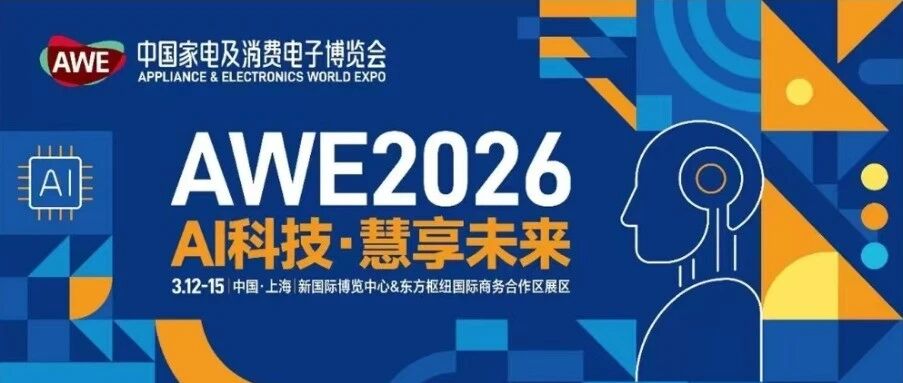
Core Viewpoint - The article emphasizes the profound adjustment in the global industrial landscape, driven by de-globalization and complex geopolitical relationships, presenting both challenges and strategic transformation opportunities for Chinese companies in the smart terminal industry [2]. Group 1: Event Overview - AWE2026, one of the most influential exhibitions in the global home appliance and consumer electronics sector, will be held in Shanghai, adopting a "one exhibition, two zones" model [3][15]. - The total exhibition area for AWE2026 will reach 170,000 square meters, attracting over 1,200 top domestic and international companies to showcase innovations in technology and smart products [15]. Group 2: Summit Focus - The summit will cover the entire smart terminal industry chain, focusing on macro guidance, technology-driven discussions, market foresight, and core supply chain localization processes [4][5][6]. - Key topics include interpreting national industrial development policies, exploring how AI and other cutting-edge technologies reshape the consumer electronics industry, and identifying new growth opportunities in global markets [4][5][6]. Group 3: Exhibition Zones - The Shanghai New International Expo Center will serve as the core exhibition area, focusing on smart home, AI appliances, and health technology, showcasing innovations from over 1,000 domestic and international brands [18]. - The Shanghai Oriental Hub International Business Cooperation Zone will highlight advanced technologies in consumer electronics, including AI smartphones, humanoid robots, and low-altitude economy products [20]. Group 4: Consumer Engagement Activities - AWE2026 will host various consumer engagement activities, including the "AWE Renewal Consumption Festival," which aims to convert innovative results into market consumption momentum, with last year's event driving appliance sales exceeding 2 billion yuan [24]. - The event will also feature live streaming sessions to enhance consumer interaction and showcase new products, with expectations to surpass last year's sales of over 1 billion yuan during the live streaming nights [24]. Group 5: Forums and Discussions - AWE2026 will feature a record number of high-level forums and activities, focusing on topics such as industry upgrades, new consumption trends, and the integration of AI in household services [28][29]. - The event aims to solidify its position as a global benchmark for smart living and foster strong momentum for global technological cooperation and economic development [29].
中国家电及消费电子博览会将于3月12日至15日在沪举办
Zhong Guo Fa Zhan Wang· 2026-02-26 11:01
Group 1 - The AWE (Appliance & Electronics World Expo) will take place from March 12 to 15 in Shanghai, featuring a total exhibition area of 170,000 square meters and 1,200 participating companies, showcasing the latest consumer electronics and innovations [1] - The theme of this year's AWE is "AI Technology, Enjoying the Future," aiming to create a global platform for product launches, technical exchanges, and business negotiations [1] - The newly established Shanghai Oriental Hub International Business Cooperation Zone will facilitate a "one exhibition, dual zones" layout, enhancing the integration of cutting-edge technology displays with everyday life scenarios [3] Group 2 - The Oriental Hub allows for "two-way convenience" for personnel, enabling foreign invited guests to enter the zone without a Chinese visa for up to 30 days, while domestic personnel can easily access the area [2] - In terms of logistics, the hub enables efficient flow of goods, with bonded goods allowed to circulate conveniently and tax exemption policies applicable to construction materials and equipment [2] - The AWE will feature innovative technologies such as humanoid robots capable of performing tasks, emotional companion devices, and AI smart glasses that bridge the virtual and real worlds, showcasing a blend of advanced technology and consumer-friendly products [3][4] Group 3 - Major exhibitors at AWE include leading companies like Haier, Huawei, and Xreal, covering the entire industry chain from smart terminal chips to AI models, creating a global cooperation platform for technology exchange and product sharing [4] - The event is expected to attract numerous leading and high-growth companies from both domestic and international markets, promoting cross-border communication and international cooperation in the global consumer electronics sector [3]

“智气”对联背后,藏着海尔智慧家庭的科技创新
Quan Jing Wang· 2026-02-26 08:14
Core Insights - The article highlights the integration of traditional Chinese New Year customs with modern technology, particularly through the lens of smart home appliances and the concept of a "smart family" [1][2] Group 1: Smart Home Engagement - Haier Smart Home launched a Spring Festival couplet collection activity from January 30 to February 6, engaging numerous participants who shared their experiences with smart home technology [1] - The activity reflects the growing popularity of smart home appliances, with Haier reporting over 130 million cumulative global users and more than 13 million monthly active users, alongside over 100 million connected devices [2] Group 2: Technological Innovations - Haier Smart Home utilizes AI technology to enhance user experiences, such as an AI eye in the kitchen that adjusts stove heat automatically and an AI refrigerator that preserves food freshness [2] - The company leads in the smart home patent landscape, with 4,667 patent applications projected for 2025, maintaining the top position for fourteen consecutive years according to IPRdaily [3]

伍戈:谁开启周期?
Xin Lang Cai Jing· 2026-02-25 15:03
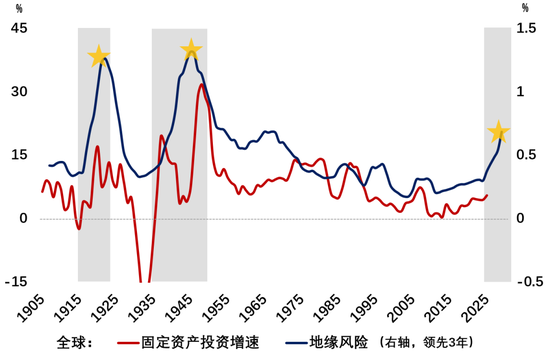
Group 1 - The global manufacturing sentiment index has been on the rise since the beginning of the year, maintaining an expansionary phase for six consecutive months, which fuels market expectations for a new round of capital expenditure cycle [1][2] - Geopolitical risk indicators have significantly increased in recent years, currently second only to the periods of the two World Wars, which historically have led to global capital expenditure and economic cycles [1][2] - The expansion of capital expenditure driven by defense and technology, combined with recent U.S. Supreme Court tariff rulings, is expected to support high levels of world trade [1][6] Group 2 - The absolute demand for commodities, represented by non-ferrous metals, appears to have room for growth despite price fluctuations, with tightening supply-demand balance supporting future price trends [1][9] - The potential for a moderate downward adjustment in economic growth expectations may lead to strong external demand, significantly supporting industrial production and actual GDP in China [1][6] - The current global expansion in technology and defense spending differs from traditional consumer demand, indicating possible discrepancies between macroeconomic readings and microeconomic experiences [1][9]
高端存储芯片制造所必须的核心耗材,公司已进入北方华创、中微公司等厂商核心产业链
摩尔投研精选· 2026-02-25 10:29
Group 1 - The core viewpoint is that the technology sector is expected to regain its dominance after the holiday, as historical trends indicate a high probability of style switching between large and small caps around the Spring Festival [1] - From 2010 to 2025, there were only 2 years out of 16 where growth and value styles did not switch, suggesting that if the market leaned towards large caps before the holiday, it is likely to shift towards small caps afterward [1] - The market style shifted towards value before the Spring Festival, with technology growth styles receding, but with the easing of concerns in AI and robotics, the technology growth style is anticipated to rebound [1] Group 2 - The internal rebalancing within the technology sector indicates that AI technology is moving downstream, transitioning towards the fourth stage of supply-demand gaps [1] - The upstream gaps are identified in copper, storage, and power equipment, while downstream gaps are in AI applications and components [1]

港股科技配置价值凸显,港股科技ETF(513020)近10日净流入超2亿元
Mei Ri Jing Ji Xin Wen· 2026-02-25 02:43
Group 1 - The core viewpoint is that the technology style is expected to make a comeback, particularly after the Spring Festival, with a high probability of a switch from value to growth styles [1] - Historically, the market tends to favor value and large-cap stocks before the Spring Festival, while growth and small-cap stocks gain traction afterward [1] - The stabilization of overseas markets and the resurgence of robots and large models during the Spring Festival are seen as catalysts for the technology growth style [1] Group 2 - The Hong Kong Stock Connect Technology ETF (513020) tracks the Hong Kong Stock Connect Technology Index (931573), which includes core assets in sectors like Internet, innovative pharmaceuticals, and new energy vehicles [1] - The Hong Kong Stock Connect Technology Index has outperformed the Hang Seng Technology Index, with a cumulative return of 224.25% from the end of 2014 to the end of 2025, exceeding the Hang Seng Technology Index's return of 83.87% by over 140% [1] - The index reflects a diversified technology industry characteristic and the overall performance of core technology companies in the Hong Kong market [1]
千问3.5登顶全球最大AI开源社区!港股科技ETF天弘(159128)昨日净申购超8000万份,已实现连续25日“吸金”累超8.4亿元
2 1 Shi Ji Jing Ji Bao Dao· 2026-02-25 01:20
Group 1 - The Hong Kong technology sector experienced a decline, with the National Index of Hong Kong Technology Stocks dropping by 2.47%. Notable stocks included Hua Hong Semiconductor rising over 3%, XPeng Motors increasing over 1%, and BeiGene up by 0.65% [1] - The Tianhong Hong Kong Technology ETF (159128) recorded a total trading volume of 106 million yuan, with a premium/discount rate of 0.69%, and saw a net subscription of over 80 million shares during the day [1] - As of February 13, the Tianhong ETF had a net inflow of 66.55 million yuan, marking 25 consecutive trading days of net inflows, totaling 849 million yuan. The latest circulating shares stood at 2.728 billion, with a total market size of 2.432 billion yuan [1] Group 2 - Hugging Face, the largest global AI open-source community, announced that Alibaba's latest open-source multimodal model, Qianwen 3.5, topped the global rankings. Eight out of the top ten models in the latest Hugging Face list are from Chinese teams, including Alibaba and others [2] - According to Dongfang Securities, there is a strong consensus among investors regarding which Hong Kong stocks to buy, but there is a lack of consensus on potential short-term market risks. The overall strategy for Hong Kong stocks remains a barbell strategy, suggesting a controlled allocation while waiting for more information [2]

中辉有色观点-20260224
Zhong Hui Qi Huo· 2026-02-24 02:55
中辉有色观点 | | | of Real | | --- | --- | --- | | - | 1000 Controller | C | | 品种 | 核心观点 | 主要逻辑 | | --- | --- | --- | | 黄金 | | 国内假日期间事件复杂:美国关税反复、伊朗局势变化,另外日本政府或给资本市 | | ★ | 多单持有 | 场带来潜在动荡。黄金大涨,今日开盘国内市场将补涨。中长期地缘秩序重塑,不 | | | | 确定性持续存在,央行继续买黄金,长期战略配置价值不变。 | | | | 地缘政治局势动荡,带来白银价格在国内春节期间大幅上涨逼近 15%。尽管长期理 | | 白银 | 谨慎追高 | 由仍然存在供需缺口连续 5 年,全球大财政均对白银长期有利。短期国内市场会补 | | ★ | | 涨,短期参与难度大,风险报酬比不合适,关注补涨情绪节奏。 | | | | 美国关税政策反复,伊朗局势多变,黄金再次拉涨。机器人和 AI 科技春晚亮眼,春 | | 铜 | 回调试多 | 节假期消费回暖。随着金三银四消费旺季和国内两会临近,铜整体趋势偏强,建议 | | ★ | | 回调逢低试多,中长期对铜依旧看 ...
主动量化周报:春节特别篇:低起点,大空间,维持乐观-20260223
ZHESHANG SECURITIES· 2026-02-23 13:33
- The report does not contain specific quantitative models or factors, nor does it provide detailed construction processes, formulas, or backtesting results for any quantitative models or factors. The content primarily focuses on market analysis, investment opportunities, and thematic discussions such as AI technology and price increase logic[2][3][10][11][12][13]