
实体经济

Search documents
亮点速览、“干货满满”!这场发布会介绍和解读党的二十届四中全会精神→
Yang Shi Wang· 2025-10-24 05:48
Core Viewpoint - The most significant outcome of the Fourth Plenary Session of the 20th Central Committee is the approval of the "Suggestions on Formulating the 15th Five-Year Plan for National Economic and Social Development" [1][3] Group 1: Overall Framework - The "Suggestions" consist of 15 parts and 61 articles, divided into three main sections: general discussion, specific strategies, and tasks for strengthening centralized leadership [3] - The first section discusses major achievements during the 14th Five-Year Plan and the significance of the 15th Five-Year Plan for economic and social development [3] Group 2: Economic and Social Development Goals - The 15th Five-Year Plan aims to address the historical positioning of China's development and analyze both international and domestic situations to clarify guiding principles and main objectives for economic and social development [5][7] - Emphasis is placed on modernizing agriculture and rural areas, addressing the "three rural issues" as a priority for the entire party's work [7] Group 3: Industrial and Technological Development - The plan prioritizes building a modern industrial system and strengthening the foundation of the real economy, with four key tasks: upgrading traditional industries, nurturing emerging industries, promoting high-quality service development, and constructing a modern infrastructure system [9] - The plan highlights the importance of technological modernization, focusing on original innovation and the integration of technology and industry [11][13] Group 4: Open Economy and Trade - The plan includes a dedicated section on expanding high-level opening-up, emphasizing proactive engagement with international high-standard economic and trade rules [15] - It aims to enhance market access and expand the network of high-standard free trade zones while promoting regional and bilateral trade agreements [15] Group 5: Health and Population Development - The plan underscores the importance of accelerating the construction of a healthy China and promoting high-quality population development, with specific strategies for improving health services and supporting family growth [17]

郑栅洁:未来十年再造一个中国高技术产业,适度超前建设新基建
2 1 Shi Ji Jing Ji Bao Dao· 2025-10-24 05:20
Core Viewpoint - The Fourth Plenary Session of the 20th Central Committee of the Communist Party of China emphasized the importance of building a modern industrial system and strengthening the foundation of the real economy as a strategic task for national development [3]. Group 1: Modern Industrial System - The session highlighted the need to focus on the real economy, advocating for intelligent, green, and integrated development to accelerate the construction of a manufacturing powerhouse, quality powerhouse, aerospace powerhouse, transportation powerhouse, and cyber powerhouse [3]. - The proposal aims to maintain a reasonable proportion of manufacturing and establish a modern industrial system centered on advanced manufacturing [3]. Group 2: Key Tasks - The four key tasks outlined in the proposal are: solid foundation upgrading, innovation nurturing, capacity expansion and quality improvement, and strengthening the foundation and efficiency [4]. Solid Foundation Upgrading - This involves optimizing and upgrading traditional industries, which currently account for about 80% of the value added in manufacturing [4]. - The proposal anticipates a market space of approximately 10 trillion yuan to be created over the next five years, providing significant development momentum and benefits to people's livelihoods [4]. Innovation Nurturing - The focus is on cultivating and expanding emerging and future industries, with the "three new" economy's value added expected to exceed 18% of GDP by 2024 [4]. - Strategic emerging industries such as new energy, new materials, aerospace, and low-altitude economy are to be developed, potentially creating several trillion-yuan markets [4]. - Future industries like quantum technology, biomanufacturing, hydrogen energy, and sixth-generation mobile communication are identified as new growth points for the economy [4]. Capacity Expansion and Quality Improvement - The proposal emphasizes the need for high-quality and efficient development of the service industry, which still has significant room for expansion and improvement [5]. - Actions to enhance the integration of modern services with advanced manufacturing and modern agriculture are proposed to create new economic growth spaces [5]. Strengthening Foundation and Efficiency - The plan includes constructing a modern infrastructure system, leveraging China's existing extensive infrastructure network [5]. - It calls for coordinated planning and moderately advanced construction of new-type infrastructure to enhance connectivity and safety [5].
郑栅洁:中国经济靠实体经济起家,也要靠实体经济走向未来
Nan Fang Du Shi Bao· 2025-10-24 04:03
南都讯 记者潘珊菊 发自北京 10月20日至23日,中国共产党第二十届中央委员会第四次全体会议在北京 召开。全会审议通过了《中共中央关于制定国民经济和社会发展第十五个五年规划的建议》。 二是提升效益。我国固定资产投资年度规模已达到50万亿元,但惠民生、补短板、育动能等任务还很 重,必须把"钱"特别是政府资金更好地用在发展紧要处,花在群众生活上。对此,《建议》提出优化政 府投资结构,提高民生类政府投资比重,统筹用好各类政府投资,加强政府投资全过程管理等举措,将 更好地发挥政府投资的撬动作用,不断增进投资的综合效益。 三是畅通循环。有了统一大市场,才能畅通大循环。我国市场准入负面清单事项已从过去的328项减到 目前的106项,4200多件阻碍要素流动的政策举措得到清理,但还有不少堵点和卡点。对此,《建议》 提出统一市场基础制度规则,破除地方保护和市场分割,规范地方政府经济促进行为,统一市场监管执 法,综合整治"内卷式"竞争等举措,将更加有力有效地破除各种市场障碍,充分释放我国超大规模市场 红利。 强基增效,就是要构建现代化基础设施体系。我国已拥有全球规模最大的高速铁路、高速公路、港口、 邮政快递、电力、宽带等基础 ...
中共中央新闻发布会:将巩固壮大实体经济根基摆在战略任务第一位
Xin Jing Bao· 2025-10-24 02:42
国家发展改革委党组书记、主任郑栅洁表示,中国经济靠实体经济起家,也要靠实体经济走向未来,全 会审议通过《中共中央关于制定国民经济和社会发展第十五个五年规划的建议》,把"建设现代化产业 体系,巩固壮大实体经济根基"摆在战略任务的第一条,部署四方面重点任务,可以从"固本升级、创新 育新、扩容提质、强基增效"来把握。 新京报讯(记者姜慧梓)10月24日,中共中央举行新闻发布会,介绍和解读党的二十届四中全会精神。 ...
四中全会公报,十大信号
HUAXI Securities· 2025-10-24 01:40
Group 1: Economic Strategy and Goals - The emphasis on "historical initiative spirit" reflects a proactive approach to challenges, shifting from "responding to challenges" to "fighting risks and facing challenges" in the 15th Five-Year Plan[1] - The reaffirmation of "economic construction as the center" highlights its critical role in the upcoming five years, maintaining a focus on high-quality development[2] - The goal for 2035 includes achieving a per capita GDP of at least $20,000, implying a need for approximately 4.4% average annual growth over the next decade[3] Group 2: Industrial and Technological Development - The focus on the real economy and maintaining a reasonable proportion of manufacturing is crucial for building a modern industrial system[4] - The plan includes a shift towards advanced manufacturing, with new priorities such as aerospace and transportation, while emphasizing intelligent, green, and integrated development[4] - The call to "seize the high ground in technological development" indicates an increasing commitment to original innovation and key core technology breakthroughs[4] Group 3: Domestic Demand and Consumption - The strategy emphasizes expanding domestic demand, with a primary focus on boosting consumption and effective investment, aligning with previous plans[6] - The meeting indirectly addresses the issue of "involution" by highlighting the need to eliminate barriers to a unified national market[7] Group 4: Financial and Social Considerations - The meeting briefly mentioned real estate, focusing on promoting high-quality development in the sector, with further details expected in the full 15th Five-Year Plan[7] - There is a shift towards improving the income distribution system, indicating a focus on protecting legitimate income and regulating excessive income[7]
保持战略定力,增强必胜信心,“十五五”蓝图令世界瞩目
Huan Qiu Shi Bao· 2025-10-23 23:32
Group 1 - The core message of the article emphasizes the significance of the 15th Five-Year Plan, which aims to achieve high-quality development, enhance technological self-reliance, and deepen reforms during the critical period of socialist modernization [2][3][4] - The meeting highlighted the importance of maintaining a reasonable proportion of the manufacturing industry and building a modern industrial system centered on advanced manufacturing [4][6] - The plan outlines major goals for the next five years, including significant improvements in social civilization, quality of life, and national security [3][5] Group 2 - The focus on technological innovation and self-reliance is seen as a response to increasing global uncertainties and competition, particularly in high-tech sectors like semiconductors and artificial intelligence [6][7] - The plan is expected to contribute to global stability by promoting fair trade, infrastructure cooperation, and climate collaboration, positioning China's development as a model for other developing countries [8][9] - The emphasis on solidifying the foundation of the real economy indicates a shift towards a more practical development focus, which is crucial for job creation and social stability [6][9]
每日债市速递 | 二十届四中全会强调坚决实现全年经济社会发展目标
Wind万得· 2025-10-23 22:40
1. 公开市场操作 央行公告称, 10 月 23 日以固定利率、数量招标方式开展了 2125 亿元 7 天期逆回购操作,操作利率 1.40% ,投标量 2125 亿元,中标量 2125 亿元。 Wind 数据显示,当日 2360 亿元逆回购到期,据此计算,单日净回笼 235 亿元。 财政部 、 央行 10 月 23 日以利率招标方式进行了 2025 年中央国库现金管理商业银行定期存款(十期)招投标,中标总量 1200 亿元,中标利率 1.76% ,起息日 10 月 23 日,到期日 11 月 20 日。 (*数据来源:Wind-央行动态PBOC) 2. 资金面 银行间市场资金面仍维持平稳,存款类机构隔夜回购利率已在 1.31% 附近徘徊数日;匿名点击( X-repo )系统上,隔夜报价还报在 1.30% 。非银机构以 存单及信用债等抵押融入隔夜,报价亦连续多日维持在 1.40%-1.45% 区间。交易员指出,在央行呵护之下,市场流动性预期延续稳定乐观。短期内缴税影 响渐近,并与跨月叠加,资金难免有短暂收敛过程,但整体平衡偏松大局仍难改。 海外方面,最新美国隔夜融资担保利率为 4.23% 。 // 债市综述 / ...

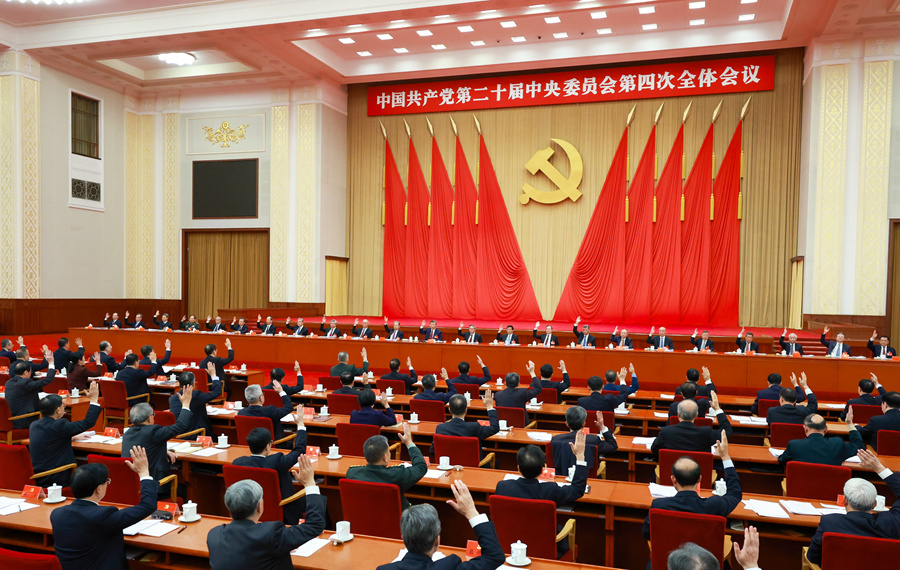
四中全会公报:培育壮大新兴产业和未来产业
Xin Hua She· 2025-10-23 15:37
Core Viewpoint - The Fourth Plenary Session emphasizes the construction of a modern industrial system and the consolidation of the foundation of the real economy, focusing on intelligent, green, and integrated development [1] Group 1: Economic Development Focus - The focus of economic development will be on the real economy, with an emphasis on maintaining a reasonable proportion of manufacturing [1] - The session aims to accelerate the construction of a manufacturing powerhouse, quality powerhouse, aerospace powerhouse, transportation powerhouse, and cyber powerhouse [1] Group 2: Industry Optimization and Growth - There is a commitment to optimizing and upgrading traditional industries while nurturing and expanding emerging and future industries [1] - The development of high-quality and efficient services is also a priority, alongside the construction of a modern infrastructure system [1]
政协委员翟美卿:“十五五”规划为企业发展提供了历史性机遇
Nan Fang Du Shi Bao· 2025-10-23 13:40
Core Insights - The 20th Central Committee's Fourth Plenary Session outlined a development blueprint for the 15th Five-Year Plan, emphasizing the importance of economic and social development in China [1][3] Group 1: Achievements and Confidence - The summary of achievements during the 14th Five-Year Plan period has instilled confidence in businesses, highlighting China's economic resilience and potential amid complex international conditions [3][4] - The session emphasized the need to strengthen the domestic market and accelerate the construction of a new development pattern, focusing on expanding domestic demand and enhancing the interaction between consumption and investment [3][4] Group 2: Strategic Opportunities - The strategic deployment for the 15th Five-Year Plan period presents historical opportunities for businesses, particularly in focusing on the real economy and modern industrial systems [4] - The emphasis on intelligent, green, and integrated industrial directions provides clear guidance for businesses to transform and upgrade, encouraging increased R&D investment and collaboration [4] Group 3: Business Environment and Responsibilities - The session's focus on stimulating the vitality of various business entities and expanding high-level opening-up is expected to improve the business environment, making it more stable, fair, and transparent [4] - Companies are encouraged to align their development with national strategies, promote common prosperity, and engage in green development while fulfilling social responsibilities [4]
