
两新政策

Search documents
前5个月我国新能源汽车新车销量占汽车新车总销量44%
Xin Hua Wang· 2025-08-12 05:50
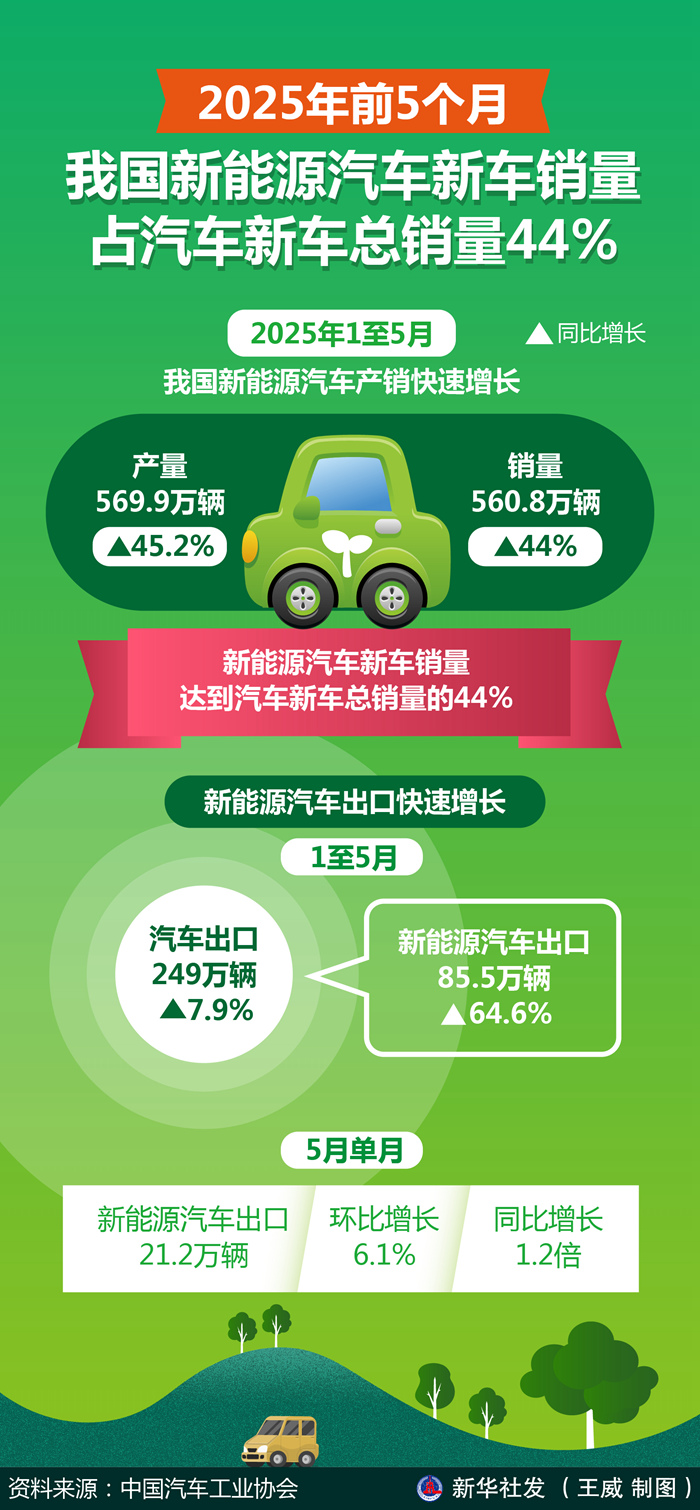
新华社北京6月11日电(记者唐诗凝)记者11日从中国汽车工业协会获悉,2025年1至5月,我国新能源 汽车产销快速增长,分别完成569.9万辆和560.8万辆,同比分别增长45.2%和44%,新能源汽车新车销量 达到汽车新车总销量的44%。 【纠错】 【责任编辑:施歌】 新能源汽车出口快速增长。1至5月,汽车出口249万辆,同比增长7.9%;其中,新能源汽车出口85.5万 辆,同比增长64.6%。5月单月,新能源汽车出口21.2万辆,环比增长6.1%,同比增长1.2倍。 乘用车市场延续良好表现。1至5月,乘用车产销分别完成1108万辆和1099.6万辆,同比分别增长14.1% 和12.6%。 数据显示,1至5月,我国汽车产销分别完成1282.6万辆和1274.8万辆,同比分别增长12.7%和10.9%,产 量增速较前4个月收窄0.2个百分点,销量增速扩大0.1个百分点。 "两新"政策加力扩围,持续显效,叠加汽车企业新品投放等利好因素,助力汽车市场消费活力加速释 放。1至5月,汽车国内销量1025.8万辆,同比增长11.7%。5月单月,汽车国内销量213.5万辆,环比增 长3%,同比增长10.3%。 ...


国家发展改革委:7月将下达今年第三批消费品以旧换新资金
Xin Hua Wang· 2025-08-12 05:49
Group 1 - The National Development and Reform Commission (NDRC) plans to issue the third batch of funds for the consumer goods replacement policy in July, emphasizing a focus on "timeliness" and "balance" in fund allocation [1] - The NDRC has allocated a total of 300 billion yuan in special long-term bonds to support the consumer goods replacement policy, with 162 billion yuan already distributed in the first two batches [1] - Sales of related goods under the replacement policy have exceeded 1.4 trillion yuan this year, indicating a rapid growth in sectors such as home appliances, furniture, and communication equipment [1] Group 2 - The NDRC will enhance the inter-ministerial joint meeting mechanism for the "Two New" policy, focusing on project management, accelerating construction, and strengthening fund supervision [2] - A new loan interest subsidy policy for equipment updates will be introduced to further reduce financing costs for businesses [2]
银行业积极推动“两新”政策落地实施
Jin Rong Shi Bao· 2025-08-12 00:57
Group 1 - Huaxia Electric Power has officially put into operation its new 660,000 kW supercritical reheat steam turbine generator unit, which is part of its capacity replacement project to enhance energy efficiency and reduce emissions [1] - The project is expected to decrease coal consumption by approximately 17%, saving about 139,000 tons of standard coal annually and reducing carbon dioxide emissions by around 361,000 tons [1] - The financing costs for Huaxia Electric Power have been significantly lowered due to policy support, easing the financial burden of equipment upgrades [1] Group 2 - The China Development Bank is actively utilizing the People's Bank of China's re-loan policy to support technological innovation and equipment upgrades for enterprises, facilitating a smoother transition for companies [2] - The re-loan quota has been increased from 500 billion yuan to 800 billion yuan to bolster the "two new" policies, which aim to enhance technological transformation and equipment renewal [2] - Financial institutions are focusing on their core responsibilities to support the "two new" policies, aiming to create a dynamic balance between supply and demand [2] Group 3 - Large-scale equipment updates are crucial for industrial upgrading and stimulating domestic demand, with significant implications for high-end, intelligent, and green production [3] - The Anhui Sanduo Bearing Company is planning to enhance its production capacity for high-end bearings used in robotics and intelligent equipment, supported by a 600 million yuan loan from Agricultural Bank of China [3][4] - The timely financial support from banks is enabling companies to upgrade their production lines and enhance their competitiveness in the international market [4] Group 4 - The banking sector plays a vital role in promoting the "old-for-new" policy, which is essential for stimulating consumer spending and economic growth [5] - Banks are launching various initiatives to support the "old-for-new" policy, including payment discounts and streamlined services, to inject financial vitality into the consumer market [5] - Traffic Bank has introduced special subsidy activities in collaboration with government-designated merchants to promote consumption in high-demand sectors such as home appliances and digital products [5][6] Group 5 - The surge in consumer demand due to the "old-for-new" policy has led to increased sales for many merchants, but also challenges related to cash flow and financing [6] - Traffic Bank has identified the financial needs of merchants participating in national subsidy activities and provided timely credit support to help them capitalize on market opportunities [6] - The bank's loan products are designed to be simple and quick to access, enabling merchants to respond effectively to the fast-paced sales environment driven by national subsidy policies [6]

中国“反向开票”助力“两新”落地,促进循环经济
Zhong Guo Xin Wen Wang· 2025-08-12 00:54
Core Points - The "reverse invoicing" policy has been implemented to support the recycling industry and promote the circular economy in China, with significant positive effects being observed [1][2][3] Group 1: Policy Impact - As of June 30, 2023, 13,300 resource recovery companies issued reverse invoices amounting to 515.2 billion RMB, benefiting 1.67 million individuals [1] - The policy addresses the long-standing issue of "missing source invoices" in the recycling industry, facilitating smoother operations for resource recovery companies [2][3] - The implementation of the policy has led to a significant increase in the volume of recycled materials, with a reported 65% year-on-year increase in the recovery of scrapped vehicles [4] Group 2: Company Experiences - A scrapped vehicle recycling company reported issuing reverse invoices to over 4,000 individuals, with an invoicing amount nearing 8 million RMB, and expects a 100% increase in scrapped vehicle processing this year [2] - A construction waste processing company noted a 58% year-on-year increase in sales of recycled materials, enhancing the resource utilization rate and promoting collaboration across the supply chain [3] - A company specializing in the recycling of old appliances achieved a 98% utilization rate of recyclable materials, with reduced financial costs allowing for investment in deeper resource processing [3] Group 3: Industry Growth - The recycling system in China is becoming increasingly robust, with significant growth in various sectors, including a 25% increase in the recovery of old household appliances [4] - The recycling of discarded electrical and electronic products has seen a leading industry growth rate of 70% year-on-year [4]
助力“两新”政策落地,截至6月底 1.33万户资源回收企业实现“反向开票”
Ren Min Ri Bao· 2025-08-11 21:42
Core Insights - The latest statistics from the National Taxation Administration indicate that as of the end of June this year, 13,300 resource recovery enterprises issued reverse invoices to 1.67 million individuals, with a total invoicing amount of 515.2 billion yuan and 5.11 million invoices issued [1] Group 1: Policy Impact - Starting from April 29, 2024, the tax authorities will implement a "reverse invoicing" policy in the resource recovery industry to facilitate the acquisition of invoices when purchasing scrapped products from individuals, supporting a new round of large-scale equipment updates and the replacement of consumer goods [1] - The "reverse invoicing" policy has positively contributed to the implementation of the "two new" policies, standardizing industry order, and promoting the development of the circular economy over the past year [1] Group 2: Industry Performance - Under the guidance of policy and market forces, the waste recovery, dismantling, and recycling industry chain has improved significantly [1] - In the first four months of this year, the domestic recovery volume of scrapped automobiles reached 2.767 million units, a year-on-year increase of 65% [1] - The number of standardized dismantled old household appliances exceeded 7 million units, reflecting a year-on-year growth of 25% [1] - The recovery volume of discarded electrical and electronic products led the industry with a year-on-year growth rate of 70% [1]
国家税务总局最新数据显示 资源回收企业“反向开票”金额超5000亿元
Zhong Guo Zheng Quan Bao· 2025-08-11 21:13
Group 1 - The "reverse invoicing" policy has effectively addressed the long-standing issue of "source invoice shortage" in the resource recovery industry, facilitating smoother transactions for companies [2][3] - Companies like Wuhu Chery Resource Technology Co., Ltd. have reported significant reductions in financial costs due to the ability to issue invoices directly to individuals, with an expected increase in vehicle dismantling volume by over 100% this year [2][3] - The policy has encouraged more enterprises and individuals to participate in the recycling of waste materials, supporting the implementation of the "two new" policies [2][3] Group 2 - Awareness of compliance among individuals and enterprises in the resource recovery industry has increased since the implementation of the "reverse invoicing" policy [3] - Tax authorities have intensified policy promotion efforts, leading to improved understanding and acceptance of the invoicing process among natural persons selling waste [3] - The number of individuals transitioning to individual businesses and obtaining tax registrations has increased significantly, with over 150 individuals in a specific city registering as individual businesses since the policy's implementation [3] Group 3 - The "reverse invoicing" policy has supported the resource utilization and harmless treatment of waste materials, with companies like Guangxi Guiwu Recycling Resource Co., Ltd. issuing over 56 million yuan in invoices since the policy's implementation [4] - The financial savings from streamlined invoicing processes are being reinvested into resource deep processing, with a utilization rate of over 98% for recyclable materials [5] - The domestic scrap vehicle recovery volume reached 2.767 million units in the first four months of this year, a year-on-year increase of 65%, while the number of properly dismantled waste appliances exceeded 7 million units, up 25% [5]
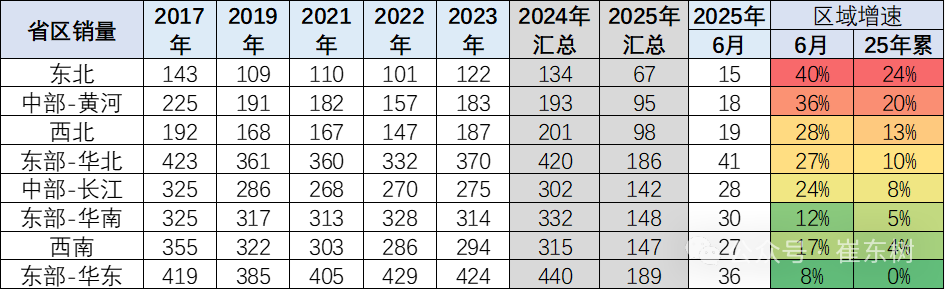
崔东树:两新政策促进下国内车市强势增长 北强南弱特征明显
智通财经网· 2025-08-11 12:40
Core Viewpoint - The Chinese passenger car market is expected to see a retail growth of 11% year-on-year by 2025, driven by favorable national policies and a strong performance in the northern regions, while the southern regions show weaker growth [1]. Group 1: Regional Market Trends - The northern car market is showing significant strength, with a 3.3 percentage point increase in market share in June 2025 compared to the previous year, and a 5.7 percentage point increase compared to 2019 [2][3]. - The Northeast region has been steadily growing, maintaining a high market share of 7% in June 2025, while the southern regions, particularly East China, have experienced significant declines [1][4]. - The overall market growth is characterized by a "north strong, south weak" pattern, with the Northeast and Northwest regions being the fastest-growing areas in China [2][3]. Group 2: Policy Impact and Market Structure - Subsidy policies are encouraging the growth of mid-to-low-end economic vehicles, with A00 and A0 level electric vehicles performing well in the northern regions [1][4]. - The shift towards new energy vehicles (NEVs) is accelerating in northern provinces, with plug-in hybrid models gaining traction due to their advantages in colder climates [1][4]. - The market structure is evolving, with SUVs showing strong demand in the central and western regions, while traditional fuel vehicles still dominate in these areas [7][9]. Group 3: New Energy Vehicle Market - The new energy vehicle market is performing well, particularly in pure electric and plug-in hybrid segments, with traditional fuel vehicles still holding a significant share of around 60% in the central and western regions [9][10]. - Regions like Hainan and Tianjin have seen new energy vehicle penetration rates reach approximately 60%, indicating robust growth [10][11]. - The overall structure of the passenger car market is shifting, with economic vehicles benefiting the most from government subsidies, reflecting a fair and equitable policy approach [11][12].
(经济观察)中国“反向开票”助力“两新”落地 促进循环经济
Zhong Guo Xin Wen Wang· 2025-08-11 11:22
Group 1 - The "reverse invoicing" policy has been implemented to support the recycling industry, allowing resource recovery companies to issue invoices to individuals selling scrap products, effectively addressing the long-standing issue of "missing source invoices" in the industry [1][2] - As of June 30, 2023, 13,300 resource recovery companies issued invoices amounting to 515.2 billion yuan, with 5.11 million invoices issued, demonstrating the policy's positive impact on the circular economy [1] - The policy encourages more enterprises and individuals to participate in waste recycling, supporting the implementation of the "Two New" policies and promoting the development of the circular economy [2][3] Group 2 - A scrap vehicle recycling company reported a significant increase in its operations, with an expected processing volume of 20,000 vehicles this year, representing over 100% growth, attributed to the "reverse invoicing" policy [2] - The policy has led to a 58% year-on-year increase in the sales of recycled construction waste materials, enhancing the resource utilization rate and fostering collaboration across the supply chain [3] - In the first four months of the year, the domestic scrap vehicle recovery volume reached 2.767 million units, a 65% year-on-year increase, while the recovery of discarded household appliances and electronic products also saw significant growth [4]
国家税务总局:截至6月底“反向开票”政策开票金额5152亿元,有力支持“两新”政策落地
Sou Hu Cai Jing· 2025-08-11 10:25
Core Insights - The latest statistics from the National Taxation Administration show that as of June 30, 2023, there are 13,300 resource recovery enterprises issuing "reverse invoices" to 1.67 million individuals, with a total invoicing amount of 515.2 billion yuan and 5.11 million invoices issued [1] Group 1: Policy Impact - The "reverse invoicing" policy will be implemented in the resource recovery industry starting April 2024 to facilitate the acquisition of invoices when purchasing scrapped products from individuals [1] - The promotion of the "reverse invoicing" policy effectively addresses the long-standing issue of resource recovery enterprises lacking the "first invoice," which has hindered their ability to deduct VAT input tax and obtain corporate income tax deductions [1] Group 2: Industry Growth - The resource recovery system in China is becoming increasingly robust, driven by policy guidance and market forces, which is enhancing the recycling, dismantling, and reuse industry chain [1] - In the first four months of this year, the domestic scrapped vehicle recovery volume reached 2.767 million units, a year-on-year increase of 65% [1] - The number of standardized dismantled old household appliances exceeded 7 million units, reflecting a 25% growth [1] - The recovery volume of discarded electrical and electronic products led the industry with a year-on-year growth rate of 70% [1]
“两新”政策如何再加力?
Zhong Guo Chan Ye Jing Ji Xin Xi Wang· 2025-08-11 00:28
Core Viewpoint - The "Two New" policy is being enhanced to further stimulate investment and consumption, with a focus on equipment updates and consumer goods replacement programs [1][6]. Group 1: Investment Growth - The market scale for equipment updates is projected to exceed 5 trillion yuan annually as many existing assets reach their end-of-life [2]. - In 2024, 150 billion yuan of special long-term bonds will support over 4,600 projects across 12 sectors, including industrial and environmental infrastructure [2]. - By 2025, the funding for equipment updates will increase to 200 billion yuan, expanding support to additional sectors such as electronic information and agricultural facilities [2]. Group 2: Equipment Update Impact - The total number of equipment updates in key sectors is expected to surpass 20 million units in 2024, with significant year-on-year growth in related manufacturing sectors [3]. - Industries such as medical equipment and general parts manufacturing have seen profit increases of 12.1% and 9.5% respectively, indicating a positive impact from the equipment update policies [3]. Group 3: Consumer Activation - There is substantial potential for consumer goods replacement, with over 7 million passenger cars and 180 million household appliances exceeding their safe usage period [4]. - In 2024, 150 billion yuan will be allocated to support the replacement of old consumer goods, with the funding increasing to 300 billion yuan in 2025 [4]. - The sales generated from consumer goods replacement programs are projected to exceed 1.3 trillion yuan in 2024 and 1.6 trillion yuan by mid-2025 [4]. Group 4: Policy Implementation and Support - The government is committed to ensuring the effective use of special long-term bond funds, with 690 billion yuan allocated for consumer goods replacement already distributed [7]. - There is a focus on enhancing the efficiency of project implementation and fund allocation to ensure a smooth execution of the "Two New" policies [7]. - The government aims to create a long-term mechanism for updates and replacements, emphasizing strict supervision and risk management [8].