生成式人工智能

Search documents
英矽智能(03696) - 全球发售
2025-12-17 22:22
英矽智能 InSilico Medicine Cayman TopCo (於開曼群島註冊成立的有限公司) 股份代號:3696 全球發售 聯席保薦人 整體協調人、聯席全球協調人、聯席䵷簿管理人及聯席牽頭經辦人 聯席全球協調人、聯席䵷簿管理人及聯席牽頭經辦人 聯席䵷簿管理人及聯席牽頭經辦人 英矽智能 InSilico Medicine Cayman TopCo 重要提示 重要提示: 閣下如對本招股章程的任何內容有任何疑問,應諮詢獨立專業意見。 整體協調人、聯席全球協調人、聯席賬簿管理人及聯席牽頭經辦人 INSILICO MEDICINE InSilico Medicine Cayman TopCo 英矽智能 (於開曼群島註冊成立的有限公司) 全球發售 | 全球發售項下的發售股份數目 | : | 94,690,500股發售股份(視乎超額配股權行使 | | --- | --- | --- | | | | 與否而定) | | 香港發售股份數目 | : | 9,469,500股發售股份(可予重新分配) | | 國際發售股份數目 | : | 85,221,000股發售股份(可予重新分配及視乎 | | | | 超額配股權行使 ...
大山深处,数据标注员越来越多
Ren Min Ri Bao· 2025-12-17 22:11
Core Insights - The article highlights the emergence of data annotation as a new profession for young people in Guizhou, driven by the increasing demand for high-quality datasets due to the advancement of generative artificial intelligence and the marketization of data elements [1] Group 1: Industry Development - Guizhou has seen the establishment of multiple data annotation bases in mountainous counties, creating job opportunities for local youth [1] - By 2025, Guizhou plans to implement incentive policies for data annotation companies, offering rewards for reaching specific employment and revenue milestones, with the highest reward being 10 million yuan [1] - The Baiyun District has developed over 80,000 square meters of industrial space dedicated to data, with plans to create several data annotation bases that are expected to generate employment for over 5,000 individuals [1] Group 2: Talent and Education - Talent is identified as a key factor for sustaining the large-scale industrial layout, prompting Baiyun District to establish close ties with local universities that offer big data programs [1] - Companies are providing practical opportunities and career development platforms for students specializing in data-related fields [1]
企业聊天机器人“失控”乱象
Xin Lang Cai Jing· 2025-12-17 12:26
Group 1 - The article discusses the integration of generative AI into chatbots by companies like IBM and Salesforce, enhancing their capabilities beyond fixed responses [2][7] - There are concerns regarding the inability of some technology providers to control these AI chatbots, leading to inappropriate responses on unrelated topics [2][7] - A notable incident involved Sierra, a startup valued at $10 billion, which apologized for its chatbot discussing inappropriate subjects such as adult products and Nazi Germany [2][7] Group 2 - Glean's chatbot suggested purchasing 2 to 3 bottles of vodka for a party of about 20 people and provided medical and legal advice for potential injuries at the event [3][8] - AutoRabit's chatbot irresponsibly advised on the use of psilocybin mushrooms, indicating a lack of proper content filtering [3][8] - OpenTable's chatbot was more restrained, generally refusing to answer unrelated questions, but still provided a response about tequila for a party scenario [3][9] Group 3 - Microsoft's Cortana has a user base of approximately 100 million monthly active users, significantly lower than ChatGPT's 800 million [4][10] - A new partnership with LG Electronics aims to integrate Cortana into millions of television sets, although some users are frustrated that the app cannot be uninstalled [5][10] - LG promotes this feature as a convenient program search tool, but user dissatisfaction may impact the success of this collaboration [5][10]




英国银行业智能体竞赛加剧,监管机构面临新风险
Xin Lang Cai Jing· 2025-12-17 08:48
英国金融监管机构表示,各大银行竞相采用具备决策与自主执行能力的智能体人工智能(agentic AI),这给零售客户带来了新的风险。该监管机构承诺,将确保零售客户的利益不会被忽视。 人工智能 "智能体" 有望彻底改变人们的预算规划、储蓄和投资方式。例如,它可自动将闲置资金转入 高收益账户,或根据市场波动调整投资组合。 英国国民西敏寺银行(NatWest)、劳埃德银行(Lloyds)以及星展银行(Starling)向路透社透露,它 们正与英国金融行为监管局(FCA)协作,筹备面向零售客户的试点项目。这与银行业此前仅将人工智 能用于后台办公的模式相比,是一次重大转变。 2026 年正式推向市场 英国金融行为监管局首席数据官杰西卡・鲁苏预计,面向消费者的智能体人工智能应用最早将于明年初 正式大规模投放市场。 鲁苏在接受路透社采访时表示:"所有人都意识到,智能体人工智能带来了新的风险,这主要源于其高 速执行任务的能力。" 人工智能智能体的自主性及其与其他智能体交互的速度,放大了金融稳定和治理层面的相关风险。 鲁苏指出,英国金融行为监管局将实施高级管理人员制度及消费者权益保护准则,要求企业负责人对违 规行为承担责任,并确 ...
商界领袖认同人工智能是未来,但盼其当下就能派上用场
Xin Lang Cai Jing· 2025-12-16 11:55
Core Insights - The article discusses the challenges and limitations faced by companies in effectively implementing generative AI technologies, despite the initial hype and expectations surrounding them [1][2][14]. Group 1: AI Implementation Challenges - A survey by Forrester Research revealed that only 15% of executives reported AI improving profit margins in the past year, while only 5% believed AI provided widespread value to businesses [14]. - Companies are reassessing the speed at which generative AI can be effectively integrated into their operations, with predictions that about 25% of AI budgets will be delayed until 2026 [2][14]. - The tendency of AI models to cater to user preferences, known as "flattery bias," can undermine their ability to provide quality recommendations, as seen in the case of CellarTracker's wine recommendation feature [3][16]. Group 2: Human-AI Interaction - Companies like Klarna and Verizon are finding that while AI can handle simple tasks, complex customer interactions still require human involvement, with a significant percentage of consumers preferring to interact with human agents [19][20]. - AI's lack of empathy is identified as a key barrier to fully integrating AI into customer service roles, as customers often seek human interaction for more nuanced issues [22]. Group 3: Investment and Market Outlook - OpenAI's CEO indicated that the market for enterprise AI systems could reach $100 billion, highlighting the ongoing investment interest in AI technologies across various sectors [2][14]. - Experts warn that the current wave of investment in AI infrastructure could lead to a crisis similar to the early 2000s internet bubble if companies fail to find effective ways to leverage AI for revenue growth and innovation [15]. Group 4: AI Development and Support - Companies are increasingly focusing on developing tailored AI solutions for specific industries, as opposed to generic models, to create greater value [26]. - OpenAI is working on new products and support teams to help businesses effectively implement AI technologies, emphasizing the need for practical guidance in transforming AI tools into productive assets [26][12].
两大金融领域论坛同日在沪召开 探讨科技金融体系构建与绿色金融实践路径
Zheng Quan Shi Bao Wang· 2025-12-15 06:21
Group 1: Technology and Financial Integration - The "14th Five-Year Plan" period is crucial for achieving socialist modernization, requiring the consolidation of advantages and breaking through bottlenecks to gain strategic advantages in international competition [2] - The construction of a technology finance system is essential for efficient resource allocation and the transformation of technological achievements into productive forces [2] - Financial institutions need to build a multi-tiered technology finance market and enhance risk management innovation to support early-stage technology enterprises [2][3] Group 2: Trends in Technology Finance - Technology finance is shifting from merely supporting services to strategic leadership, with a focus on top-level design and institutional supply [3] - The emergence of disruptive technologies is pushing the boundaries of technology finance, necessitating a shift from resource-driven to quality-driven services [3] - Commercial banks are evolving from traditional fund providers to comprehensive service partners throughout the enterprise lifecycle [3] Group 3: Green Finance Development - The Fourth Green Finance Forum emphasized the need to transition green finance from policy-driven to market-driven approaches, focusing on carbon market mechanisms [5] - The development of carbon assets and the enhancement of carbon market vitality through financing and trading tools are critical for sustainable growth [6] - The demand for green low-carbon investment in China over the next 30 years is projected to reach 487 trillion yuan, indicating significant investment opportunities [6] Group 4: Industry Practices and Innovations - Various enterprises showcased their achievements in green technology innovation, reflecting their commitment to national green development strategies [7] - The Green Finance Forum has evolved into a significant annual event, addressing pressing issues in green finance and aligning with national strategies since its inception in 2022 [7]
推进人智协同 培养新质人才(师说)
Ren Min Ri Bao· 2025-12-13 22:19
Group 1 - Generative artificial intelligence is a key driver of a new technological revolution and is essential for integrating AI deeply into education, which is crucial for building a strong education system and enhancing international competitiveness [1][3] - The integration of generative AI into higher education revitalizes the sector and provides new solutions to educational challenges, transforming the teaching model from "teacher-student" to "teacher-student-machine" and then to "teacher-student-intelligence" [1][2] - Generative AI helps to alleviate the conflict between standardized supply and personalized demand in education by creating interdisciplinary inquiry projects and facilitating intelligent question-answering, lesson preparation, summarization, and grading across the entire educational process [1][2] Group 2 - Generative AI plays a significant role in enhancing the supply of high-caliber innovative talent by creating immersive learning environments and personalized growth paths, which help to address issues of underutilized talent potential [2] - The technology aids in bridging educational gaps across regions and institutions by sharing AI dual-teacher classrooms and intelligent teaching resources, thus addressing the uneven distribution of talent [2] - In scientific research, there is a need to strengthen the development of large models across multiple modalities and tasks, accelerating the pace of AI-driven research and fostering new industries through the integration of AI with traditional sectors [2][3]
上海交大高金严弘:多维深耕可持续发展领域 以研究、实践与交流助力ESG生态构建
Xin Lang Cai Jing· 2025-12-12 14:13
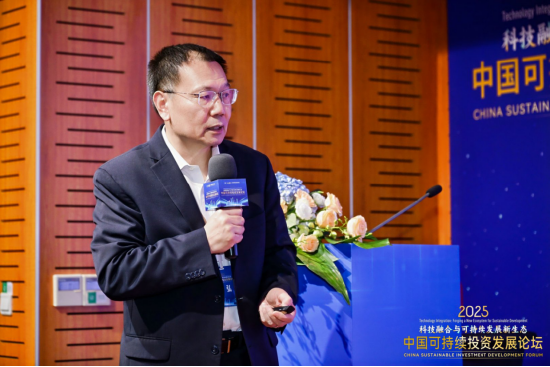
专题:2025中国可持续投资发展论坛 12月12日金融一线消息,2025中国可持续投资发展论坛今日召开,本次论坛的主题为"科技融合与可持 续发展新生态"。上海交通大学上海高级金融学院副院长、金融学讲席教授、可持续投资研究中心主任 严弘出席论坛并介绍了高金可持续投资研究中心最近一年的研究成果。 2025年中心应时代和行业之需开展了多项重大课题研究,完成了包括《2025上海ESG发展报告》《上海 市涉外企业ESG发展报告》《中国多层次REITsESG实践标准的设计和推广》在内的多项前沿课题,还 有一批专项研究正在紧锣密鼓推进中,如《沪滇协作框架下生物多样性保护机制研究》《生成式人工智 能如何影响企业估值:劳动力重塑的关键作用》等。中心聚焦金融赋能产业低碳转型、绿色价值创造等 议题举办多层次交流活动,以多渠道汇集国内外顶层智慧,探索引导资本投入可持续发展目标的最佳路 径与模式。 严弘表示,中心仍有多项在研项目持续推进,未来将继续深耕可持续发展领域,通过研究、实践与交流 的多元发力,为构建ESG良好生态、推动绿色高质量发展贡献力量。 责任编辑:曹睿潼 专题:2025中国可持续投资发展论坛 12月12日金融一线消息,2 ...
英矽智能与太景达成管线授权合作,助力AI驱动的PHD抑制剂开发和商业化,用于慢性肾病(CKD)贫血治疗
智通财经网· 2025-12-12 06:49
Core Insights - Insilico Medicine and TaiGen Biopharmaceuticals have entered into an exclusive licensing agreement for the PHD inhibitor ISM4808, aimed at treating anemia associated with chronic kidney disease (CKD) in Greater China [1][3]. Group 1: Partnership Details - TaiGen will receive exclusive rights for the development, commercialization, and sublicensing of ISM4808 in Greater China, while Insilico Medicine will receive upfront payments, milestone payments based on development and sales, and tiered royalties based on net sales, with the total transaction amount reaching tens of millions of dollars [3]. - The partnership is expected to leverage Insilico's AI-driven drug discovery capabilities, which have demonstrated efficiency in identifying new drug candidates [4]. Group 2: Product Information - ISM4808 is recognized as a candidate drug for PHD inhibition, targeting the HIF-α pathway, which has been awarded a Nobel Prize, and aims to induce EPO production and improve iron utilization to enhance red blood cell regeneration [3]. - The drug has shown strong efficacy in preclinical studies, with a lower effective dose validated in chronic kidney disease rat models, and has received clinical trial approval from China's CDE in 2023 [4]. Group 3: Market Potential - The market for PHD inhibitors is experiencing rapid growth, with the market size in mainland China increasing from 50 million RMB to 2.45 billion RMB over five years, indicating a significant demand for oral medications that replace traditional injectable therapies [4].
GPT-5.2发布;摩尔线程提示风险并预估业绩丨科技风向标
2 1 Shi Ji Jing Ji Bao Dao· 2025-12-12 02:32
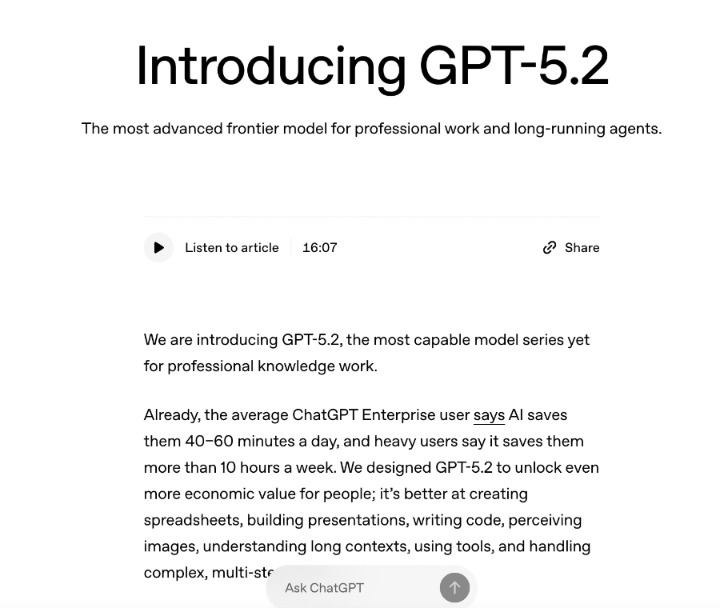
Group 1: Technology Developments - OpenAI has released the latest version of its AI model, GPT-5.2, which aims to enhance economic value by excelling in tasks such as spreadsheet creation, presentation making, code writing, image recognition, long text understanding, tool usage, and managing complex multi-step projects, outperforming industry professionals in 44 specific knowledge work tasks [2] - DingTalk has launched version 8.1.10, introducing AI-powered features such as AI Q&A and AI dynamic reply suggestions, enhancing user interaction [5] - QQ has implemented an AI summary feature for group chats, allowing users to quickly grasp key messages without scrolling through extensive chat histories [7] Group 2: Corporate Announcements - Elon Musk hinted at a potential IPO for SpaceX, indicating the company's financial health with consistent positive cash flow and regular stock buybacks [4] - JD Group announced the listing of JD Industrial on the Hong Kong Stock Exchange, with shares starting trading at 14.1 HKD [13] - ZTE Corporation's stock fell approximately 2% following news of an investigation related to compliance with the U.S. Foreign Corrupt Practices Act, although the company maintains that its operations are normal [10] Group 3: Strategic Partnerships and Initiatives - Guangdong Province and JD Group have established the first "Modern Rider Academy" in China, focusing on vocational training for delivery personnel, aiming to cover over 100,000 full-time riders in the region within three years [9] - Huawei has announced the beta launch of its HarmonyOS for computers, with the ecosystem expanding from around 2,000 applications to 12,000, indicating significant growth in its application coverage [8] Group 4: Mergers and Acquisitions - Chuangyuan Xinke plans to acquire 100% of Weiyu Tiandao for 886 million CNY, focusing on satellite navigation testing technology [17] - Whirlpool intends to purchase assets related to washing machines from its controlling shareholder, Gree Electric Appliances, to eliminate competition concerns [16] - Blue Shield Optoelectronics has decided to terminate a planned acquisition of shares in Shanghai Star Thinking Semiconductor for 80 million CNY, citing the need to control investments and protect shareholder interests [15]