
反垄断

Search documents
传对冲基金Standard General正洽购华纳兄弟探索(WBD.US)旗下电视资产 CNN成交易“分水岭”?
智通财经网· 2025-12-18 11:09
Group 1 - Standard General is negotiating to acquire or invest in Warner Bros. Discovery's television assets, including CNN, as proposed by a major shareholder [1] - Trump has expressed that any acquisition of Warner Bros. Discovery must include CNN, criticizing the network and suggesting it should be run by more Republican-friendly individuals [1][2] - Paramount Global has made a hostile bid of $108 billion for Warner Bros. Discovery, claiming their offer is more attractive to shareholders compared to Netflix's proposal [4][5] Group 2 - Netflix announced a deal valued at $82.7 billion to acquire Warner Bros. Discovery's film and television production units, excluding television assets like CNN [3] - Warner Bros. Discovery's cable network revenue has declined by 23% in the last quarter due to subscriber cancellations and loss of advertisers [3] - Warner Bros. Discovery's board has recommended shareholders reject Paramount's offer, citing concerns over financing and potential risks associated with the deal [5] Group 3 - Both Netflix and Paramount's acquisition proposals face legal scrutiny regarding potential antitrust issues, raising concerns about consumer impact [2][3] - Netflix's executives have assured that the acquisition will not lead to layoffs or studio closures, emphasizing growth and support for the film and television production industry [4] - The merger of Netflix and Warner Bros. Discovery is projected to have a lower audience share than potential mergers involving Paramount, alleviating some antitrust concerns [4]


近三年市场监管反垄断执法罚没29.3亿元
Chang Jiang Shang Bao· 2025-12-18 07:58
长江商报奔腾新闻记者 李璟 反垄断执法是维护公平竞争、保障民生权益的重要手段。 数据显示,近三年来,市场监管总局共查处垄断协议案件35起、滥用市场支配地位案件25起,罚没 款总计29.3亿元,切实保障消费者权益,维护公平竞争市场秩序。审结民生领域经营者集中案件950 起,支持企业通过并购提升经营效率。办结滥用行政权力排除、限制竞争案件148起,纠治地方保护和 市场分割等妨碍公平竞争市场秩序问题。 12月17日,国家市场监管总局召开民生领域反垄断执法专项行动成果宣介专题新闻发布会,介绍民 生领域反垄断执法专项行动开展三年来的工作进展和主要成效。 会上披露,近年来,市场监管总局聚焦人民群众反映强烈的垄断问题,查处了一批典型案件,惩戒 了一批违法主体,维护了群众切身利益,以"执法力度"提升人民群众幸福指数。 从监管实践看,平台经济领域垄断风险较为突出,平台企业反垄断合规意识和能力有待提升,在此 背景下,市场监管总局研究制定《互联网平台反垄断合规指引》,提出了8个新型垄断风险,目的是引 导平台企业加强风险识别、风险管理和合规保障,有效防范反垄断合规风险,促进平台经济创新和健康 发展。 市场监管总局相关负责人表示,平台 ...
越秀证券每日晨报-20251218
越秀证券· 2025-12-18 06:57
Market Performance - The Hang Seng Index closed at 25,468, up 0.92% year-to-date (YTD) increase of 26.96% [1] - The Hang Seng Technology Index closed at 5,457, up 1.03% with a YTD increase of 22.15% [1] - The CSI 300 Index closed at 4,579, up 1.83% with a YTD increase of 16.39% [1] - The Shanghai Composite Index closed at 3,870, up 1.19% with a YTD increase of 15.47% [1] - The Shenzhen Component Index closed at 13,224, up 2.40% with a YTD increase of 26.98% [1] Currency and Commodity Performance - The Brent crude oil price is at $60.16 per barrel, down 5.66% over the last month and down 15.73% over the last six months [2] - Gold price is at $4,320.56 per ounce, up 6.82% over the last month and up 27.53% over the last six months [2] - The Chinese Yuan Index is at 97.710, down 0.26% over the last month but up 2.23% over the last six months [2] Economic Indicators - The general public budget revenue in mainland China for the first eleven months reached 20.05 trillion RMB, a year-on-year increase of 0.8% [9] - The revenue from state-owned land use rights in mainland China decreased by 10.7% year-on-year [10] - The UK inflation rate for November increased by 3.2% year-on-year, lower than the expected 3.5% [12] Company News - Micron Technology reported a first-quarter earnings per share of $4.78, exceeding market expectations, with revenue of $13.64 billion, also above expectations [19] - Tencent released its mixed reality model 1.5, which includes a comprehensive real-time world model framework [16] - Xiaomi launched its self-developed AI model MiMo-V2-Flash, which supports deep thinking and real-time data applications [17][18]
携程,撞到了“反垄断”枪口上
Xin Lang Cai Jing· 2025-12-18 06:45
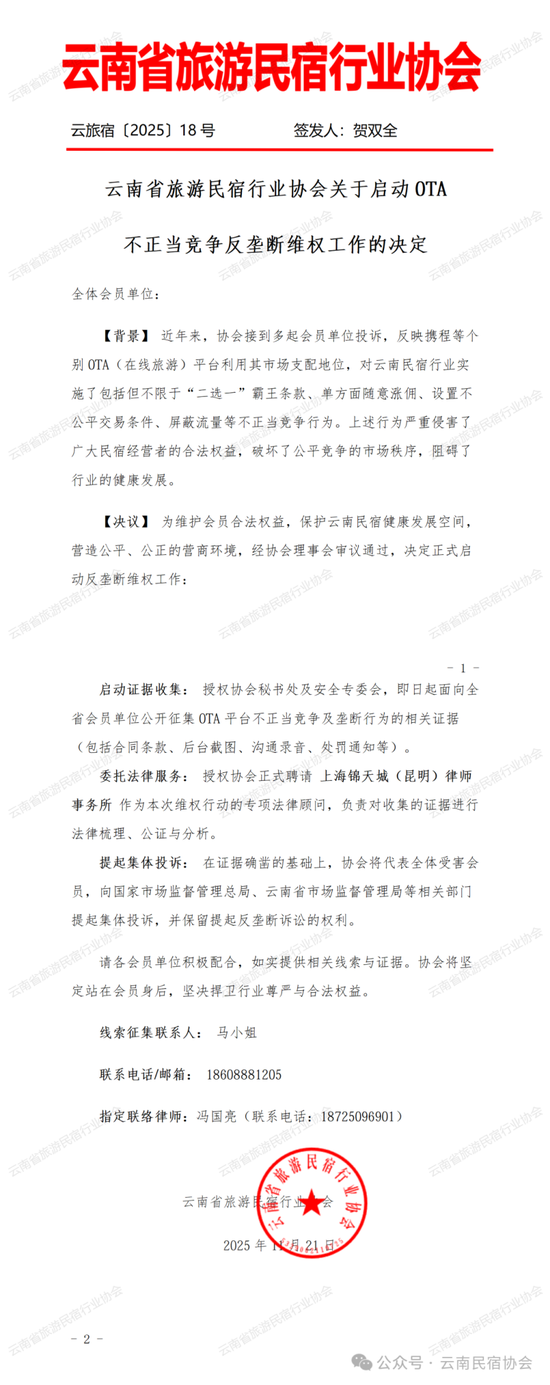
Core Viewpoint - The article highlights the growing tension between the Yunnan Homestay Association and the online travel agency (OTA) Ctrip, driven by allegations of monopolistic practices and unfair competition in the industry [2][21][22]. Group 1: Regulatory Actions - The State Administration for Market Regulation released a draft guideline indicating that requiring merchants to maintain "the lowest price online" may constitute abuse of market dominance or monopolistic agreements [2][20]. - Ctrip has been under scrutiny from regulatory bodies, with multiple administrative interviews conducted to address issues such as "choose one from two" practices and price manipulation [11][31][34]. Group 2: Industry Response - The Yunnan Homestay Association initiated a collective action against Ctrip, citing long-standing grievances regarding unfair practices, including unilateral commission increases and unfair trading conditions [5][25]. - The association has engaged a specialized legal team to gather evidence for potential collective complaints and antitrust lawsuits against Ctrip [6][25]. Group 3: Market Dynamics - Ctrip is projected to hold a 56% market share in the hotel and travel market by 2024, with its closest competitor, Tongcheng, at 13%, indicating a significant concentration of market power [8][27]. - The commission rates for merchants on Ctrip typically range from 10% to 15%, but additional hidden costs can push total commission expenses close to 40%, severely impacting profit margins for small operators [9][28][29]. Group 4: Technological Manipulation - Ctrip's "pricing assistant" tool is criticized for undermining merchants' pricing autonomy by automatically adjusting prices based on competitor rates, often without merchant consent [14][35][36]. - The platform's insistence on maintaining "the lowest price online" effectively shifts competitive costs onto merchants, exacerbating their financial strain [17][38]. Group 5: Future Outlook - The article questions whether Ctrip can reconcile its business interests with regulatory compliance and regain trust from merchants and consumers in the coming decade [39][40].


欧盟出手阻止亚马逊,促成美国老牌扫地机器人被中企收购 | 欧陆志
Xin Lang Cai Jing· 2025-12-18 06:39
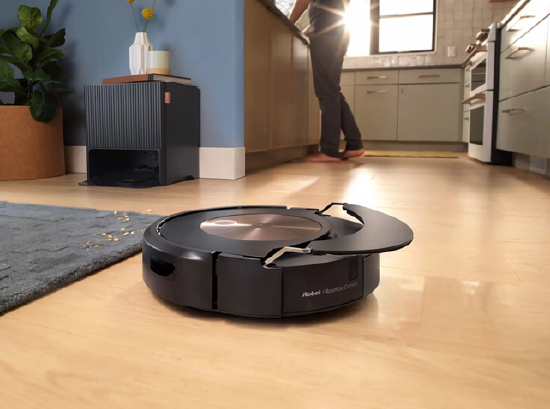
Core Insights - iRobot, a pioneer in the robotic vacuum industry, has filed for bankruptcy protection and will be restructured as a subsidiary of Shenzhen Picea Group after failing to secure a merger with Amazon due to EU antitrust regulations [1][15][20]. Company Background - iRobot was founded in 1990 by Rodney Brooks, Colin Angle, and Helen Greiner, with the revolutionary Roomba vacuum launched in 2002, selling over 50 million units globally [4][18]. - The company raised $38 million from investors, went public in 2005, and achieved revenues exceeding $400 million by 2010 [5][19]. Market Challenges - iRobot has faced declining sales in recent years, with increasing competition from Chinese brands and innovative companies like Dyson, leading to a loss of its technological edge [6][19]. - Supply chain issues have compounded these challenges since 2021, with criticisms regarding the declining quality of iRobot products [6][19]. Acquisition Attempt - Amazon announced a $1.7 billion acquisition of iRobot in 2022, which would have been its fourth-largest acquisition, aimed at enhancing its smart home product line [8][20]. - The acquisition was blocked by EU regulators due to antitrust concerns, which argued it could unfairly limit competition on Amazon's platform [9][21]. Financial Status - iRobot reported a loss of over $145 million last year, with its valuation dropping from over $3 billion in 2021 to $137 million [10][22]. - The company is in significant debt, owing $161 million to Picea, and has exhausted its funding sources, necessitating the acquisition by Picea to avoid total collapse [10][22][24]. Strategic Shift - Following the acquisition, iRobot will operate as a wholly-owned subsidiary of Picea, with its stock being delisted from U.S. markets [12][24]. - The deal is seen as a last-ditch effort to maintain some operational continuity after a series of failures and losses in the competitive landscape [12][24].

【e公司观察】产业链 “二选一” 引发反垄断新难题
Zheng Quan Shi Bao Wang· 2025-12-18 01:04
Group 1 - The core conflict between YingShi Innovation and DJI highlights the issue of "exclusive selection" behavior in the technology industry, raising concerns about antitrust regulations in technology-intensive sectors [1][2] - YingShi Innovation's founder revealed that 33 key suppliers faced "exclusive" pressure, affecting various components such as optical lens modules, structural parts, screens, batteries, and electronic chips, with some suppliers halting cooperation despite having completed sample deliveries or chip designs [1] - The sales conflict is also intense, with reports of a shopping mall forcibly removing an "Insta360" sign and prohibiting YingShi from opening a brand store during DJI's leasing period [1] Group 2 - DJI, as a leader in the global consumer drone market, has established a "super vertical integration" supply chain management model, controlling core components through self-research or deep cooperation, which may create competitive advantages [2] - The practice of "exclusive selection" in the supply chain is unprecedented in China, although similar behaviors in sales channels have led to penalties for companies like Alibaba and Meituan [2] - The antitrust law prohibits the abuse of market dominance by imposing unreasonable trading conditions, but identifying "exclusive selection" in technology-intensive industries poses challenges for regulators [2] Group 3 - A potential solution to balance innovation protection and fair competition is "technical isolation," where suppliers establish independent technical teams and production lines for different clients to avoid core technology overlap [3] - The outcome of this dispute will determine the future of both companies and may set a new benchmark for competition boundaries in the technology industry [3] - Policymakers need to find a path that encourages innovation while ensuring fair competition, allowing commercial competition to focus on products and technology rather than resource blocking [3]
马斯克预测某车企:必死;“天才少女”罗福莉首秀,称小米开源模型全球前二;好特卖回应新加盟叫停;玛莎拉蒂APP遭下架丨邦早报
创业邦· 2025-12-18 00:07
Group 1 - Elon Musk predicts Ford's electric strategy will lead to its demise, citing a $19.5 billion asset impairment and the halt of F-150 Lightning production as key factors [3] - Tesla's market value surpassed $1.6 trillion, with a single-day increase of $48.5 billion, reflecting investor confidence in electric vehicle technology [3] - Xiaomi's new model, MiMo-V2-Flash, has been released and is capable of deep thinking and real-time data retrieval, indicating advancements in AI capabilities [18] Group 2 - Luckin Coffee is reportedly considering acquiring Blue Bottle Coffee, although Blue Bottle has not confirmed this information [13] - OpenAI is in talks with Amazon for a potential investment of at least $10 billion, which could elevate OpenAI's valuation to over $500 billion [14] - Databricks has completed over $4 billion in Series L funding, raising its valuation to $134 billion, indicating strong investor interest in data and AI sectors [17] Group 3 - BYD has initiated comprehensive testing for L3 autonomous driving in Shenzhen, completing over 150,000 kilometers of real-world validation [18] - The Chinese music theater market is projected to generate over 1.8 billion yuan in ticket revenue by 2025, with a growing number of performances and audience engagement [22] - The foldable smartphone panel shipment is expected to grow by 46% in 2026, driven by Apple's first foldable device, with Samsung Display likely to capture over 50% market share [22]





美加墨世界杯冠军将获5000万美元奖金;原油大涨3%,白银创新高;馆藏画作现身拍卖市场?南京博物院回应;万科抛37亿中票展期方案丨每经早参
Mei Ri Jing Ji Xin Wen· 2025-12-17 22:06
Group 1 - The U.S. stock market experienced a collective decline, with the Dow Jones down 0.47%, Nasdaq down 1.81%, and S&P 500 down 1.16%, driven by significant drops in large tech stocks such as Tesla and Nvidia [4] - International oil prices surged, with U.S. crude oil rising by 2.87% to $56.71 per barrel, and Brent crude oil increasing by 2.9% to $60.63 per barrel [5] - International gold prices increased, with spot gold rising by 0.97% to $4343.7 per ounce, and COMEX gold futures up by 1.02% to $4376.3 per ounce [6] - Silver prices reached a new historical high, with spot silver rising by 4.29% to $66.45 per ounce, and COMEX silver futures up by 5.38% to $66.72 per ounce [7] Group 2 - The Chinese government is actively engaging in diplomatic efforts, with Foreign Minister Wang Yi supporting Venezuela's sovereignty and independence during a phone call with the Venezuelan Foreign Minister [9] - The Chinese Ministry of Foreign Affairs announced plans for further mediation efforts between Cambodia and Thailand to resolve border conflicts [9] - The Chinese Ministry of Defense responded to the Philippines regarding the Spratly Islands incident, asserting China's indisputable sovereignty over the area [10] Group 3 - The Chinese National Health Commission and five other departments issued guidelines to strengthen the construction of specialty departments in grassroots medical institutions, aiming to enhance healthcare services [11] - The Chinese State Administration for Market Regulation indicated that platforms requiring merchants to offer "lowest prices online" may constitute monopolistic behavior [11] - The Chinese Ministry of Education released measures to improve daily exam management in primary and secondary schools, aiming to reduce student burdens and enhance exam quality [11] Group 4 - Beijing's housing authority and other departments conducted joint interviews with major internet platforms, resulting in the removal of over 17,000 pieces of illegal real estate information [12] - Shenzhen introduced new housing support policies for young talents, offering a monthly housing subsidy of 1250 yuan and transitional housing options [13] - A police operation dismantled a group that spread negative information about electric vehicle companies, resulting in the arrest of 12 individuals and the shutdown of over 8,000 accounts [14] Group 5 - Tencent upgraded its AI model development structure, appointing a former OpenAI researcher as Chief AI Scientist to enhance its capabilities in AI infrastructure [19] - CATL launched the world's first humanoid intelligent robot production line for battery assembly, marking a significant advancement in smart manufacturing [21] - Huayi Brothers announced a reduction in shareholding by Alibaba's venture capital arm and Jack Ma, with their combined stake falling below 5% [22]




反内卷不是商量着“不卷” | 反内卷系列评论
经济观察报· 2025-12-17 13:28
Core Viewpoint - The article emphasizes the risks associated with industry self-discipline and price coordination, warning that such actions can lead to potential antitrust violations and market inefficiencies [1][4][5]. Group 1: Industry Competition Dynamics - In many industries, including solar energy, home appliances, automotive manufacturing, and internet services, companies are engaged in "involutionary competition," characterized by price wars, subsidies, and resource depletion, which ultimately harms profitability and innovation [2][3]. - The root cause of involution is an imbalance in competitive mechanisms, where companies sacrifice long-term benefits for short-term market share, leading to excessive competition and potential violations of antitrust laws [2][4]. Group 2: Risks of Price Coordination - As the industry consensus shifts towards anti-involution, some companies are beginning to form price alliances and production coordination under the guise of self-discipline, which poses risks of collusion and antitrust violations [3][4]. - The recent establishment of a platform company for silicon material acquisition in the photovoltaic industry illustrates the potential for coordinated actions that could violate antitrust laws by limiting production and sales [3][5]. Group 3: Legal and Compliance Considerations - The legal framework presents challenges for companies attempting to justify coordinated actions as necessary for economic downturns, as meeting the criteria for exemptions under antitrust laws is complex and difficult [5][6]. - Regulatory bodies have already noted the trend of companies using anti-involution as a cover for collusion, emphasizing that self-discipline should not lead to price-fixing or production limits [5][6]. Group 4: Recommendations for Companies - Companies, especially leading firms, should be cautious of leading price alliances or production agreements under the pretext of market stability, as this could lead to accountability issues [1][6]. - Establishing an antitrust compliance system and internalizing compliance culture is essential for companies to navigate the competitive landscape effectively and avoid regulatory pitfalls [7][8].

反内卷不是商量着“不卷” | 反内卷系列评论
Jing Ji Guan Cha Bao· 2025-12-17 12:47
Core Viewpoint - The article discusses the phenomenon of "involution" in various industries, highlighting the need for a shift towards rational competition rather than price wars and resource monopolization, which can lead to long-term inefficiencies and potential violations of antitrust laws [1][2]. Group 1: Involution and Its Consequences - Involution has become a common issue across industries such as photovoltaics, home appliances, automotive manufacturing, and internet services, where companies engage in price competition and subsidies, sacrificing long-term profits and innovation [1]. - The root cause of involution is an imbalance in competitive mechanisms, where companies prioritize short-term market share over sustainable practices, leading to excessive competition and resource waste [1][2]. Group 2: Industry Response and Risks - As the consensus against involution grows, some companies are forming price alliances and industry coordination under the guise of self-discipline, which poses risks of collusion and potential violations of antitrust laws [2][3]. - The silicon material storage incident illustrates the challenges faced by the photovoltaic industry, where overcapacity has led to significant price fluctuations and a crisis of losses, prompting major companies to adopt production cuts and self-regulatory strategies [2][3]. Group 3: Antitrust Concerns - The establishment of a silicon material storage platform by competing companies to manage overcapacity may inadvertently lead to price increases, raising concerns about potential violations of antitrust laws regarding horizontal agreements to limit production or sales [3][4]. - Regulatory bodies have noted the trend of companies using the pretext of anti-involution to engage in collusion, emphasizing that industry self-regulation should not lead to price-fixing or production limitation agreements [4][5]. Group 4: Compliance and Future Directions - Companies must be cautious of leading price alliances or production agreements under the banner of industry self-discipline, as this could expose them to legal repercussions [5][6]. - To genuinely escape the trap of involution, companies should focus on building a compliance culture that integrates antitrust considerations into their strategic and operational frameworks, shifting the competitive focus from price to service and value [6].