
财富管理

Search documents
【活动】财富会员开奖啦!速领最高454元初冬礼遇
中国建设银行· 2025-11-13 06:14
Group 1 - The article promotes a wealth management program offering various benefits for customers, including tax deductions and savings through personal pension contributions [1] - The program includes a winter promotion for wealth members, providing up to 454 yuan in rewards [2] - Customers with an average financial asset amount of at least 50,000 yuan in October can receive a WeChat discount of up to 60 yuan during the promotional period [3] Group 2 - Customers with an average financial asset amount of at least 9,000 yuan in October are eligible to enter a draw for a WeChat discount of up to 188 yuan [4] - Wealth members who upgrade to a higher wealth level for the first time this year can receive corresponding upgrade rewards, with a maximum value of 206 yuan for multiple level upgrades [5]


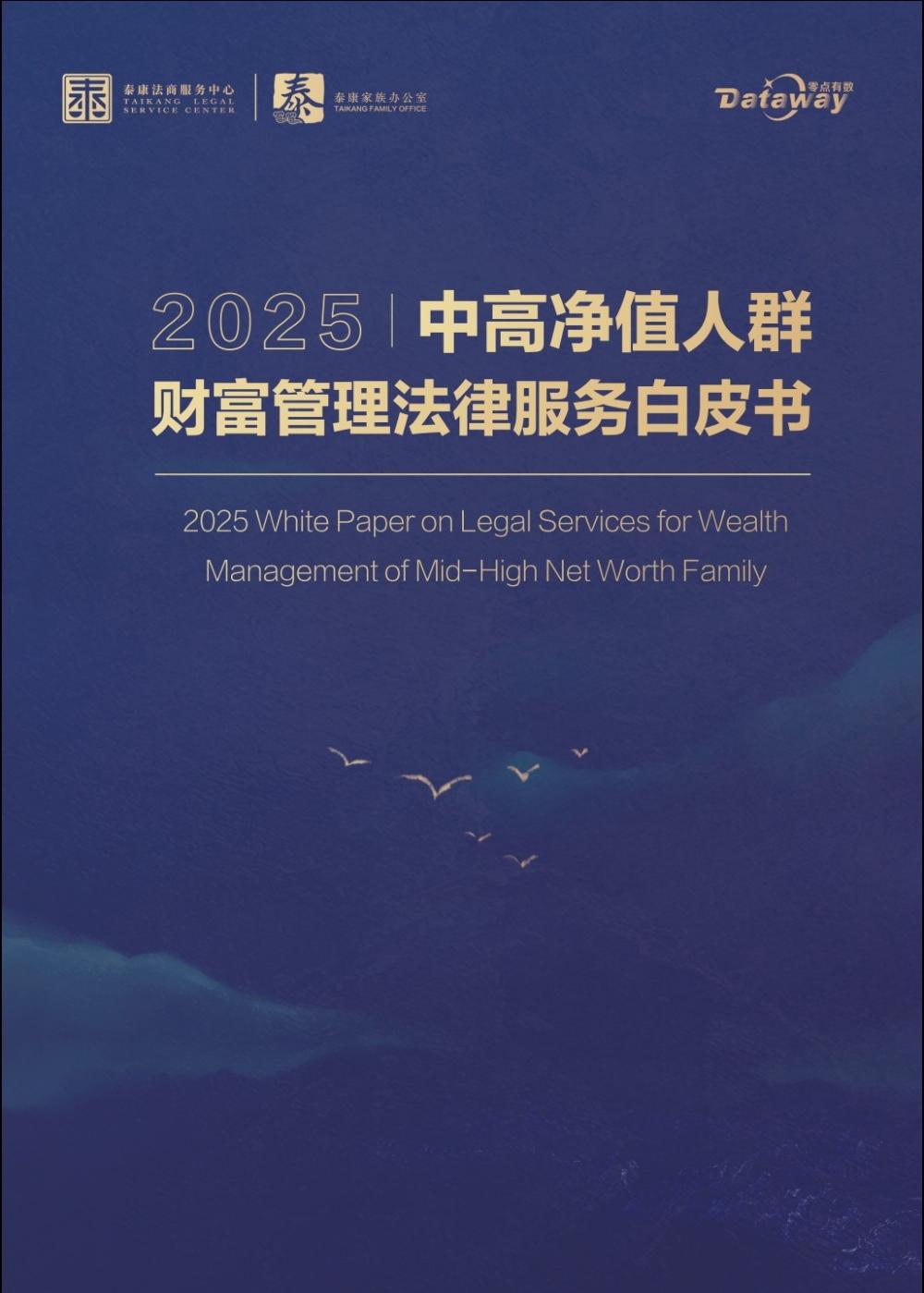
《中高净值人群财富管理法律服务白皮书》2025焕新发布:财富管理法律风险担忧跃升21%
2 1 Shi Ji Jing Ji Bao Dao· 2025-11-12 10:55
Core Insights - The "2025 Wealth Management Legal Services White Paper" was jointly released by Taikang Law Business Service Center, Taikang Family Office, and Zero Point You Shu, marking a significant development in understanding the legal service needs of high-net-worth individuals [1][3] - This second edition builds upon the first white paper published in 2023, which identified key legal risks in five areas: marriage, inheritance, retirement, family-business integration, and policy awareness [3][4] Group 1: Key Developments - The white paper focuses on four major upgrades for 2025, including trend analysis, policy and technology insights, dynamic risk mapping, and comprehensive risk profiling across different life stages [4][5] - Eight significant events in the wealth management legal sector were identified and analyzed, providing a snapshot of current market opportunities and challenges [6] Group 2: New Wealth Management Trends - The white paper reveals five new trends in wealth management, emphasizing the importance of wealth security in a volatile environment, with nearly 70% of high-net-worth individuals prioritizing wealth safety [8] - There is a notable increase in legal risk awareness, with a score of 67.6 in 2025, up 21 percentage points from 2023, highlighting concerns among both large and small families regarding wealth distribution and elder care [8][9] - Different life stages present unique risks, from single individuals to families and businesses, with evolving concerns as individuals progress through life [8][9] Group 3: Risk Management Strategies - Legal risk prevention is shifting from reactive measures to proactive strategies, with 34.6% of individuals opting for legal agreements to mitigate marriage risks and 59.0% prioritizing wealth planning for retirement [9] - AI is becoming an essential tool for high-net-worth individuals, with nearly 30% using AI legal services daily, although trust in AI remains cautious among more educated and affluent groups [9]
不追规模重稳健 汇华理财五周年定调下一个五年:以国际视野行稳致远
Zhong Zheng Wang· 2025-11-12 06:03
Core Viewpoint - The company aims to establish itself as a benchmark in wealth management with a focus on stable absolute returns, global allocation capabilities, and innovative vitality over the next five years [1] Group 1: Strategic Direction - The strategic direction for the next five years is defined as "international vision, innovation leadership, and steady progress" [1] - The company emphasizes that scale is not the ultimate goal; instead, stable returns and customer reputation are the core logic for long-term success [1] Group 2: Industry Challenges - The banking wealth management industry is facing common challenges, with many peers experiencing confusion as the "valuation magic" fades [1] - The company acknowledges past difficulties due to market volatility and single strategies, leading to a transformation towards diversified development [1] Group 3: Future Focus - The company will not prioritize scale but will focus on "steady progress," maintaining conservative strategies in unfavorable market conditions and enhancing returns when opportunities arise [1] - As the first joint venture wealth management company in the country, the company plans to leverage its international vision to achieve innovation leadership in investment solutions and comprehensive services [1]
已有7家银行私银客户超10万户
2 1 Shi Ji Jing Ji Bao Dao· 2025-11-12 05:45
Core Insights - The private banking sector has seen significant growth in the first three quarters of this year, with seven listed banks reporting over 100,000 private banking clients as of September 30, 2023, indicating a rising demand for wealth management services among high-net-worth individuals [2][4][5] Group 1: Growth in Private Banking Clients - Multiple banks reported a client growth rate exceeding 10%, with Minsheng Bank, Beijing Bank, and Nanjing Bank showing increases over 15% [4] - Minsheng Bank had the fastest growth, reaching 73,409 private banking clients, an increase of 18.21% from the end of last year [5] - Beijing Bank reported 20,586 private banking clients, up 17.9%, and an asset under management (AUM) of 224 billion yuan, a 14.39% increase [5][6] Group 2: Market Position of Major Banks - State-owned banks continue to dominate the private banking market, with Agricultural Bank of China leading at 279,000 clients, followed by China Construction Bank and Bank of China [6] - China Merchants Bank and Ping An Bank have also joined the "100,000 club," with Ping An Bank reaching 103,300 clients, marking its first entry into this category [6][7] Group 3: Challenges and Opportunities in Wealth Management - The growth in private banking clients is attributed to the expanding base of high-net-worth individuals and the upgrading of banking services [9] - The Hu Run Wealth Report indicates that the total wealth of China's 6 million affluent families has reached 150 trillion yuan, with ultra-high-net-worth families holding 87 trillion yuan, an increase from 56% to 58% of total wealth [9] - The private banking sector is facing challenges such as economic shifts, declining risk-free returns, and reduced investor confidence, necessitating a transformation in wealth management services [10][11]







已有7家银行私银客户超10万户
21世纪经济报道· 2025-11-12 05:38
Core Insights - The private banking business has seen significant growth in the first three quarters of this year, with seven listed banks surpassing 100,000 private banking clients as of September 30, 2023, driven by the increasing number of high-net-worth individuals and evolving wealth management needs [1][3][6] Growth of Private Banking Clients - Several banks reported a client growth rate exceeding 10%, with Minsheng Bank, Beijing Bank, and Nanjing Bank showing increases over 15%. Minsheng Bank led with an 18.21% growth, reaching 73,409 clients [3][6] - Beijing Bank's private banking clients grew by 17.9% to 20,586, with total assets under management (AUM) increasing by 14.39% to 224 billion yuan [3][6] - Nanjing Bank also reported a 15.43% increase in private banking clients [3] Dominance of State-Owned Banks - State-owned banks continue to lead in absolute numbers, with Agricultural Bank of China having 279,000 clients, followed by China Construction Bank with 265,500 clients [4] - China Merchants Bank and Ping An Bank have also joined the "100,000 club," with Ping An Bank reaching 103,300 clients, marking its first time surpassing this threshold [4][6] Market Dynamics and Competition - The private banking market is characterized by a competitive landscape where state-owned banks leverage their scale, while joint-stock banks focus on differentiated services and operational efficiency [7] - The growth of high-net-worth individuals is expected to drive competition towards service quality and asset allocation capabilities [7] Challenges in Wealth Management - The wealth management sector faces three main challenges: economic growth slowdown, declining risk-free returns, and reduced investor confidence [10][11] - Banks are urged to upgrade their wealth management services to meet clients' real needs and utilize various financial tools for comprehensive solutions [11] Changing Client Demographics - The core client base for private banking is shifting from traditional business owners to new economy groups, with a notable increase in demand for comprehensive wealth management services [9] - Banks are redefining their target clients based on their strengths, with some focusing on family wealth transfer and others on retirement financial management [9]




新华保险盛世荣耀庆典版 家庭财富管理的焕新力作
Hua Xia Shi Bao· 2025-11-11 13:00
Core Insights - The article discusses the growing demand for professional and long-term wealth management services among consumers, driven by interest rate cuts and an aging population [2] - It highlights the policy direction provided by the government to support the insurance industry, emphasizing the need for diversified pension security and financial planning [2] - Xinhua Insurance, with 30 years of industry experience, is positioned as a key player in the innovation of participating insurance products [2] Group 1: Product Features - The "Shengshi Glory Celebration Edition" whole life insurance (participating) offers dual-core growth, providing guaranteed benefits and cash value growth while allowing policyholders to share in the company's surplus through dividends [3][4] - The product features flexibility with options for reducing coverage and policy loans, catering to consumers' need for financial planning and stability [3][4] - It includes a high-quality dividend account that ensures stable returns, managed by a professional team, which is essential for effective wealth management [4] Group 2: Investment Strength - Xinhua Insurance boasts total assets exceeding 1.8 trillion yuan, leveraging its strong investment capabilities to provide reliable wealth protection services [5] - As of September 30, 2025, the company reported an annualized total investment return of 8.6% and a comprehensive investment return of 6.7%, maintaining a strong position in the industry [5] - The company emphasizes a long-term value investment approach, balancing traditional strengths with innovative strategies to enhance investment performance [5] Group 3: Social Responsibility - Xinhua Insurance actively responds to national calls by establishing nearly 100 billion yuan in private equity investment pilot funds, achieving a balance of benefits, safety, and liquidity [6] - The company focuses on strategic sectors such as semiconductors, artificial intelligence, and biomedicine, contributing over 1.21 trillion yuan to the real economy [6] - By aligning family wealth management with national development strategies, Xinhua Insurance aims to share the benefits of China's economic transformation and technological advancement with its clients [6] Group 4: Customer Services - Xinhua Insurance integrates various service brands to offer a comprehensive support system for high-end clients, including asset allocation, wealth inheritance, and legal consultation [7] - The company has established a network for health and wellness services, providing professional care and travel options for consumers [7] - Collaborations with top hospitals enable Xinhua Insurance to offer high-quality medical services, ensuring comprehensive protection for clients [7]


eToro Group Ltd-A(ETOR) - 2025 Q3 - Earnings Call Transcript
2025-11-10 14:30
Financial Data and Key Metrics Changes - Net contribution increased by 28% year over year to $215 million, while adjusted EBITDA rose by 43% to $78 million, resulting in solid operating margins of 36% [3][22] - Assets under administration reached a record high of $20.8 billion, up 76% year over year, and funded accounts grew by 16% to 3.73 million [5][22] Business Line Data and Key Metrics Changes - Net trading contribution from crypto surged by 229% year over year to $56 million, driven by higher invested amounts per trade and increased activity [23] - Net trading contribution from capital markets, equities, commodities, and currencies declined by 21% year over year to $73 million due to a shift in investor activity towards crypto [23] - Net interest income increased by 44% year over year to $62 million, largely due to a 52% rise in higher interest-earning assets [23] Market Data and Key Metrics Changes - Funded accounts in the US saw significant growth, with new funded accounts surpassing those of 2024 year-to-date, and a three-times increase in crypto volumes quarter over quarter [16][17] - The company expanded its market access globally, now offering access to 22 different exchanges and planning to increase to over 30 by 2026 [6] Company Strategy and Development Direction - The company is focused on four strategic pillars: trading, investing, wealth management, and neobanking, while accelerating product innovation [5][11] - Plans to democratize investing by making it simple, accessible, and social, with a focus on AI-driven tools and community engagement [4][12] - A $150 million share repurchase program was announced, reflecting confidence in long-term growth prospects [19] Management's Comments on Operating Environment and Future Outlook - Management expressed confidence in the company's ability to capture significant growth opportunities driven by innovation, global expansion, and macro trends [11][19] - The company anticipates continued strong performance in Q4, with positive momentum in capital markets and crypto businesses [25] Other Important Information - The company launched a new subscription model for the eToro Club, providing premium benefits and exclusive features [10][26] - The integration of Spaceship in Australia allows users direct access to superannuation products, enhancing the wealth management offering [10] Q&A Session Summary Question: Comment on the new subscription offering and its opportunity - The subscription model was launched to provide premium benefits and consolidate previous models, enhancing customer engagement [26][27] Question: Discuss account growth and contributing regions - Account growth has been strong, with double-digit growth driven by increased deposits and engagement, though geographic breakdowns were not provided [28][29] Question: Implications of artificial intelligence on trading - AI tools are being developed to enhance user engagement and automate trading strategies, with early signs of success in user adoption [30][31] Question: Strategic focus by geography - The company aims for long-term growth in the US and Asia while maintaining leadership in Europe, focusing on data-driven marketing strategies [33][34] Question: Account growth expectations - The company targets double-digit growth in funded accounts, supported by a growing market of younger investors [35][36] Question: Dynamics of crypto trading volumes - Strong crypto trading volumes were noted, with a shift in investor activity impacting capital markets revenues [37][38] Question: Capital allocation priorities - The company is balancing share buybacks with potential M&A opportunities, maintaining a strong cash position [40][41] Question: Pathway for prediction markets - The company is exploring both organic and inorganic opportunities for prediction markets, leveraging existing infrastructure [42] Question: Mechanics of copy trading in the US - Copy trading operates similarly in the US and internationally, with ongoing enhancements to the Pro Investor program [50][51]

规模、盈利、服务多点开花,郑州银行2025年三季度交出亮眼答卷
Bei Jing Shang Bao· 2025-11-10 12:31
Core Insights - Zhengzhou Bank has demonstrated strong growth in both scale and quality amidst challenges in the banking sector, achieving a total asset value exceeding 740 billion yuan, a year-on-year increase of 9.93%, marking a historical high for the same period [1][2] Asset Growth - As of September 30, 2025, Zhengzhou Bank's total assets reached 743.55 billion yuan, with an increase of 67.19 billion yuan compared to the previous year, showcasing the bank's core capability in serving regional economic needs [2] - The bank's total deposits amounted to 459.52 billion yuan, reflecting a growth of 13.59%, with personal deposits increasing by 22.44% to 267.14 billion yuan, indicating enhanced brand loyalty and effective customer retention strategies [2] Revenue and Profitability - The bank's operating income for the first three quarters was 9.395 billion yuan, a year-on-year increase of 3.91%, while net profit attributable to shareholders reached 2.279 billion yuan, up 1.56%, indicating a balanced approach to growth and quality [1][2] - Net interest income reached 7.816 billion yuan, growing by 5.83%, while non-interest income rose significantly to 1.579 billion yuan, demonstrating diversification in revenue streams that mitigates risks from interest margin fluctuations [3] Credit and Retail Business - Zhengzhou Bank issued loans totaling 406.72 billion yuan, a growth of 4.91%, with a focus on key sectors and small and micro enterprises, reflecting its commitment to supporting the real economy [4] - The bank's retail transformation strategy has shown positive results, with personal loan balances reaching 96.31 billion yuan, an increase of 5.88%, indicating a robust growth trajectory in retail banking [4][5] Risk Management and Cost Efficiency - The bank maintained a provision coverage ratio of 186.17%, an increase of 19.94 percentage points year-on-year, and a non-performing loan ratio of 1.76%, down 0.1 percentage points, indicating stable asset quality [6] - Total operating and management expenses were 2.243 billion yuan, a decrease of 0.56 billion yuan, leading to a cost-to-income ratio of 23.99%, down 1.57 percentage points, showcasing effective cost control measures [7]
相约深圳!2025湾区财富大会将于11月20日金博会期间启幕
2 1 Shi Ji Jing Ji Bao Dao· 2025-11-10 06:09
Group 1 - The "2025 Bay Area Wealth Conference" will take place on November 20, 2025, during the 19th Shenzhen International Financial Expo, focusing on "New Trends in Wealth Management: Investing Globally from the Bay Area" [1] - The event will gather top financial institutions and high-net-worth participants from the Greater Bay Area, discussing current wealth management and global allocation strategies [1][2] - The Greater Bay Area has an economic total of 14.79 trillion yuan, making it the largest bay area globally, with Hong Kong's asset and wealth management scale exceeding 35 trillion HKD and Shenzhen's wealth management total surpassing 31 trillion yuan [1] Group 2 - The morning forum will feature discussions on global wealth management, asset revaluation in China, alternative investments for high-net-worth individuals, and trends in the Hong Kong ETF market, with insights from major financial institutions [2] - The Guangdong-Hong Kong-Macao Greater Bay Area Research Institute will release the "2025 Cross-Border Wealth Management Report," revealing trends in cross-border wealth management over the past year [2] - The afternoon session will delve into global asset allocation, exploring new paradigms and practical topics such as Hong Kong stock investments and cross-border wealth management [2][3] Group 3 - The conference will analyze the changing investment behaviors of high-net-worth clients, focusing on the shift from preservation to "inheritance + impact investing" [3] - The collaboration between 21st Century Business Herald and Shenzhen International Financial Expo aims to create a platform for wealth management and asset management institutions to showcase their brands and foster cooperation [3] - Registration is open for representatives from financial institutions, high-net-worth individuals, and industry researchers interested in wealth management and asset allocation [3]
如果你的存款已经有十万、二十万了,请记住这几条“保富法则”
Sou Hu Cai Jing· 2025-11-09 11:42
Core Insights - The article emphasizes the importance of not only earning wealth but also the ability to preserve it, highlighting that the true turning point in life is the capacity to maintain financial stability rather than merely accumulating money [3][19] Group 1: Principles of Wealth Preservation - First Principle: Avoid rushing into investments; prioritize preserving the principal amount. It is advised to save six months to a year’s worth of living expenses in low-risk options like fixed deposits or money market funds [5][9] - Second Principle: Maintain a low profile regarding wealth. Displaying wealth can lead to risks, as it reflects short-sightedness and vanity. True financial wisdom lies in keeping wealth discreet [7][9] - Third Principle: Diversify funds into three parts: 40% in a safety fund, 40% in stable investments like government bonds or money market funds, and 20% in personal development [9][11] Group 2: Mindset and Behavioral Aspects - Fourth Principle: Avoid the mindset of wanting to get rich quickly. Greed can lead to significant losses, and it is more beneficial to earn steady returns over time rather than seeking rapid wealth [13][15] - Fifth Principle: Practice delayed gratification. Controlling spending urges and prioritizing investments in personal growth and family security over immediate pleasures is crucial for long-term wealth preservation [17][19]
