量化投资

Search documents
量化赋能,专业护航,建信创业板综增强ETF来了!
Xin Lang Cai Jing· 2025-12-10 13:56
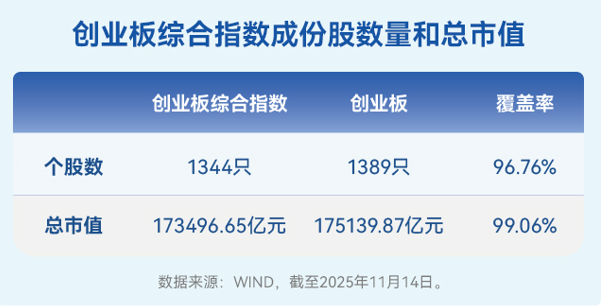
Core Viewpoint - The A-share market has shown strong performance this year, with major indices experiencing varying degrees of increase, reflecting an enhancement in market risk appetite and active structural opportunities [1][18] Index Overview - The ChiNext Composite Index (399102.SZ) covers over 1,300 listed companies on the ChiNext board, with a total market capitalization coverage of 98% [1][19] - The index has a base point of 1,000 and was established on May 31, 2010 [1] | | ChiNext Composite Index | ChiNext | Coverage Rate | | --- | --- | --- | --- | | Number of Stocks | 1344 | 1389 | 96.76% | | Total Market Value | 173,496.65 billion | 175,139.87 billion | 99.06% | Historical Performance - Since its inception on May 31, 2010, the ChiNext Composite Index has increased by 285.29%, significantly outperforming the Shanghai Composite Index and Shenzhen Component Index during the same period [2][19] Industry Distribution - The ChiNext Composite Index has a high concentration in technology sectors, covering industries such as power equipment, electronics, biomedicine, communications, and computers, which helps capture investment opportunities in various high-tech fields [4][21] - The top five industries by weight are: - Power Equipment (23.5%) - Electronics (13.7%) - Biomedicine (10.4%) - Communications (9.7%) - Computers (9.5%) - These five industries collectively account for approximately 66.8% of the index [4][21] Valuation - The current Price-to-Earnings (PE) ratio (TTM) of the ChiNext Composite Index is 66.75, which is within a reasonable range of around 57% over the past decade, indicating potential for upward adjustment compared to other major A-share indices [7][24] | | PE (TTM) | PE Percentile | | --- | --- | --- | | ChiNext Composite | 66.75 | 57.04% | | Shanghai Composite | 16.64 | 97.53% | | Shenzhen Component | 30.56 | 80.70% | | Wind All A | 22.20 | 89.96% | Investment Strategy - The enhanced strategy ETF aims to outperform the benchmark index by closely tracking the ChiNext Composite Index while employing quantitative management strategies to optimize portfolio holdings [8][25] - The investment model emphasizes consistent performance and aims to adapt to different market conditions to achieve better investment outcomes [10][27] Management Expertise - The management team at Jianxin Fund has extensive experience in index product investment management, with members possessing diverse academic backgrounds in mathematics, computer science, and finance [11][28]


上海百亿私募大爆发,年内新晋12家!最新百亿私募达53家!各辖区十强私募都有谁?
私募排排网· 2025-12-10 07:00
Core Insights - Shanghai is a significant hub for asset management in China, hosting 2,020 private equity firms, accounting for 26.69% of the national total, with 53 firms managing over 10 billion yuan, representing 46.90% of the total [2] - In 2023, 12 private equity firms in Shanghai successfully surpassed the 10 billion yuan management scale, with 6 being quantitative firms and 9 located in the Pudong New Area [2] Summary by Region Pudong New Area - Pudong New Area has 1,188 private equity firms, with 68 managing over 5 billion yuan, including 30 firms with over 10 billion yuan [4] - The average return for 139 private equity firms in Pudong from January to November 2023 is 26.94%, with the top three performers being Haisheng Fund, Shanghai Yixin Private Equity, and Guiyuan Investment [5] Hongkou District - Hongkou District has 127 private equity firms, with 12 managing over 5 billion yuan, including notable firms like Mingyuan Investment and Mingxi Capital [9] - The top three performers in Hongkou for the same period are Mingxi Capital, Mingyuan Investment, and Guanghe Future Private Equity [9] Xuhui District - Xuhui District has 119 private equity firms, with 5 managing over 5 billion yuan, including Jin De Private Equity and Rui Tian Investment [12] - The top three performers are Shanghai Zijie Private Equity, Cai Xia Wan Investment, and Yanfu Investment [12] Huangpu District - Huangpu District has 124 private equity firms, with 5 managing over 5 billion yuan, including Zhengying Asset and Liwei Private Equity [15] - The top three performers are Quan Cheng Fund, Qingdao Hongyun Ruiheng Private Equity, and Shanghai Darin Asset [15] Other Districts - Other districts in Shanghai have a total of 474 private equity firms, with 7 managing over 5 billion yuan, including Shanghai Boke Private Equity and Hexie Huiyi Asset [18] - The top three performers in these districts are Shanghai Hengsui Asset, Jinwang Investment, and Liangli Private Equity [18]

量化私募最新业绩出炉!幻方连续3月排名稳居前2!天算、海南盛丰等表现突出!
私募排排网· 2025-12-10 03:34
Core Insights - The private equity industry has returned to the "double hundred era," with 113 billion-yuan private equity firms as of the end of November, including 55 quantitative private equity firms, indicating a significant increase in the popularity of quantitative investment [2][3] - The performance of quantitative private equity has gained recognition from most investors, with a total of 852 existing quantitative private equity firms [2] Group 1: Billion-Yuan Private Equity Landscape - As of November 2025, there are 55 billion-yuan quantitative private equity firms, with 14 firms breaking the 100 billion mark this year, a new high since 2022 [3][4] - The average time taken for these firms to reach the billion-yuan scale is approximately 7 years, with the fastest being Yanfu Investment at only 1.2 years [3][4] - The majority of billion-yuan quantitative private equity firms focus on stock strategies, with 47 firms, followed by multi-asset strategies with 6 firms [4] Group 2: Performance Rankings - The top three performing billion-yuan quantitative private equity firms this year are Lingjun Investment, Ningbo Huansheng Quantitative, and Wenbo Investment, with the threshold for the top 10 performance being ***% [7][11] - Lingjun Investment has consistently ranked high for three consecutive months, with an average return of ***% across its products [9][11] - The performance of quantitative private equity firms has been bolstered by the increasing trend of firms obtaining Hong Kong's Type 9 license for global investment and risk diversification, with 22 billion-yuan quantitative private equity firms currently holding this license [4] Group 3: Mid-Sized Private Equity Firms - In the 50-100 billion category, the top three firms are Yunqi Quantitative, Qianshu Investment, and Hainan Shengfeng Private Equity, with the performance threshold for the top 10 being over ***% [11][12] - Yunqi Quantitative, established in February 2021, has rapidly grown from a management scale of 10-20 billion to 50-100 billion this year [12] Group 4: Smaller Private Equity Firms - In the 20-50 billion category, the top three firms are Hanrong Investment, Xiangmu Asset, and Yinhhe Investment, with the performance threshold for the top 10 being over ***% [15] - The 10-20 billion category has seen a decrease in stock strategy firms, with multi-asset and futures strategies becoming more prominent [20][21] - In the 5-10 billion category, the top three firms are Huacheng Private Equity, Shanghai Zijie Private Equity, and Zhenzhen Investment, with performance thresholds exceeding ***% [22][25] Group 5: Emerging Firms - In the 0-5 billion category, the top three firms are Jingying Zhito, Jinwang Investment, and Quancheng Fund, with Jingying Zhito achieving significant returns [26][29] - Jingying Zhito, established in 2021, focuses on futures and derivatives strategies and is led by a team with extensive quantitative investment experience [29]
打卡一家今年收益表现出色、较低回撤的黑马私募!主攻量化CTA与选股
私募排排网· 2025-12-10 03:34
Core Insights - The article highlights the performance and strategies of Zhixin Rongke, a quantitative private equity firm, which has shown impressive returns in the market, particularly in the CTA (Commodity Trading Advisor) category [4][13][24]. Company Overview - Zhixin Rongke Investment Management (Beijing) Co., Ltd. was established in 2013 by PhDs from Tsinghua University and the Chinese University of Hong Kong, focusing on quantitative investment with over 10 years of experience in CTA strategies and 5 years in quantitative stock strategies [13][14]. - The firm has developed a dual-driven strategy system centered on quantitative CTA and quantitative stock selection, aiming for high Sharpe ratios and low drawdowns [13][24]. Performance Metrics - As of October 2025, Zhixin Rongke's products have achieved significant average returns, ranking second among quantitative private equity firms and sixth among those with assets over 5 billion [4][10]. - The "Zhixin Rongke CTA No. 7 A Class" product ranked third in terms of returns and drawdown control among CTA products, showcasing its strong performance [4][8]. Investment Strategies - The firm employs a dual-engine strategy that combines CTA and quantitative stock selection, providing both trend-following returns and tail risk hedging [41][45]. - The strategies have demonstrated crisis alpha, achieving positive returns during market downturns, such as a +***% return when the CSI 300 index fell by 21.6% in 2022 [41][42]. Team and Development - The core team has over 15 years of stable collaboration, previously working at the renowned hedge fund WorldQuant, which enhances their research and investment capabilities [17][21]. - The firm has undergone several strategy iterations since its inception, continuously adapting to market changes and improving performance metrics [46]. Product Lines - Zhixin Rongke offers various product lines, including CTA-enhanced strategies and quantitative stock selection strategies, catering to different investor risk preferences [24][30]. - The "CTA No. 7" product is positioned as a flagship quantitative CTA product, while the "Multi-Strategy No. 8" integrates both CTA and quantitative stock selection for enhanced absolute returns [28][30].

2025投教新浪潮!金融业高质量发展与投资者教育创新传播活动来了!
Zhong Guo Ji Jin Bao· 2025-12-10 03:01
Core Insights - The financial industry is undergoing a transformation in investor education, shifting from simple knowledge dissemination to deeper "value empowerment" in the context of capital market reforms and digitalization [1][2] Group 1: Investor Education Initiatives - The "Financial Industry High-Quality Development and Investor Education Innovation Communication Activity" has been launched, involving over 150 major asset management institutions to collect high-quality educational materials [2] - The educational materials include short videos, long videos, in-depth articles, creative posters, and public welfare practices, showcasing the asset management industry's exploration and achievements in investor education [2] Group 2: Short Video Content - Short videos are becoming a key channel for investors to acquire knowledge, with various themes such as long-term investment concepts and asset allocation explained through engaging narratives and cultural references [3] - Examples include the series "Investment Road with Jingli" promoting long-term investment and "Asset Allocation Classroom" using traditional culture to explain key concepts [3] Group 3: Long Video Content - Long videos address the demand for in-depth content, providing comprehensive analyses of industries and investment logic, such as the competitive landscape of solid-state batteries and the evolution of intelligent robots [5] - These videos aim to guide investors from chasing short-term trends to understanding underlying investment logic [5] Group 4: In-Depth Articles - In-depth articles focus on building a cognitive moat for investors, covering strategies, market dynamics, and psychological aspects of investing [7] - Topics include quantitative investment strategies, asset allocation techniques, and the impact of macro policies on investment decisions [7] Group 5: Creative Posters - Creative posters serve as an important medium for investor education, utilizing visual elements to simplify complex concepts and convey investment philosophies [8] - Examples include posters that explain net asset values and investment principles through engaging designs and cultural references [8] Group 6: Public Welfare Practices - Financial institutions are expanding the boundaries of investor education through public welfare initiatives, such as educational programs targeting youth and rural communities [10] - These initiatives aim to enhance financial literacy and support sustainable development in various demographics [10]

用机器学习解锁量化投资新边界
Qi Huo Ri Bao Wang· 2025-12-10 01:33
Core Insights - The article highlights the successful implementation of a day trading strategy using machine learning and pressure factors to identify trading opportunities in the futures market [2][4]. Strategy Overview - The day trading strategy, initiated in February 2023, employs a machine learning framework to analyze market data and predict daily returns for selected futures [2]. - The strategy focuses on 40 to 50 mainstream commodity futures but trades only the top five predicted by the model, optimizing for a higher Sharpe ratio during backtesting [2]. - Position allocation follows an "equal market value" principle, which has shown comparable performance to a "strong signal high position" model while simplifying operations [2]. Data Utilization - The strategy captures short-term fluctuations using 1-minute K-line data while also considering daily data for long-term trends, generating signals twice a day [3]. - The approach avoids frequent predictions to reduce model complexity, especially in the absence of significant incremental information during trading hours [3]. Risk Management - A multi-layered risk control framework is established, including mandatory position closing before market close to avoid overnight risks and immediate liquidation in case of market reversals [4]. - The strategy has demonstrated strong drawdown control, with a real trading drawdown rate of 5% to 6% and a maximum drawdown of 28.95% during a specific competition [4]. - The strategy is best suited for volatile markets, relying on a reversal effect, and incorporates traditional trend sub-strategies to mitigate risks [4]. Future Plans - The company plans to expand the trading universe to 10 to 15 products, which will enhance capital capacity while maintaining profitability through diversified order placements [5]. - A new product based on the day trading strategy has been registered, indicating a move towards a broader asset management market [5]. - The focus will remain on the commodity futures CTA sector, with ongoing investments in factor exploration and model optimization to ensure robust performance for clients [5].
满风资产刘海影:AI重塑量化仍处“初级阶段”
Zhong Guo Zheng Quan Bao· 2025-12-09 22:39
Core Viewpoint - The conference highlighted the importance of deep research in investment, emphasizing that the "pricing differences" in China's capital market provide fertile ground for quantitative investment [1][2]. Group 1: Investment Philosophy - The company positions itself as a "research-centric" private equity firm, believing that research is the core and foundation of investment [2]. - The investment strategy is driven by both subjective and quantitative approaches, with a focus on deep value research and long-term tracking of company fundamentals [2]. - The company aims to provide long-term returns through extensive research, rather than relying on luck or impulsive decisions [2]. Group 2: Market Characteristics - The Chinese stock market has more "noise traders" whose behaviors lead to significant deviations from true value, creating "pricing differences" that serve as a source of alpha [3]. - The process of identifying and correcting these pricing differences contributes to the maturation of China's capital market [3]. Group 3: AI in Quantitative Investment - AI is seen as a transformative force for all industries, including investment, but its application in quantitative strategies is still in its early stages [4]. - The integration of deep learning into market data analysis offers new perspectives and strategies beyond traditional models [4]. - Continuous investment in AI and quantitative methods is essential for developing new strategies and overcoming challenges in the competitive landscape [4]. Group 4: Market Outlook - The recent recovery in the A-share market is primarily driven by a restoration of confidence, with a significant turning point noted in September 2022 [6]. - The company maintains a cautiously optimistic outlook for the stock market over the next two to three quarters, citing several positive indicators [6]. - Challenges remain, particularly regarding the improvement of corporate earnings, suggesting that future market growth may rely on "valuation expansion" [6].
AI重塑量化仍处“初级阶段”
Zhong Guo Zheng Quan Bao· 2025-12-09 20:22
Core Insights - The conference on high-quality development of the quantitative industry highlighted the importance of deep research as the core foundation of investment, particularly in the context of China's capital market, which presents pricing discrepancies that are fertile ground for quantitative investment [1][2] - AI is seen as a transformative force for the quantitative industry, although it is currently in its early stages of development, with significant potential for growth in the next decade [1][3] Company Strategy - The company, Manfeng Asset, positions itself as a "research-centric" private equity firm, emphasizing the importance of deep value research and long-term tracking of listed companies [1][2] - The investment strategy is driven by both subjective and quantitative approaches, with the subjective strategy led by the founder and the quantitative team managed by Liu Haiying, who has extensive experience in quantitative investment [1][2] Market Analysis - Liu Haiying noted that the recent recovery in the A-share market is primarily driven by a restoration of confidence, particularly following a turning point in late September last year [4] - The outlook for the next two to three quarters is cautiously optimistic, with several positive indicators, including policy measures to mitigate negative factors and resilience in the export sector [4] AI Integration - AI is believed to significantly expand the horizons of quantitative investment, allowing for new insights and strategies beyond traditional models [3] - The integration of AI into quantitative practices is still a niche area, with only a few firms achieving notable success, indicating a need for continued investment in resources and talent to compete with major tech players [3]
4000点上的困惑:为何指数涨了钱没赚到?
Sou Hu Cai Jing· 2025-12-09 13:37
Group 1 - The upcoming Federal Reserve meeting is significant due to a record number of dissenting votes, indicating serious internal disagreements regarding the assessment of neutral interest rates [4] - The Shanghai Composite Index has increased by 19.6% since April 7, but only 40% of stocks have outperformed the index, highlighting a disconnect between index performance and individual stock returns [4] - The phenomenon of "making money on the index but not in reality" reflects a cognitive gap between ordinary investors and institutional investors [4][5] Group 2 - Market trends are influenced by various factors such as policies, earnings, and capital flows, but the true determinant of trends is the trading intentions of large institutional funds [6] - Ordinary investors often struggle to grasp the stock market because they are not privy to the true intentions behind surface-level information [6] - The analysis of trading behavior through quantitative data can reveal the underlying market dynamics, distinguishing between institutional and retail investor actions [10][13] Group 3 - The analysis of two stocks demonstrates typical market behavior where rapid increases are followed by quick adjustments, causing confusion among ordinary investors [9] - Quantitative data analysis can identify whether institutional funds are actively participating in market movements, which is crucial for understanding market trends [13][15] - The Federal Reserve's internal divisions and the A-share market's current state both emphasize the importance of recognizing the hidden truths behind market appearances [15]
降息狂欢背后:华尔街大鳄正在悄悄撤退!
Sou Hu Cai Jing· 2025-12-09 12:34
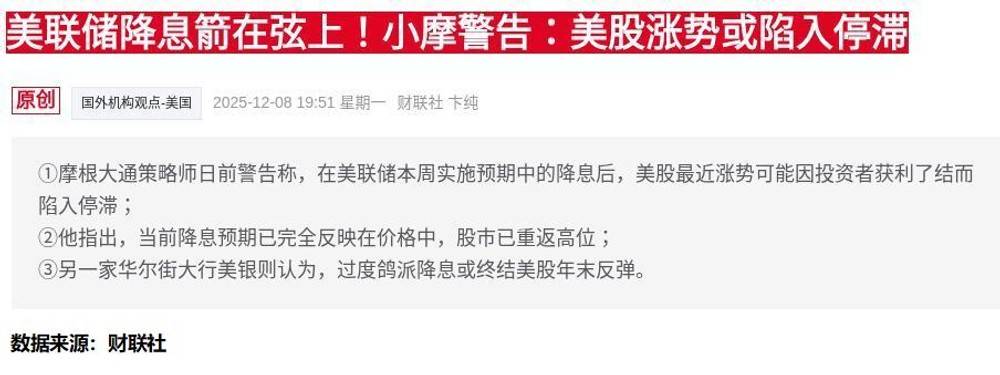
Core Insights - Morgan Stanley's latest report indicates a pause in market enthusiasm for interest rate cuts, contrasting with previous expectations for a rally [1] - The report suggests that institutional investors are likely to lock in profits, indicating a potential exit from the market while maintaining a cautiously optimistic mid-term outlook [3] Group 1: Market Sentiment - The report highlights a shift in investor behavior, with large funds potentially looking to exit the market while still being wary of missing out on future gains [3] - Historical context is provided, referencing a similar situation in 2023 where market expectations for rate cuts led to a prolonged period of volatility [1] Group 2: Technical Analysis - The article discusses the pitfalls of traditional technical analysis, emphasizing that volume-based breakouts can sometimes mislead investors, as they may indicate distribution rather than genuine upward momentum [4] - A case study of Cambrian shows that despite a long period of sideways movement, institutional funds were quietly accumulating shares, contradicting traditional analysis expectations [6] Group 3: Institutional Behavior - The concept of "institutional inventory" is introduced as a key indicator of large fund activity, suggesting that sustained institutional engagement can precede significant price movements [6] - The report notes that when institutional selling signals appear, it often precedes sharp declines in stock prices, highlighting the predictive power of quantitative data [10] Group 4: Interest Rate Dynamics - The report implies that institutional investors have already positioned themselves ahead of anticipated interest rate cuts, using the announcement as an opportunity to sell [10] - A statement from a U.S. bank strategist suggests that overly dovish signals from the Federal Reserve could stifle market rebounds, as seasoned investors recognize that good news can quickly turn into bad news [10] Group 5: Investment Strategy - The article advises investors to move away from traditional candlestick patterns and instead focus on quantitative tools to navigate market complexities [11] - It emphasizes the importance of understanding who controls the market dynamics, rather than merely predicting price movements [11] Group 6: Conclusion - The financial market is characterized by information asymmetry, and the report underscores that true opportunities lie in the details that are not immediately visible to the average investor [13] - The survival of market participants hinges on their ability to interpret data effectively, distinguishing between those who understand the market and those who are merely influenced by it [13]