食品安全

Search documents
伪科普有哪些常见套路(唠“科”)
Ren Min Ri Bao· 2025-12-19 22:10
Core Viewpoint - The article discusses the prevalence of pseudoscience in online content, particularly in health and wellness, and highlights the challenges in distinguishing credible scientific information from misleading claims [2][3]. Group 1: Pseudoscience Overview - Pseudoscience is particularly rampant in health-related topics, with statistics indicating that approximately 35% of debunked claims pertain to health, 30% to food safety and nutrition, and 15% to beauty and skincare [3]. - Emerging pseudoscience in technology, such as claims about "quantum" products and exaggerated AI capabilities, is also noted, which can mislead the public and undermine respect for genuine science [3]. Group 2: Common Tactics of Pseudoscience - Fear-based marketing is a common tactic, using alarming terms like "cancer-causing" to attract attention and encourage sharing among users [4]. - The use of complex jargon to confuse the audience is prevalent, as seen in claims about "quantum" products that lack scientific basis [4]. - False authority is often invoked, with claims of research from reputable institutions that are later found to be unsubstantiated [4]. Group 3: Challenges in Combating Pseudoscience - The low cost of spreading misinformation contrasts sharply with the resource-intensive process of debunking false claims, which requires thorough investigation and scientific explanation [5]. - Economic incentives drive the production of pseudoscientific content, with a growing gray industry that leverages social media for profit [5]. - The advancement of AI technology has lowered the barriers for creating and disseminating pseudoscientific content, complicating efforts to identify and counteract it [5]. Group 4: Recommendations for Public Awareness - Individuals are encouraged to verify the sources of information, as credible scientific content typically cites authoritative studies and data [6]. - Skepticism towards absolute claims is advised, as legitimate scientific research often uses tentative language [6]. - Consulting authoritative platforms for verification of claims is recommended, such as the scientific debunking platforms established by national organizations [7].
三聚氰胺吹哨人简光洲:一名调查记者和他的黄金时代丨我们的四分之一世纪
Jing Ji Guan Cha Wang· 2025-12-19 10:28
0:00 编者按: 2025 年,经济观察报以 " 我们的四分之一世纪 " 为年终特刊主题,旨在通过数十位时代亲历者的故事,共绘一幅属于这段岁月的集体记忆图谱。 12月的上海还没有入冬,简光洲穿着西装白衬衫,商务装成了他转行后的标配。在做媒体人时,他常穿的是T恤。相比做记者时,他的身材有些发福,"各 种应酬太多了,为了生活"。 17年前爆发的"三鹿奶粉三聚氰胺事件"是中国食品安全史上最严重的危机之一。简光洲正是该事件的吹哨人,也是中国首批调查记者之一。 2008年9月11日,《东方早报》A20版以半版篇幅,刊登了简光洲的调查报道《甘肃14婴儿同患肾病 疑因喝"三鹿"奶粉所致》。由此,当时的中华人民共和 国卫生部查出三鹿奶粉里含有三聚氰胺,随之也改写了中国奶业的发展进程,推动了《中华人民共和国食品安全法》(下称《食品安全法》)的提前出台。 报道刊发当年,简光洲被《新周刊》评为年度新锐人物。评委会的颁奖词如是写道:真相因良知而显露,黑幕因勇气而洞开。他打破媒体"某"规则,直接说 出了"三鹿"两个字,引发了中国奶制品行业的地震,间接挽救了无数婴幼儿的生命健康。在蝼蚁撼大象的背后,他和他所供职的《东方早报》的诚实和勇 ...


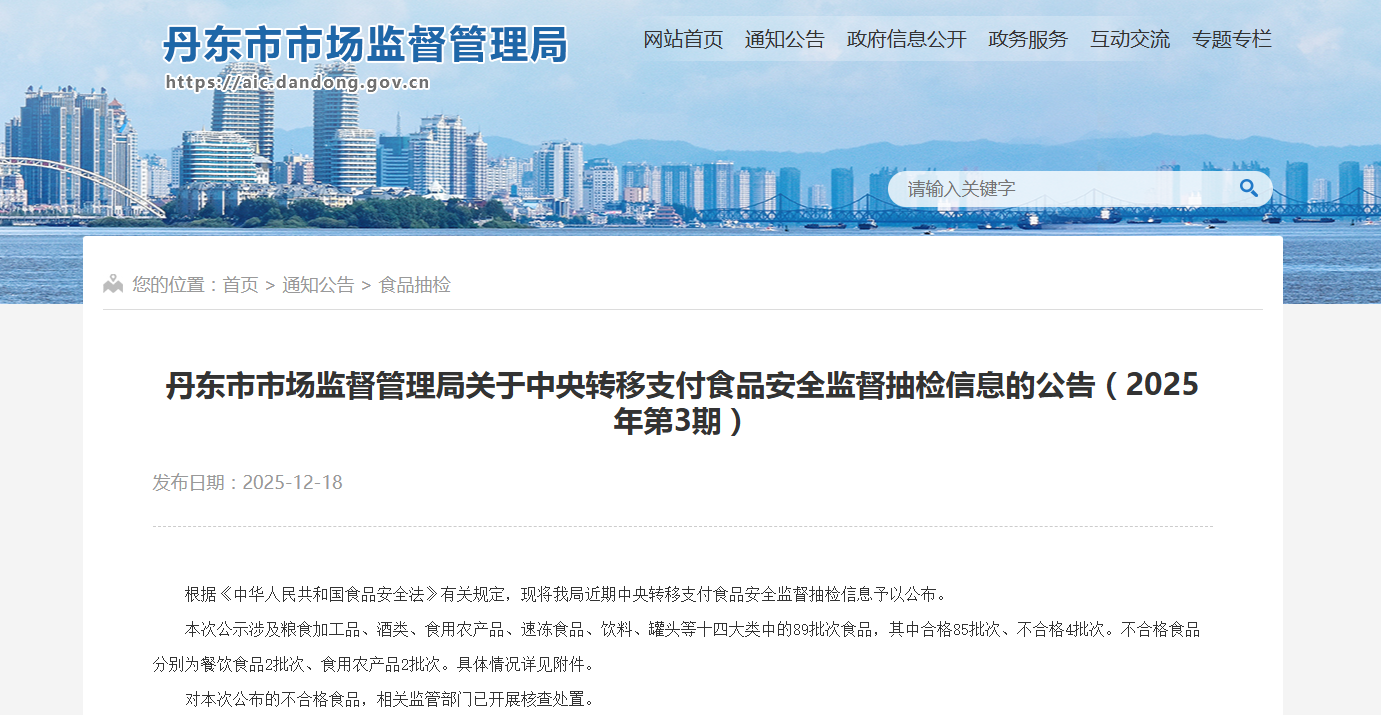
辽宁省丹东市市场监督管理局关于中央转移支付食品安全监督抽检信息的公告(2025年第3期)
Zhong Guo Zhi Liang Xin Wen Wang· 2025-12-19 06:34
根据《中华人民共和国食品安全法》有关规定,现将我局近期中央转移支付食品安全监督抽检信息予以公布。 本次公示涉及粮食加工品、酒类、食用农产品、速冻食品、饮料、罐头等十四大类中的89批次食品,其中合格85批次、不合格4批次。不合格食品分别为餐 饮食品2批次、食用农产品2批次。具体情况详见附件。 对本次公布的不合格食品,相关监管部门已开展核查处置。 特此公告。 丹东市市场监督管理局 2025年12月18日 | 附件1 | | | | | | | | | | | | | | --- | --- | --- | --- | --- | --- | --- | --- | --- | --- | --- | --- | --- | | | | | | 丹东市市场监管局2025年中央转移支付食品监督抽检合格信息(三) | | | | | | | | | | | | | | | | | | | | | 任 | | | 标称 | | | | | | | | | | | 务 检 来 | 检 | | | | | | | | 生产 | | | | | | | | 序 | 生产 | 标称生产 | 被抽样单 | 食品名称 | 规格型号 ...
三县联动筑防线 共护“柿饼”安全甜 ——恭城、平乐、阳朔三县召开食品安全(柿饼产业)风险预警交流区域协作联席会议
Zhong Guo Shi Pin Wang· 2025-12-18 10:22
(撰稿人:恭城县市场监管局--唐艳华) 为深入防范区域性食品安全风险,推动地方特色食品产业健康持续发展,2025年12月18日,恭城瑶族自 治县、平乐县、阳朔县市场监管局在恭城召开食品安全(柿饼产业)风险预警交流区域协作联席会议。 会议通报了近两年来与会各县柿饼抽样检测、日常监督检查、投诉举报中发现的风险隐患点,分享了在 柿饼小作坊整治提升、标准化加工龙头企业示范基地、追溯体系建设等方面监管服务探索做法。通过数 据共享和案例剖析,对共性问题和潜在风险讨论研判,建立完善了区域风险预警清单。 会议旨在针对柿饼水果干制品、柿饼蜜饯等产品在生产、加工、销售环节中可能存在的区域性、系统性 风险,强化严密高效跨县域的协同监管。强调要严格落实属地管理责任、部门监管责任和企业主体责 任,形成齐抓共管格局。坚持问题导向紧盯风险清单,实施精准治理,持续消除安全隐患。加强政府、 行业、企业、社会多方联动,加大科普宣传力度,提升消费者辨识能力,营造食品安全社会共治良好氛 围,守牢产业金字招牌,护好安全底色,推动产业可持续发展。 ...
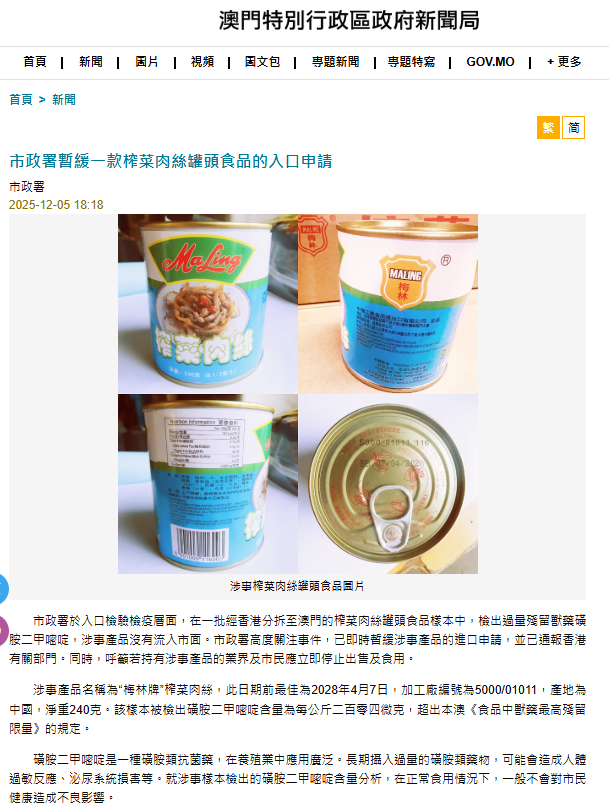
ESG观察|中粮“梅林”罐头检出过量残留兽药 何以守护“舌尖安全”?
资料来源:
Xin Lang Cai Jing· 2025-12-18 09:15
Core Viewpoint - Recent detection of excessive veterinary drug residues in "Meilin" canned food has raised serious concerns regarding food safety associated with COFCO's brand, COFCO Meilin [1][14] Group 1: Incident Details - The Macau Municipal Bureau announced on December 5 that a batch of "Meilin" canned food was found to contain 204μg/kg of sulfanilamide, exceeding the regulatory limit of 100μg/kg by more than double [7][20] - The Macau authorities have suspended the import application for the affected products and advised the public to stop selling and consuming them [1][14] - This is not the first instance of COFCO Meilin's products being flagged for sulfanilamide residue; a similar issue was reported in 2017 [20] Group 2: Implications for Food Safety - The incident highlights critical issues regarding compliance and control of veterinary drug use in the food supply chain, which is essential for public health [21] - Any issues revealed during testing, regardless of whether the products reach consumers, serve as warning signals for the food safety management system [21] - COFCO's ESG rating is B (lagging), indicating significant room for improvement in environmental, social, and governance performance [21] Group 3: Corporate Response and Future Actions - COFCO has previously emphasized the importance of food safety as a core aspect of its operations, establishing "six red lines" for food safety management [22] - The incident underscores the need for COFCO and its supply chain partners to implement stringent internal control standards and traceability systems throughout the entire food production process [22] - Companies must remain sensitive to regulatory requirements in different regions, ensuring that food safety management goes beyond mere testing to include proactive and transparent ESG practices [22]
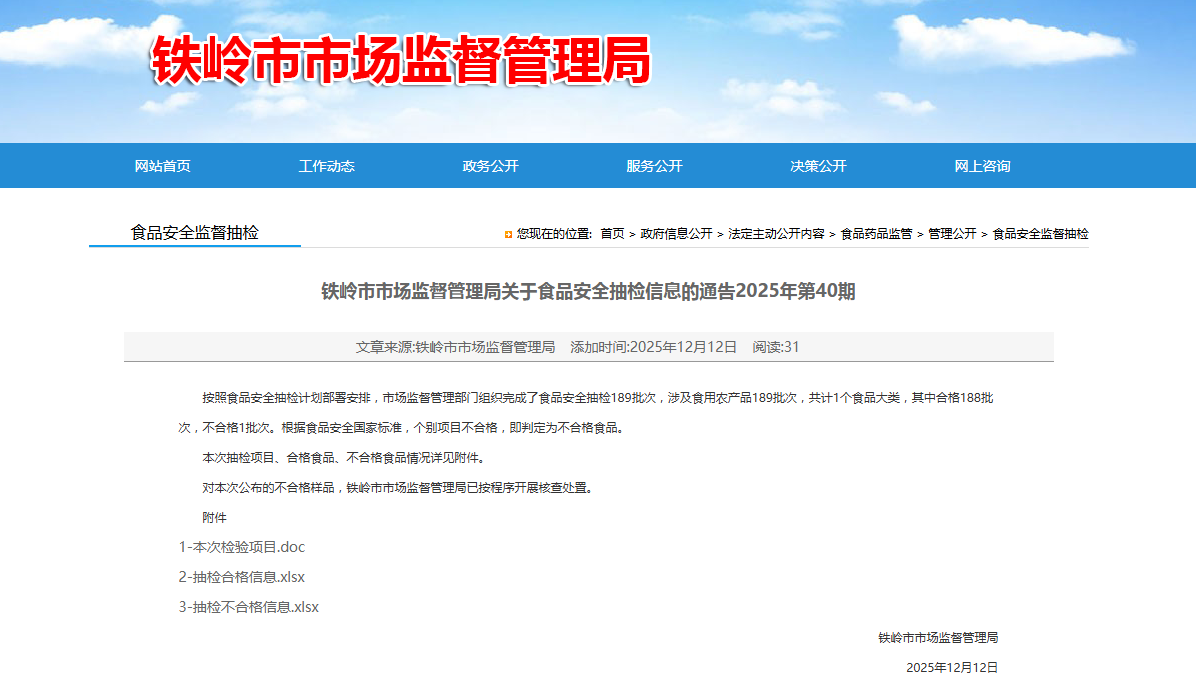
辽宁省铁岭市市场监督管理局关于食品安全抽检信息的通告2025年第40期
Zhong Guo Zhi Liang Xin Wen Wang· 2025-12-18 03:15
Summary of Key Points Core Viewpoint The Iron Ridge Market Supervision Administration conducted a food safety inspection, testing 189 batches of edible agricultural products, with 188 passing and 1 failing the national food safety standards. The administration has initiated verification and disposal procedures for the non-compliant sample [1][2]. Group 1: Inspection Results - A total of 189 batches of edible agricultural products were tested, with 188 deemed compliant and 1 non-compliant [1][2]. - The non-compliant sample was determined based on individual project failures according to national food safety standards [1][2]. Group 2: Follow-up Actions - The Iron Ridge Market Supervision Administration has commenced verification and disposal procedures for the reported non-compliant sample [1][2]. Group 3: Attachments and Details - Detailed information regarding the inspection projects, compliant products, and non-compliant products is available in the attached documents [2].
日本海鲜退场后,印度海鲜欲“霸占”中国市场!
Jin Tou Wang· 2025-12-17 09:50
Core Viewpoint - The suspension of Japanese seafood imports by China has led to a surge in Indian seafood stocks, with Indian media claiming a potential market opportunity in China, despite significant consumer resistance in China against Indian seafood products [1][2]. Group 1: Indian Seafood Market Potential - India is the second-largest seafood producer globally, with a rich variety of products including farmed shrimp, sea fish, crabs, squid, and lobsters, particularly excelling in shrimp exports [2]. - Following China's ban on Japanese seafood, Indian seafood companies experienced an 11% increase in stock prices, indicating optimism about entering the Chinese market [1]. Group 2: Food Safety Concerns - Indian food safety issues are a major concern, with data showing that from 2008 to 2018, food poisoning accounted for 31.5% of illnesses in certain regions, and 8.7% of deaths were attributed to foodborne illnesses [2]. - The leading cause of foodborne illnesses in India is food chemical contamination, which has a death rate of 70%, highlighting severe food safety challenges [2]. Group 3: Environmental and Hygiene Issues - India's climate, characterized by high temperatures and humidity, fosters bacterial growth, leading to rapid food spoilage [3]. - Poor sanitation practices, including the direct discharge of waste into water bodies, have resulted in severe water pollution, with 70% of surface water in India deemed unsafe for consumption [4]. Group 4: Alternatives to Indian Seafood - China has viable alternatives to Indian seafood, such as Ecuadorian shrimp and increasing domestic shrimp production, which reached 1.66 million tons last year [5]. - The decline in imported frozen shrimp from 1.17 million tons to 1.04 million tons indicates a shift towards domestic sources, as consumer preferences lean towards quality and safety over origin [5].
贵阳市市场监督管理局2025年第19期市级食品安全监督抽检公告
Zhong Guo Zhi Liang Xin Wen Wang· 2025-12-17 08:39
Core Points - The Guizhou Market Supervision Administration conducted a food safety inspection, sampling 722 batches of food products across 21 categories, with 25 batches found to be non-compliant [3]. Group 1: Inspection Results - A total of 722 samples were collected, covering categories such as biscuits, tea, nuts, egg products, starch, condiments, and beverages [3]. - 25 batches were identified as non-compliant, with issues related to indicators such as coliform bacteria, anionic synthetic detergents, and pesticide residues [3]. Group 2: Compliance Actions - The local market supervision departments have been instructed to investigate and manage the non-compliant products, including tracing product distribution and recalling defective items [3]. - The administration emphasized strict legal actions against violations and committed to publicly disclose the risk control measures taken by the companies involved [3].
贵阳市市场监督管理局2025年第20期市级食品安全监督抽检公告
Zhong Guo Zhi Liang Xin Wen Wang· 2025-12-17 08:37
Summary of Key Points Core Viewpoint - The Guizhou Provincial Market Supervision Administration conducted a food safety inspection, revealing that out of 1,053 samples across 26 categories, 35 samples were found to be non-compliant with safety standards, indicating potential risks in food safety in the region [2]. Group 1: Inspection Results - A total of 1,053 samples were collected from various food categories including biscuits, tea, and meat products [2]. - 35 samples were identified as non-compliant, with issues related to contaminants such as cadmium, lead, and various pesticide residues [2]. - Specific non-compliance examples include cadmium levels exceeding the limit in chili peppers (0.0891 mg/kg vs. ≤0.05 mg/kg) and the presence of banned substances like malachite green in fish [3]. Group 2: Regulatory Actions - The local market supervision departments have been instructed to investigate and manage the non-compliant products, including product recalls and risk control measures [2]. - The administration emphasized strict legal actions against any violations and committed to publicizing the risk control measures taken by the companies involved [2]. Group 3: Categories of Non-compliance - Non-compliance issues were found in various food categories, including: - Vegetables: Cadmium and pesticide residues [3]. - Dairy Products: Issues with acid value in dairy products [3]. - Processed Foods: Presence of harmful substances like sulfur dioxide and various pesticides [4][5]. Group 4: Public Health Implications - The findings highlight ongoing concerns regarding food safety and public health in Guizhou, necessitating increased vigilance and regulatory oversight [2]. - The administration's proactive approach aims to mitigate risks and enhance consumer confidence in food safety [2].
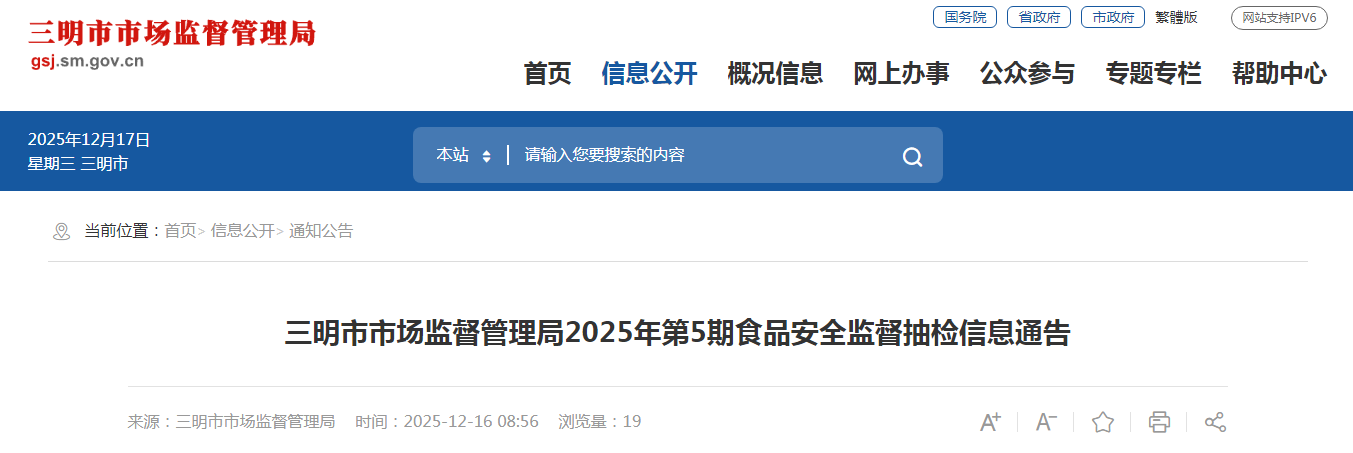
福建省三明市市场监督管理局2025年第5期食品安全监督抽检信息通告
Zhong Guo Zhi Liang Xin Wen Wang· 2025-12-17 07:34
Summary of Key Points Core Viewpoint - The announcement from the Sanming Market Supervision Administration highlights the results of the fifth round of food safety supervision and sampling inspections, indicating a high compliance rate with 237 out of 242 batches passing inspection, while 5 batches were found to be non-compliant [2]. Group 1: Inspection Results - A total of 242 batches of food products were inspected, which included both catering food (including dining utensils) and edible agricultural products [2]. - Out of the 242 batches, 237 were found to be compliant, resulting in a compliance rate of approximately 98% [2]. - The 5 non-compliant batches have prompted local market regulatory authorities to take action, including stopping sales, removing products from shelves, recalling items, and announcing the violations [2]. Group 2: Consumer Advisory - Consumers are advised to report any instances of the non-compliant products listed in the announcement by calling the complaint hotline 12315 [2]. - The announcement serves as a reminder for consumers to remain vigilant regarding food safety and to take action if they encounter the specified non-compliant products [2].