
全国统一大市场

Search documents
深刻把握“五个必须” 推动“十五五”良好开局
Ren Min Ri Bao· 2026-01-13 00:35
Group 1 - The core viewpoint emphasizes the necessity of fully tapping into economic potential, combining policy support with reform innovation, ensuring effective governance while allowing market flexibility, integrating investments in both physical and human capital, and honing internal capabilities to face external challenges [1][6][20]. Group 2 - Fully tapping into economic potential is crucial for solidifying the material foundation of Chinese-style modernization, leveraging the country's multiple advantages to foster new growth points and high-quality development [2][3]. - China, as the world's second-largest economy, benefits from a vast market that ensures internal circulation, a robust innovation ecosystem, and a strong industrial supply chain, positioning it as a key player in the global economic landscape [3][4]. - The Chinese economy has shown resilience against external shocks, maintaining its status as a major contributor to global economic growth, supported by a large consumer market and a complete industrial system [4][21]. Group 3 - The approach of combining policy support with reform innovation is essential for addressing the intertwined cyclical, structural, and institutional issues in the economy, ensuring effective macroeconomic governance [7][9]. - This dual approach has been proven effective in navigating complex domestic and international environments, enhancing macroeconomic stability while promoting structural reforms [8][10]. Group 4 - Achieving a balance between market freedom and government regulation is vital for enhancing economic governance and ensuring high-quality development [12][13]. - The focus should be on creating a fair competitive environment while allowing market forces to allocate resources efficiently, thus fostering a dynamic economic order [14][15]. Group 5 - Investments should be closely integrated between physical assets and human capital, with a shift towards enhancing human development as the economy matures [16][18]. - There is significant room for improvement in both physical and human capital investments, with current levels lagging behind developed countries, indicating potential growth areas [17][19]. Group 6 - The emphasis on internal capabilities is crucial for responding to external challenges, with a focus on maintaining strategic determination and leveraging the advantages of a large economy [20][22]. - Historical resilience against external shocks has been demonstrated, with strategies to shift towards domestic demand and innovation driving economic stability and growth [21][23].
人民日报钟才文:深刻把握“五个必须”,推动“十五五”良好开局
Xin Lang Cai Jing· 2026-01-12 23:09
Core Viewpoint - The article emphasizes the importance of leveraging China's economic advantages to achieve a strong start in the "14th Five-Year Plan" by enhancing the real economy and building a modern industrial system [1] Group 1: Economic Development Strategies - Strengthening and optimizing the real economy while addressing structural contradictions through digital transformation [1] - Promoting the development of emerging and future industries through classified planning and large-scale application demonstrations of new technologies and products [1] - Enhancing the quality and efficiency of the service industry to uncover new economic growth points [1] Group 2: Innovation and Technology - Increasing self-innovation capabilities and accelerating high-level technological independence [1] - Implementing extraordinary measures to overcome reliance on critical core technologies [1] - Strengthening the role of enterprises in innovation and facilitating the aggregation of innovation resources [1] Group 3: Market and Investment - Building a strong domestic market and ensuring smooth domestic and international dual circulation [1] - Breaking down barriers to establish a unified national market and improving supporting systems such as statistics and taxation [1] - Promoting balanced development of imports and exports while diversifying export markets [1]
政府投资基金进入规范发展新阶段
Ren Min Ri Bao· 2026-01-12 20:24
从具体投向看,政府投资基金投向领域应当符合国家生产力布局宏观调控要求,符合《产业结构调整指 导目录》等国家级产业目录中的鼓励类产业,符合国有经济布局优化和结构调整指引的具体要求,符合 国家级发展规划及国家级专项规划、区域规划要求,支持省级重点产业和特色产业发展,鼓励有关行业 企业加快技术更新换代,推动产业提质升级。 本报北京1月12日电(记者邱海峰)12日,国家发展改革委等部门对外发布《关于加强政府投资基金布局 规划和投向指导的工作办法(试行)》(以下简称《工作办法》)和《政府投资基金投向评价管理办法(试 行)》(以下简称《管理办法》),更加突出政府引导和政策性定位,促进政府投资基金高质量发展。 政府投资基金是各级政府通过预算安排,单独出资或与社会资本共同出资设立,采用股权投资等市场化 方式,引导各类社会资本支持相关产业和领域发展及创新创业的投资基金。中国宏观经济研究院经济所 研究员刘国艳表示,近年来,政府投资基金作为财政支出方式的重要创新,在撬动社会资本、支持创新 创业、培育新兴产业、推动产业升级等方面发挥了积极作用。国家发展改革委会同有关部门出台了《工 作办法》和《管理办法》两份文件,旨在构建"规划先行、 ...
人民日报评论员:更加坚决有力地贯彻落实党中央重大决策部署——论学习贯彻习近平总书记二十届中央纪委五次全会重要讲话精神
Xin Hua She· 2026-01-12 16:12
新华社北京1月12日电 人民日报1月13日评论员文章:更加坚决有力地贯彻落实党中央重大决策部 署——论学习贯彻习近平总书记二十届中央纪委五次全会重要讲话精神 进入基本实现社会主义现代化夯实基础、全面发力的关键时期,如何把党的二十届四中全会擘画的 蓝图变为现实?历史和实践告诉我们:关键在党、关键在全面从严治党。 再比如纵深推进全国统一大市场建设。近年来,集中清理4218件妨碍全国统一市场和公平竞争的规 定和做法,但在企业竞争、政府采购招标、地方招商引资等领域,仍存在阻碍全国统一大市场建设的卡 点堵点。牢固树立大局意识,坚决破除地方保护和市场分割,才能不断塑造我国发展新动能新优势。 坚决有力贯彻落实党中央重大决策部署与创造性开展工作并不矛盾。党中央的决策部署是立足全国 发展大局制定的,带有普遍性、全局性、方向性。只有立足发展实际,创造性抓落实,才能确保党中央 决策部署落地生根。 从党的二十届四中全会的战略擘画,到开好局、起好步的明确要求,再到今年经济社会发展的目标 任务……党中央作出的重大战略决策,明确的工作思路、任务、政策,都是经过充分论证、反复研究提 出的。定了就要落实。坚持全党一条心、全国一盘棋,切实把党中 ...
港口期现聚新力 赋能统一大市场
Qi Huo Ri Bao Wang· 2026-01-12 13:54
Core Viewpoint - The establishment of a unified national market is a strategic initiative aimed at facilitating domestic circulation and constructing a new development pattern, focusing on breaking regional barriers, optimizing resource allocation, and enhancing the resilience of industrial and supply chains [1] Group 1: Market Development and Integration - Shandong Port Group's investment holding company has aligned with national strategic deployments, leveraging innovation in futures and spot market integration to enhance industry services and market functions [1] - The company has achieved a comprehensive layout of futures and spot trading licenses, creating a full-chain market system that includes clearing houses, futures companies, risk management subsidiaries, delivery centers, and spot trading centers [1] Group 2: Supply Chain Innovations - The company has developed a sales-based procurement model for liquefied petroleum gas (LPG) that effectively activated 21,400 tons of port-stored LPG, supporting regional energy trade and creating an efficient commodity circulation system [2] - In the rubber industry, the company has implemented a comprehensive service model that reduces production costs by over 10% for partner enterprises by eliminating intermediary trade markups and utilizing futures tools to mitigate price volatility risks [2] Group 3: Risk Management and Data Utilization - The company has created an integrated supply chain service solution for iron ore that combines port logistics, raw material supply, and risk management, effectively lowering overall costs for enterprises and securing the steel industry supply chain [3] - A collaboration with Xinhua News Agency has led to the establishment of a commodity index system that reflects market fluctuations and provides authoritative price benchmarks, enhancing price monitoring and risk prevention capabilities for enterprises [3] Group 4: Financial Services and Technology - The company has launched a comprehensive electronic warehouse receipt service platform that utilizes advanced technologies such as blockchain and big data, facilitating over 21 billion yuan in financing for clients and addressing financing challenges for small and medium-sized enterprises [4] - Regular cross-border RMB settlement services for crude oil transactions have been established, with plans to attract 10 foreign clients by 2025, contributing to the internationalization of the RMB and the Belt and Road Initiative [4] Group 5: Commitment to Economic Development - The company is committed to supporting the construction of a unified national market by enhancing service capabilities, optimizing resource allocation, and promoting high-quality development through continuous innovation in futures and spot market integration [5]
“国家级”规范!政府投资基金“投向哪、怎么投、谁来管”,明确了
Sou Hu Cai Jing· 2026-01-12 13:26
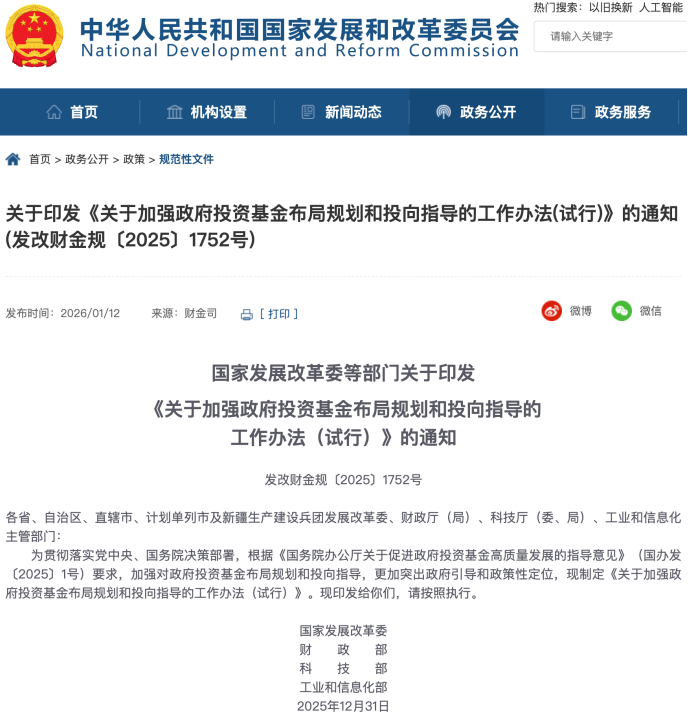
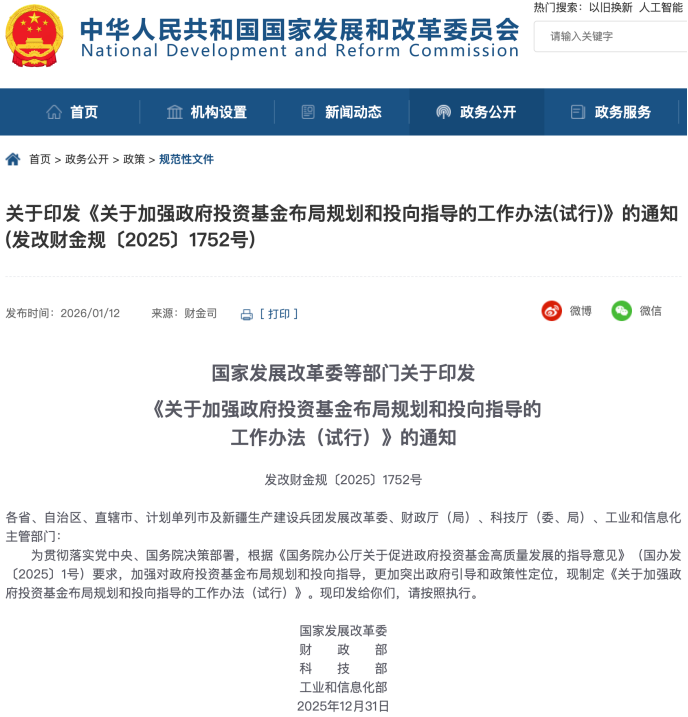
新年伊始,政府投资基金迎来首个"国家级"规范政策。 1月12日,国家发展改革委、财政部、科技部、工业和信息化部等四部门联合印发《关于加强政府投资 基金布局规划和投向指导的工作办法 (试行)》(以下简称《工作办法》),国家发展改革委同步出台 《政府投资基金投向评价管理办法(试行)》(以下简称《管理办法》),从布局规划、投向指导到评 价管理,形成全链条政策规范。 证券时报记者详细梳理发现,《工作办法》与2025年年初国务院发布的《促进政府投资基金高质量发展 的指导意见》(国办一号文)一脉相承,对各级政府投资基金的投资方向、基金定位、基金的统筹管理 等方面提出了指导意见。而《管理办法》则对政府投资基金的评价指标和评价指标体系作出了具体的安 排,其中,评价指标体系从政策符合性指标、优化生产力布局指标和政策执行能力指标三大门类和下设 的多个细分指标来对基金进行全方位的考察评价。 国家发展改革委相关负责人表示,这是首次在国家层面对政府投资基金的布局和投向作出系统规范。 LP投顾创始人国立波在接受记者采访时指出,国家发展改革委这套"组合拳"正在重构政府投资基金的 底层逻辑:推动基金从"招商工具"回归"产业资本"本质,从"地 ...
习近平在二十届中央纪委五次全会上发表重要讲话
中国基金报· 2026-01-12 11:27
中共中央政治局常委李强、赵乐际、王沪宁、蔡奇、丁薛祥出席会议。中共中央政治局常委、中央纪律 检查委员会书记李希主持会议。 习近平指出,2025年,党中央深入推进党风廉政建设和反腐败斗争,取得显著成效。强化政治监督,深 化政治巡视,有力保障党中央重大决策部署贯彻落实;扎实开展深入贯彻中央八项规定精神学习教育, 推动全党进一步改作风树新风;保持反腐败高压态势,推进风腐同查同治,深化整治群众身边不正之风 和腐败问题,着力铲除腐败滋生的土壤和条件。 习近平强调,贯彻落实党中央重大决策部署,是维护党中央权威和集中统一领导的根本要求,也是党和 人民事业不断发展进步的重要历史经验。"十五五"时期是基本实现社会主义现代化夯实基础、全面发力 的关键时期,各级党组织和广大党员、干部要增强政治责任感、历史使命感,以实际行动贯彻落实好党 的二十届四中全会各项决策部署。要紧紧围绕贯彻新发展理念、推动高质量发展、加快构建新发展格 局,聚焦建设现代化产业体系、因地制宜发展新质生产力、建设全国统一大市场、扩大高水平对外开 放、扎实推进全体人民共同富裕、常态化防止返贫致贫、化解地方政府隐性债务、加强生态环境保护、 统筹发展和安全等任务要求,加 ...

利好来了,“国家队”投向明确,四部门联合发布
Zheng Quan Shi Bao· 2026-01-12 06:56
Core Viewpoint - The National Development and Reform Commission and three other departments have jointly issued guidelines to strengthen the planning and investment direction of government investment funds, marking the first systematic regulation at the national level regarding the layout and investment focus of these funds [3][6]. Group 1: Investment Focus and Areas - The guidelines emphasize that investment funds should support the development of new productive forces, focusing on emerging industries such as new generation information technology, new energy, new materials, high-end equipment, new energy vehicles, green environmental protection, civil aviation, and marine engineering equipment [6][9]. - Future industries highlighted include the metaverse, brain-computer interfaces, quantum information, humanoid robots, generative artificial intelligence, biomanufacturing, biological breeding, future displays, future networks, and new energy storage [9][10]. Group 2: Policy Measures and Implementation - The guidelines propose 14 policy measures focusing on three main aspects: where to invest, how to invest, and who manages the funds [6][7]. - It requires funds to support major strategies and key areas, addressing weak links in resource allocation, and promoting deep integration of technological and industrial innovation [6][7]. - Local funds are instructed to align their investment directions with local industrial foundations and development realities, supporting industrial upgrades and the incubation of small and medium-sized enterprises [7][10]. Group 3: Evaluation and Management - The newly established evaluation management method includes three primary indicators: policy compliance (60% weight), optimization of productive force layout (30% weight), and policy execution capability (10% weight) [9][12]. - The policy compliance indicator assesses the fund's role in supporting new productive forces, technological innovation, and green development, among other areas [9][12]. - The optimization of productive force layout indicator evaluates the fund's alignment with national regional strategies and effective utilization of production capacity [12].
利好来了!事关政府投资基金,四部门重磅发文
Zheng Quan Shi Bao Wang· 2026-01-12 06:12
Core Viewpoint - The joint release of the "Work Method" by four government departments aims to provide systematic guidelines for the layout and investment direction of government investment funds, focusing on supporting emerging and future industries [1][2]. Group 1: Investment Direction - The "Work Method" emphasizes that funds should support major strategies and key areas, particularly in sectors where market resource allocation is weak, promoting deep integration of technological and industrial innovation [5]. - Investment areas include emerging industries such as new generation information technology, new energy, new materials, high-end equipment, new energy vehicles, green environmental protection, civil aviation, and marine engineering equipment [7]. - Future industries highlighted include the metaverse, brain-computer interfaces, quantum information, humanoid robots, generative artificial intelligence, biomanufacturing, biological breeding, future displays, future networks, and new energy storage [7]. Group 2: Fund Management and Evaluation - The "Management Method" establishes a comprehensive evaluation system for fund operations, combining quantitative and qualitative assessments, focusing on policy compliance, production layout optimization, and policy execution capabilities [6][7]. - Three primary evaluation indicators are set: policy compliance (60% weight), production layout optimization (30% weight), and policy execution capability (10% weight) [7]. - The evaluation will consider whether fund investments align with national major planning and encourage industries listed in the national industrial directory, avoiding restricted or eliminated sectors [5][6]. Group 3: Regional Focus and Local Fund Management - Local funds are required to align their investment directions with local industrial foundations and development realities, supporting industrial upgrades and innovation capabilities, particularly for small and micro enterprises and technology-based companies [6]. - The "Work Method" mandates that provincial development and reform departments create lists of key investment areas to optimize fund layout and direction [5][6].
政府投资基金怎么投?文件明确
Zhong Guo Zheng Quan Bao· 2026-01-12 04:46
国家发展改革委1月12日消息,为加强对政府投资基金布局规划和投向指导,更加突出政府引导和政策 性定位,国家发展改革委、财政部、科技部、工业和信息化部制定《关于加强政府投资基金布局规划和 投向指导的工作办法(试行)》。 国家发展改革委同步制定《政府投资基金投向评价管理办法(试行)》,充分发挥投向评价工作的指导 带动作用,引导政府投资基金落实国家产业调控要求,支持现代化产业体系建设。 中国宏观经济研究院经济所研究员刘国艳表示,两项办法协同实施,有助于引导金融资源更精准地流向 实体经济急需的领域,尤其是周期长、风险高、社会资本初期投入不足的环节,从而有效发挥政府投资 基金"引导、补缺、撬动"的功能。 投资鼓励类产业要防止盲目跟风 工作办法明确,政府投资基金应在基金设立方案中明确重点投资的产业领域。政府投资基金投向领域应 当符合国家生产力布局宏观调控要求,符合《产业结构调整指导目录》等国家级产业目录中的鼓励类产 业,符合国有经济布局优化和结构调整指引的具体要求,符合国家级发展规划及国家级专项规划、区域 规划要求,支持省级重点产业和特色产业发展,鼓励有关行业企业加快技术更新换代,推动产业提质升 级。 政府投资基金不得投 ...