
量化投资

Search documents
对话富达基金赵强:富达FOF的背后不是一个团队在“战斗”
Sou Hu Cai Jing· 2025-12-05 04:03
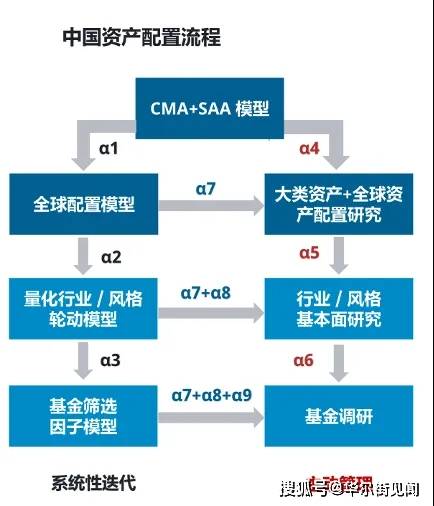
Core Insights - Public FOF products are expected to become a prominent category in the fund industry by 2025, driven by their inherent "diversified investment" and "asset allocation" capabilities [1] - The market is increasingly recognizing that stable product positioning and clear allocation logic, managed by experienced teams, make FOF products appealing as "one-stop" investment options for the general public [1] - However, there is a growing awareness that high-quality FOF products are scarce, and exceptional FOF managers are rare [1] Group 1: FOF Management and Team Structure - Zhao Qiang, head of the Multi-Asset Department at Fidelity, emphasizes that FOF management involves not just the fund manager's decisions but also teamwork and the support of a robust research system [2][3] - Fidelity's FOF management is supported by a comprehensive financial technology system that provides real-time strategy performance, risk alerts, and AI investment tools for portfolio optimization [2] - Fidelity China has developed the "NEMO" system to assist fund managers in managing investment processes from strategic to tactical allocation [2] Group 2: Investment Philosophy and Framework - Zhao Qiang's investment philosophy is influenced by his education at the University of Chicago, where he learned from Nobel laureates, shaping his views on quantitative and active investing [5] - He emphasizes the importance of accumulating a "framework" through practical experience, which helps in refining investment principles and response patterns [7] - Zhao Qiang's early experiences with Go have also influenced his approach to problem-solving and investment challenges, reinforcing the idea that difficulties often have systematic solutions [8] Group 3: Investment Strategy and Market Insights - Zhao Qiang initially focused on cash flow-related assets, prioritizing investments in markets and products with strong cash flow, such as high-yield overseas bonds and high-dividend stocks in Hong Kong [9] - After joining Fidelity, he recognized the importance of a balanced approach to FOF management, moving away from aggressive strategies that do not align with the product's design philosophy [9] - The FOF products are ultimately driven by asset allocation thinking, tailored to meet client wealth management needs [10] Group 4: Fidelity's Competitive Advantages - Fidelity's long-term strategic investments and commitment to its non-public company structure allow for sustained focus on long-term goals, which is rare in the industry [14] - The company places significant emphasis on human resources, fostering global team collaboration and integration to enhance strategic asset allocation [14] - Fidelity's investment systems, such as NEMO, facilitate collaboration among research teams, enabling effective portfolio construction and optimization [15] Group 5: Decision-Making Process in FOF Management - Fidelity employs a dual decision-making approach in FOF management, integrating both quantitative systems and subjective team insights to achieve balanced investment strategies [17] - Each asset allocation decision involves multiple layers of analysis, ensuring that both quantitative and qualitative perspectives are considered [17] - This structured approach minimizes emotional decision-making among research personnel, maintaining product integrity and optimizing performance [18] Group 6: New Product Launch and Market Positioning - The "Fidelity Renyuan Conservative Pension FOF" is notable for being the first pension FOF in the market to include overseas market indices in its benchmark [19] - Historical backtesting indicates that incorporating global assets like gold and overseas indices improves both returns and drawdowns compared to traditional asset mixes [19] - As a leading global player in pension investment, Fidelity's new FOF product is expected to attract significant interest regarding its performance and net value trajectory [20]

机构年底调仓:散户如何不被收割?
Sou Hu Cai Jing· 2025-12-04 18:40
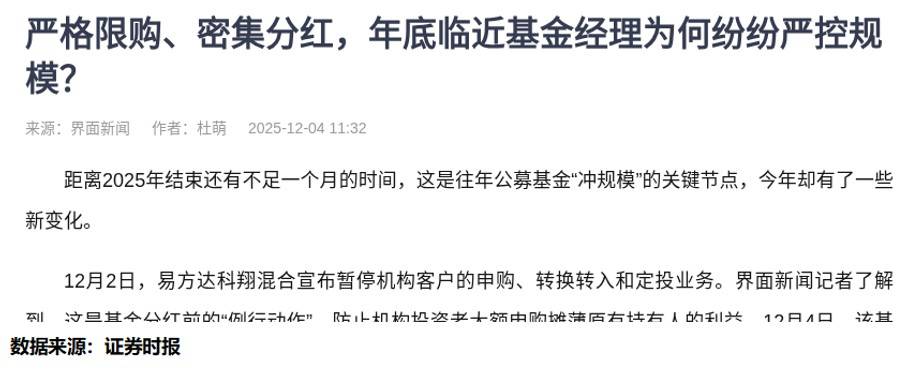
Group 1 - The core observation is the simultaneous occurrence of a dividend wave and purchase limits among high-performing funds, indicating a strategic maneuver by institutions [1][2] - As of December 4, 2025, a total of 3,364 funds have distributed approximately 215.517 billion yuan in dividends, with the Huatai-PB CSI 300 ETF leading at 8.394 billion yuan [2] - The practice of large-scale dividends often coincides with market turning points, suggesting that institutions are cashing in profits to prepare for future investments [3] Group 2 - From a quantitative perspective, the analysis reveals distinct behaviors in stock movements, with one stock showing institutional accumulation while another reflects retail investor activity [6][8] - The year-end market behavior aligns with the "year-end effect," where fund managers begin positioning for the upcoming year, often starting their strategies earlier than retail investors realize [8] - The importance of understanding the underlying intentions behind dividends and purchase limits is emphasized, as they do not always correlate with positive or negative market signals [9][13] Group 3 - Recommendations for ordinary investors include recognizing the psychological impact of dividends for locking in annual returns and understanding the rationale behind purchase limits to mitigate performance risks [9][10] - The future of quantitative investing is anticipated to flourish with advancements in AI and big data, enabling individual investors to access analytical tools previously available only to institutions [12] - The focus should be on tracking capital movements and establishing a personal analytical framework to navigate the complexities of the market [13][14]
私募11月备案产品激增近30%
Shen Zhen Shang Bao· 2025-12-04 17:16
Group 1 - The private equity market is experiencing a surge in product registrations, with November seeing a nearly 30% month-on-month increase, marking the second highest registration volume of the year [1] - A total of 1,285 private equity securities products were registered in November, reflecting a strong willingness among private equity firms to issue products as the year-end approaches [1] - Equity strategies remain the dominant focus for private equity firms, with 849 equity strategy products registered in November, accounting for 66.07% of the total [1] Group 2 - Multi-asset strategies and futures and derivatives strategies are also maintaining high levels of interest, with 193 multi-asset strategy products registered, representing 15.02% of the total [1] - Quantitative private equity products have shown particularly strong performance, with 565 products registered in November, making up 43.97% of the total [2] - Within quantitative strategies, equity strategies dominate with 402 products registered, while futures and derivatives strategies account for 80 products, representing 66.12% of that strategy's total [2]
海量Level2数据因子挖掘系列(六):用逐笔订单数据改进分钟频因子
GF SECURITIES· 2025-12-04 14:05
Quantitative Factors and Construction Factor Name: KeyPeriod_ret_zero - **Construction Idea**: This factor focuses on the return characteristics during horizontal trading periods within key intraday timeframes, leveraging Level 2 tick data to refine minute-frequency factors[7][25][41] - **Construction Process**: - Identify horizontal trading periods based on minimal price fluctuations - Calculate returns during these periods using tick-level data - Aggregate and smooth the data over different time horizons (e.g., 5-day, 20-day)[25][27] - **Evaluation**: Demonstrates strong predictive power for stock selection, with high IC stability and win rates[7][25] Factor Name: KeyPeriod_ret_low5pct - **Construction Idea**: This factor captures return characteristics during significant downward price movements within key intraday timeframes[7][25][64] - **Construction Process**: - Identify periods where returns fall within the bottom 5% of all intraday returns - Calculate and aggregate these returns over different time horizons - Apply smoothing techniques to enhance signal stability[25][27] - **Evaluation**: Exhibits robust performance in identifying underperforming stocks, with high IC values and win rates[7][25] Factor Name: KeyPeriod_price_low5pct - **Construction Idea**: This factor focuses on price levels during periods of low prices (bottom 5%) within key intraday timeframes[7][25][88] - **Construction Process**: - Identify periods where prices fall within the bottom 5% of all intraday prices - Aggregate and smooth the data over different time horizons - Incorporate buy/sell distinctions for further refinement[25][32] - **Evaluation**: Effective in capturing undervalued stocks, with strong IC performance and high win rates[7][25] Factor Name: KeyPeriod_amount_top30pct - **Construction Idea**: This factor targets periods of high transaction amounts (top 30%) within key intraday timeframes[7][25][110] - **Construction Process**: - Identify periods where transaction amounts are in the top 30% of all intraday amounts - Aggregate and smooth the data over different time horizons - Differentiate between buy and sell transactions for enhanced granularity[25][35] - **Evaluation**: Demonstrates strong predictive power for high-liquidity stocks, with high IC values and win rates[7][25] Factor Name: KeyPeriod_amount_low50pct - **Construction Idea**: This factor captures periods of low transaction amounts (bottom 50%) within key intraday timeframes[7][25][133] - **Construction Process**: - Identify periods where transaction amounts are in the bottom 50% of all intraday amounts - Aggregate and smooth the data over different time horizons - Incorporate buy/sell distinctions for further refinement[25][35] - **Evaluation**: Useful for identifying low-liquidity stocks, though performance is less consistent compared to other factors[7][25] Factor Name: KeyPeriod_sync_low50pct - **Construction Idea**: This factor measures volume-price divergence during periods of low synchronization (bottom 50%) within key intraday timeframes[7][25][155] - **Construction Process**: - Identify periods where volume and price movements are least synchronized - Aggregate and smooth the data over different time horizons - Differentiate between buy and sell transactions for enhanced granularity[25][38] - **Evaluation**: Effective in capturing unique market dynamics, with strong IC performance and high win rates[7][25] --- Backtesting Results KeyPeriod_ret_zero - **IC Mean**: -5.36% (20-day horizon)[27] - **Win Rate**: 85.1% (20-day horizon)[27] - **IR**: 1.34 (2020-2025)[55] KeyPeriod_ret_low5pct - **IC Mean**: 5.47% (20-day horizon)[27] - **Win Rate**: 84.1% (20-day horizon)[27] - **IR**: 1.41 (2020-2025)[77] KeyPeriod_price_low5pct - **IC Mean**: 5.59% (20-day horizon)[32] - **Win Rate**: 85.3% (20-day horizon)[32] - **IR**: 2.22 (2020-2025)[97] KeyPeriod_amount_top30pct - **IC Mean**: 11.23% (20-day horizon)[35] - **Win Rate**: 84.8% (20-day horizon)[35] - **IR**: 1.37 (2020-2025)[123] KeyPeriod_amount_low50pct - **IC Mean**: -10.50% (20-day horizon)[35] - **Win Rate**: 75.0% (20-day horizon)[35] - **IR**: 0.77 (2020-2025)[145] KeyPeriod_sync_low50pct - **IC Mean**: 6.00% (20-day horizon)[38] - **Win Rate**: 81.5% (20-day horizon)[38] - **IR**: 1.44 (2020-2025)[172]
权益因子观察周报第 128 期:上周成长因子表现较好,本年中证2000指数增强策略超额收益为28.08%-20251204
GUOTAI HAITONG SECURITIES· 2025-12-04 11:04
Quantitative Models and Construction Methods Index Enhancement Strategies - **Model Name**: Index Enhancement Strategy for CSI 300, CSI 500, CSI 1000, and CSI 2000 - **Model Construction Idea**: The strategy is based on a multi-factor stock selection model, leveraging an equity factor library to identify effective factors within the constituent stocks of the respective indices[77] - **Model Construction Process**: - **Factor Selection**: Hundreds of factors from the equity factor library are screened for effectiveness within the constituent stocks of CSI 300, CSI 500, CSI 1000, and CSI 2000 indices[77] - **Portfolio Optimization**: - For CSI 300: Strict sector and market capitalization neutrality, individual stock weight capped at 8%, and weight deviation capped at 3%[77] - For CSI 500: Strict sector and market capitalization neutrality, individual stock weight capped at 1%, and weight deviation capped at 1%[77] - For CSI 1000 and CSI 2000: Market capitalization deviation capped at 0.5 standard deviations, sector deviation capped at 2.5%, individual stock weight capped at 1% for CSI 1000 and 0.5% for CSI 2000[77] - **Rebalancing**: Weekly tracking of the performance of the index enhancement strategy within the constituent stocks[77] Model Evaluation - **Evaluation**: The strategy effectively utilizes a multi-factor approach to enhance index performance while maintaining sector and market capitalization neutrality. However, the strategy's performance is subject to transaction costs and historical data limitations[77][83] --- Model Backtesting Results CSI 300 Index Enhancement Strategy - **Weekly Return**: 1.53% (Index Return: 1.64%, Excess Return: -0.12%)[78] - **Monthly Return**: -3.31% (Index Return: -2.46%, Excess Return: -0.85%)[78] - **Year-to-Date Return**: 21.83% (Index Return: 15.04%, Excess Return: 6.8%)[78] - **Maximum Drawdown of Excess Return**: -3.15%[78] CSI 500 Index Enhancement Strategy - **Weekly Return**: 2.97% (Index Return: 3.14%, Excess Return: -0.17%)[78] - **Monthly Return**: -4.54% (Index Return: -4.08%, Excess Return: -0.46%)[78] - **Year-to-Date Return**: 23.41% (Index Return: 22.81%, Excess Return: 0.61%)[78] - **Maximum Drawdown of Excess Return**: -4.77%[78] CSI 1000 Index Enhancement Strategy - **Weekly Return**: 3.77% (Index Return: 3.77%, Excess Return: 0%)[83] - **Monthly Return**: -2.59% (Index Return: -2.3%, Excess Return: -0.29%)[83] - **Year-to-Date Return**: 35.59% (Index Return: 23.1%, Excess Return: 12.49%)[83] - **Maximum Drawdown of Excess Return**: -5.59%[83] CSI 2000 Index Enhancement Strategy - **Weekly Return**: 4.38% (Index Return: 4.99%, Excess Return: -0.61%)[83] - **Monthly Return**: -0.03% (Index Return: -0.4%, Excess Return: 0.37%)[83] - **Year-to-Date Return**: 59.74% (Index Return: 31.65%, Excess Return: 28.08%)[83] - **Maximum Drawdown of Excess Return**: -5.23%[83] --- Quantitative Factors and Construction Methods Single Factors - **Factor Name**: Analyst Forecast ROE-FY3 - **Construction Idea**: Measures the expected return on equity (ROE) for the next three fiscal years as forecasted by analysts[33] - **Construction Process**: Derived from analyst consensus estimates for ROE over the next three fiscal years[33] - **Evaluation**: Demonstrates strong predictive power for stock selection, particularly in CSI 300 and CSI 2000 stock pools[33][36] - **Factor Name**: Standardized Unexpected Quarterly ROE with Drift - **Construction Idea**: Captures the deviation of actual quarterly ROE from expectations, adjusted for drift[35] - **Construction Process**: - Calculate the unexpected component of quarterly ROE - Standardize the values and adjust for drift to account for temporal effects[35] - **Evaluation**: Effective in identifying outperforming stocks, particularly in CSI 1000 and CSI 2000 stock pools[35][36] - **Factor Name**: One-Month Price Change - **Construction Idea**: Reflects short-term momentum by measuring the percentage change in stock price over the past month[36] - **Construction Process**: Calculate the percentage change in stock price over the last 30 days[36] - **Evaluation**: Demonstrates strong performance in CSI 2000 and CSI 1000 stock pools, indicating momentum effects[36] Factor Neutralization - **Neutralization Process**: - Apply absolute median method for outlier removal - Perform Z-score standardization - Conduct cross-sectional regression using log market capitalization and industry dummy variables as independent variables, with the factor as the dependent variable - Use the residuals as the neutralized factor values[32] --- Factor Backtesting Results CSI 300 Stock Pool - **Top Factors (Year-to-Date Excess Return)**: - Single-Quarter Revenue Growth Rate: 25.24%[33] - Single-Quarter ROE: 22.28%[33] - Single-Quarter ROA Change: 22.21%[33] CSI 500 Stock Pool - **Top Factors (Year-to-Date Excess Return)**: - Analyst Forecast Net Profit Growth Rate FY3: 14.53%[34] - Analyst Forecast Revenue Growth Rate FY3: 13.69%[34] - Analyst Forecast Revenue FY3 120-Day Change: 12.81%[34] CSI 1000 Stock Pool - **Top Factors (Year-to-Date Excess Return)**: - Standardized Unexpected Quarterly ROE with Drift: 19.18%[35] - Analyst Forecast ROE-FY3 120-Day Change: 18.4%[35] - Standardized Unexpected Quarterly Net Profit with Drift: 18.34%[35] CSI 2000 Stock Pool - **Top Factors (Year-to-Date Excess Return)**: - 90-Day Report Upward Revision Ratio: 25.01%[36] - Standardized Unexpected Quarterly Net Profit with Drift: 24.46%[36] - 5-Minute Volume Skewness: 23.74%[36] CSI All-Share Stock Pool - **Top Factors (Year-to-Date Excess Return)**: - Analyst Forecast ROE-FY3 120-Day Change: 23.52%[37] - Single-Quarter Revenue Growth Rate: 20.47%[37] - Analyst Forecast Revenue Growth Rate FY3: 19.35%[37]
蝶威量化荣获“三年期金牛量化机构(指数增强策略)”奖项
Zhong Zheng Wang· 2025-12-04 09:20
Group 1 - The core event was the "2025 Quantitative Industry High-Quality Development Conference and Financial Technology · Quantitative Institution Golden Bull Award Ceremony" held in Shanghai, where Shanghai Diewei Private Fund Management Co., Ltd. (Diewei Quantitative) won the "Three-Year Golden Bull Quantitative Institution (Index Enhancement Strategy)" award for its outstanding long-term performance and robust research and investment system [1] - Diewei Quantitative, established in 2018, focuses on quantitative investment and has a core team with a strong interdisciplinary background, being one of the early adopters of artificial intelligence and machine learning methods in financial market practices [1] - The company has over 20 members in its research and IT teams, forming a professional group centered on data science and artificial intelligence, deeply integrating investment logic [1] Group 2 - Diewei Quantitative emphasizes deep data mining and efficient transformation, utilizing a factor library that includes traditional financial and volume-price data, as well as unstructured information through a self-developed text processing system and large models [2] - The company constructs a unique capability to understand short-term market funding trends by analyzing order flow and transaction data, combining fundamental, alternative, and micro-level data mining to form the basis of its strategy diversity and alpha sources [2] - In risk management, the company adheres to a strategy of "advance planning and real-time adjustment," incorporating dynamic risk budgeting and risk parity frameworks within its research and investment system to adjust risk allocation based on market volatility and strategy status [2] Group 3 - The award received by Diewei Quantitative is seen as both an acknowledgment of past achievements and a responsibility for the future, with a commitment to continue focusing on end-to-end reinforcement learning, multi-source data mining, and multi-stage combination optimization [3] - The company aims to increase technological investment to provide robust quantitative investment solutions for professional institutions and high-net-worth investors, seeking sustainable certainty amid uncertainty [3]
私募11月备案产品激增近30%,股票策略占比近七成
Sou Hu Cai Jing· 2025-12-04 06:43
Group 1 - The private equity market in China is experiencing a surge in product registrations, with November seeing a 29.28% increase compared to the previous month, totaling 1,285 registered private equity securities products, marking the second-highest monthly registration this year [1] - Equity strategies remain the dominant focus for private equity firms, with 849 equity strategy products registered in November, accounting for 66.07% of total registrations, indicating strong investor interest despite recent adjustments in the A-share market [1] - Multi-asset strategies and futures and derivatives strategies are also maintaining high levels of activity, with 193 multi-asset strategy products registered, representing 15.02% of the total [1] Group 2 - Quantitative private equity products are particularly noteworthy, with 565 products registered in November, making up 43.97% of total registrations; equity strategies dominate this category as well, with 402 products registered [2] - A total of 719 private equity firms registered products in November, with 49 firms registering five or more products, highlighting a strong enthusiasm for product registration, especially among leading quantitative firms [2] - Century Frontier leads in product registrations with 20 products, followed by Starstone Investment with 15, and Mingchao Investment, Shanghai Xiaoyong Private Equity, and Tiansuan Quantitative each with 12 products [2] Group 3 - The A-share market has seen fluctuations around the 3,900-point mark, but long-term trends remain positive according to DWSQ, which believes that current adjustments do not alter the medium to long-term bullish outlook for A-shares [3] - Support for market risk appetite is expected from policy and liquidity environments, with expectations of the Federal Reserve entering a rate-cutting phase and overall liquidity in the A-share market remaining ample [3] - Corporate earnings are showing signs of stabilization, with the technology and advanced manufacturing sectors expected to contribute positively to market opportunities due to external demand and technological upgrades [3]
新晋百亿私募!独特的指增策略:预测周期长,日内做T积累超额
私募排排网· 2025-12-04 03:58
Core Viewpoint - The article highlights the rapid growth and performance of Zhengying Asset, a private equity firm that has successfully surpassed 10 billion in management scale by leveraging a combination of subjective and quantitative investment strategies, particularly in the T0 trading space [2][4][5]. Group 1: Company Growth and Performance - Zhengying Asset's management scale increased from 20-50 billion at the end of 2024 to over 100 billion by September 2025 [2]. - The product "Zhengying Qiji Index Enhanced No. 1" has achieved significant returns, ranking among the top ten in excess return rates for quantitative private equity firms [2]. - The firm has seen its stock T0 strategy grow from zero to 8 billion in just four years, with current product lines in stock neutral T0 and index enhancement T0 strategies each around 4 billion [5][7]. Group 2: Investment Strategy and Technology - Zhengying Asset employs a combination of subjective and quantitative strategies, focusing on market insights and risk management [4]. - The firm has invested heavily in technology, particularly in financial technology and artificial intelligence, to enhance its trading capabilities [4][5]. - The high-frequency trading team consists of members from prestigious universities and has extensive experience in quantitative trading, contributing to the firm's rapid rise in the stock high-frequency domain [5]. Group 3: Risk Management - The company prioritizes risk control, implementing a comprehensive risk management framework that includes preemptive measures, real-time monitoring, and post-analysis of strategies [13][14][15][16]. - The risk management process involves thorough research and analysis of market conditions, industry trends, and company fundamentals to ensure the feasibility of investment strategies [14]. - The firm maintains a robust monitoring system for real-time tracking of positions and performance, ensuring timely responses to market changes [15]. Group 4: Unique Product Offerings - Zhengying Asset's index enhancement products have shown strong performance, with the "Zhengying Qiji Index Enhanced No. 17" achieving notable excess returns since its inception [17][19]. - The firm's strategy focuses on full replication of index constituents for daily trading to achieve excess returns, demonstrating a stable historical performance compared to peers [20]. - The trading frequency of the index enhancement products is high, with an average annual turnover rate of 200-300 times, aiming for short-term gains through intra-day trading [23].

随“集”而变——量化投资2026年度展望
2025-12-04 02:21
Summary of the Conference Call Industry Overview - The discussion revolves around the **quantitative investment** landscape and its performance relative to **active investment** strategies, particularly in the context of market conditions from 2017 to 2026 [1][3][6]. Key Insights and Arguments - **Market Conditions**: The performance of quantitative versus active investment is closely tied to market patterns. Divergent markets (frequent sector rotations) favor quantitative strategies, while consensus markets (high sector concentration) favor active strategies [1][3]. - **Historical Performance**: From 2013 to 2017, quantitative investment significantly outperformed active investment, driven by the strong performance of small-cap factors. However, from 2017 to 2021, quantitative investment underperformed due to market phenomena like the "beautiful 50" and the concentration in sectors like renewable energy and semiconductors. Since 2022, quantitative strategies have regained an edge [3][6]. - **Capital Concentration**: The concentration of capital is a key indicator for determining market patterns. High concentration indicates a consensus market, where cognitive alpha (industry trend predictions, in-depth stock analysis) is advantageous. Low concentration indicates a divergent market, where trading alpha (capturing behavioral biases, price-volume relationships) is more beneficial [4][6]. - **Future Outlook for 2026**: A structural market is anticipated in 2026, with a high probability that quantitative investment will outperform active investment. The recent rise in capital concentration, driven by sectors like AI and technology, may face challenges as valuations become high, potentially weakening the "herding" effect [6][8]. - **Institutional Preferences**: There are notable differences in asset allocation among institutions. Public funds favor technology sectors, while foreign and insurance companies lean towards dividend and value sectors. This suggests a potential shift in market focus between technology growth and traditional industry recovery [6][8]. Additional Important Points - **Short-term Market Sentiment**: The sentiment towards the stock market is optimistic, with a shift in investment style from growth to value since September. The current market shows a balanced approach between large-cap and small-cap stocks, with a slight preference for small-cap value [7][8]. - **Performance Metrics**: Historical data indicates that the narrow win rate for recommended styles is approximately 40%, while the broad win rate is around 80% [7]. - **Investment Recommendations**: There is a recommendation for a small-cap value style in the short term, alongside a suggestion to monitor the performance of models and strategies over the long term [2][7]. This summary encapsulates the key points discussed in the conference call, providing insights into the quantitative investment landscape and its future trajectory.
广发证券发展研究中心金融工程实习生招聘
广发金融工程研究· 2025-12-04 02:15
Group 1 - The company is recruiting interns for positions in Shenzhen, Shanghai, and Beijing, requiring in-person internships with a minimum commitment of three days per week for at least three months [1] - The application deadline for submitting resumes is December 31, 2025 [1] - Interns with outstanding performance may have the opportunity for full-time employment after the internship [1] Group 2 - Responsibilities include data processing, analysis, and assisting researchers with quantitative investment projects [2] - Interns will also assist in the development and tracking of financial engineering strategy models [2] - Additional tasks may be assigned by the team [2] Group 3 - Basic requirements include being a master's or doctoral student in STEM fields or financial engineering, with a strong preference for exceptional fourth-year students [3] - Proficiency in programming languages such as Python and familiarity with SQL databases are essential [3] - Candidates should possess strong self-motivation, analytical skills, and effective communication abilities [3] Group 4 - Preferred qualifications include a solid foundation in financial markets, familiarity with key concepts in stocks, bonds, futures, indices, and funds [4] - A strong mathematical background, research project experience, and published academic papers in SCI or EI are advantageous [4] - Familiarity with financial terminals like Wind, Bloomberg, and Tianruan, as well as knowledge of machine learning and deep learning, is a plus [4] Group 5 - Interested candidates should submit their resumes in PDF format to the specified email address, following a specific naming convention for the email subject [5] - Resumes not adhering to the naming format will be treated as spam [5] - Qualified candidates will be contacted for written tests and interviews after the resume collection deadline [5]

