
量子计算

Search documents
基金经理夏普比率10强曝光!幻方陆政哲摘桂冠!量魁梁涛、杨湜郑彬领衔
Sou Hu Cai Jing· 2025-12-29 07:19
Market Overview - Since 2025, the A-share market has shown an upward trend with significant market activity and distinct structural characteristics. As of December 19, the Shanghai Composite Index, Shenzhen Component Index, and ChiNext Index have increased by 16.07%, 26.17%, and 45.79% respectively, with an average daily trading volume of 1.72 trillion yuan [1] - Sectors such as technology, military industry, and non-ferrous metals have performed well, with companies like Cambrian, BYD, and CATL reaching new highs. The North Securities 50 Index has seen a peak increase of over 60% this year [1] Private Fund Performance - Private fund managers have also demonstrated strong performance in stock strategies, with an average return of 36.64% as of December 19, outperforming the Shanghai Composite and Shenzhen Component indices [1] - A total of 319 fund managers have stock strategy products that meet ranking criteria, with varying performance based on fund size [2] Fund Manager Analysis by Size 100 Billion and Above - In the 100 billion and above category, 57 fund managers have an average return of 35.58% and a Sharpe ratio of 1.79. The top fund manager is Lu Zhengzhe from Ningbo Huansheng Quantitative [5][6] 50-100 Billion - Among the 29 fund managers in the 50-100 billion category, the average return is 35.57% with a Sharpe ratio of 1.62. The top three fund managers are Shi En from Yunqi Quantitative, Liang Tao from Liang Kui Private Equity, and Liu Xiaofang from Guangdong Dehui Investment [11][15] 20-50 Billion - In the 20-50 billion category, 45 fund managers have an average return of 39.52% and a Sharpe ratio of 1.51. The top three are Yuan Hao from Beijing Xiyue, He Yuqing from Yidian Najin, and Wu Libin from Fox Investment [18] 10-20 Billion - For the 10-20 billion category, 36 fund managers have an average return of 41.89% and a Sharpe ratio of 1.62. The top three are Zheng Bin from Yangshi Asset, He Zhenquan from Liangli Private Equity, and Zhou Yifeng from Beiheng Fund [20][24] 5-10 Billion - In the 5-10 billion category, 52 fund managers have an average return of 34.57% and a Sharpe ratio of 1.24. The top three are Chen Long from Youbo Capital, Chen Zhidan from Hongyan Asset, and Sun Min from Wuzhi Investment [25] 0-5 Billion - Among the 100 fund managers in the 0-5 billion category, the average return is 35.43% with a Sharpe ratio of 1.20. The top three are Qin Peihua from Fengyu Investment, Hu Qintian from Guangzhou Tianzhanhan, and Zeng Fengwen from Changyi Fund [28][30]


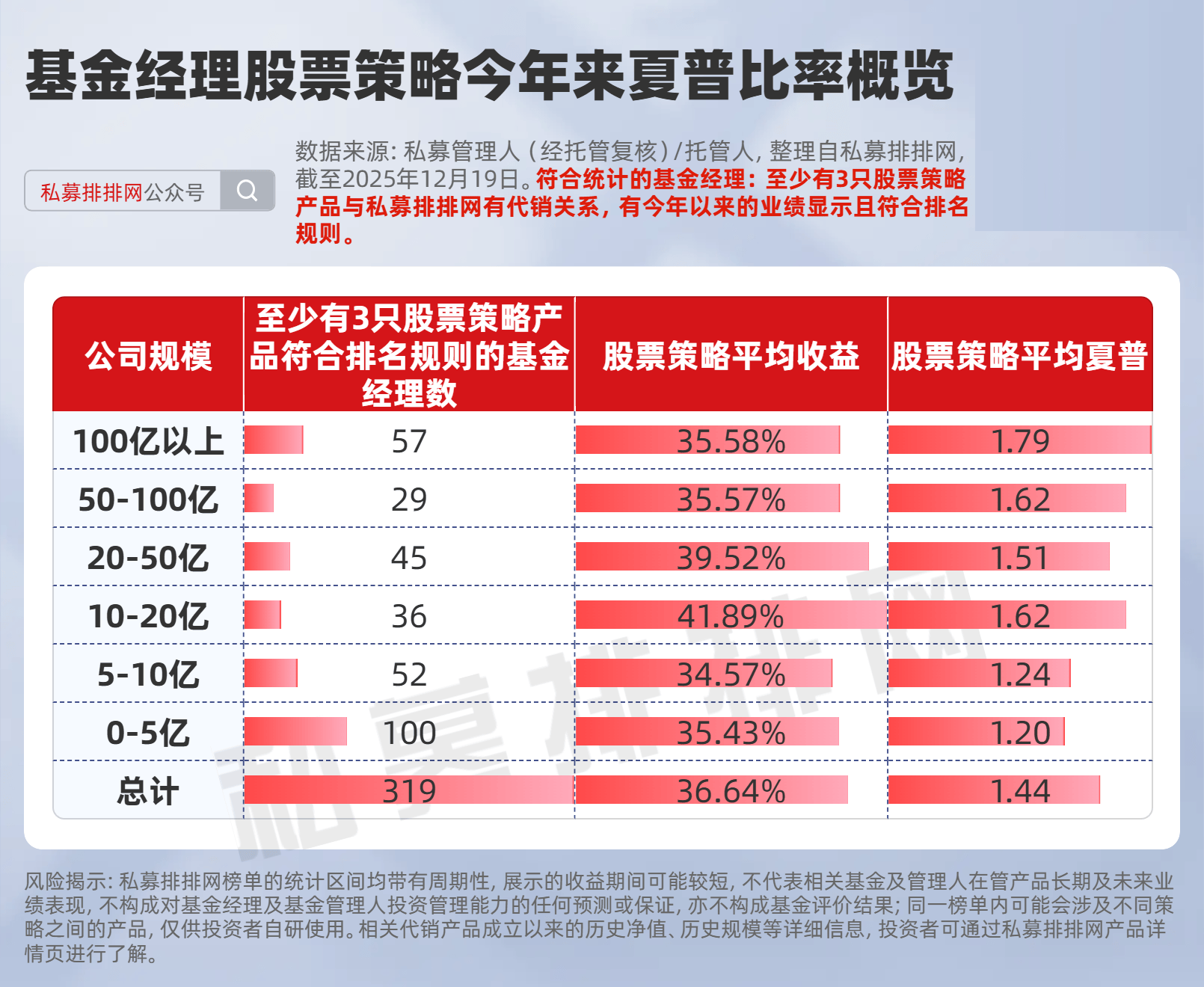
基金经理夏普比率10强曝光!幻方陆政哲摘得桂冠!量魁梁涛、杨湜郑彬领衔
私募排排网· 2025-12-29 03:39
Core Viewpoint - The A-share market has shown a significant upward trend since 2025, with notable increases in major indices and active trading volumes, indicating a strong structural market characteristic [2]. Market Performance - As of December 19, the Shanghai Composite Index, Shenzhen Component Index, and ChiNext Index have increased by 16.07%, 26.17%, and 45.79% respectively, with an average daily trading volume of 1.72 trillion yuan [2]. - Key sectors such as technology, military industry, and non-ferrous metals have performed well, with stocks like Cambrian, BYD, and CATL reaching new highs [2]. Private Fund Manager Performance - Among 319 fund managers with stock strategies, the average return is 36.64%, outperforming the major indices [2][3]. - The average Sharpe ratio for these fund managers is 1.44, with those managing over 10 billion yuan showing the best performance at an average Sharpe of 1.79 [3]. Fund Manager Rankings by Size - **100 Billion and Above**: 57 managers, average return 35.58%, average Sharpe 1.79 [3][4]. - **50-100 Billion**: 29 managers, average return 35.57%, average Sharpe 1.62 [8][11]. - **20-50 Billion**: 45 managers, average return 39.52%, average Sharpe 1.51 [12][15]. - **10-20 Billion**: 36 managers, average return 41.89%, average Sharpe 1.62 [17][20]. - **5-10 Billion**: 52 managers, average return 34.57%, average Sharpe 1.24 [21]. - **0-5 Billion**: 100 managers, average return 35.43%, average Sharpe 1.20 [24][27]. Notable Fund Managers - **Top in 100 Billion and Above**: Lu Zhengzhe from Ningbo Huansheng Quantitative, leading with a high Sharpe ratio [4][7]. - **Top in 50-100 Billion**: Shi En from Yunqi Quantitative, recognized for his quantitative investment experience [8][11]. - **Top in 20-50 Billion**: Yuan Hao from Beijing Xiyue, noted for his ability to combine fundamental and technical analysis [12][15]. - **Top in 10-20 Billion**: Zheng Bin from Yangshi Asset, with a focus on algorithmic trading [17][20]. - **Top in 5-10 Billion**: Chen Long from Youbo Capital, recognized for his investment strategies [21]. - **Top in 0-5 Billion**: Qin Peihua from Fengyu Investment, noted for his performance in the small fund category [24].
让量子科技更好造福人类
Ke Ji Ri Bao· 2025-12-29 00:48
Core Insights - Quantum technology is emerging as a pivotal force in the global tech landscape, with significant advancements made in 2025, including breakthroughs in quantum computing and communication [1][2][3] - The potential of quantum mechanics is vast, challenging traditional logic and offering revolutionary solutions to complex problems across various fields [2][3] Group 1: Quantum Technology Advancements - The "Zuchongzhi No. 3" developed by the University of Science and Technology of China set a world record for the superiority of superconducting quantum computing systems [1] - Google's "Quantum Echo" experiment achieved speeds 13,000 times faster than classical supercomputers for specific tasks, influencing global quantum computing research [1] Group 2: Integration of Quantum Mechanics in Daily Life - Quantum mechanics underpins essential technologies such as semiconductors in smartphones and magnetic resonance imaging in hospitals, indicating its deep integration into everyday life [2] - The maturation of quantum computing, communication, and sensing is expected to revolutionize information processing and world transformation [2] Group 3: National Strategies and Investments - Multiple countries have elevated quantum research to a national strategic level, with the U.S. enacting the National Quantum Initiative Act and investing heavily in quantum research [3] - The European Union has launched a significant ten-year "Quantum Flagship Program," while other nations like Canada, Japan, South Korea, and Australia have developed their own quantum technology blueprints [3] Group 4: Future Implications of Quantum Technology - Quantum technology is seen as a key to addressing global challenges such as energy crises and information security, fostering international collaboration [3]
未来五年,世界期待与中国继续同行(2025年终特别报道)
Ren Min Ri Bao Hai Wai Ban· 2025-12-28 22:48
Core Viewpoint - The article discusses China's "15th Five-Year Plan" (2021-2025) and its focus on high-quality development, innovation, and green transformation, highlighting the international community's expectations for China's future growth and cooperation with the world [10][11][12]. Group 1: High-Quality Development - The "15th Five-Year Plan" emphasizes prioritizing economic quality over mere growth speed, with innovation, modern services, artificial intelligence, and green transformation identified as new growth engines [10][11]. - The plan aims to modernize traditional industries and foster new and future industries, ultimately establishing an advanced modern industrial system [11][12]. Group 2: New Quality Productivity - The concept of "new quality productivity" is highlighted as crucial for China's development, focusing on high-level technological self-reliance and advancements in sectors like artificial intelligence and biotechnology [12][13]. - The plan outlines a roadmap towards becoming a technological and digital powerhouse by 2030, with an emphasis on fostering new industries such as renewable energy and advanced manufacturing [13][14]. Group 3: Comprehensive Green Transformation - The plan includes initiatives for pollution prevention, ecosystem optimization, and the establishment of a new energy system, aiming for a "beautiful China" and contributing to global green transformation [14][15]. - It sets ambitious environmental goals, indicating a shift towards low-carbon development and ecological technology innovation [15]. Group 4: High-Level Openness - The "15th Five-Year Plan" proposes expanding institutional openness and maintaining a multilateral trade system, aiming to share opportunities and promote joint development with the global community [16][17]. - The plan signals China's commitment to high-level openness despite rising protectionism, emphasizing the benefits of its growth for global economic development [17][18]. Group 5: Policy Continuity - The article notes the long-term strategic planning reflected in the "15th Five-Year Plan," which provides stability and predictability in governance amid global uncertainties [18][19]. - The plan is seen as a tool for enhancing resilience against external shocks, showcasing China's confidence in its political and economic model [19].
Are These 2 Quantum Computing Stocks the Key to Decades of Wealth?
The Motley Fool· 2025-12-28 21:30
Industry Overview - Quantum computing is a nascent industry with significant long-term potential, currently in its early commercialization phase, making it a high-risk, high-reward investment opportunity [1] - Investors can approach the sector through established tech giants for stability or pure-play start-ups for higher potential returns, albeit with increased volatility [2][3] Company Analysis: Alphabet - Alphabet, through its Google Quantum AI division, is a leader in quantum computing, focusing on developing a large-scale, error-corrected quantum computer [5] - The Willow quantum chip, unveiled in late 2024, has achieved major milestones, including significantly reduced error rates and a breakthrough algorithm called Quantum Echoes that performs calculations 13,000 times faster than classical supercomputers [6][7] - Google Quantum AI aims to build a large error-corrected quantum computer with a goal of 1 million qubits, collaborating with universities and national labs [8] - In Q3, Alphabet's revenue grew 16% year over year to $102.3 billion, with net income climbing 33% to about $35 billion, supported by a strong balance sheet with $98.5 billion in cash and low debt [11][12] Company Analysis: IonQ - IonQ is a leading pure-play quantum computing company utilizing trapped-ion technology, achieving 99.99% two-qubit gate fidelity, a critical benchmark for high accuracy in quantum operations [13][15] - The company collaborates with various partners, including AstraZeneca and Nvidia, for drug development and Hyundai for self-driving car technology [16] - In Q3, IonQ's revenue surged 222% year over year to $39.9 million, despite a substantial GAAP net loss of $1.1 billion due to non-cash charges [19] - IonQ operates a business model monetizing its technology through Quantum Computing as a Service (QCaaS) and partnerships with government agencies, while expanding into quantum networking and security [17][18]




量子计算商用破冰!2025 十大科技突破重塑未来
Sou Hu Cai Jing· 2025-12-28 17:13
Core Insights - The year 2025 is designated as the "International Year of Quantum Science and Technology," marking a paradigm shift in the tech sector with ten breakthroughs redefining human understanding of the world [1] Quantum Computing - Quantinuum launched the third-generation universal quantum computer Helios, featuring 98 physical qubits and a single-qubit gate fidelity of 99.9975%, achieving the highest precision in commercial computing globally [1] - Helios combines 48 logical qubits with the Guppy programming language, enabling quantum computing to address real-world business problems for the first time [1] - The Nobel Prize in Physics recognized superconducting quantum circuit technology, laying the groundwork for macroscopic quantum control and advancing quantum computing from theory to application [1] Brain-Computer Interfaces and Communication Technologies - Columbia University developed the BISC chip, integrating 65,536 electrodes into a 3mm³ flexible chip, with a thickness of 50µm, capable of sliding into the brain cortex, supporting epilepsy monitoring and neural prosthetics with a data transmission rate of 100Mbps [1] - A new type of hollow-core optical fiber, supported by Microsoft, achieved a record low loss of 0.091dB/km and a bandwidth window of 66THz, opening new avenues for long-distance communication [1] Energy and Material Science - China's "artificial sun" EAST achieved a steady-state operation at 100 million degrees Celsius for 1066 seconds, representing a significant advancement in fusion energy research [1] - Breakthroughs in the fabrication of emi-level two-dimensional metals push the limits of material science, creating opportunities in energy, healthcare, and electronics sectors, potentially generating trillion-dollar markets [1]
未来产业潜力企业获40多亿金融支持
Sou Hu Cai Jing· 2025-12-27 19:19
记者了解到,在这9场路演活动中,累计近200家投资机构、30家金融机构与150家企业开展对接,其中 脱颖而出的83家企业获得市级财政资金支持。路演活动后续,市经信局还与中国人民银行北京市分行联 合举办了3场金融对接活动,通过金融产品接续赋能企业发展。 据经信局方面介绍,"创赢未来"公开路演活动是北京市建立未来产业投入增长机制的重要举措,聚焦未 来产业重点领域多技术路线布局,持续引导社会资本投入,形成"企业发现—助推成长—产业集聚"的全 链条机制,支持未来产业领域潜力企业成长。 下一步,市经信局将持续组织开展"创赢未来"公开路演活动,发现和支持一批高成长潜力的未来产业企 业,并依托产业链上下游合作机制、中小企业服务体系等,对纳入培育范围的企业实施全周期跟踪服 务。 本报讯(记者 杨天悦)资本赋能是推动未来产业发展的重要因素。记者近日从市经信局获悉,"创赢未 来"公开路演活动已陆续举办9场,搭建起创新企业与社会资本精准对接的桥梁。据统计,共有83家企业 通过上述路演活动获得市级财政资金支持,在后续举行的融资对接活动中,数十家未来产业潜力企业又 获得超40亿元的金融支持。 获得支持的未来产业潜力企业,主要覆盖未来信 ...
推进量子计算深度应用 量超融合创新实验室揭牌
Xin Lang Cai Jing· 2025-12-27 17:39
转自:成都日报锦观 推进量子计算深度应用 量超融合创新实验室揭牌 新实验室揭牌 服务前沿科学研究与产业应用 现场,国家超算成都中心·量超融合创新实验室正式揭牌,该平台将充分发挥经典超算在大规模数值计算上的优势与量子算力在组合优化、人 工智能等特定场景中的指数级加速能力,探索经典超级计算与量子计算深度融合的技术路径,通过智能任务分配系统实现"1+1>2"的协同效 应,为前沿科学研究与产业应用提供新型算力支撑。 会上,国家超级计算成都中心发布了2026版能力清单,以"更优算力、更全服务"为核心,实现"规模扩容、能力深化、生态升级"三大突破。服 务项从21项增至28项,新增量子计算、全国性数据集、能源预测等7项核心服务,原有21项服务均实现能力迭代,构建起涵盖多元算力、算力 增值、数据要素等全方位服务体系。 在算力服务方面,西南首台550量子比特相干光量子计算机落地成都,实现量子与经典算力协同调度;AI算力规模和种类大幅提升,新增的"蓉 数·AI服务平台"整合算力调度、模型管理等四大核心能力,适配10余款主流AI框架,支持千亿参数模型训练,为企业AI应用提供一站式解决方 案。 2026版能力清单面向人工智能、航空航 ...
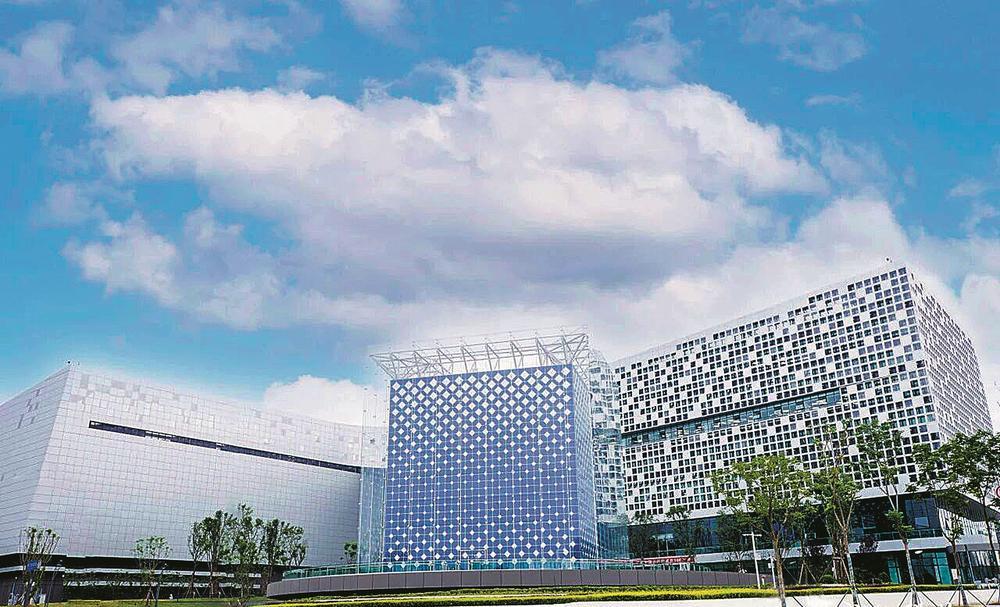
科学有答案 创新无止境(院士讲科普·年终特别报道)
Ren Min Wang· 2025-12-26 22:21
Core Insights - By 2025, China is expected to achieve significant breakthroughs in various scientific fields, including quantum technology and lunar research, contributing to the nation's technological self-reliance and innovation [3][5]. Group 1: Space Exploration - The Chang'e 6 mission is set to return samples from the moon's far side, revealing new insights into lunar oxidation mechanisms and marking a major scientific breakthrough in lunar research [4]. - The Tianwen-2 probe will conduct close-range exploration of a near-Earth asteroid, with a sample return expected by the end of 2027, indicating a shift towards long-term space exploration and resource utilization [4]. - China plans to advance its lunar research station, manned lunar missions, Mars sample return, and Jupiter system exploration, enhancing its capabilities in deep space exploration [4]. Group 2: Quantum Computing - Quantum computing is identified as a critical future technology, with China focusing on achieving full autonomy in quantum computing through the development of hardware and software systems [7]. - The third-generation superconducting quantum computer "Benyuan Wukong" has been launched, participating in numerous collaborations across key industries and achieving international cooperation in quantum computing [8]. - The development of quantum computing is likened to building a rocket, emphasizing the importance of integrating hardware and software for effective functionality [7]. Group 3: Brain-Computer Interfaces - Brain-computer interface technology is evolving to connect biological intelligence with machine intelligence, utilizing advanced decoding and encoding techniques to interpret brain signals [9]. - Clinical advancements in brain-computer interfaces are being made, with the establishment of comprehensive clinical trial centers and the initiation of global trials [11]. - The technology aims to redefine the boundaries of intelligence by merging carbon-based and silicon-based systems, enhancing cognitive capabilities [10]. Group 4: Digital Intelligence Technologies - Digital intelligence technologies, including cloud computing and artificial intelligence, are seen as essential tools for enhancing innovation across various industries [13]. - The integration of digital technologies into industrial processes is expected to significantly improve production efficiency and transform manufacturing paradigms [13]. - Open collaboration and resource sharing are highlighted as accelerators for technological advancement, contributing to global challenges [14]. Group 5: Hydrogen Energy - Hydrogen energy is recognized as a vital component of the renewable energy revolution, complementing electricity and supporting sustainable development [16]. - China has made significant progress in hydrogen fuel cell technology and is establishing a related industrial chain to enhance the role of hydrogen in the energy transition [17]. - The future of hydrogen energy will focus on tailored solutions that meet specific regional needs, ensuring its benefits for society [16]. Group 6: Research Talent Development - Universities are positioned as key players in nurturing research talent, aligning educational programs with national strategic needs [19]. - The emphasis is on practical applications of research, encouraging scientists to engage with industry and address real-world challenges [19]. - A supportive environment for young researchers is essential, promoting innovation and allowing for flexible evaluation of research outcomes [20]. Group 7: Basic Research Support - Basic research in China is gaining increased attention and funding, although it still lags behind developed countries in terms of investment [22]. - Continuous support for basic research is necessary, including funding stability and diverse investment channels to foster groundbreaking discoveries [22][23]. - A positive research culture is crucial for sustaining long-term engagement in basic research, promoting a supportive atmosphere for scientists [23]. Group 8: Science Popularization - The relationship between scientific innovation and public science education is emphasized, with efforts to enhance public understanding of science [24][25]. - Initiatives aimed at improving scientific literacy among youth are seen as foundational for future technological advancements [25][26].
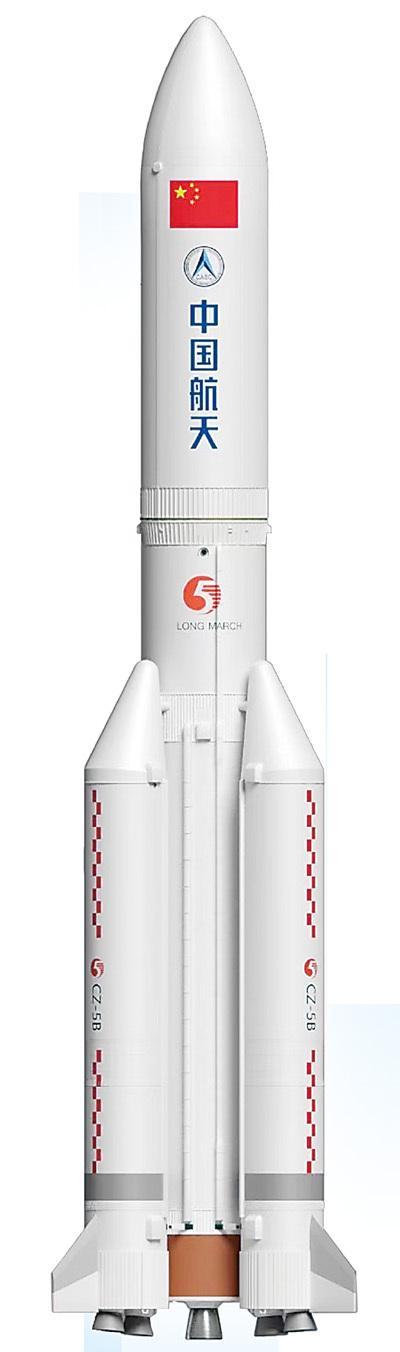
科学有答案 创新无止境(院士讲科普·年终特别报道) ——八位院士眼中的二〇二五
Ren Min Ri Bao· 2025-12-26 22:15
Group 1: Technological Innovation and Achievements - In 2025, China made significant advancements in scientific research, particularly in quantum technology and lunar studies, achieving original breakthroughs [1] - The global innovation index ranked China 10th, reinforcing the foundation for high-level technological self-reliance [1] - Major breakthroughs in lunar science were achieved with the Chang'e 6 mission, revealing new lunar oxidation reaction mechanisms [2][3] Group 2: Quantum Computing Developments - Quantum computing is identified as a key future technology, with China focusing on achieving full autonomy in its development [4] - The third-generation superconducting quantum computer "Benyuan Wukong" has been launched, participating in numerous application collaborations across various sectors [4][6] - The development of quantum computing is likened to building a rocket, emphasizing the importance of both hardware and software integration [4] Group 3: Brain-Computer Interface Technology - Brain-computer interface technology is evolving to connect biological intelligence with machine intelligence, with significant clinical advancements reported in 2025 [7][9] - The technology is moving from unidirectional reading to bidirectional interaction, enhancing its potential applications [7] Group 4: Digital Intelligence and Industrial Transformation - Digital intelligence technologies, including cloud computing and AI, are seen as essential tools for enhancing innovation capabilities across industries [10][11] - The integration of digital technologies into industrial processes is expected to transform manufacturing paradigms and improve efficiency [10] Group 5: Hydrogen Energy and Renewable Resources - Hydrogen energy is recognized as a crucial component of the renewable energy revolution, complementing electricity and promoting low-carbon transitions [12][13] - China has made progress in mastering hydrogen fuel cell technologies and establishing related industrial chains [12][13] Group 6: Research Talent Development - The cultivation of research talent is emphasized as critical for supporting high-level technological self-reliance, with a focus on aligning educational programs with national strategic needs [14][15] - Young researchers are increasingly contributing to scientific advancements, with a significant proportion of key research personnel being under 45 years old [15] Group 7: Support for Basic Research - Basic research in China is receiving increased attention and support, although challenges remain in funding and stability [16][17][18] - The government is implementing reforms to enhance the support for basic research, including funding mechanisms and cultural improvements [16][17][18] Group 8: Science Popularization and Innovation - The relationship between scientific innovation and public science education is highlighted, with efforts to engage the public in scientific knowledge [19][20] - Enhancing public understanding of science is seen as foundational for fostering future research talent and innovation [19][20]