
风险管理

Search documents
从“卷价格”到“卷价值” 惠民保的可持续经营之“道”
Jin Rong Shi Bao· 2025-11-19 09:20
Core Insights - The recent launch of the 2026 version of the Huiminbao products emphasizes "upgraded protection" and "comprehensive enhancement," with unchanged premiums but higher coverage and lower claims thresholds [1][2] - Huiminbao, a city-customized commercial health insurance, has evolved over ten years to become a crucial part of China's multi-tiered medical security system, shifting from price competition to value competition [1][3] Product Features - The 2026 version of Huiminbao products focuses on expanding special drug coverage, including CAR-T therapy and rare disease medications, significantly enhancing their appeal to consumers [2][3] - The coverage range is extending to chronic disease management and health management services, with examples like dental services and health assessments included in the Anhui Huiminbao 2026 version [3] - Premiums remain stable while coverage limits are increasing, such as the Beijing Puhui Health Insurance maintaining a premium of 195 yuan per person per year while raising the total coverage to 3.5 million yuan [3] Pricing Strategy - Differentiated pricing is becoming a mainstream trend in new Huiminbao products, allowing for tailored premiums based on age and health status [4][5] - This approach enhances the attractiveness of Huiminbao to healthier populations and supports sustainable development by avoiding the pitfalls of uniform pricing [5][6] Market Dynamics - The transformation of Huiminbao reflects a balance between inclusivity and sustainability, with significant participation rates and increasing renewal rates indicating a positive trend [8] - The long-term positioning of Huiminbao is seen as a middle layer in the multi-tiered insurance system, complementing basic medical insurance and commercial health insurance [8] Future Directions - Future Huiminbao products are expected to evolve towards precision, ecological integration, and technological advancement, relying more on data for product design and enhancing service efficiency [9] - Recommendations for Huiminbao include maintaining its inclusive positioning, continuous innovation in products and services, and leveraging insurance technology to improve actuarial and risk management capabilities [9]
调费率、重预防 多地力推安责险为企业系好“保险带”
Bei Jing Shang Bao· 2025-11-19 01:38
Core Viewpoint - The implementation of safety production responsibility insurance (安责险) is being enhanced across various regions in China, with new policies aimed at improving accident prevention and regulatory oversight, thereby strengthening the insurance framework for high-risk industries [1][2][3]. Group 1: Policy Implementation and Regulation - The Ministry of Emergency Management and six other departments issued the "Implementation Measures for Safety Production Responsibility Insurance" in April, providing clear guidelines for local governments [1]. - Shanxi Province has mandated that in high-risk industries, 20% of the actual insurance premium collected must be allocated for accident prevention services, with a minimum compensation limit of 400,000 yuan per person for death or disability [2][3]. - Hunan Province has introduced a dynamic rate adjustment mechanism for insurance premiums based on various safety factors, effective from December 1 [2]. Group 2: Product Development and Innovation - Insurance companies are shifting from standardized products to customized offerings, focusing on specific high-risk industries and expanding coverage [1][3]. - Ningbo City has launched a specialized insurance product for the port sector, emphasizing risk reduction and preemptive services, with a dynamic premium mechanism linked to safety performance [3][5]. - The market is moving towards more precise and segmented insurance products, with a focus on enhancing risk management capabilities [5]. Group 3: Challenges and Future Directions - Current challenges in the 安责险 market include pricing risks, the effectiveness of accident prevention services, and the complexity of multi-party collaboration [6]. - Companies are encouraged to integrate technology, such as IoT and big data, into their insurance solutions to proactively manage risks [6]. - A comprehensive risk management approach is recommended, encompassing pre-emptive training, emergency response assistance, and efficient claims processing to create a complete safety management loop [6].
调费率、重预防 多地力推安责险为企业系好“保险带”
Bei Jing Shang Bao· 2025-11-19 01:33
Core Viewpoint - The implementation of safety production responsibility insurance (安责险) is being enhanced across various regions in China, with a focus on customized products, accident prevention, and stricter regulations to improve safety management in high-risk industries [1][2][3]. Group 1: Policy Implementation - In April, the Ministry of Emergency Management and six other departments issued the "Implementation Measures for Safety Production Responsibility Insurance," providing clear guidelines for local governments [1]. - Shanxi Province mandates that in high-risk industries, 20% of the actual premium collected for 安责险 must be allocated for accident prevention services, with a minimum compensation limit of 400,000 yuan per person for death or disability [1][2]. - Hunan Province has introduced a dynamic rate adjustment mechanism for 安责险 based on various factors, including accident records and compliance with safety standards [2]. Group 2: Product Development - The insurance industry is shifting from standardized products to customized offerings tailored to specific high-risk sectors, enhancing the scope of coverage [1][3]. - Ningbo City has launched a specialized 安责险 product for the port sector, featuring a floating rate mechanism linked to the safety performance of enterprises [3][5]. - The focus is on transforming the service model from mere compensation to proactive risk management, with insurance companies becoming partners in safety management [5][6]. Group 3: Market Trends - The release of the "Implementation Measures" has acted as a catalyst for market standardization, moving away from chaotic competition towards a more orderly market [4]. - The insurance sector is increasingly adopting technology, such as IoT and big data, to enhance risk assessment and prevention capabilities [6]. - There is a growing emphasis on creating a complete safety management loop that includes pre-incident training, real-time response, and post-incident support [6].

Navios Maritime Partners L.P.(NMM) - 2025 Q3 - Earnings Call Transcript
2025-11-18 14:32
Financial Data and Key Metrics Changes - For Q3 2025, the company reported revenue of $346.9 million, an increase of 1.8% compared to $341 million in Q3 2024, driven by higher fleet combined time charter equivalent (TCE) rates despite lower available days [16] - EBITDA for Q3 2025 was $193.9 million, while net income was $56.3 million, with earnings per common unit at $1.90 [4][18] - For the first nine months of 2025, total revenue decreased by $23 million to $978.6 million, with adjusted EBITDA down by $29 million to $519.8 million and adjusted net income down by $67 million to $196 million compared to the same period in 2024 [19][20] Business Line Data and Key Metrics Changes - The TCE rate for the combined container and tanker fleet increased by 3.7% and 1.7% to $31,832 and $26,238 per day, respectively, while the TCE rate for the dry bulk fleet decreased by 3.5% to $17,976 per day [17] - The company added $745 million of long-term contracted revenue during the quarter, with total contracted revenue amounting to $3.7 billion, including $1.3 billion from tankers, $0.2 billion from dry bulk, and $2.2 billion from containerships [15][16] Market Data and Key Metrics Changes - The geopolitical environment has shifted trading routes, impacting the tanker and dry bulk markets positively due to sanctions on Russian, Venezuelan, and Iranian oil [22][26] - The dry bulk market is expected to benefit from strong Atlantic basin iron ore growth, with significant new projects in Guinea and Brazil anticipated to create demand for additional vessels [24][25] Company Strategy and Development Direction - The company is focused on modernizing its fleet, with an average fleet age of 9.7 years compared to the industry average of 13.5 years, and aims to maintain a low net loan-to-value (LTV) ratio of 20.5% [4][5][7] - The company has a strong risk management culture, continuously monitoring and assessing risks while maintaining a diversified fleet [5][7] Management's Comments on Operating Environment and Future Outlook - Management expressed confidence in the prospects for 2026, with 58% of available days fixed and a reduced cost break-even of $894 per day [8][12] - The company remains focused on capital allocation and opportunistic purchases, with a strong backlog of contracted revenue providing visibility in an uncertain environment [11][15] Other Important Information - The company completed a $300 million senior secured bond issuance at a coupon of 7.75%, which will be used to refinance existing floating rate debt, thereby reducing interest rate risk [9][21] - The company has returned $42.2 million under its dividend and unit repurchase programs, with a remaining purchase power of $37.3 million [10] Q&A Session Summary Question: How does the company plan to fix its vessels going forward into 2026? - Management indicated that they are using maximum flexibility, with the majority of open vessels being dry bulk, and they are comfortable with fixing the fleet based on market assumptions [31][32] Question: Is there an opportunity to build smaller ships against contracts? - Management noted increased activity in the market for smaller vessels, emphasizing the importance of counterparty and duration in such projects [36][37] Question: How will the proceeds from the recent bond issue be deployed? - The proceeds will enhance optionality, as the company has $1.2 billion of debt-free vessels, maintaining the same net debt before and after the bond issuance [39]

Navios Maritime Partners L.P.(NMM) - 2025 Q3 - Earnings Call Transcript
2025-11-18 14:32
Financial Data and Key Metrics Changes - Revenue for Q3 2025 was reported at $346.9 million, a 1.8% increase from $341 million in Q3 2024, while revenue for the first nine months of 2025 was $978.6 million, a decrease of $23 million compared to the same period in 2024 [4][18] - EBITDA for Q3 2025 was $193.9 million, adjusted EBITDA decreased by $1.4 million compared to Q3 2024, while EBITDA for the first nine months of 2025 was $519.8 million, a decrease of $29 million from the previous year [4][19] - Net income for Q3 2025 was $56.3 million, down from $97 million in Q3 2024, and adjusted net income for the first nine months of 2025 was $196 million, a decrease of $67 million compared to the same period in 2024 [4][19] Business Line Data and Key Metrics Changes - The combined time charter equivalent (TCE) rate for Q3 2025 increased by 2.4% to $24,167 per day, with container and tanker fleets seeing increases of 3.7% and 1.7% respectively, while the dry bulk fleet's TCE rate decreased by 3.5% to $17,976 per day [16][17] - For the first nine months of 2025, the TCE rate for containers increased by 3.1% to $31,213 per day, while dry bulk and tanker TCE rates decreased by approximately 9.2% and 3.5% respectively [19] Market Data and Key Metrics Changes - The company reported a low net loan-to-value (LTV) ratio of 34.5% and a gross LTV of 40.6% at the end of Q3 2025, with a target net LTV of 20.5% [5][8] - The company has a revenue backlog of $3.7 billion, with 92% of container days and 73% of tanker days fixed for the fourth quarter of 2025 [8][16] Company Strategy and Development Direction - The company focuses on fleet modernization, with an average fleet age of 9.7 years compared to the industry average of 13.5 years, and aims to maintain a strong risk management culture [4][5] - The company has a reinvestment program that includes acquiring new vessels and opportunistically selling older ones, with plans to invest $1.9 billion in 25 newbuilding vessels through 2028 [13][15] Management's Comments on Operating Environment and Future Outlook - Management expressed confidence in the prospects for 2026, with 58% of available days fixed and a reduced cost break-even of $894 per day [8][12] - The geopolitical environment, including the Ukraine war and changing global trade patterns, is seen as a challenge but also an opportunity for the company to adapt and thrive [10][22] Other Important Information - The company successfully issued a $300 million senior secured bond at a coupon of 7.75%, which will be used to refinance existing floating rate debt, thus reducing interest rate risk [9][21] - The company has returned $42.2 million under its dividend and unit repurchase programs, with a remaining purchase power of $37.3 million [10] Q&A Session Summary Question: How does the company plan to manage its vessels in 2026 given the current flexibility? - Management indicated that they are comfortable with their current position and will continue to assess the market for fixing vessels, particularly in the dry bulk sector where they see significant upside [31][32][34] Question: Is there an opportunity to build smaller feeder ships in response to market demand? - Management acknowledged increased activity in the market for smaller vessels but emphasized the importance of careful evaluation of counterparties and contract durations [36][37] Question: How will the proceeds from the recent bond issue be deployed? - The proceeds will enhance the company's financial flexibility and maintain a strong balance sheet, with a focus on optionality given the significant amount of debt-free vessels [39]
Navios Maritime Partners L.P.(NMM) - 2025 Q3 - Earnings Call Transcript
2025-11-18 14:30
Financial Data and Key Metrics Changes - For Q3 2025, the company reported revenue of $346.9 million, an increase of 1.8% compared to $341 million in Q3 2024. EBITDA was $193.9 million, and net income was $56.3 million, with earnings per common unit at $1.90 [4][16][17] - For the first nine months of 2025, total revenue decreased by $23 million to $978.6 million, with adjusted EBITDA down by $29 million to $520 million and adjusted net income down by $67 million to $196 million compared to the same period in 2024 [17][18] Business Line Data and Key Metrics Changes - The combined time charter equivalent (TCE) rate for the container fleet increased by 3.1% to $31,213 per day, while the TCE rate for the tanker fleet decreased by 3.5% to $26,290 per day. The dry bulk fleet's TCE rate was down 9.2% to $15,369 per day [18] - The company added $745 million of long-term contracted revenue during the quarter, with total contracted revenue amounting to $3.7 billion, including $1.3 billion from tankers, $0.2 billion from dry bulk, and $2.2 billion from containerships [14][15] Market Data and Key Metrics Changes - Geopolitical developments are shifting trading routes, with the Ukraine war affecting grain exports and benefiting exports from Brazil and the U.S. The tanker market is expected to remain positive due to a low order book and an aging fleet [21][24] - The dry bulk market shows steady long-term demand growth with a constrained supply of vessels, particularly due to aging fleets and low new building prices [22][23] Company Strategy and Development Direction - The company focuses on modernizing its fleet, with an average fleet age of 9.7 years compared to the industry average of 13.5 years. The reinvestment program aims to maintain a younger fleet and reduce net loan-to-value (LTV) ratios [5][11] - The company emphasizes a strong risk management culture, continuously monitoring risks and structuring transactions with risk management professionals [6][11] Management's Comments on Operating Environment and Future Outlook - Management expressed confidence in the prospects for 2026, with 58% of available days fixed and a reduced cost break-even of $894 per day for open index days. The company is well-positioned to capitalize on market opportunities [8][12] - The management highlighted the importance of flexibility in chartering decisions, particularly in the dry bulk sector, where they see significant upside potential [30][32] Other Important Information - The company completed a $300 million senior secured bond issuance at a coupon of 7.75%, which will be used to refinance existing floating rate debt and improve interest rate risk management [9][20] - The company has returned $42.2 million under its dividend and unit repurchase programs, with a remaining purchase power of $37.3 million [10] Q&A Session Summary Question: How does the company plan to manage its vessels in 2026 given the flexibility in charter coverage? - Management indicated that they are comfortable with their current position and will continue to assess market conditions to determine the best approach for fixing vessels [30][32] Question: Is there an opportunity to build smaller feeder ships in response to market shifts? - Management acknowledged increased activity in the market for smaller vessels but emphasized the importance of careful evaluation of counterparties and contract durations [34][35] Question: How will the proceeds from the recent bond issue be deployed? - The proceeds will be used to diversify funding sources and maintain optionality, with a focus on managing debt levels effectively [37]
调费率、重预防,多地力推安责险为企业系好“保险带”
Bei Jing Shang Bao· 2025-11-18 13:11
Core Viewpoint - The implementation of the Safety Production Responsibility Insurance (安责险) is being strengthened across various regions in China, with new policies aimed at enhancing safety management in high-risk industries and ensuring compliance with insurance requirements [1][4][6]. Group 1: Policy Implementation - The Ministry of Emergency Management and six other departments issued the "Implementation Measures for Safety Production Responsibility Insurance" in April, providing clear guidelines for local governments [1][7]. - Multiple regions, including Shanxi and Hunan, are introducing new regulations to enhance the effectiveness of 安责险, focusing on premium adjustments, accident prevention, and stricter supervision [4][5]. - Shanxi Province mandates that the accident prevention service budget must be set at 20% of the actual premium collected for 安责险, with a minimum compensation limit of 400,000 yuan per person for death or disability [4][5]. Group 2: Industry Response - Insurers are encouraged to shift from standardized products to customized solutions, focusing on in-depth research in high-risk sectors and expanding coverage to better meet industry-specific needs [3][6]. - The introduction of dynamic premium adjustment mechanisms based on accident records and safety compliance is being implemented to ensure fair pricing and incentivize better safety practices among insured companies [4][7]. Group 3: Service Enhancement - The focus of the insurance industry is transitioning from claims processing to risk management, with insurers becoming partners in risk management rather than just providers of insurance [8][9]. - Companies are advised to either build their own teams of safety engineers or collaborate with top-tier safety service providers to ensure effective accident prevention services [9]. - A complete risk management cycle is being promoted, encompassing pre-incident training, real-time support during incidents, and post-incident claims assistance [9].

“一夜之间”,每个人都在卖英伟达
华尔街见闻· 2025-11-18 10:43
Core Viewpoint - Major institutional investors are selling off Nvidia shares, indicating a shift towards risk management despite the ongoing AI hype [1][2][5]. Group 1: Institutional Investor Actions - Billionaire Peter Thiel's hedge fund, Thiel Macro LLC, sold all 537,742 shares of Nvidia by the end of Q3, coinciding with Nvidia's market cap surpassing $5 trillion [1][4]. - Bridgewater Associates significantly reduced its Nvidia holdings by 65.3%, from 7.23 million shares to 2.51 million shares, marking a strategic shift from trend-following to risk management [4][6]. - SoftBank also disclosed the sale of all its Nvidia shares, reflecting a broader trend among top institutional investors towards cautious repositioning [5][7]. Group 2: Macro Risks and Strategy Shift - The collective withdrawal of institutional investors aligns with warnings from Bridgewater's founder Ray Dalio about the global debt cycle entering a late-stage risk phase, with potential financial crises stemming from sovereign debt issues [3][6]. - Rising U.S. public debt, geopolitical tensions, and central bank interventions are increasing systemic risks, prompting investors to adopt a more cautious stance on high-valuation tech stocks [7]. Group 3: Analyst Expectations for Nvidia - Despite the sell-off by major investors, Wall Street analysts maintain optimistic expectations for Nvidia's upcoming earnings report, with projected adjusted earnings of $1.23 per share and revenue of $54.83 billion for the October quarter [3][8]. - Analysts from D.A. Davidson and Morgan Stanley reaffirmed their buy ratings and set target prices of $250 and $215, respectively, citing strong demand trends in cloud services and potential for robust earnings surprises [9][10].

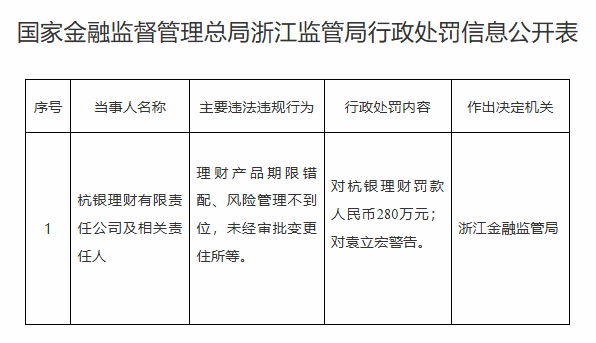
杭银理财被罚280万 涉理财产品期限错配等3宗违规
Zhong Guo Jing Ji Wang· 2025-11-18 09:05
Core Viewpoint - The Zhejiang Financial Supervision Administration has imposed a fine of 2.8 million RMB on Hangyin Wealth Management Co., Ltd. for various violations, including mismatched product durations and inadequate risk management [1] Group 1: Regulatory Actions - Hangyin Wealth Management was fined 2.8 million RMB due to violations such as mismatched durations of financial products and insufficient risk management [1] - A warning was issued to Yuan Lihong, a responsible individual associated with Hangyin Wealth Management [1] Group 2: Company Background - Hangyin Wealth Management was established on December 20, 2019, with a registered capital of 1 billion RMB and is wholly owned by Hangzhou Bank [1]
沪银行情持续走弱 美联储沃勒支持再降息
Jin Tou Wang· 2025-11-18 05:05
Group 1 - Silver futures are currently trading below 11830, with a recent opening price of 11975 and a current price of 11788, reflecting a decline of 1.80% [1] - The highest price reached today was 12027, while the lowest was 11767, indicating a short-term oscillating trend in silver futures [1] - The sentiment in the silver market remains strong despite the recent price drop, with resistance levels noted between 12000-12500 and support levels between 11500-11700 [3] Group 2 - Federal Reserve Governor Waller supports another rate cut in December, citing concerns over the labor market and employment slowdown [2] - Waller indicated a preference for a 25 basis point cut, emphasizing the need for risk management to prevent further weakening of the labor market [2] - Recent hawkish comments from other Fed officials have reduced the probability of a December rate cut from nearly 100% to about 40% [2]